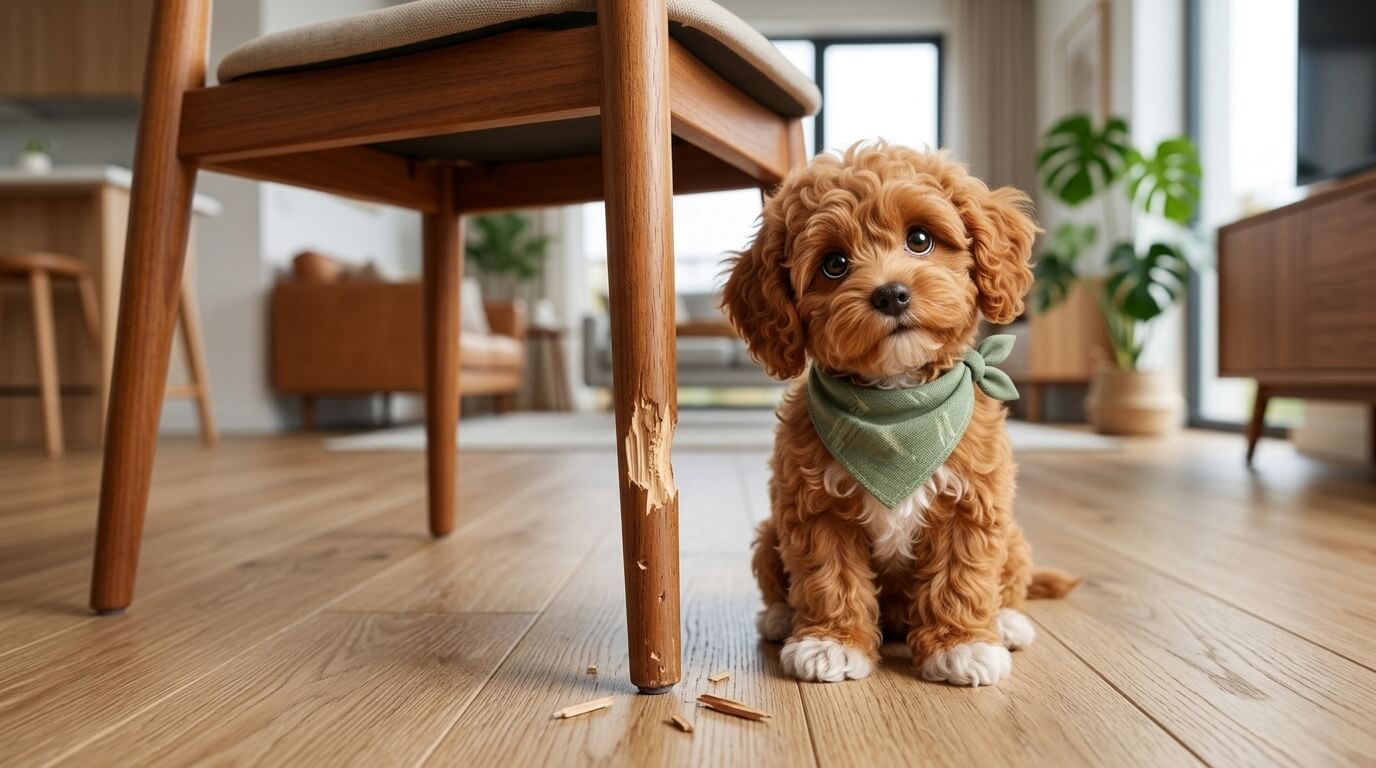
It was a Sunday afternoon, and I was working at my desk when I noticed it had been suspiciously quiet for about twenty minutes. Anyone who owns a dog knows that specific silence — the kind that means something is either adorable or catastrophic.
I found Ollie in the dining area, sage green bandana slightly askew, methodically working on the leg of my mid-century modern dining chair with the focused intensity of a professional. Not chewing casually. Gnawing. Structurally.
The kind of damage that makes you immediately calculate the distance between your security deposit and the nearest furniture repair shop. My first thought was the landlord. My second thought was that I needed to stop dog chewing furniture before Ollie redecorated anything else, and I needed to do it fast.
What followed was an intensive few weeks of research, experimentation, and a few additional minor casualties (one paperback book, one television remote, the corner of a jute rug that I’m choosing not to discuss). What I found was that furniture chewing is almost never random — it has specific causes, and the fix depends almost entirely on which cause you’re actually dealing with.
This post covers everything I learned, including the seven fixes that actually worked for Ollie, and the things I tried that made everything worse.
How To Stop Dog Chewing Furniture (Quick Answer)
To effectively stop dog chewing furniture, you must combine management with redirection. Apply a bitter apple deterrent spray to vulnerable wooden legs and fabric edges, restrict unsupervised access using pet gates, and immediately redirect chewing behavior to safe, high-value rubber chew toys. Never punish after the fact — timing is everything in canine behavior modification.
The “Beaver” Discovery (Why Wood?)
Before we get to solutions, it’s worth understanding why dogs go after wooden furniture specifically — because the answer is more interesting than “they’re being destructive,” and understanding it genuinely changes how you respond.
Wood is deeply appealing to dogs for several specific reasons:
- Texture: Wood offers meaningful resistance — it pushes back against biting pressure in a way that is satisfying to a dog’s jaw muscles. This is particularly appealing during teething and for breeds with strong chewing drives.
- Scent: Wood, especially older or treated furniture, holds scent compounds that are detectable to a dog’s nose and genuinely interesting to them. The oils and finishes used on wooden furniture can also smell faintly like food or organic material to a dog.
- Previous scent transfer: If you’ve ever eaten at your dining table, rested your hands on a coffee table, or touched chair legs while going about your day, your scent is embedded in that wood. Dogs chew things that smell like their people — it’s a comfort behavior rooted in attachment.
- Accessibility: Furniture legs are at exactly the right height for most dogs, require no effort to locate, and are conveniently stationary targets.
The wood-specific attraction also explains why dogs often return to the same piece of furniture repeatedly even after you’ve intervened. Once a dog has chewed a spot, their own saliva scent marks it as interesting — and the texture change from the initial chewing makes it even more appealing for continued work.
Teething vs. Boredom vs. Anxiety
This is the section that changes everything about your approach, because the same behavior — chewing your furniture — can have three very different root causes that require three very different responses.
Getting the cause wrong means the fix won’t work. I learned this firsthand when I applied a deterrent spray to the chair legs but hadn’t addressed the underlying boredom that was driving Ollie’s behavior. He simply found a new target.
Cause 1: Teething
Age range: Roughly 3–7 months during puppy teething, with a secondary phase during adolescence (6–18 months) as adult teeth fully settle.
Signs it’s teething:
- Your dog is under 18 months old
- Chewing is relatively indiscriminate — multiple surfaces, multiple objects
- You may notice small puppy teeth in unusual places
- Gum redness or sensitivity when you check their mouth
- The chewing provides visible relief — the dog returns to it repeatedly and seems soothed
Teething chewing is driven by genuine physical discomfort. The pressure of chewing against a hard surface provides counter-pressure that relieves the pain of emerging teeth. This type of chewing is instinctive, involuntary in the sense that the dog isn’t making a behavioral choice — they’re managing pain — and it requires substitution rather than punishment.
Cause 2: Boredom and Under-Stimulation
The most common cause for apartment dogs. A dog who doesn’t have adequate physical exercise, mental enrichment, or appropriate outlets for their natural behaviors will fill that void with whatever is available and interesting.
Signs it’s boredom:
- Chewing happens most when the dog has been inactive for a long period
- The dog seems to choose the “most interesting” objects — things with scent, texture, or novelty
- Chewing is accompanied by other boredom behaviors (digging, pacing, excessive vocalization)
- Your dog is a breed with a high chewing drive (terriers, retrievers, spaniels)
Over-arousal often spills into other bad habits—if your dog struggles with boundaries at the front door, you must also read our guide on [how to stop dog jumping on guests].
Cause 3: Anxiety
This is the cause that gets misread most often as stubbornness or “bad behavior,” and it requires a fundamentally different approach from the other two.
Signs it’s anxiety:
- Chewing primarily or exclusively happens when you are not home
- Destruction is concentrated near exits — doors, windows, the area around the front door
- The dog shows pre-departure stress signals when you prepare to leave (pacing, whining, following you closely)
- Damage seems frantic rather than methodical — scattered destruction rather than focused chewing
If this pattern sounds familiar, you might be dealing with severe dog separation anxiety apartments issues rather than normal teething or boredom — and in that case, deterrent spray and redirection alone will not solve the problem. Anxiety-driven chewing requires behavioral intervention at the source, not just symptom management at the furniture level.
To lower their baseline stress during training, you should also research which [calming aids for dogs] actually have scientific backing.
7 Steps To Stop The Gnawing
These seven steps work in combination. Steps 1 and 2 are immediate interventions. Steps 3 through 5 are the behavioral foundation that makes the immediate interventions actually hold. Steps 6 and 7 are environmental modifications that remove the opportunity for the behavior to continue while training is in progress.
Step 1: Apply Deterrent Spray Immediately
Bitter deterrent sprays work by making the target surface taste genuinely unpleasant without being toxic. The most well-known formulation is bitter apple spray — a taste deterrent based on an extremely bitter compound that most dogs find deeply off-putting.
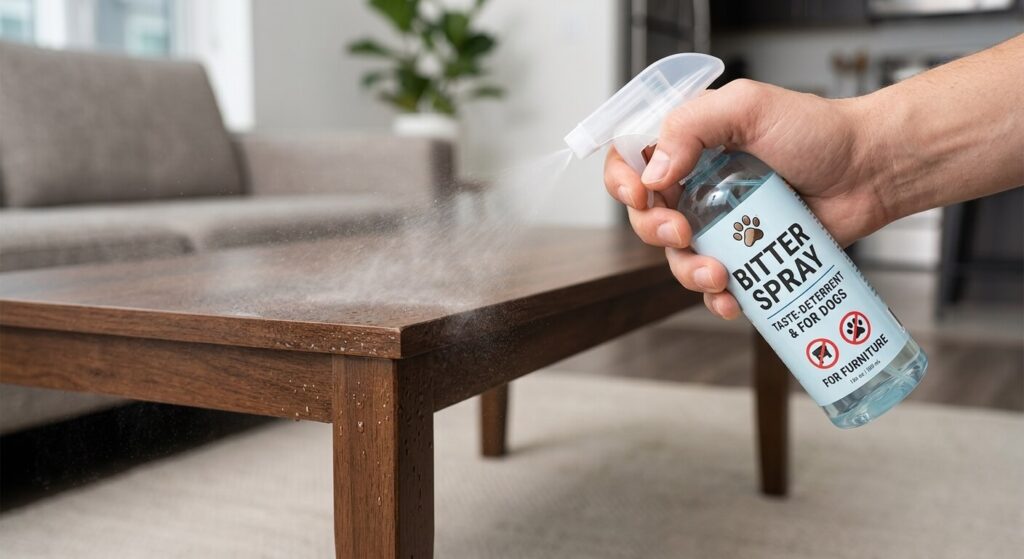
How to apply it correctly:
- Spray all vulnerable surfaces — furniture legs, table corners, baseboards — not just the areas already damaged
- Reapply every 24–48 hours and after any surface cleaning, as the effectiveness diminishes with time and cleaning products
- Test on a small hidden area first — some formulations can affect certain wood finishes
- Apply to a cloth and let your dog sniff it first to give them the chance to create a “this tastes bad” association with the smell before they reach the furniture
Important caveat: Deterrent spray is a management tool, not a solution. It buys you time and prevents ongoing damage while you address the underlying cause. Used alone without behavioral work, it simply redirects the chewing to a non-sprayed surface.
Step 2: Redirect to an Appropriate Chew Target
The moment you catch your dog chewing furniture — or better yet, the moment they approach a furniture target — calmly redirect them to an appropriate chew item. Not a reprimand. A redirect.
The redirection needs to be to something genuinely superior to the furniture in terms of chew satisfaction. A thin nylon bone offered against the sensory appeal of a wooden chair leg is not a fair competition. To stop the behavior, you must provide alternatives — which is why investing in the [best indestructible dog toys for apartments][Internal Link to ID: 42] is a non-negotiable step in this process rather than an optional add-on.
Chew toy characteristics that work for redirection:
- Appropriate resistance — the toy should push back against jaw pressure similarly to the furniture being targeted
- Interesting texture — ridges, channels, and variable surfaces keep chewing engagement higher than smooth surfaces
- Scent enhancement — stuffing with a small amount of peanut butter, frozen broth, or kibble gives the toy a scent profile that competes with the furniture’s appeal
- Size appropriateness — a toy that’s too small is a choking risk; a toy that’s too large is difficult to manipulate and less satisfying
Step 3: Establish a “Chew Zone”
This is a strategy I stumbled into accidentally and found more effective than I expected. Designate a specific area of the apartment — a mat, a dog bed, a specific corner — as the only location where chewing is actively encouraged and rewarded.
Place all chew toys in this zone. When you redirect from furniture, you redirect to this specific location. Over time, the spatial association becomes strong: this spot is where chewing is allowed, rewarded, and abundant. Other locations have less appealing options and deterrent sprays.
The chew zone also gives your dog a form of agency — they have a place that is theirs, where a specific behavior is welcomed. This small shift in the power dynamic of your dog’s environment has meaningful behavioral effects, particularly for dogs whose chewing is partially boredom-driven.
Step 4: Supervise or Confine — There Is No In Between
This is the step most people resist because it feels inconvenient, and it’s also the step that is non-negotiable for any furniture protection plan to actually work.
The rule is simple: When you cannot directly supervise your dog, they do not have access to the furniture. Full stop.
- Use baby gates or pet gates to restrict access to rooms with vulnerable furniture
- Use an exercise pen or crate for periods when active supervision isn’t possible
- Gradually expand freedom as trustworthy behavior is demonstrated over consistent time
You must take immediate steps to dog proof rental apartment spaces before more damage occurs — because every unsupervised session that results in successful chewing reinforces the behavior, makes it more likely to recur, and chips away at your security deposit simultaneously.
Step 5: Address the Root Cause
Return to the three-cause framework above and honestly identify which category you’re dealing with.
If it’s teething:
- Frozen chew toys (a Kong stuffed and frozen, a frozen carrot) provide cold counter-pressure that soothes inflamed gums more effectively than room-temperature alternatives
- Rotate through multiple appropriate chew items to maintain novelty
- Understand that this phase is time-limited — with adequate management, it resolves naturally
If it’s boredom:
- Increase daily enrichment meaningfully — a sniff walk, a puzzle feeding session, a frozen Kong as a meal replacement
- Ensure your dog is getting adequate physical and mental exercise for their specific breed and age
- Implement an enrichment schedule that structures your dog’s day and prevents the long, unstimulating periods that precede boredom chewing
If it’s anxiety:
- Behavioral modification for separation anxiety is a structured process that requires graduated desensitization — and often professional guidance
- Deterrent sprays and chew toys will not resolve anxiety-driven destruction, though management tools can limit damage during the treatment process
- Your vet is the right first contact if you suspect anxiety is the root cause, as medication is sometimes a component of effective treatment
Step 6: Make Furniture Physically Less Accessible
Beyond gating rooms, there are specific protective measures worth applying to the furniture itself while training is underway.
Physical protection options:
- Furniture leg wraps — clear plastic or fabric wraps that cover wooden legs and remove the textural appeal while protecting the surface
- Clear corner guards — adhesive protectors applied to corners and edges that both deter chewing and protect the underlying material
- Sofa and chair covers — washable covers over upholstered pieces protect fabric surfaces and can be laundered if they do sustain damage
- Double-sided tape — the sticky texture on surfaces is deeply unpleasant to most dogs and can be used on fabric upholstery edges where spray is impractical
None of these are permanent solutions. They are environmental modifications that support the training process by removing easy access to the target behavior while the behavioral work progresses.
Step 7: Reward What You Want To See
This is the step that gets the least attention in most furniture-chewing guides, and it’s arguably the most important for long-term change.
Actively reward your dog for making the right choice. When you see your dog approach a piece of furniture and then turn away, reward that. When your dog picks up one of their chew toys independently, reward that. When your dog settles calmly near the furniture without engaging it, reward that.
The goal isn’t just to stop the unwanted behavior. It’s to build a positive behavioral pattern in its place — and positive reinforcement of the replacement behavior is what makes the new pattern durable.

The Danger of Wood Splinters
I want to address this directly because it’s a health risk that most furniture-chewing articles skip, and it’s serious enough to warrant its own section.
Wood splinters are a genuine veterinary emergency risk. When a dog chews wood aggressively enough to break the surface — as Ollie did on the chair leg — they can ingest wood fragments that splinter into sharp pieces inside the digestive tract.
The specific risks include:
- Oral lacerations — splinters can embed in the gum tissue, tongue, and throat, causing lacerations that range from minor to requiring surgical removal
- Esophageal perforation — sharp wood fragments traveling down the esophagus can cause perforations that are life-threatening without emergency intervention
- Gastrointestinal obstruction or perforation — wood fragments in the stomach or intestine can cause obstruction or puncture the intestinal wall, causing peritonitis, which is a surgical emergency
Signs that your dog may have ingested wood splinters:
- Pawing at the mouth or face
- Excessive drooling or difficulty swallowing
- Gagging, retching, or unproductive vomiting
- Reluctance to eat
- Lethargy or obvious abdominal discomfort
- Bloody stool
If you observe any of these signs after a furniture-chewing incident involving wood, contact your veterinarian immediately. Do not wait to see if it resolves on its own.
This risk is another reason why rapid intervention when you discover furniture chewing isn’t just about protecting your deposit — it’s about protecting your dog.
What NOT To Do
In my research and in my own early, not-very-informed responses to Ollie’s chewing, I encountered several commonly recommended approaches that either don’t work or actively make the problem worse. I want to address these specifically because they’re still widely circulated.
❌ Punishing After the Fact
The single most common and damaging mistake. If you discover chewed furniture and your dog is not currently in the act of chewing, any punishment you deliver is meaningless for behavior modification purposes. Dogs do not connect a consequence delivered minutes after a behavior to the behavior itself — their associative learning window is measured in seconds.
What late punishment does produce: a dog who is anxious around you in that context, who may learn to chew only when you’re not watching, and who is more stressed in ways that can actually escalate destructive behavior. Never punish what you didn’t catch in real time.
❌ Physical Correction
Hitting, leash corrections, or any form of physical intimidation for chewing behavior is not supported by behavioral science and causes measurable harm to your dog’s trust in you and their overall stress levels. Research from the American College of Veterinary Behaviorists consistently supports positive reinforcement and management over aversive correction for destructive behavior.
❌ Scolding With Long Reprimands
A firm “no” delivered the moment you catch the behavior — paired with immediate redirection — is appropriate. A lengthy verbal reprimand that continues past the moment of intervention is just noise to your dog and stress to the relationship.
❌ Removing All Chew Options
Some owners, frustrated by chewing behavior, remove all chew toys thinking that “if they have nothing to chew, they’ll stop chewing.” This reasoning underestimates how fundamental the chewing drive is for dogs. A dog without appropriate chew outlets doesn’t stop chewing — they chew more, and more desperately, on whatever is available.
❌ Relying on Spray Alone Without Training
Deterrent sprays are tools, not solutions. A dog who is highly motivated to chew — due to teething pain, significant boredom, or anxiety — will often work through the deterrent or find an unsprayed alternative. Spray without behavioral work addresses the symptom and leaves the cause entirely intact.
Frequently Asked Questions
At what age do dogs stop chewing furniture?
There are actually two chewing phases to be aware of. The first is puppy teething, which typically resolves by six to seven months of age as adult teeth fully emerge. The second is adolescent chewing, which is driven by the physical settling of adult teeth and the behavioral energy of adolescence, and which typically decreases significantly between 18 months and two years.
However — and this is important — dogs who have learned that furniture chewing is rewarding, or who have ongoing boredom and anxiety issues, can and do chew furniture well into adulthood. Age alone doesn’t resolve the behavior if the underlying cause isn’t addressed.
Does bitter apple spray actually work to stop dog chewing furniture?
For most dogs, yes — bitter apple and similar taste-deterrent sprays are effective at reducing chewing on treated surfaces. Studies and widespread clinical use support their utility as a management tool.
The important caveats: effectiveness varies by individual dog (a small percentage of dogs appear indifferent to bitter tastes), the spray must be reapplied consistently to remain effective, and it works best as part of a complete behavioral management plan rather than as a standalone solution.
Some dogs require a period of direct introduction to the taste — applying a small amount to a cloth and letting the dog sniff and taste it — to establish the aversive association before the spray on surfaces becomes an effective deterrent.
Should I crate my dog to stop them chewing furniture when I’m gone?
Used correctly, a crate is one of the most effective management tools for preventing furniture damage during unsupervised periods — but the emphasis is on “used correctly.” A crate should be introduced through positive conditioning so that your dog views it as a safe, comfortable space rather than a punishment.
Crating time should be age-appropriate (puppies cannot safely hold their bladder for extended periods), and the crate should always be paired with adequate exercise and enrichment during the periods when the dog is not crated.
A dog who is crated for excessive hours without adequate activity will develop the very anxiety and frustration that drives destructive behavior, making the crate counterproductive. For most adult dogs, a properly introduced crate used during genuinely unsupervised periods is a responsible and humane management strategy.
References
- Herron, M. E., Shofer, F. S., & Reisner, I. R. (2009). “Survey of the use and outcome of confrontational and non-confrontational training methods in client-owned dogs showing undesired behaviors.” Applied Animal Behaviour Science, 117(1–2), 47–54. https://doi.org/10.1016/j.applanim.2008.12.011
- American College of Veterinary Behaviorists (ACVB). (2023). Destructive Behavior in Dogs: Clinical Guidelines for Behavior Modification. Available via ACVB member resources at: https://www.dacvb.org
The dining chair leg has been professionally repaired and the chair is currently sitting in a corner that Ollie has, through the combination of spray, redirection, and a truly excellent frozen Kong, completely lost interest in. The security deposit, I am relieved to report, remains intact. If you’re in the middle of the discovery phase right now — take a breath, assess which cause you’re dealing with, and start with Step 1. It gets better faster than you’d expect.