
Dog separation anxiety apartments can become stressful very quickly because the problem is not private. In a detached house, a dog may bark or scratch while the owner works through a plan. In an apartment, neighbors may hear barking through walls, management may receive complaints, and a panicked dog may damage doors, trim, blinds, flooring, or a crate in a rented space.
This guide is for apartment dog owners who need a practical, careful plan. It does not promise a quick cure. True separation anxiety is a distress problem, not a stubbornness problem, and moderate or severe cases may need help from a veterinarian, veterinary behaviorist, certified separation anxiety trainer, or qualified behavior professional.
The goal is to reduce panic, protect the apartment, avoid neighbor escalation, and build alone-time tolerance at a pace your dog can handle.

Table of Contents
Dog Separation Anxiety Apartments: Quick Answer
The safest way to handle dog separation anxiety apartments is to record your dog when you leave, identify the time or cue that triggers panic, prevent long panic episodes while training, practice departures below your dog’s threshold, and get professional or veterinary support if the dog is injuring themselves, barking for long periods, eliminating from distress, or panicking immediately. Food toys, crates, calming beds, and white noise may help some dogs, but they do not replace gradual behavior work.
Boredom vs. Separation Anxiety
Not every dog who barks or chews when alone has separation anxiety. Some dogs are bored, under-exercised, adolescent, curious, or reacting to hallway noise. The difference matters because the solutions are different.
Boredom-related behavior often looks like casual exploration. The dog may nap, chew a cushion, look out the window, bark at a hallway sound, and settle again. Separation anxiety looks more like distress. The dog may pace, pant, drool, howl, scream, scratch the door, ignore food, try to escape, urinate or defecate shortly after departure, or stay tense until the owner returns.
| Pattern | More Like Boredom | More Like Separation Anxiety |
|---|---|---|
| Timing | Random during the absence | Often begins soon after departure |
| Body language | Loose, curious, playful | Pacing, panting, drooling, trembling |
| Food toys | Usually interested | May ignore food until owner returns |
| Damage | Chews available items | Targets doors, crates, windows, blinds |
| Noise | Intermittent barking | Howling, screaming, repeated distress barking |
If you are not sure, record video. Guessing from what you find when you come home is unreliable. A dog who looks guilty may simply be responding to your tone or body language, not confessing to a plan.
The 7 Safe Calming Steps
1. Record the First 30 Minutes
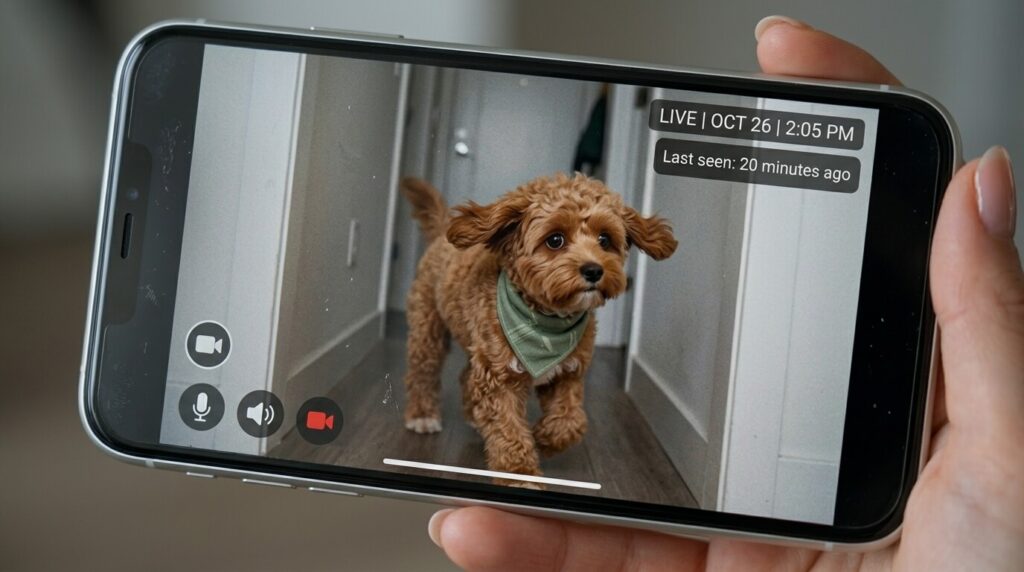
Use a phone, laptop, pet camera, or spare tablet to record your dog when you leave. You do not need a fancy setup. You need to know what actually happens after the door closes.
Record at least the first 30 minutes because many separation-related behaviors start early. Note when your dog first shows stress, what they do, whether they take food, and whether they recover. If your dog is calm for 20 minutes and then begins barking at hallway noise, that is a different pattern from a dog who panics in 20 seconds.
2. Find the Threshold
The threshold is the amount of departure your dog can handle before distress begins. For one dog, the threshold may be ten minutes. For another, it may be the sound of keys, the owner touching the doorknob, or the door closing for two seconds.
Training works best below threshold. That means you practice absences your dog can handle instead of repeatedly letting them panic. If your dog begins barking, clawing, drooling, or pacing intensely, the session was too hard.
3. Reduce Panic Rehearsal
Every long panic episode can make the apartment problem harder. While you train, reduce unavoidable absences where possible. This may mean using a dog walker, sitter, daycare, friend, neighbor, remote work block, lunch visit, or temporary schedule adjustment.
This is not spoiling the dog. It is preventing repeated emotional overload while you build the skill. Apartment owners often feel pressure to solve the problem instantly because of neighbor complaints, but forcing long absences usually creates more noise, more damage, and more stress.
4. Practice Sub-Threshold Departures
Start where your dog can succeed. If your dog panics when the door closes, begin with walking to the door and returning. If your dog can handle one minute, practice 30 to 45 seconds. Keep sessions quiet and boring.
A simple early session might look like this:
- Pick up keys, put them down, sit again.
- Walk to the door, touch the handle, return.
- Open the door, close it, return.
- Step outside for two seconds, return calmly.
- Repeat only while the dog stays under threshold.
Keep returns calm enough that your dog can regain their footing, but you do not need to ignore them. A quiet hello, a brief potty trip, and normal contact are fine. The useful question is not whether you greeted your dog; it is whether departure and return repeatedly push them into frantic arousal.
5. Make Departure Cues Boring
Many dogs start panicking before the owner leaves because departure cues predict loneliness. Shoes, keys, laptop bags, makeup, coffee mugs, and jackets can all become signals.
Practice those cues without leaving. Pick up your keys and watch TV. Put on shoes and make dinner. Touch the door and go back to your desk. The goal is to make the cues less predictive.
6. Create a Safer Apartment Setup
A separation anxiety setup should reduce injury and rental damage without trapping the dog in a place that increases panic. Some dogs settle well in a crate. Others panic harder in a crate and may break teeth, nails, or wire trying to escape.
Options include a crate, pen, gated room, bedroom, or dog-safe living room zone. Choose based on video evidence, not habit. If your dog is worse in a crate, stop using the crate for alone time until you can rebuild crate comfort with professional guidance.
Protect obvious risk zones: front door, blinds, windows, cords, loose rugs, trash, and low shelves. Your dog proof rental apartment guide can help you reduce damage while training is in progress.
7. Know When to Get Help
Call your veterinarian or a qualified behavior professional if panic starts immediately, your dog injures themselves, barking lasts a long time, crate confinement makes things worse, your dog has repeated distress accidents, or neighbors are already complaining.
Medication is not a failure. In some cases, veterinary support helps a dog become calm enough to learn. Decisions about medication should be made with a veterinarian who understands the dog’s health and behavior history.
Apartment-Specific Problems
Separation anxiety is difficult anywhere, but apartments add extra pressure. The dog hears neighbors, elevators, footsteps, trash chutes, delivery workers, and other dogs. The owner hears complaints. The lease may include noise rules or damage fees. That pressure can push owners toward harsh corrections or random quick fixes, which often make anxiety worse.
Common apartment risk zones include:
- The front door, where many dogs scratch, chew, or wait.
- Windows and blinds, especially if the dog watches for the owner.
- Crates, if the dog panics inside confinement.
- Shared walls, where barking carries to neighbors.
- Hallways, where the sound of leaving becomes a trigger.
- Trash and counters, if distress turns into frantic searching.
If barking is the main neighbor issue, pair this article with your stop dog barking in apartment guide. If the issue is long workday absences, also review how long you can leave a dog alone in an apartment.
First-Week Apartment Plan
This first week is not meant to cure separation anxiety. It is meant to gather evidence, reduce panic, and create a safer routine.
| Day | Goal | Action |
|---|---|---|
| Day 1 | Observe | Record a normal short departure and note the first stress sign. |
| Day 2 | Find threshold | Test smaller absences that your dog can handle calmly. |
| Day 3 | Improve setup | Move rest area, protect the door, remove hazards. |
| Day 4 | Practice cues | Use keys, shoes, and door movements without leaving long. |
| Day 5 | Train below threshold | Practice several tiny departures that stay easy. |
| Day 6 | Add support | Arrange walker, sitter, daycare, or schedule help if needed. |
| Day 7 | Review | Compare videos and adjust the plan based on real behavior. |
What to Look for on Video
Video is useful only if you know what to watch for. Do not look only for barking. Some anxious apartment dogs are loud; others are quiet but distressed. A quiet dog who scratches the door for 20 minutes, drools on the floor, or stands frozen at the entryway is still struggling.
Watch for these details:
- Start time: How many seconds or minutes pass before the first stress sign?
- Trigger: Does stress begin with keys, shoes, the door closing, elevator sounds, or silence after you leave?
- Movement: Does your dog settle, pace, circle, jump, scratch, or stay at the door?
- Vocalization: Is barking brief and alert-based, or repeated and distressed?
- Food response: Does your dog eat while alone or ignore food until you return?
- Recovery: Does your dog calm down after a few minutes, or stay upset until you return?
- Damage target: Is damage aimed at exits, windows, blinds, crate bars, or random objects?
The first stress sign is especially important. If your dog begins pacing at 90 seconds, do not practice five-minute departures yet. Start well below 90 seconds and build gradually.
Sample Threshold Training Ladder
This ladder is only an example. Your dog’s real ladder should come from video evidence. Move up only when the current step stays easy for several repetitions.
| Level | Practice Step | Success Looks Like |
|---|---|---|
| 1 | Pick up keys, sit back down | Dog notices but stays relaxed |
| 2 | Put on shoes, walk around the apartment | No pacing or whining |
| 3 | Open and close the front door without leaving | Dog can remain settled |
| 4 | Step into the hallway for one to five seconds | Dog stays under threshold |
| 5 | Short hallway absence | Dog waits calmly or returns to resting |
| 6 | Longer absence with elevator or stair sound | Dog does not escalate after building sounds |
| 7 | Realistic short errand | Dog can settle for the planned time |
Do not increase time in a straight line every day. Real training often moves up, pauses, and sometimes drops back. If your dog has a rough session, make the next one easier.
Crates, Food Toys, and Calming Products
Crates help some dogs because they create a familiar resting space. They hurt other dogs because confinement increases panic. The deciding factor is your dog’s behavior, not the idea that crates are always good or always bad.
Food toys can help mild cases, especially when the dog is bored or mildly unsettled. In true panic, many dogs ignore food until the owner returns. If your dog will not touch a high-value food toy while alone but eats it immediately when you return, that is useful evidence.

Calming beds, pheromone diffusers, white noise, lick mats, and supplements may support the environment. They are not a complete treatment for serious separation anxiety. Think of them as support layers, not the main plan.
Daily Support Routine
A dog with separation anxiety still needs normal dog needs met: sleep, predictable meals, bathroom breaks, movement, sniffing, and calm owner interaction. A frantic fetch session right before you leave may tire the body but raise arousal. Many apartment dogs do better with a decompression walk, sniffing, gentle training, or food scatter before rest.
A supportive routine might look like this:
- Morning potty trip with enough time to sniff.
- Breakfast in a calm place, not during a stressful departure.
- A short settling period before alone-time practice.
- One or two tiny departure sessions below threshold.
- Midday help if your dog cannot handle a long workday yet.
- Evening exercise that does not overstimulate the dog before bed.
- Consistent sleep routine so the dog is not overtired.
If your dog is also struggling with boredom or excess energy, add quiet enrichment before you focus on departures. Your article on how to tire out dog before bed can help with calmer evening routines, but avoid turning every day into an exhausting exercise campaign. Anxiety is not solved by exhaustion alone.
Neighbor and Lease Management
If neighbors complain, thank them for telling you and ask for specifics. You need to know when barking starts, how long it lasts, and whether it happens only when you leave or also during hallway noise. Avoid promising that it will be fixed tomorrow. A better response is that you are recording, working with a plan, and taking steps to reduce long noise episodes.
Keep a simple record of your actions: video dates, training sessions, sitter days, daycare days, professional contacts, and management changes. Documentation is not magic, but it shows that you are acting responsibly if the building raises concerns.
What Not to Do
Apartment pressure can make owners reach for fast answers. Some fast answers create new problems.
- Do not punish the dog after you return. The dog will not connect delayed punishment with panic that happened earlier.
- Do not use bark collars as the main solution. Suppressing noise does not treat the underlying distress and may increase fear.
- Do not crate a dog who panics in the crate. Crate injury risk is real in severe cases.
- Do not jump from short success to a full workday. Alone-time tolerance needs gradual building.
- Do not rely only on toys or treats. A panicked dog may not be able to eat or play.
- Do not ignore neighbor feedback. Complaints are stressful, but they are also useful information about timing and severity.
The best plan is usually quieter and less dramatic: collect evidence, reduce panic, practice below threshold, and get help early when the case is not improving.
Red Flags That Need Professional Support
Some cases are too risky for trial-and-error advice. Get help promptly if you see:
- Broken teeth, torn nails, bloody paws, or crate injuries.
- Escape attempts through doors, windows, or crates.
- Distress barking or howling that lasts for long periods.
- Repeated urination or defecation soon after departure.
- Panic that begins before you fully leave.
- Refusal to eat, drink, or settle during any absence.
- Neighbor complaints that are escalating.
A veterinarian can rule out medical issues and discuss whether medication may be appropriate. A qualified behavior professional can help you design a desensitization plan that fits your building and schedule.
What Progress Looks Like
Progress rarely looks like jumping from five minutes to a full workday. In apartments, progress may be quieter and smaller:
- Your dog starts barking later after departure.
- Barking lasts less time.
- Your dog eats part of a food toy while alone.
- Pacing decreases.
- Door scratching stops or becomes less intense.
- Your dog can handle departure cues without following you.
- Neighbors report shorter or less frequent noise.
Small improvements count. If your dog used to panic at 20 seconds and can now stay calm for two minutes, that is real progress. Build from there.
Apartment Case Examples
The door scratcher
This dog runs to the front door as soon as the owner leaves and scratches the trim. The first goal is not a long absence. The first goal is to move the rest area away from the door, protect the trim, and practice door movements that do not trigger rushing.
The crate panicker
This dog screams, drools, and bites the crate bars. The crate is not currently a safe unsupervised alone-time tool. Avoid another full departure in that setup, arrange the safest practical supervision or managed space available, and contact a veterinarian or qualified behavior professional promptly. Confinement training can be rebuilt separately only after immediate injury risk is addressed.
The quiet destroyer
This dog does not bark, so the owner assumes the dog is fine. Video shows pacing and blind chewing after departure. Quiet distress still matters. The plan should focus on threshold training and window access management.
The neighbor complaint case
This dog barks for 40 minutes after the owner leaves for work. The owner needs immediate management, such as a walker, sitter, daycare, or schedule support, while training begins. Continuing the same workday absence every day will likely keep the problem alive.
FAQ
What is the best approach for dog separation anxiety apartments?
The best approach is evidence-based and gradual: record your dog, identify the threshold, prevent repeated panic, practice sub-threshold departures, protect the apartment, and involve veterinary or behavior support when symptoms are severe.
Will getting a second dog fix separation anxiety?
Usually not. Many dogs with separation anxiety are distressed because the owner is gone, not because they lack another dog. A second dog can add cost, stress, and management problems in a small apartment.
Should I crate a dog with separation anxiety?
Only if the dog is calm and safe in the crate. If the dog drools, screams, bites the crate, bends bars, or tries to escape, the crate may make the problem worse.
Can separation anxiety cause potty accidents?
Yes. Some dogs urinate or defecate soon after the owner leaves because of distress. Sudden or frequent accidents should also be discussed with a veterinarian to rule out medical causes.
How long does separation anxiety training take?
It depends on severity, management, consistency, and support. Mild cases may improve in weeks. Moderate or severe cases may take months and may need professional and veterinary help.
What should I do if neighbors complain?
Ask when the noise happens, record your dog, reduce long panic episodes, and start a written plan. Do not promise an instant fix. Show that you are taking action and seek help early if complaints continue.
Are calming products enough?
Usually not for true separation anxiety. Products can support the environment, but the core work is threshold-based training, management, and professional or veterinary support when needed.
Start With One Honest Recording
Start with one recording. Do not change five things before you know what your dog is doing. Watch the video, identify the first stress sign, and make the next session easier than that point.