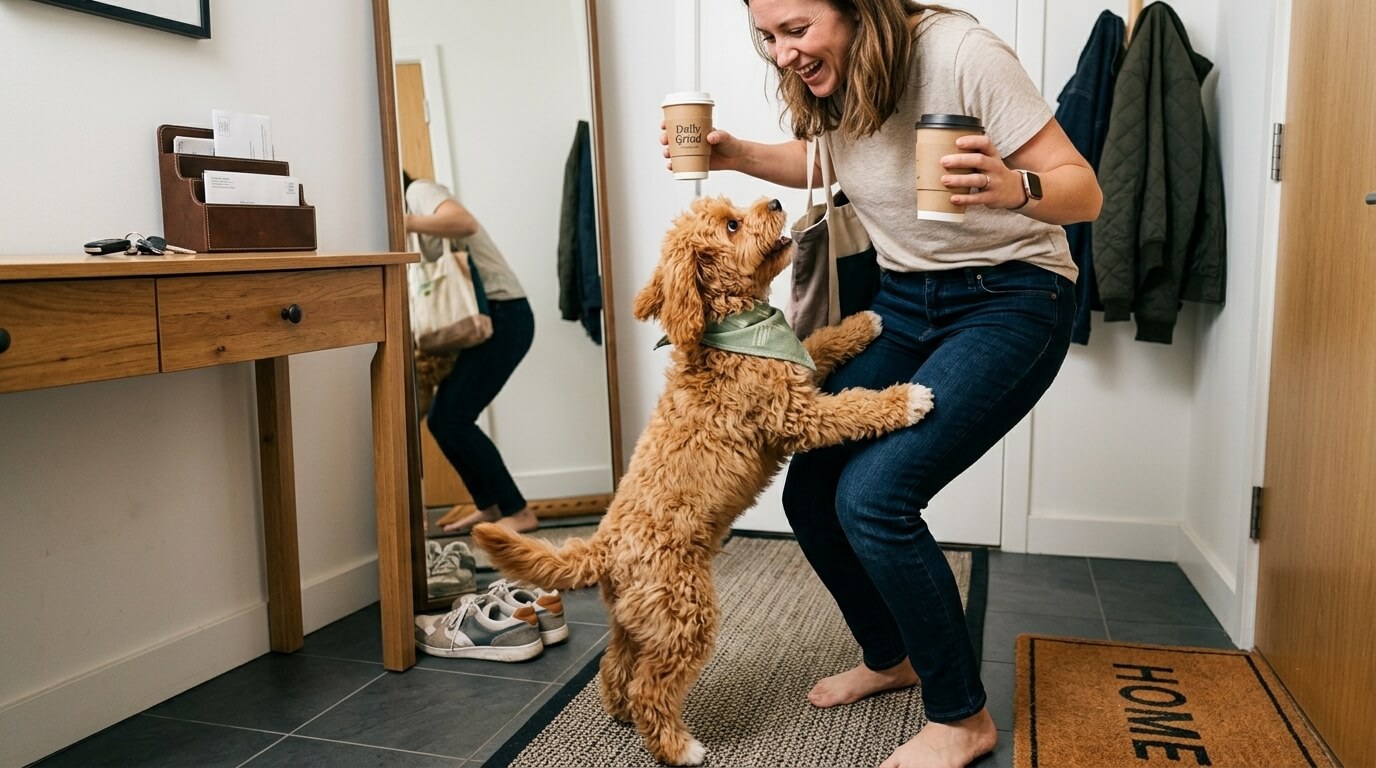
Stop dog jumping on guests by changing what happens before the front door opens, not by trying to overpower an excited dog after they are already in the air. In an apartment, one enthusiastic greeting can become a safety problem quickly. The entry is narrow, the guest may be carrying hot food or a child, and the open door may expose the dog to a shared hallway, elevator, or stairwell.
Jumping is often maintained because it works. The dog reaches a face, gets touched, hears voices, or starts a burst of movement. Pushing, laughing, grabbing paws, and repeating “off” can all add attention. But not every jumping dog is simply happy. Some dogs bounce forward and back because they are conflicted, worried, frustrated, or overwhelmed. The correct plan depends on the emotion and on who is entering.
The practical goal is not a motionless dog at every knock. It is a greeting system that protects people and gives the dog a behavior they can actually perform: remain behind a barrier, keep four paws on the floor, wait on a mat, or skip the greeting. A maintenance worker does not need to meet your dog. A frightened visitor should not be asked to train them. Calm separation is a successful outcome.
Quick Answer: How to Stop Dog Jumping on Guests
To stop dog jumping on guests, prevent access to the doorway with a closed door, secure gate, pen, or supervised leash; choose one replacement behavior such as four paws on the floor or waiting on a mat; reward it before the dog jumps; practice with calm helpers outside real social visits; and give visitors one short instruction before they enter. Use greater distance or complete separation for children, older adults, fearful guests, delivery workers, and dogs who mouth, growl, or become frantic.
Do not knee the dog, step on a leash, jerk the collar, shout, or force a sit beside someone the dog fears. Reward-based training and environmental management teach a useful greeting without making visitors predict pain or conflict.
| Visitor Situation | Safer First Setup | Do Not Use It as Practice When |
|---|---|---|
| Calm familiar adult | Gate or supervised leash, low rewards, brief greeting | The dog cannot eat, disengage, or keep distance |
| Child or frail adult | Closed door or secure barrier | Any jump could knock, scratch, or frighten the person |
| Delivery at the threshold | Dog secured before opening; no greeting | The exterior door is open to a shared building area |
| Maintenance worker | Dog in a separate comfortable room | Tools, open doors, repeated movement, or repairs are involved |
| Dog-loving training helper | Planned mock arrival with one variable at a time | The helper will encourage jumping or ignore instructions |
First Decide What the Jumping Means
VCA veterinary behavior guidance explains that jumping can be socially motivated and reinforced by attention, but it can also occur with anxiety, conflict, or overstimulation. Look at the sequence rather than labeling the dog “friendly” or “rude.” What happens at the first sound in the hall? What does the body look like as the person enters? Can the dog turn away and recover?
Excited Social Jumping
The body is generally loose, the dog seeks interaction, and the jumping reliably produces attention. The dog may wiggle, bring a toy, recover quickly, and happily reapproach. Management plus reinforcement of a lower greeting often works well, provided everyone stops rewarding the launch.
Frustrated Doorway Jumping
The dog is held back, becomes more aroused, then explodes forward when access appears. Barking, leash pulling, spinning, and repeated jumping may continue even after the guest is inside. This dog needs more distance, shorter practice, and a simpler entrance. Holding the dog inches from the visitor while asking for a perfect sit can increase frustration.
Worried or Conflicted Jumping
The dog may rush in, jump, lick, retreat, bark, and approach again. Look for a closed mouth, ears back, low posture, tucked or very stiff tail, whites of the eyes, avoidance of touch, freezing, growling, or inability to settle. Do not let the guest reach over this dog. Create distance and seek qualified help if the pattern persists or escalates.
Sudden New Jumping or Irritability
A dog who abruptly changes greeting behavior deserves a veterinary check, especially when the change includes sensitivity to touch, sleep disruption, limping, confusion, hearing or vision changes, or aggression. Pain and medical problems can alter tolerance. Training should not be used to explain away a sudden behavioral change.
Why Apartment Doorways Produce Bigger Reactions
The apartment entrance concentrates several triggers into a few square feet: hallway sounds, a knock, keys, the owner’s rushed voice, the door moving, a stranger leaning in, and the possibility of escape. Shoes, bags, and narrow furniture reduce balance and movement options. A dog on a short leash may feel trapped between the owner and the visitor.
Clear the entry before training. Move loose shoes and packages, keep the leash and rewards where an adult can reach them without bending over the dog, and create a route from the door to the guest’s seat. Place a mat off to the side rather than directly in front of the opening. The dog should not have to defend or occupy the threshold.
If barking begins before the visitor arrives, combine this work with the apartment barking guide. If a gate is part of the setup, check pressure fit, height, wall protection, and the dog’s behavior around it with the renter-safe no-drill gate guide.
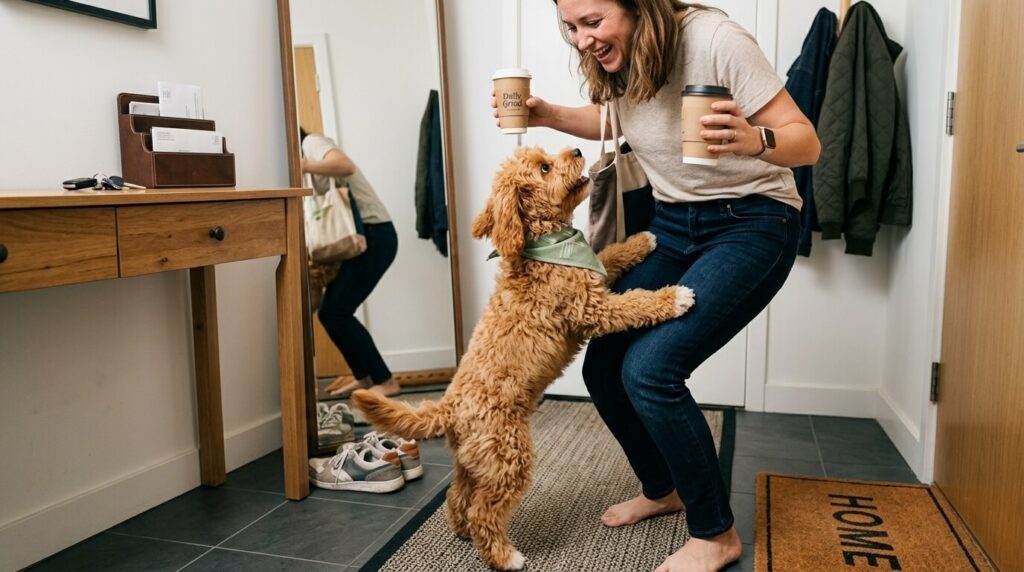
Table of Contents
Seven Calm Fixes to Stop Dog Jumping on Guests
1. Prevent the First Jump Before Opening the Door
A dog cannot practice jumping on a guest they cannot reach. Before the knock, place the dog behind a closed door, secure gate, or pen, or attach a leash that a capable adult will actively hold. A crate is suitable only when the dog is already comfortable resting in it; a dog who panics in a crate needs a different setup.
Do this before the trigger. Waiting until the dog hears footsteps and charges the entrance makes every later step harder. For planned guests, ask for a text instead of a knock. For unplanned deliveries, teach the household a default: secure the dog, then open the door.
A supervised leash is a safety line, not a correction tool. Keep enough distance that the dog cannot hit the guest at the end of it. Do not tether the dog to furniture or leave a leash attached without direct supervision; it can snag, tighten, or entangle the dog.
2. Choose a Greeting the Dog Can Realistically Perform
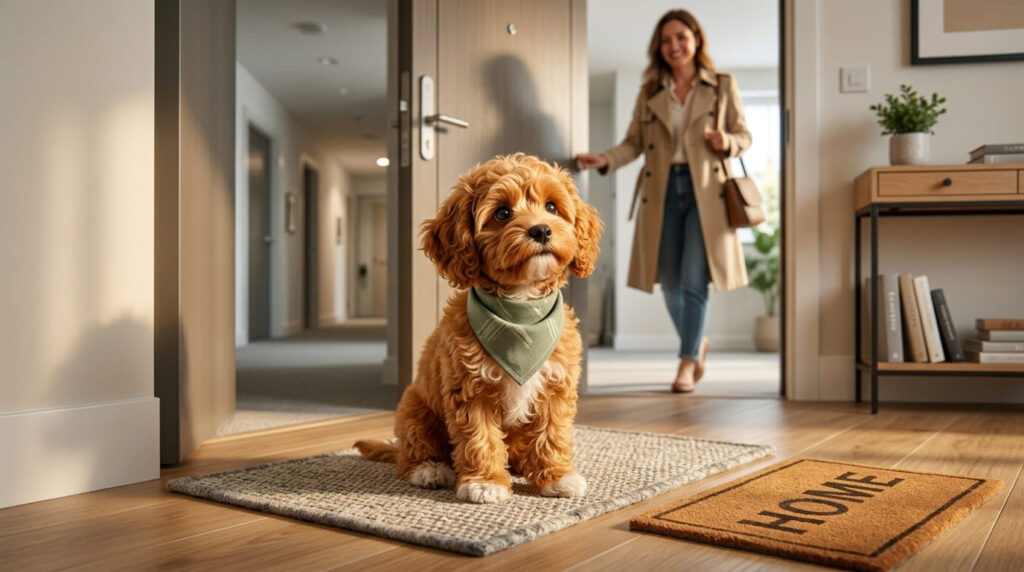
“Four paws on the floor” is often easier than a prolonged sit. The dog can shift, sniff, and orient while still meeting the rule. A mat works well when the apartment has enough distance from the door and the dog can remain there without being crowded. Complete separation is the right behavior for service workers and higher-risk guests.
Teach the replacement away from visitors first. Practice approaching a family member, hearing “hello,” keeping feet down, receiving a reward low, and moving away for another repetition. For a mat, build value for going to the mat, lying down, and staying while the handler takes one step, touches the doorknob, and returns.
Do not demand eye contact if looking at the guest increases pressure. Sniffing the floor, turning sideways, or resting with the head down may be more useful signs of regulation than staring at the owner.
3. Deliver the Reward Before the Dog Launches
VCA recommends reinforcing while all paws remain down, before the jump occurs. In practice, mark the calm approach and place the reward low between or slightly behind the front feet. Reward placement matters: food held at chest height can pull the dog’s head and body upward; food tossed directly toward a guest can create another rush.
For a dog who safely eats around visitors, several small rewards can bridge the difficult seconds while the guest crosses the threshold and sits. Then slow the rate as the dog settles. Count these rewards within the daily diet and use food appropriate to the dog’s health.
Do not scatter food when multiple dogs may compete, when the dog guards food, or when the guest’s movement around food causes tension. Use separate rooms, a barrier, or another trained behavior. Resource concerns need their own plan; consult the resource guarding safety guide rather than testing the dog at the doorway.
4. Give the Guest One Clear Script
Send instructions before the guest arrives. Long coaching in the hallway increases pressure. A workable message is:
We are practicing calm greetings. Please come in without calling, touching, or leaning over the dog. I will tell you if and when a greeting is ready. If the dog jumps, turn slightly sideways and keep your hands still while I create distance.
Turning away is useful only when it is safe. A child, older adult, person using a mobility aid, or frightened guest should not stand in reach and wait for the dog to make a better choice. Secure the dog before entry. Likewise, a guest carrying drinks, food, luggage, or an infant should get clear passage first.
Do not let a well-meaning friend pat their chest, squeal, wrestle, or say jumping is fine “just this once.” Intermittent reinforcement can make a behavior persistent. If a visitor cannot follow the plan, use separation without apology.
5. Practice Arrivals That Are Easier Than Real Life
Choose a calm adult helper the dog already likes. Start without a doorbell. The helper may simply step through an already open interior doorway, pause, and leave. When the dog can keep feet down or remain on the mat, add one change: a soft knock, a coat, a bag, a slightly longer stay, or a more animated hello.
Change one variable at a time. If the helper knocks loudly, carries takeout, rings the intercom, hugs the owner, and sits on the sofa in the same repetition, you will not know which part exceeded the dog’s skill. Short clean repetitions provide better information than a long chaotic visit.
A useful session may contain only four to six arrivals. Stop while the dog is still successful. Deteriorating responses, slower recovery, frantic treat grabbing, or inability to return to the mat indicate that the session is too difficult or too long.
6. Reset Quietly When Jumping Happens
If the dog jumps, do not turn the mistake into a wrestling match. The guest becomes still and sideways if safe. The handler calmly guides the dog behind the barrier or far enough away to recover. Wait for loose movement and the replacement behavior, then decide whether a simpler greeting can resume.
A reset is information. Ask what made that repetition harder: the visitor bent down, the leash was too long, the dog had not rested, the reward came late, or the session continued after arousal increased. Adjust the setup rather than repeating the same failure.
Do not knee the chest, step on the leash to force the dog down, yank the collar, spray water, shout, or alpha-roll. AVSAB’s humane training position supports reward-based methods and management rather than aversive techniques. Corrections can create fear or associate visitors with discomfort without teaching a safe greeting.
7. Match Access to the Visitor, Not Your Ambition
A calm friend can help with planned practice. A delivery driver, repair technician, home health worker, landlord, or emergency responder is there to do a job, not train your dog. Keep the dog in a secure separate room with water and a safe activity, and place a note on the door so no one opens it accidentally.
Children should not serve as helpers for a dog who jumps. The ASPCA emphasizes keeping all four paws on the floor around babies and protecting children from accidental injury. Use physical separation and adult supervision. Never leave a young child alone with a dog, even after a calm greeting.
For a guest who is afraid of dogs, a barrier across the same small room may not feel safe. Use a closed door. The dog does not need to greet every person, and the visitor does not need to overcome fear for the sake of training.
Build the Skill in Layers
Reliable greetings are made from smaller skills. Train each layer separately before combining them:
- The dog can move to the mat without a visitor.
- The dog can remain there while the owner walks toward the door.
- The dog can hear the lock or handle move.
- The dog can hear a soft knock or phone notification.
- A familiar person appears at a distance.
- The person enters quietly and sits.
- The dog is released for a brief greeting only when appropriate.
If one layer fails, reduce that layer instead of adding louder commands. The mat may need to be farther from the door. The knock may need to be softer. The dog may need a walk, toilet break, medication plan, or more sleep before practice.
Apartment hallway and elevator arousal can spill into the greeting. If the dog arrives home already pulling and scanning, work separately on calm elevator routines. Do not expect the front-door exercise to solve every building trigger at once.
Before a Real Social Visit
Prepare the dog and the apartment, but do not try to “wear the dog out” with exhausting exercise. A toilet break and a calm sniffing walk may help. Intense fetch, rough play, or a crowded dog park can leave some dogs more aroused. Match activity to age, health, weather, and temperament.
Put the barrier, leash, mat, rewards, and guest instructions in place before the planned arrival. Remove food or toys that the dog may guard. Ask the guest to text from outside. If multiple people are arriving, bring them in one at a time or keep the dog separated until everyone is seated.
Plan beyond the first hello. Dogs often jump again when a guest stands, removes a coat, hugs the owner, carries dishes, returns from the bathroom, or comes back from outside. Keep the management tools available and give the dog quiet breaks. A long visit should not become a continuous training session.
Use a Threshold Test, Not a Perfect-Sit Test
Ask whether the dog is under threshold: can they eat normally, respond to a familiar cue, turn away, sniff, and recover after movement? A dog who sits while trembling, staring, whining, or coiled to spring is not necessarily calm. Position alone does not reveal emotion.
| Ready for a Slightly Harder Step | Needs More Distance or Separation |
|---|---|
| Loose muscles and normal breathing | Rigid body, panting unrelated to heat, or trembling |
| Takes food gently and can look away | Will not eat or grabs food frantically |
| Returns to mat after mild movement | Cannot disengage from the visitor |
| Recovers quickly after one mistake | Jumping, barking, mouthing, or pacing escalates |
| Chooses to approach with a curved loose body | Hides, freezes, hard-stares, growls, or rushes directly |
Track the conditions of successful greetings: visitor type, time of day, distance from the door, exercise and sleep beforehand, use of food, and recovery time. This is more useful than saying the dog was “good” or “bad.” It also shows whether progress transfers from one familiar helper to different people.
Real Apartment Visitor Scenarios
These are planning examples, not claims about dogs personally treated by this site.
The Friend Who Loves Jumping Dogs
Your friend laughs and pets the dog while saying it does not bother them. Ask them to wait outside while you secure the dog, then explain that jumping on one person keeps the behavior strong for everyone. If they cannot stay neutral, keep the barrier closed and visit without a dog greeting.
The Maintenance Appointment
Place the dog behind a closed door before the worker arrives. Add water, comfortable bedding, and a safe activity if appropriate. Put a visible note on the door and tell the worker the room is off limits. Keep the dog separated until tools are packed and the exterior door is closed.
The Takeout Delivery
This is not a greeting. Secure the dog, collect the food, close and lock the door, then release the dog according to your routine. Hot containers, an open hallway, and a stranger under time pressure make training unnecessary and unsafe.
The Overnight Guest
Plan repeated “new arrivals” inside the apartment. The dog may jump when the guest wakes, exits the bathroom, puts on a coat, or returns from a walk. Give the guest the same script and keep gates or a leash available. Provide the dog with uninterrupted sleep away from guest movement.
The Visitor Bringing Another Dog
Do not combine human greeting practice with a dog-to-dog introduction at the doorway. Follow a separate neutral-ground process from the guide to introducing another dog in a small apartment, then manage the human greeting after both dogs are settled.
Common Advice That Often Backfires
“Just Ignore the Dog”
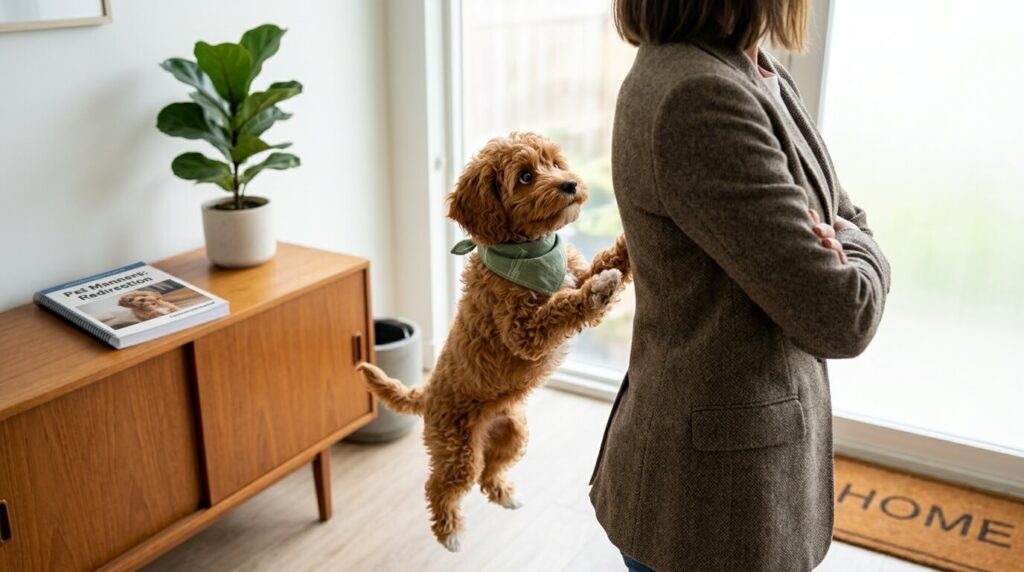
Removing attention can help with socially reinforced jumping, but it is not a complete safety plan. The dog may still scratch, mouth, knock someone over, or become more frustrated. Prevent access and reinforce an alternative. Do not ask a vulnerable guest to absorb repeated jumps while ignoring them.
“Make the Dog Sit”
A sit is useful only when the dog can perform it comfortably at that difficulty. Repeating “sit” while the dog is over threshold turns the cue into background noise. Four paws down, mat work, greater distance, or full separation may be more realistic.
“Exercise More Before Guests”
Appropriate activity can support regulation, but exhaustion is not training. Sudden intense exercise can increase arousal or be unsuitable for puppies, seniors, hot weather, or dogs with health conditions. Use a predictable routine and ask the veterinarian about safe activity.
“Let the Guest Correct the Dog”
Guests should not knee, push, shout at, or grab the dog. This can frighten the dog, escalate conflict, or create an association between visitors and discomfort. The owner is responsible for management.
“The Dog Is Friendly, So It Is Harmless”
Intent does not prevent injury. A friendly dog can knock down an older adult, scratch skin, frighten a child, spill hot food, or escape into the hall. Safety decisions should reflect size, strength, surfaces, guest vulnerability, and the physical layout.
When Jumping Includes Mouthing, Growling, or Snapping
Stop the greeting and create secure separation. Do not punish growling or force the dog back toward the guest. Growling communicates discomfort; suppressing the warning does not resolve the emotion. Record what occurred before, during, and after the incident.
Mouthing can be excited, but teeth on clothing or skin still creates risk. If the dog grabs sleeves, bruises, breaks skin, redirects toward the handler, guards the doorway, or cannot be safely moved, do not continue home experiments with visitors. Contact the veterinarian and a qualified reward-based behavior professional.
Any bite should be taken seriously. Secure the dog, provide appropriate first aid, and seek medical advice for the person. Have the dog examined when pain or illness may contribute. Local reporting or vaccination documentation requirements vary, so follow medical and local authority guidance.
When to Get Professional Help
Ask for help when the dog is large or strong enough to injure someone, jumping is accompanied by fear or aggression, the dog cannot disengage, household members cannot operate the barriers safely, or children and medically vulnerable visitors are frequent. Professional guidance is also appropriate when weeks of consistent easy practice produce no improvement.
Begin with the veterinarian when behavior changed suddenly or there may be pain, sensory loss, cognitive change, or another medical concern. For behavior support, look for humane reward-based methods and transparent qualifications. Avoid trainers who rely on dominance claims, guaranteed fixes, pain, intimidation, or flooding the dog with visitors.
If general under-stimulation contributes to chaotic evenings, use the workday enrichment guide to review the whole routine. Enrichment may support calmer behavior, but it does not replace doorway management and greeting practice.
Frequently Asked Questions
What is the fastest safe way to stop dog jumping on guests?
Use a closed door, secure gate, pen, or supervised leash before the visitor enters. Management prevents rehearsal immediately. Then teach four paws down or mat waiting through easier planned practice.
Should I turn my back when my dog jumps?
Turning slightly away may remove attention for a dog who jumps socially, but only when the person is stable and safe. It is not suitable protection for children, frail adults, fearful visitors, or powerful dogs. Use physical separation in those cases.
Should I knee or push the dog down?
No. Physical corrections may frighten the dog, increase excitement, or still reward jumping with interaction. Prevent access, reward the desired behavior, and reset calmly.
Is four paws on the floor better than sit?
It is often easier for an excited dog because movement is allowed while jumping is not. A reliable sit can be added later. Choose the behavior the dog can perform safely in the available space.
Can guests give the treats?
Only when the dog approaches loosely, takes food gently, does not guard, and the guest is comfortable. Often the owner should deliver rewards low while the guest remains neutral. Do not lure a fearful dog closer to a person they are avoiding.
What if my dog jumps only on certain people?
Compare those guests’ voices, movement, clothing, posture, history with the dog, and tendency to reward jumping. The pattern may reflect greater excitement or greater uncertainty. Adjust distance and difficulty rather than assuming defiance.
How long will polite greeting training take?
There is no fixed deadline. Progress depends on learning history, emotion, consistency, practice quality, guest behavior, and whether the dog continues to rehearse jumping. Judge progress by fewer attempts, faster recovery, and reliable replacement behavior across different helpers.
Does every guest need to meet my dog?
No. Separation is appropriate for service workers, deliveries, fearful visitors, busy gatherings, and any situation in which the dog or person would be uncomfortable. Neutral coexistence behind a closed door is a valid plan.
What Success Looks Like in a Small Entryway
A good plan to stop dog jumping on guests makes arrivals predictable. The door can open without the dog reaching the visitor. The dog understands where to go, the guest knows what to do, and the owner can add distance without drama. Mistakes become quieter and recovery becomes faster.
Keep the gate, mat, leash, and separate room available even after improvement. Skills can weaken with an unusually exciting friend, long gap between visits, adolescence, pain, or a major routine change. Management protects the training rather than proving it failed.
References
VCA Animal Hospitals: Dog Greeting Behavior and Jumping Up
VCA Animal Hospitals: Barking and Jumping at the Door
American Veterinary Society of Animal Behavior: Humane Dog Training Position Statement