
I was sitting in a meeting at 11 AM when I checked the pet camera on my phone under the table.
What I saw made my stomach drop completely.
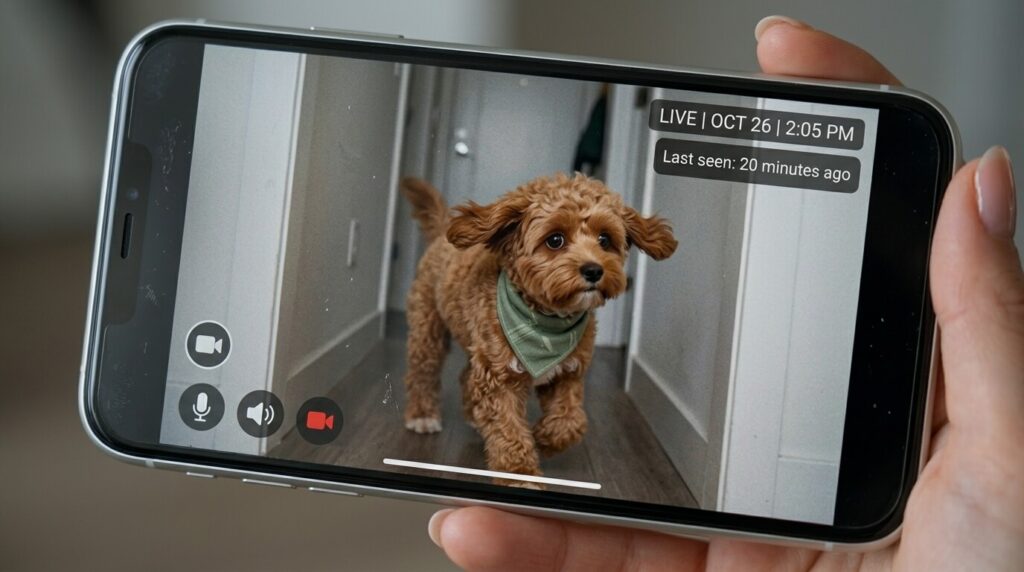
Ollie—my caramel-colored Cavapoo in his sage green bandana, the dog I’d spent months carefully training and socializing—was pressed against the front door of our apartment with his paws scratching frantically at the frame. His mouth was open. His eyes were wide with an expression I’d never seen on him before: pure, undiluted panic. The camera had audio, and even through my phone speaker I could hear the high, desperate quality of his whimpering.
I excused myself from the meeting and stood in the hallway of my office building feeling genuinely sick.
When dealing with dog separation anxiety apartments can feel like the absolute worst possible environment—paper-thin walls, neighbors who work from home, building managers who respond to noise complaints, landlords with pet addendums that can be revoked. The anxiety isn’t just your dog’s. It’s yours too: the constant fear of a noise complaint, an eviction notice, or worse, the knowledge that your dog is suffering every single day you leave for work.
That camera check was eighteen months ago. Today, Ollie sleeps calmly through my entire workday. Here’s the complete roadmap of how we got there.
Managing Dog Separation Anxiety Apartments (Quick Answer)
Managing dog separation anxiety apartments requires a combination of systematic desensitization training, counter-conditioning, and careful environmental management. Start by eliminating departure cues, practicing micro-absences of just 30-60 seconds, and pairing departures with high-value frozen treats. Use white noise to mask triggering hallway sounds. Never punish anxious behavior—punishment increases fear and makes the condition significantly worse over time.
The Nightmare of Separation Anxiety in Rentals
Let me be precise about what makes separation anxiety uniquely brutal in an apartment context, because the stakes are different than they are for homeowners.
When a dog with separation anxiety panics in a house, the consequences are largely contained within that house. The neighbors are further away. The landlord doesn’t live in the same building. The dog can destroy a door frame without that destruction potentially threatening your housing situation.
In an apartment, every consequence is amplified and every consequence has a witness.
The Cascading Apartment Consequences
The neighbor problem:
A dog howling continuously in a 650-square-foot apartment is not a private problem. It’s a shared-building problem. Your neighbor who works from home is absorbing every vocalization. The person below you can hear the pacing. The person next door gets the scratching transmitted through the shared wall.
I received a polite but clearly frustrated note from my across-the-hall neighbor within two weeks of Ollie’s anxiety becoming apparent. It was the most motivating piece of paper I’ve ever received.
The landlord problem:
Most pet addendums include clauses about noise and damage. A dog who scratches door frames, chews baseboards at exit points, and vocalizes continuously is creating documentation that a motivated landlord can use to terminate a pet agreement.
The guilt-and-anxiety spiral:
The owner’s stress about the situation feeds back into the dog’s anxiety. Dogs are exquisitely sensitive to their owner’s emotional state. The more stressed you are about Ollie’s anxiety, the more anxious Ollie becomes about your emotional state, which worsens the separation anxiety, which increases your stress.
It’s a system that gets worse without deliberate intervention.

Boredom vs. True Panic: The Critical Distinction
Before we go any further, we need to establish whether what you’re seeing is genuine separation anxiety or under-stimulation boredom. Because these two conditions look superficially similar and require completely different interventions.
You must first understand exactly how long can you leave a dog alone in an apartment before assuming separation anxiety is the diagnosis—because some “anxiety” behaviors are simply the predictable result of a young dog alone for 10 hours with no enrichment and no midday break.
The Diagnostic Questions
Ask yourself these honestly:
Does the behavior happen:
- Only when you’re gone, or also when you’re home but ignoring them?
- Immediately upon departure, or after a delay?
- At exit points (door, windows), or throughout the apartment?
- With sustained, escalating intensity, or in bursts with calm intervals?
What does the pet camera show?
- Panic from minute one = anxiety
- Active exploration for 20 minutes, then destruction = boredom
- Frantic scratching at the door specifically = anxiety
- Chewing your shoes = boredom
What’s the physical evidence?
- Damage concentrated at exit points (doors, windows) = anxiety
- Damage scattered across multiple objects = boredom
- Salivation on the door frame = anxiety (stress drooling)
- Vomiting or diarrhea during alone time = anxiety (physiological stress response)
Frantic scratching and chewing specifically at the door frame is a panic response driven by the instinct to escape and find you—and this requires a completely different approach than addressing how to stop a dog from chewing furniture out of boredom, which is a behavioral management issue rather than an emotional one. [How To Stop Dog Chewing Furniture (7 Fast Fixes)]
The Spectrum of Severity
Separation anxiety exists on a spectrum:
Mild: Some vocalization in the first 10-15 minutes, then settles. Minor attention-seeking behaviors. Recovers quickly.
Moderate: 30-60 minutes of significant distress. Some destruction. Difficulty fully settling during the absence. Visible anxiety signs on camera for extended periods.
Severe: Continuous panic for the entire absence. Significant self-injury risk (breaking nails scratching doors, injuring paws). Physiological symptoms (vomiting, diarrhea, excessive salivation). Unable to eat treats left for them because panic overrides appetite.
The protocols differ by severity. Be honest about where on this spectrum your dog falls.
The 5 Clear Signs of True Separation Anxiety
Based on current behavioral science and my clinical experience, these are the signs that distinguish genuine separation anxiety from boredom or mild adjustment difficulties.
Sign #1: Distress Begins Before You Leave
This is a tell that most owners miss: the anxiety starts during your departure routine, not after you leave.
Dogs with separation anxiety learn to read departure cues—the specific sequence of behaviors that precede your absence. Picking up your keys. Putting on your work shoes. Checking your bag. Applying your coat.
Each of these cues triggers anticipatory panic. By the time you open the door, the dog may already be panting, pacing, or whimpering. You haven’t left yet. They’re already in distress.
Sign #2: Sustained Vocalization
Not a few barks when you leave. Not some whimpering for ten minutes that settles.
Sustained, escalating vocalization that continues for extended periods. The howl specifically—that long, drawn-out, mournful sound—is a distress call. It’s your dog trying to locate you through sound. It is the single most apartment-problematic symptom and the one most likely to generate complaints.
Sign #3: Destruction at Exit Points
The scratching at the door I saw on my camera is the textbook example. Dogs with separation anxiety direct destructive behavior toward the barriers keeping them from you:
- Front door scratching and chewing
- Window sill damage
- Chewing through blinds or curtains at windows
- Scratching at the balcony door
The logic is instinctive: if I can get through this barrier, I can find my person. The destruction is not spite or misbehavior—it’s a desperate attempt to reunite.
Sign #4: Physiological Distress Responses
The body responds to panic with genuine physiological symptoms that go beyond behavioral displays:
- Excessive salivation (you find a wet door frame or wet floor near the exit)
- Vomiting during the alone period (found when you return)
- Diarrhea with no dietary explanation
- Self-injury from sustained scratching (broken or bleeding nails)
- Weight loss over time due to chronic stress affecting appetite
These physiological symptoms confirm that what you’re dealing with is a genuine fear response, not a training or obedience issue.
Sign #5: Inability to Eat During Absence
This is one of the most reliable clinical indicators.
A dog who is bored will eat a Kong. A dog who is genuinely panicking cannot eat—fear and feeding operate on competing neurological systems. When fear wins, appetite disappears entirely.
The Kong test: Leave a frozen Kong for your dog. Check the pet camera. If the Kong is completely ignored for the first two hours, anxiety is almost certainly the diagnosis. If the Kong is eaten within the first 30 minutes and then there’s some vocalization, boredom is more likely the primary issue.
The Desensitization Protocol (Step-by-Step)
This protocol is based on current evidence-based behavioral science for treating separation-related problems in dogs. It takes time. It requires consistency. It is not a quick fix.
The core principle: We systematically change your dog’s emotional association with your departure from “terror” to “neutral” or “mildly pleasant.”
Phase 1: Eliminating Departure Cues (Week 1-2)
Before we can teach your dog that your departure is safe, we need to strip the departure cues of their predictive power.
The process:
- Pick up your keys 20 times throughout the day. Put them back down. Don’t leave.
- Put on your shoes. Sit on the couch. Take them off.
- Put on your coat. Make coffee. Take it off.
- Pick up your bag. Watch television for 20 minutes. Put it down.
The goal: your dog learns that keys, shoes, coat, and bag no longer reliably predict your departure. The anticipatory anxiety that currently begins with these cues starts to dissolve.
How long does this take? Until your dog shows no response to these cues. For mild cases, 3-5 days. For severe cases, 1-2 weeks of consistent practice.
Phase 2: Micro-Absences (Week 2-4)
This is where the actual desensitization begins.
The protocol:
- Give your dog a frozen Kong or high-value chew
- Walk to the door. Touch the handle. Walk back.
- Repeat until no anxiety response: 5-10 times, multiple sessions daily
- Progress: open the door. Step outside for literally 3 seconds. Return.
- Progress: 10 seconds. 30 seconds. 1 minute. 2 minutes.
- Never progress faster than your dog can handle—the success criterion is returning to find the dog still eating their Kong or resting calmly
The progression timeline:
| Week | Target Absence Duration |
|---|---|
| Week 2 | 30 seconds to 2 minutes |
| Week 3 | 2-5 minutes |
| Week 4 | 5-15 minutes |
| Week 5-6 | 15-30 minutes |
| Week 7-8 | 30-60 minutes |
| Week 9-12 | 1-4 hours |
The critical rule: Never push to the next duration level if the previous level is not fully comfortable. One bad session can set the protocol back significantly.

Phase 3: Counter-Conditioning (Ongoing)
Simultaneously with desensitization, we’re building a positive emotional association with departure.
The only time Ollie gets a frozen Kong is when I leave.
This is a deliberate, strategic choice. The Kong is high-value enough that—for mild to moderate cases—it can shift the emotional weight of departure from “terrifying” toward “actually, this is when the great thing happens.”
Kong preparation protocol:
- Fill with soft food (peanut butter, plain yogurt, wet food, banana)
- Freeze overnight (makes it last longer and increases engagement)
- Always use the same container (it becomes a conditioned cue for “the good thing is coming”)
- Never give the Kong at other times (preserves its value as a departure-specific signal)
Phase 4: The Real Workday (Week 8-12+)
By this phase, you’ve built up to hours of comfortable alone time. Now you transition to your actual schedule.
How to do this without losing your progress:
- Don’t jump from “2 hours comfortable” to “8 hours workday” overnight
- First week of real absences: come home at lunch to break the day
- Second week: dog walker at hour 4
- Third week: dog walker at hour 5
- Gradually extend until the full workday is manageable
Apartment-Friendly Management Hacks
While the desensitization protocol does the long-term work, these apartment-specific strategies manage the immediate problem.
White Noise: The Hallway Solution
In apartment buildings, hallway sounds—footsteps, doors closing, elevator dings, neighbors’ voices—are constant triggers for anxiety dogs. Every sound registers as potential “you coming home,” followed by the devastating disappointment of “no, it wasn’t you.”
A white noise machine positioned near the front door is one of the highest-impact single interventions I’ve found. It masks the hallway soundscape enough to significantly reduce triggered anxiety cycles.
Budget option: A simple fan. The ambient sound provides enough masking to make a real difference.
Window Management
If your dog has a window view that includes street activity, people, or other dogs, that visual stimulation drives anxiety in a different way: vigilance. A dog scanning for you from a window is a dog keeping their anxiety activated.
Partially closing blackout curtains or using window frosting film reduces this vigilance loop substantially.
The Calming Environment
For cases requiring additional support beyond training, pairing the desensitization protocol with calming aids can lower your dog’s baseline anxiety enough to make the training more effective. For severe cases, training works significantly better when combined with the best calming aids for dogs in apartments, since you can’t effectively teach a dog who is already at the ceiling of their anxiety tolerance. [7 Best Calming Aids For Dogs: What Actually Works?]
Options to discuss with your veterinarian:
- Adaptil DAP diffuser: Synthetic dog appeasing pheromone; shown to reduce anxiety-related behaviors
- Zylkene (alpha-casozepine): Natural supplement with research support for anxiety reduction
- Prescription anxiolytics (Trazodone, Fluoxetine): For moderate to severe cases, medication during the training period dramatically improves outcomes
- Thundershirt: Pressure wrap; helpful for mild to moderate cases
I want to be clear about medication: There is no shame in using veterinary-prescribed medication for a dog with severe separation anxiety. Anxiety is a neurological condition. Treating it with medication during the training period is not “giving up”—it’s giving your dog a brain state in which learning is actually possible.
The Neighbor Communication Strategy
Do this before you get a complaint, not after.
Write a brief, genuine note to your immediate neighbors:
“I’m working with my dog on separation anxiety with a professional protocol. I expect significant improvement over the next 6-8 weeks. I apologize for any disturbance and welcome you to contact me directly if it’s affecting you.”
Include your phone number. Leave a small gesture (baked goods, coffee shop gift card).
This communication: acknowledges the issue honestly, demonstrates active effort, and gives neighbors a direct channel rather than a building manager complaint. In my experience, neighbors who feel informed and respected are dramatically more patient than neighbors who feel ignored.
When to Call a Professional
This article provides an evidence-based framework. But separation anxiety, particularly moderate to severe cases, genuinely benefits from professional assessment.
Seek professional help if:
- Your dog’s anxiety is severe (continuous panic, self-injury risk, physiological symptoms)
- You’ve been consistent with the protocol for 4 weeks with minimal improvement
- Your housing situation is at risk due to noise complaints
- You’re unsure whether you’re reading the progression correctly
Who to contact:
- Certified Applied Animal Behaviorist (CAAB): The highest qualification in the field
- Veterinary Behaviorist (DACVB): A veterinarian with residency training in behavioral medicine; can prescribe medication and provide behavioral treatment simultaneously
- Certified Professional Dog Trainer (CPDT-KA) with demonstrated separation anxiety expertise
FAQ
What is the best approach to dog separation anxiety apartments?
The most effective approach to dog separation anxiety apartments combines systematic desensitization (micro-absences that systematically build your dog’s alone-time tolerance) with counter-conditioning (pairing departures with the highest-value treat your dog will eat).
Apartment-specific additions—white noise for hallway sound masking, window management for visual trigger reduction, and proactive neighbor communication—address the unique environmental challenges of dense living. For moderate to severe cases, veterinary consultation for adjunctive medication dramatically improves training outcomes and shortens the recovery timeline.
Will getting a second dog help with separation anxiety?
Rarely, and you need to understand why before making this decision. Separation anxiety is specifically about separation from you, not from dogs in general. A dog with true separation anxiety doesn’t calm down because there’s another dog in the apartment—they remain distressed because you’re gone. I’ve seen cases where the second dog was fine and the anxious dog remained panicked.
The rare cases where a companion dog helps are typically dogs with mild social anxiety rather than true owner-directed separation anxiety. Bringing a second dog into an apartment as a solution to the first dog’s anxiety is likely to give you two dogs in an apartment without solving the underlying problem.
How long does it take to fix separation anxiety in a dog?
Honest answer: it depends significantly on severity, consistency of training, and individual dog factors. Mild separation anxiety often responds meaningfully within 4-6 weeks of consistent desensitization work. Moderate cases typically require 8-12 weeks of structured protocol work before workday-length absences are comfortable.
Severe cases may require 6 months or more, particularly when medication is needed to lower baseline anxiety enough for learning to occur. The most common reason for slow progress is moving through the protocol too quickly—pushing to longer absences before the shorter ones are genuinely comfortable sets the training back and extends the overall timeline.
If your return triggers explosive greetings and jumping, you will also need to learn exactly [how to stop dog jumping on guests] to keep their arousal low.
References
- Lund, J. D., & Jørgensen, M. C. (1999). Behaviour patterns and time course of activity in dogs with separation problems. Applied Animal Behaviour Science, 63(3), 219-236. This foundational peer-reviewed study documents the specific behavioral patterns, temporal progression, and physiological indicators of separation-related problems in domestic dogs, providing the evidence base for the symptom identification framework and distinguishing true separation anxiety from boredom-related behaviors.
- Butler, R., Sargisson, R. J., & Elliffe, D. (2011). The efficacy of systematic desensitization for treating the separation-related problem behaviour of domestic dogs. Applied Animal Behaviour Science, 129(2-4), 136-145. This controlled study demonstrates the clinical efficacy of systematic desensitization protocols for separation anxiety in dogs, documenting behavioral improvement rates and providing the research foundation for the graduated micro-absence protocol described in this article.