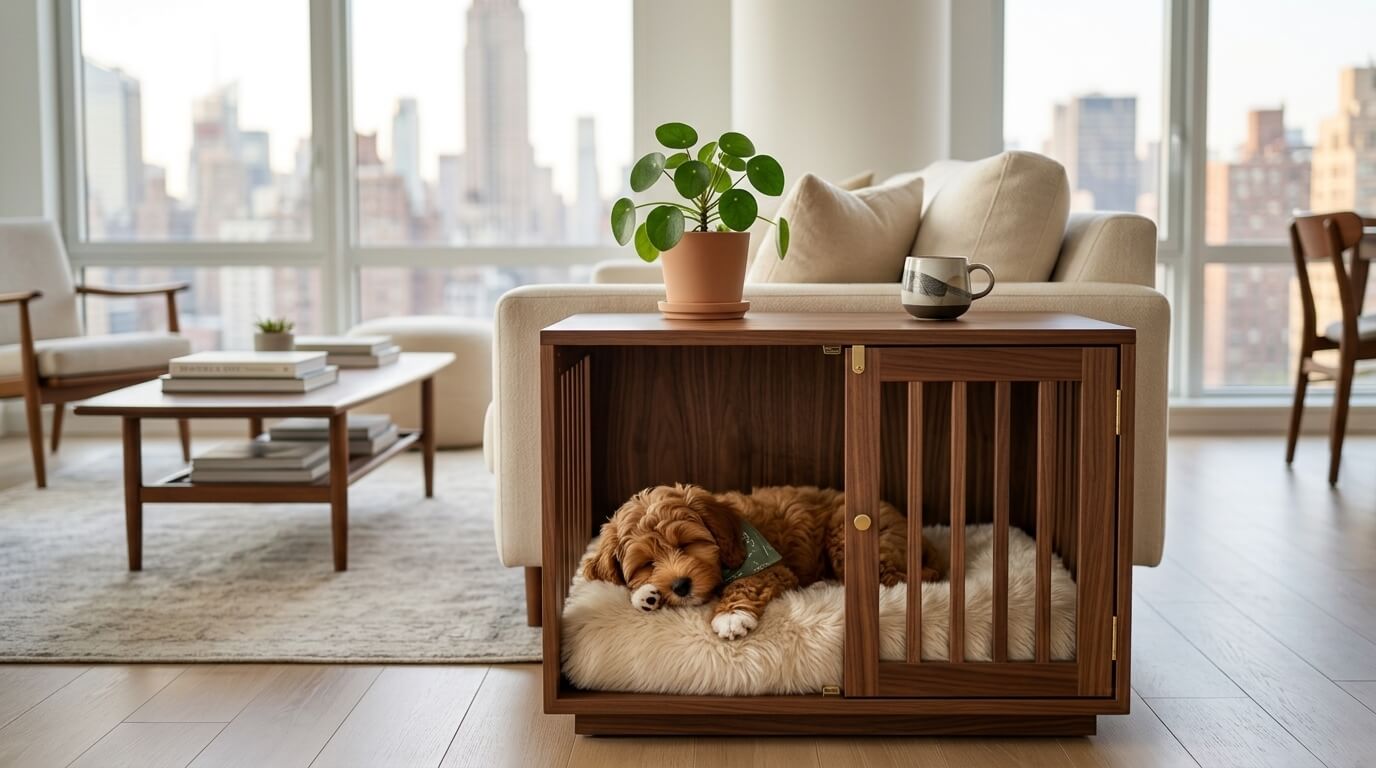
The best dog crates for apartments are not always the prettiest crates or the strongest crates. In a small rental, the right crate has to fit the dog, fit the room, stay quiet enough for neighbors, clean easily, and support calm crate training instead of becoming a storage box your dog hates.
This guide does not pretend that one crate is perfect for every dog. A calm adult dog in a studio may need a different setup than a puppy, a senior dog, a dog who chews bedding, or a dog who panics when confined. The goal is to help you choose the safest crate type for your apartment situation before you spend money.
If your dog is not crate trained yet, start with the crate training for apartment dogs guide. If you are still preparing your apartment for a new dog, pair this with the essential supplies checklist for apartment dogs.
Best Dog Crates for Apartments: Quick Answer
For most apartment dogs, the best crate is a correctly sized wire crate with a secure latch, removable tray, good ventilation, and a quiet crate mat. Wire crates are affordable, easy to clean, and simple to fold or move. Furniture-style crates can work for calm adult dogs in visible living spaces, heavy-duty crates can help with strong chewers or escape artists, and soft crates should be reserved for already crate-comfortable dogs who do not scratch, chew, or panic.
| Apartment Need | Best Crate Type | Who Should Skip It |
|---|---|---|
| Best overall value | Foldable wire crate | Dogs who bend wire or panic hard |
| Visible living room setup | Furniture-style crate | Chewers and puppies |
| Studio apartment | End-table or under-desk style | Dogs needing very large sizes |
| Travel or temporary use | Soft-sided crate | Untrained, anxious, or destructive dogs |
| Escape risk | Heavy-duty crate | Calm dogs who do not need the bulk |
Table of Contents
How I Chose These Apartment Crate Types
This is a buyer decision guide, not a fake laboratory test. I am not claiming personal testing of every model. The recommendations below are based on apartment-specific criteria that matter to renters and small-space dog owners.
- Fit: The crate must let the dog stand, turn around, and lie down comfortably without wasting half the room.
- Noise: Doors, trays, latches, and moving panels should not rattle loudly every time the dog shifts.
- Cleaning: A removable tray or wipeable surface matters in rentals.
- Ventilation: Good airflow is important, especially in warm apartments.
- Security: The latch should match the dog’s strength and problem-solving ability.
- Training fit: The crate should support calm rest, not trap a dog who is panicking.
- Layout: The crate should work near a bed, sofa, desk, or quiet corner without blocking daily life.
Before buying any crate, check the current manufacturer dimensions, weight limits, materials, and return policy. Product specs change. Your dog’s body and behavior matter more than a product label.
The 7 Best Dog Crates for Apartments by Scenario
1. Best Overall: Foldable Wire Crate
A foldable wire crate is the most practical choice for many apartment dog owners. It is usually affordable, easy to clean, easy to move, and available in many sizes. It also gives good ventilation, which matters when a crate sits in a bedroom, living room, or home office.
The biggest apartment advantage is flexibility. You can fold it when moving, add a fitted crate cover for calm, place a mat underneath to reduce floor noise, and use a divider for a growing puppy. If you are still learning where the crate fits best, wire is forgiving.
Best for: puppies, new adopters, budget-conscious renters, and owners who may move apartments.
Skip it if: your dog bends wire, paws obsessively at the door, or panics when confined. A panicking dog needs behavior support, not just stronger metal.
2. Best for Decor: Furniture-Style Dog Crate
Furniture-style crates look like end tables, cabinets, or sideboards. They can make sense in a small apartment where the crate must stay visible all day. Instead of placing a wire crate in the middle of the living room, you can use the top surface for a lamp, books, or everyday items.
The tradeoff is durability. Many furniture-style crates use wood, engineered wood, or decorative panels that are not ideal for chewers, puppies, or dogs who scratch. They can also be heavier and less ventilated than wire designs.
Best for: calm adult dogs who are already crate comfortable and owners who need the crate to blend into a living room.
Skip it if: your dog chews furniture, has accidents, claws doors, or is still learning crate basics.
3. Best for Studio Apartments: Under-Desk or End-Table Crate
In a studio, every object needs a job. A crate that fits under a desk or doubles as an end table can save space without hiding the dog away. This setup works especially well for small and medium dogs whose crates can fit near the sofa, bed, or work area.
Measure carefully. A crate that looks compact online may still block a closet, balcony door, walkway, or desk chair. Leave enough space for the door to open fully and for your dog to enter without squeezing.
Best for: studio renters, small dogs, calm work-from-home routines, and minimal layouts.
Skip it if: your dog needs a large crate, overheats easily, or needs a quieter corner away from your desk activity.
4. Best for Escape Artists: Heavy-Duty Crate
A heavy-duty crate can be useful for dogs who have damaged standard crates or learned to open weak latches. These crates are usually stronger, heavier, and more secure than standard wire crates.
But this category needs caution. If a dog is trying to escape because of separation anxiety, panic, or confinement distress, a stronger crate can increase risk if the emotional problem is ignored. Use video to see what happens when you leave. If your dog is frantic, drooling, chewing bars, or injuring themselves, read the dog separation anxiety in apartments guide before upgrading hardware.
Best for: strong dogs who are otherwise calm but need a sturdier barrier.
Skip it if: your dog panics, self-injures, or has not been crate conditioned.
5. Best for Travel and Temporary Use: Soft-Sided Crate
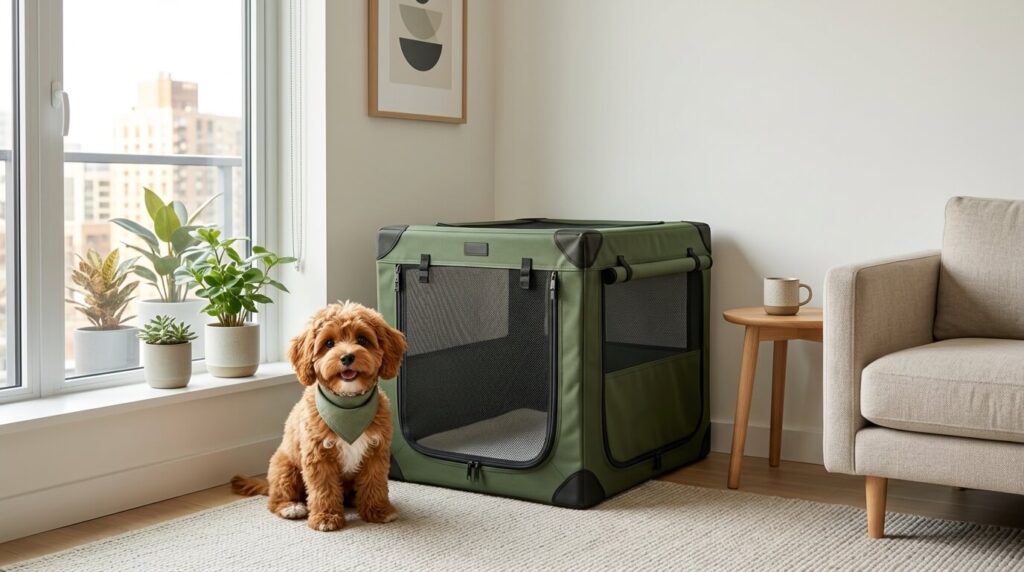
Soft-sided crates are light, quiet, and easy to store. They can be helpful for travel, visiting family, or short supervised rests. In an apartment, they are nice because they do not clang, scrape, or dominate the room visually.
They are not a good first crate for most untrained dogs. A dog can scratch mesh, chew fabric, tip the crate, or unzip weak closures. Use soft crates only for dogs who already understand crate time and are not likely to damage fabric.
Best for: calm crate-trained dogs, travel, temporary setups, and owners who need a lightweight option.
Skip it if: your dog chews, digs, escapes, has accidents, or is new to crate training.
6. Best for Puppies: Wire Crate With Divider
Puppies grow quickly, and apartment owners often want to avoid buying multiple crates. A wire crate with a divider lets you adjust the sleeping area as the puppy grows. This helps prevent the crate from being so large that one corner becomes a bathroom.
For puppies, crate placement matters as much as crate type. Keep the crate close enough that you can hear nighttime potty needs, but not in the busiest part of the apartment. Pair the crate with a realistic potty schedule from the apartment potty training guide.
Best for: growing puppies, new dog owners, and renters who want flexibility.
Skip it if: your puppy is left too long for their age. No crate fixes an unfair potty schedule.
7. Best for Senior Dogs: Low-Entry Easy-Clean Crate
Senior dogs may need a crate that is less about containment and more about comfort. Look for easy entry, a stable floor, soft but washable bedding, and a location that does not require slipping across hardwood or laminate.
A senior dog who suddenly has accidents, confusion, or nighttime restlessness may need a veterinary check. Do not assume a senior dog is being stubborn. If accidents are part of the issue, see the dog potty training regression guide.
Best for: older dogs who still enjoy a den-like rest space.
Skip it if: your senior dog has pain, mobility issues, or anxiety that makes confinement stressful.
Crate Size Guide for Apartments
A crate should be large enough for your dog to stand up, turn around, and lie down naturally. It should not be so tight that your dog curls awkwardly, and it should not be so oversized that it becomes half bedroom and half bathroom.
Measure your dog from nose to base of tail for length, and from floor to top of head or ears for height depending on how your dog stands. Then compare those numbers to the interior dimensions of the crate, not just the product name. “Medium” means different things across brands.
| Dog Situation | Crate Sizing Priority | Apartment Note |
|---|---|---|
| Puppy | Adjustable divider | Avoid too much extra space |
| Long-bodied dog | Interior length | Check lying position |
| Tall-eared dog | Interior height | Ears should not be crushed |
| Senior dog | Easy entry and turn space | Use stable flooring nearby |
| Studio layout | Door swing and footprint | Measure the walkway too |
Where to Put a Dog Crate in an Apartment
The best crate in the wrong location can still fail. Avoid placing the crate directly beside the front door if hallway noise makes your dog bark. Avoid sunny windows if the crate gets hot. Avoid the kitchen if food smells create frustration. Avoid blocking exits, closets, balcony doors, or air vents.
Good locations often include a quiet bedroom corner, a calm living room wall, or a home office area away from foot traffic. Use a rug or mat under the crate to protect floors and reduce rattling. If your dog barks at hallway noise, place the crate farther from shared walls and pair the location with the apartment barking guide.
If your dog is new to crate time, start with the crate near normal family life rather than isolated in a distant room. Once the crate has a calm association, you can test quieter locations.
Apartment Crate Noise Fixes
Crate noise matters in apartments. A dog shifting at midnight, a metal tray rattling, or a latch clanging can be more annoying than the crate’s appearance.
- Place a non-slip mat under the crate.
- Use a fitted crate mat that your dog will not chew.
- Check that the tray sits flat.
- Secure loose divider panels.
- Avoid hard toys that bang against crate walls.
- Move the crate away from shared bedroom walls.
- Choose quiet enrichment for crate time.
If your dog repeatedly paws, digs, or slams into the crate, treat that as information. The dog may need more gradual crate training, more exercise before rest, a different location, or help with anxiety.
What to Avoid When Buying a Crate
A Crate Chosen Only for Looks
A beautiful crate that your dog can chew, overheat in, or fear is not apartment-friendly. Decor matters, but safety and training fit come first.
A Crate That Is Too Big for the Room
Measure the crate footprint with tape on the floor before buying. Include door swing. If you cannot walk around it comfortably, you may resent the crate and stop using it consistently.
A Soft Crate for an Untrained Dog
Soft crates are convenient, but they are not escape-proof. Use them after your dog has proven they can rest calmly.
A Heavy-Duty Crate Used as an Anxiety Shortcut
Stronger walls do not teach calm alone time. If your dog panics, build a behavior plan and talk with a qualified professional.
A Crate Without a Cleaning Plan
Renters need easy cleanup. Removable trays, washable bedding, and floor protection matter more than fancy styling.
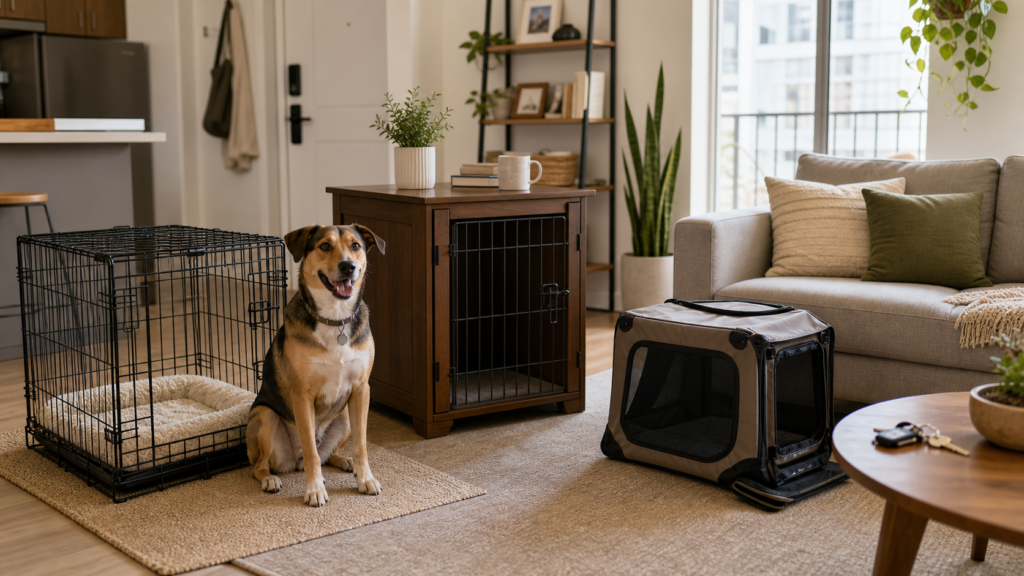
How to Make Any Crate More Apartment-Friendly
The crate itself is only part of the setup. A basic crate can work beautifully if the environment is thoughtful.
- Add a washable mat under the crate to protect floors.
- Use bedding only if your dog does not chew or soil it.
- Keep water access appropriate for your dog’s age, health, and schedule.
- Give crate-safe enrichment only after testing it while you are home.
- Keep the crate away from direct heat, drafts, and intense sun.
- Do not use the crate as punishment.
- Pair crate time with calm routines and predictable exits.
If your dog gets restless at night, the crate may not be the only issue. The tire out a dog before bed guide can help you build a calmer evening routine before crate time.
Crate Type Comparison
| Crate Type | Apartment Strength | Main Tradeoff | Best Match |
|---|---|---|---|
| Wire | Ventilation, cleaning, value | Can rattle or look plain | Most dogs and new owners |
| Furniture | Blends into living space | Less durable for chewers | Calm adult dogs |
| Soft-sided | Light and quiet | Not secure for many dogs | Travel and trained dogs |
| Heavy-duty | Strong containment | Heavy, expensive, bulky | Strong calm dogs |
| Plastic kennel | Den-like and travel-friendly | Less visibility and airflow than wire | Dogs who prefer enclosed spaces |
Buying Checklist Before You Order
Before you choose from the best dog crates for apartments, slow down and check the practical details. A crate can look perfect online and still fail in your actual room.
- Measure your dog while standing and lying naturally.
- Compare your dog’s measurements to the crate’s interior dimensions.
- Tape the crate footprint on your floor before buying.
- Check whether the door opens left, right, upward, or outward.
- Look for a removable tray or easy-clean surface.
- Check ventilation if the crate has wood, plastic, or solid panels.
- Read the latch style and make sure it matches your dog’s strength.
- Confirm the return policy in case the fit is wrong.
For apartment owners, door swing is one of the most overlooked details. A crate may fit against the wall but become annoying if the door opens into a walkway, desk chair, closet, bed frame, or balcony path. Measure the crate as an object you live around, not just as a dog bed.
Best Crate Setup by Apartment Layout
Studio Apartment
In a studio, choose a crate that can sit along a wall without visually taking over the room. A wire crate with a neat cover, an end-table style crate for a calm dog, or an under-desk setup can work. Keep the crate away from the kitchen if food prep makes your dog restless.
One-Bedroom Apartment
A one-bedroom gives you more flexibility. Many dogs settle better in the bedroom at night and near the living room during the day. If you move the crate between rooms, choose a foldable or lighter design. If the crate stays in one place, focus on quiet placement and floor protection.
High-Rise Apartment
High-rise dogs may hear elevators, hallway doors, and carts. Avoid placing the crate against the wall closest to the elevator or trash room. If your dog reacts to building sounds, choose a calmer interior wall and use crate training before leaving them alone for long periods.
Shared Apartment or Roommate Setup
If you share the apartment, the crate should protect both the dog and the household routine. Put it somewhere your roommate will not bump into it, open it accidentally, or use it as storage. Make sure everyone understands that the crate is the dog’s rest space.
When a Crate Is Not the Right Tool
A crate can be helpful, but it is not always the answer. Some dogs need a pen, gated room, tethered supervision while you are home, or a gradual alone-time plan instead.
Do not rely on a crate if your dog injures themselves trying to escape, soils the crate repeatedly despite fair potty breaks, screams or pants the whole time, or becomes more fearful each day. Those are not signs that you need a prettier crate. They are signs that the confinement plan needs to change.
For some dogs, a crate is useful only after exercise, enrichment, and training are in place. If your dog is bouncing off the walls before confinement, revisit how to exercise a dog in a small apartment. If the issue is long workdays, revisit alone-time planning before buying a stronger crate.
How to Introduce a New Crate
Even the best crate should be introduced gradually. Put the crate in its planned location, leave the door open, and let your dog investigate without pressure. Feed treats near the entrance, then inside the crate, then on the bed or mat. Keep early sessions short.
Do not close the door for a long session on the first day. Close it briefly, reward calm behavior, and open it before your dog panics. Build from seconds to minutes, then to normal rest periods. If your dog leaves calmly and returns later by choice, you are on the right track.
For apartment dogs, practice at different times of day. A crate may feel easy when you are sitting beside it but harder when hallway noise starts, dinner smells are in the air, or you pick up your keys. Train the real moments your dog will experience.
FAQ
What are the best dog crates for apartments?
The best dog crates for apartments are correctly sized, easy to clean, secure, well ventilated, and quiet. For most renters, a foldable wire crate is the most practical first choice. Furniture crates, soft crates, and heavy-duty crates can work for specific dogs and layouts.
Are furniture dog crates good for apartments?
Furniture dog crates can be good for calm adult dogs because they save visual space and double as home furniture. They are not ideal for chewers, puppies, dogs with accidents, or dogs who scratch when confined.
Should I cover my dog’s crate in an apartment?
A crate cover can help some dogs settle, especially if hallway activity or room movement is distracting. Keep airflow in mind and avoid covers for dogs who pull fabric into the crate or overheat easily.
Can I crate my dog while I am at work?
It depends on your dog’s age, training, bladder control, and comfort. A crate should not be used to make an unfair alone-time schedule work. If your workday is long, review how long dogs can be left alone in an apartment.
What crate is best for a puppy in an apartment?
A wire crate with a divider is often the most practical puppy option. It can grow with the puppy, clean easily, and support house-training when paired with frequent potty breaks.
Are soft dog crates safe for apartments?
Soft crates are safe only for dogs who are already calm and crate trained. They are not a good choice for dogs who chew, dig, escape, panic, or have accidents.
Where should I put a dog crate in a small apartment?
Choose a quiet, comfortable location away from direct sun, drafts, heavy foot traffic, and hallway noise. Make sure the crate door can open fully and the crate does not block daily movement.
Next Step
Before buying, tape the crate footprint on your floor. Check the door swing, walkway, and distance from noisy walls. Then choose the crate type that matches your dog’s actual behavior, not just your apartment decor.
The best dog crates for apartments are the ones your dog can use calmly and safely. Start with fit, safety, cleaning, and training comfort. Style is a bonus, not the foundation.