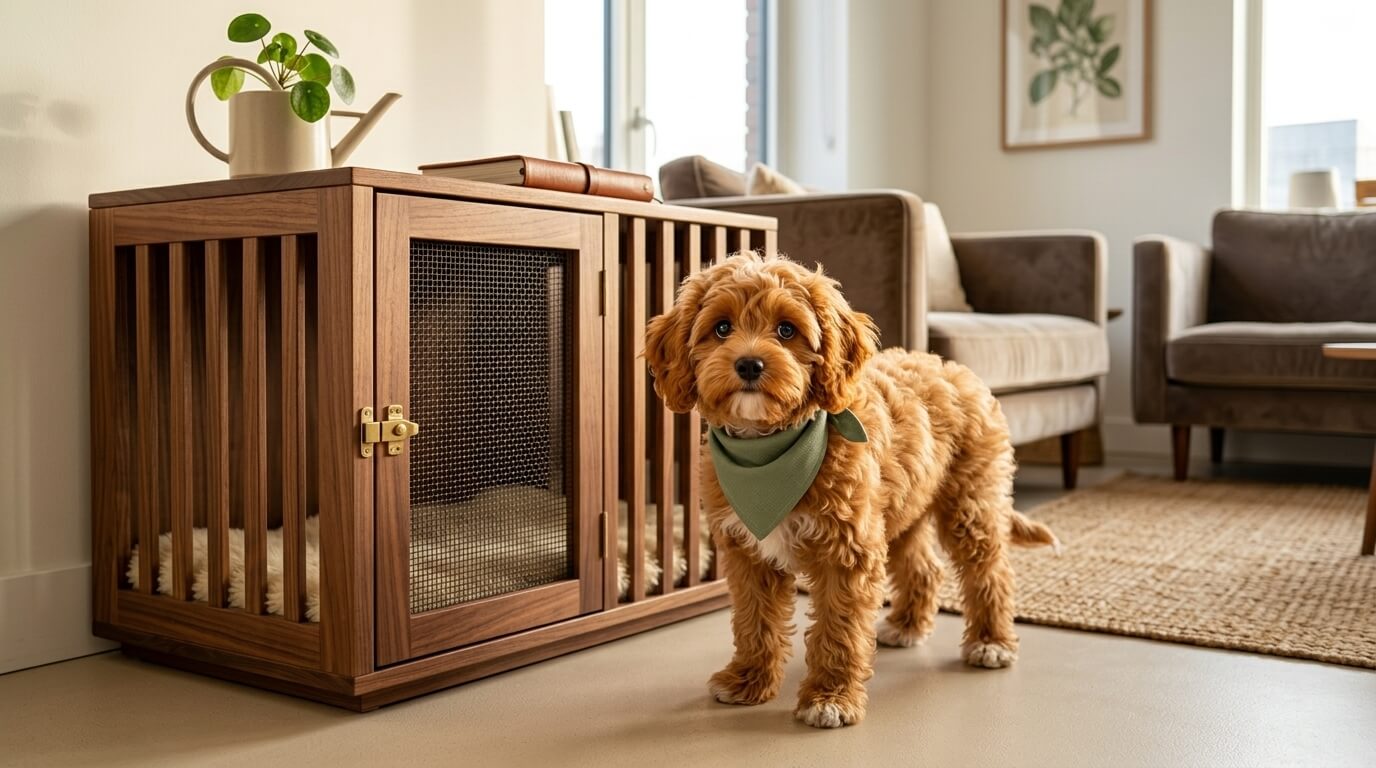
Crate training in an apartment requires the same gradual, reward-based foundation used in any home, with extra planning for shared walls, hallway sounds, elevators, and nearby neighbors. The goal is to teach your dog that the crate is a comfortable place to rest—not to shut a distressed dog away until the noise stops.
Start while you are home, keep the first sessions very short, and increase difficulty only when your dog remains relaxed. A crate can support safe management, travel, and house training, but it does not replace exercise, toilet breaks, social contact, or treatment for separation-related distress.
Quick Answer
To crate train a dog in an apartment, place a correctly sized crate in a calm part of the home where your dog does not feel isolated. Leave the door open, reward voluntary entry, feed meals or give safe enrichment near or inside the crate, and practice closing the door for only a few seconds at first. Build duration, distance, and departures separately. Return before your dog becomes distressed, and use a camera when you begin brief out-of-apartment practice.
Expect progress to vary by dog. Brief frustration can be information that a step was too difficult; persistent barking, frantic escape attempts, heavy panting, drooling, repeated elimination, or self-injury are reasons to stop the session and reassess. Do not use “cry it out” as the default plan. If confinement or departure triggers panic, speak with your veterinarian and a qualified reward-based behavior professional.
Table of Contents
- How to Crate Train a Dog in an Apartment: 7 Safe Steps
- Where to Put a Dog Crate in an Apartment
- A Flexible First-Week Crate Training Schedule
- Puppy Crying and Crate Barking in an Apartment
- Accidents and Setbacks
- When Crate Training May Not Be Appropriate
- Alternatives to a Crate
- When to Get Professional Help
- Frequently Asked Questions
How to Crate Train a Dog in an Apartment: 7 Safe Steps
The seven steps below form one gradual protocol. They are not a seven-day deadline. A dog who is relaxed can move forward; a dog who becomes tense, stops taking food, repeatedly tries to leave, or escalates vocalizing needs an easier version of the current step.
Step 1: Build a Safe, Voluntary Crate Setup
Choose a crate that allows your dog to stand without crouching, turn around, lie down comfortably, and rest in a natural position. For a growing puppy, a divider can make an adult-size crate usable without creating an oversized toilet area. If you still need to choose a style or size, use our guide to the best dog crates for apartments rather than turning the training session into a shopping experiment.
Put the crate in the location you intend to use most often. Secure the door so it cannot swing and startle your dog. Add comfortable bedding only if your dog does not shred or swallow it. Never leave a leash attached in the crate, and remove or manage collars and harnesses when they could snag on the crate. Any cover must leave ample airflow and let you monitor your dog.
Leave the door open. Toss a few treats just outside the entrance, then at the threshold, and finally inside. Let your dog choose whether to enter. Do not push, pull, or lift a reluctant dog into the crate. During ordinary apartment life, occasionally place a treat inside for your dog to discover without a formal training session.
Ready to continue: Your dog approaches the crate, enters for food, and can turn around or step back out without rushing.
Step 2: Make the Crate Predict Calm, Useful Things
Once your dog enters willingly, serve part of a meal at the doorway. Over several repetitions, move the bowl farther inside. If your dog stretches toward the food while keeping the back feet outside, the bowl is too far in. Bring it closer and allow confidence to grow.
You can also offer a safe, familiar food toy or chew that you already know your dog can use safely. Supervise new items before considering them for crate use; no chew or toy is risk-free for every dog. Quiet praise is enough. Excited cheering can make settling harder in a small home.
At this stage, the door remains open. The lesson is simple: entering the crate makes good, calm things happen, and your dog retains the ability to leave.
Ready to continue: Your dog walks fully inside, eats comfortably, and may pause or settle after the food is gone.
Step 3: Close the Door for Seconds, Not Minutes
Sit next to the crate while your dog is inside with a meal or safe enrichment item. Close the door for one or two seconds, open it, and continue sitting calmly. Repeat only if your dog remains loose and interested in the food. Gradually work toward five seconds, ten seconds, and then a little longer.
Open the door during a calm moment when possible, but do not wait through escalating distress merely to avoid “rewarding” noise. If your dog becomes worried, open the door safely and make the next repetition much easier. Training succeeds by keeping the dog under threshold, not by proving that you can outlast them.
Avoid making every door opening exciting. Pause, open the latch quietly, and let your dog exit without a burst of play. This helps the closed and open states feel ordinary.
Ready to continue: Your dog can remain comfortable with the door closed for a short period while you sit beside the crate.
Step 4: Add Calm Time While You Stay Nearby
Now extend closed-door time in small, uneven increments while you remain in the room. One repetition might last 20 seconds, the next 10, and the next 30. Mixing easy repetitions into the session prevents every attempt from becoming harder than the last.
Read your dog rather than the clock. Relaxed signs may include a soft face, normal breathing, loose posture, eating, shifting into a comfortable position, or resting. Concern may show as freezing, refusing food, repeated lip licking, scanning, pressing at the door, or an increasingly tense posture. These observations are not a diagnosis, but they help you decide whether to shorten the exercise.
End after a successful, easy repetition. Several brief sessions across the day are usually more useful than one long session that ends in barking or frustration.
Ready to continue: Your dog can settle while you read, work, or move lightly nearby without watching the door continuously.
Step 5: Add Distance Inside the Apartment
With your dog relaxed, stand up and sit down. On another repetition, take one step away and return. Build toward walking across the room, briefly turning your back, or stepping around a corner for one second. Change only one factor at a time: duration, distance, or distraction.
Apartment doors, keys, shoes, and bags can predict a long absence. Practice these signals without leaving. Pick up your keys and put them down. Put on shoes, sit for a minute, and take them off. Touch the doorknob and return to the sofa. Reward calm behavior, but keep the routine low-key.
If hallway footsteps or an elevator chime makes your dog alert, begin at a level where they can still eat and respond to you. A fan or steady white noise may reduce sudden sound contrast, but it should not be used to mask sustained distress.
Ready to continue: Your dog remains comfortable when you move out of sight for a few seconds and return.
Step 6: Practice Micro-Departures With a Camera
The first real departure should be shorter than the successful indoor absence you have already practiced. Step outside, close the door, and return after one or two seconds. Use a camera or old phone so you can see what happens after the door closes instead of assuming silence means relaxation.
Increase departures in small steps and include easier repetitions. Five seconds does not have to lead immediately to ten, then twenty, then a minute. A sequence such as five seconds, two seconds, eight seconds, and four seconds can keep the exercise predictable enough to succeed without turning it into a rigid countdown.
Watch the whole dog. A quiet dog who is rigid, panting, drooling, or fixed on the exit is not necessarily comfortable. If you see escalating distress, return calmly, end the exercise, and go back to an easier step later. Repeated panic is not a training milestone.
Ready to continue: Your dog can remain loose and settle through several very short departures without escalating when the apartment door closes.
Step 7: Build Real Apartment Scenarios Responsibly
Once micro-departures are easy, practice ordinary situations one at a time: taking trash down the hall, checking the mail, or waiting briefly by the elevator. Keep using the camera. Do not make the first long workday the test of whether training succeeded.
Before a crate period, give your dog an appropriate toilet opportunity and meet their needs for movement, sniffing, play, and social contact. The right routine depends on age, health, house-training reliability, and the individual dog. A crate should not be used to stretch alone time beyond what your dog can physically and emotionally handle.
For broader planning, see how long you can leave a dog alone in an apartment. That separate guide covers alone-time decisions; this page stays focused on teaching comfort with the crate.
Continue offering occasional easy crate sessions while you are home. If the crate predicts departure every time, some dogs begin to worry as soon as they enter it.
Training goal: Your dog chooses to enter, can rest during an appropriate absence, and shows no pattern of escalating distress before or during confinement.
Where to Put a Dog Crate in an Apartment
The best location is usually a calm, ventilated area where your dog can feel included without being exposed to every trigger in the building. In a studio, that may be beside the bed or near the living area. In a larger apartment, it may be a quiet corner of the room where you spend time.
Avoid placing the crate against a shared wall when you have another workable option. Keep it away from direct sun, heating vents, unstable furniture, dangling cords, and a front door that produces constant hallway alerts. Do not block an exit or create a trip hazard in a narrow walkway.
For a puppy at night, placing the crate near your bed can make it easier to notice a genuine toilet need and provide calm reassurance without turning every sound into playtime. The crate can move gradually later if another permanent location works better.
Sound management should lower sudden environmental noise, not isolate the dog from all normal life. A rug beneath a stable crate can reduce vibration. A fan or white-noise machine at a moderate level can soften hallway sound changes. If you use a cover, keep ventilation open and confirm that your dog relaxes rather than becoming warmer or more worried.
Tell immediate neighbors that you are working on short, daytime training sessions if that feels appropriate in your building. Choose hours when brief practice noise is least disruptive, and stop before barking becomes a rehearsal. A courteous note is useful; it is not a substitute for changing a plan that repeatedly causes distress.
A Flexible First-Week Crate Training Schedule
This schedule is a sequence of goals, not a deadline. Stay on a stage for additional days when needed, and move backward whenever your dog shows concern.
| Stage | Training focus | Example sessions | Advance when |
|---|---|---|---|
| 1 | Open-door exploration | Treats at the entrance, voluntary entry, meals near the crate | Dog enters without pressure and eats comfortably |
| 2 | Meals and rest inside | Bowl farther inside, door still open, quiet settling | Dog remains inside briefly by choice |
| 3 | Door closed for seconds | One- to ten-second repetitions while you sit beside the crate | Body stays loose and food interest remains normal |
| 4 | Short duration nearby | Mixed easy intervals while you work or read in the room | Dog can settle without monitoring the latch |
| 5 | Indoor distance | Stand, move across the room, step out of sight for a second | Dog stays comfortable through brief distance |
| 6 | Micro-departures | One- to several-second exits monitored by camera | No escalating vocalizing or distress signs |
| 7 | Small real-life practice | Very short hallway or mailbox trips, mixed with easy sessions | Dog rests through appropriate brief absences |
A young puppy may need frequent toilet opportunities and may progress unevenly as sleep, meals, and development change. A newly adopted adult may need time to feel safe in the apartment before confinement training advances. A dog with an unpleasant crate history may require much smaller steps. None of these dogs has “failed” the schedule.
Keep a simple log of the setup, duration, and behavior you observed. Record facts such as “ate for 30 seconds, then lay down” or “stopped eating when I touched the doorknob.” This is more useful than labels such as “stubborn” or “bad,” and it helps a professional understand the pattern if you later need support.
Puppy Crying and Crate Barking in an Apartment
Noise is often the most stressful part of apartment crate training for the person. Treat crying or barking as information about context, timing, and emotional state. The answer is not automatically to open the door at every sound, and it is not to ignore every sound until it stops.
If Your Puppy Cries When the Door Closes
Return to an open-door meal or a one-second closure. Sit beside the crate and keep the session easy. Check whether the puppy needs to toilet, is overtired, is too warm, or has been asked to progress faster than their comfort allows. At night, a crate near the bed may help you distinguish restlessness from a toilet need.
Do not punish the noise, hit the crate, spray water, or use an aversive bark device. Do not make prolonged “cry it out” the default. AAHA’s current puppy guidance emphasizes voluntary rest and positive association before closing a puppy in the crate.
If Hallway Sounds Trigger Crate Barking
Move the crate farther from the entry door or shared wall if possible. Reduce visual access to the trigger while preserving airflow. Practice at a quiet time: play a low-level recording of a knock or hallway sound, reward your dog for noticing and returning attention to you, and stop while they can still respond.
Crate-specific work should address the dog’s response while confined. If barking also happens at windows, doors, balconies, and during ordinary household life, the broader guide to stopping dog barking in an apartment is the better place for that training plan.
If Barking Starts Only After You Leave
Use a camera to identify when the behavior begins and what accompanies it. Vocalizing combined with pacing, heavy panting, drooling, elimination, frantic escape attempts, destruction at exits, or inability to eat may reflect more than incomplete crate training. Return to very short, successful absences and do not keep increasing duration to see whether the dog will “get used to it.”
Review the signs of separation anxiety and speak with your veterinarian or a qualified behavior professional when the pattern is intense, repeated, or specifically tied to departure. A crate can increase risk for a dog who panics during confinement, so treatment should not depend on forcing longer crate periods.
If Your Dog Barks at Release Time
Reduce the difficulty of the session so you can open the door before frustration escalates. Practice many brief openings while you remain nearby. When your dog is calm, unlatch and open the door without excitement. If barking begins, avoid a confrontation at the crate; wait only for a safe, manageable pause, release calmly, and make the next repetition shorter.
The long-term goal is a dog who feels safe, not a dog who has learned that signals of distress are ineffective.
Accidents and Setbacks
An accident in the crate is a management signal. Take your dog out calmly, clean the crate with an appropriate enzymatic cleaner, and reconsider the interval, toilet schedule, crate size, and any recent change in food, water, medication, or health. Do not punish the dog or push their face toward the mess.
If a previously house-trained dog suddenly begins eliminating in the crate, or if you notice diarrhea, straining, increased thirst, pain, vomiting, or another health change, contact your veterinarian. This article cannot determine whether a behavior has a medical cause.
After a frightening event—such as a dropped object, fire alarm, or escape attempt—return to open-door sessions and easy rewards. Repairing the association may take longer than the initial training. Replace damaged crates, bent wires, sharp edges, or unsafe latches before another session.
Progress is rarely linear. Moving to a new apartment, construction noise, a schedule change, illness, or adolescence can temporarily reduce comfort. Lower the difficulty until your dog succeeds again instead of adding longer confinement as a correction.
When Crate Training May Not Be Appropriate
Some dogs do not tolerate confinement safely, even when the plan is gradual. Stop using the crate for unsupervised periods if you see frantic escape attempts, biting or bending bars, injured teeth or nails, repeated heavy panting, excessive drooling, uncontrolled elimination, prolonged pacing or vocalizing, collapse, or self-injury. Seek urgent veterinary care for an injury or acute physical concern.
A crate is also the wrong tool when it is being used mainly to compensate for an unmet need: an interval that exceeds the dog’s toilet capacity, too little activity or social contact, untreated pain or illness, or a departure problem that occurs regardless of crate training.
Dogs with respiratory, mobility, orthopedic, neurological, recovery, or other medical needs may require a setup recommended by their veterinarian. Extreme apartment temperatures and poor ventilation create additional risk. Do not assume a cover, cooling product, or larger crate solves a medical or environmental safety problem.
Choosing another management method is not giving up. Cornell’s veterinary guidance notes that dogs who are highly stressed when confined or left alone may do better with a larger protected space or human support while their owner works with a veterinarian or qualified trainer.
Alternatives to a Crate
An exercise pen can provide more room to change positions and may allow separate resting and toilet areas for a puppy. Secure it on a stable, easy-to-clean surface, remove climbable objects, and confirm that the dog cannot push it into furniture or tip it over.
A dog-proofed room can work for a dog who becomes distressed by a small enclosure but relaxes in a larger space. Remove cords, medications, trash, plants, cleaning products, small objects, and items the dog may chew or swallow. Use a camera during initial trials.
A baby gate can preserve visual access to the household while limiting movement, provided the dog will not jump, climb, or become caught in it. Some dogs settle best with a trusted pet sitter, dog walker, family member, or other planned human support during longer absences.
Introduce any alternative gradually. A pen or room does not automatically treat departure distress, and a camera remains useful for seeing whether the dog is resting or escalating.
When to Get Professional Help
Contact your veterinarian when behavior changes suddenly, when a medical issue may affect elimination or comfort, when your dog injures themselves, or when panting, salivation, vomiting, diarrhea, collapse, pain, or other physical signs occur. A veterinarian can rule out medical contributors and discuss whether referral is appropriate.
Seek help from a qualified reward-based trainer or veterinary behavior professional when your dog cannot progress beyond very short door closures, repeatedly panics during confinement or departure, attempts to escape, or creates a level of noise that you cannot safely prevent with easier sessions. Ask about credentials, methods, and experience with confinement and separation-related behavior.
Bring a short behavior log and camera clips. Record what happened before the session, how long it took for behavior to begin, whether the dog ate, and what physical signs you observed. This gives the professional useful evidence without requiring you to diagnose the problem yourself.
Frequently Asked Questions
How long does it take to crate train a dog in an apartment?
There is no reliable universal timeline. A comfortable dog with positive prior experience may progress quickly, while a puppy, newly adopted dog, or dog with a negative confinement history may need weeks or longer. Advance according to relaxed behavior, not a calendar deadline.
Should a crate be in the bedroom or living room?
Use the place where your dog can rest with good airflow and manageable noise. A bedroom near the owner often helps a young puppy at night. A quiet living-room corner may work for daytime sessions. Avoid direct sun, heating vents, busy entrances, and shared walls when another location is practical.
Can a crate fix separation anxiety?
No. A crate is a management and training tool, not a treatment by itself. Some dogs with separation-related distress are calmer in an established crate, while others panic more when confined. Use a camera, stop unsafe confinement, and seek professional help for repeated departure distress.
Can I crate my dog for a full workday?
A full workday is not an appropriate default training goal. Dogs need toilet opportunities, movement, social contact, and the ability to perform normal behavior. Age, health, and the individual dog matter. Plan breaks or human support and use the separate alone-time guide for the broader decision.
References
- AAHA: What to do when you first bring home a new puppy
- Cornell University College of Veterinary Medicine: Dog crates—when to use them and how to pick one
- Humane World for Animals: How to crate train your dog or puppy
- VCA Animal Hospitals: How to crate train your dog
- VCA Animal Hospitals: Separation anxiety in dogs