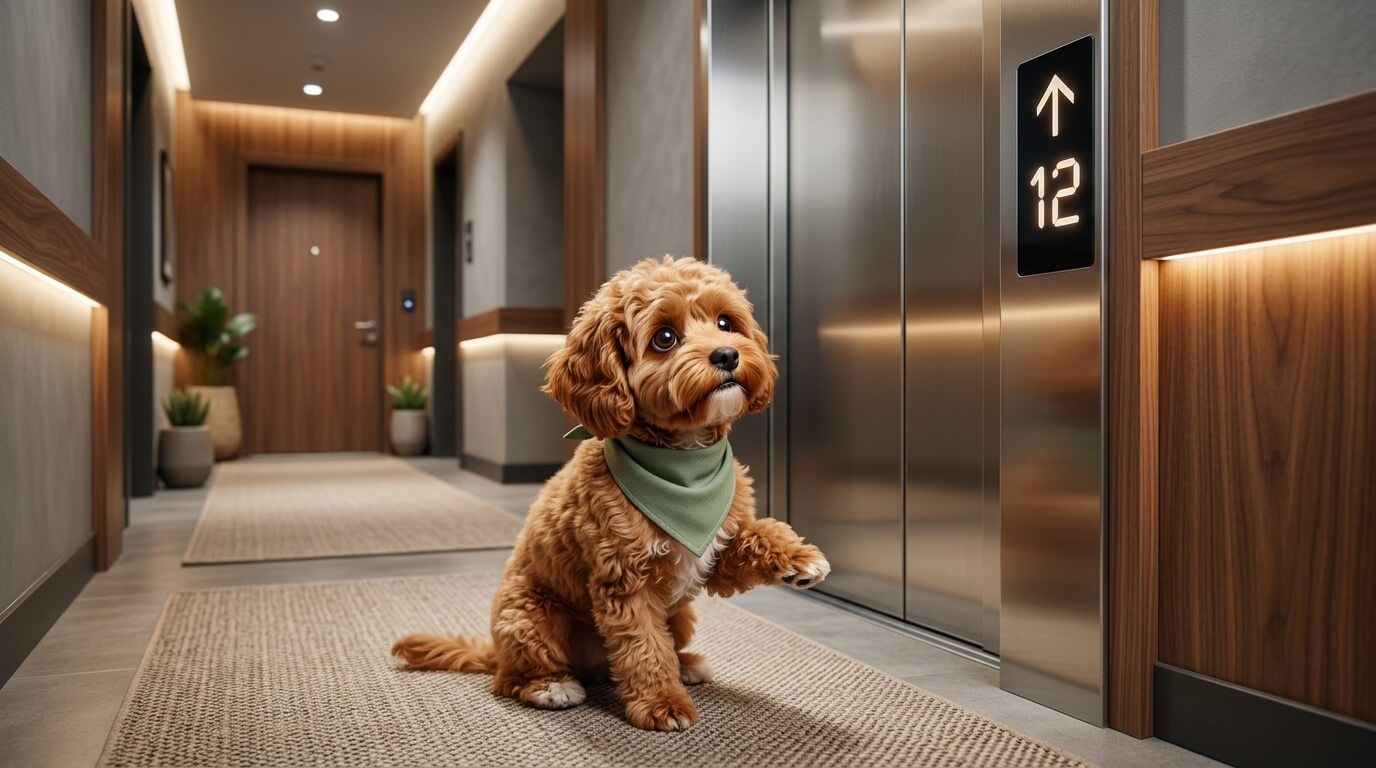
If you are trying to learn how to potty train a dog in an apartment, the hard part is usually not the dog. It is the distance between your living room and the right potty spot. A puppy in a house may only need to reach the back door. An apartment dog may need a leash, keys, hallway manners, an elevator, a lobby, a sidewalk, bad weather, and enough bladder control to survive the whole trip.
That is why apartment potty training needs a slightly different plan. You are not just teaching your dog where to go. You are teaching a complete routine: notice the urge, move calmly to the door, wait through apartment delays, potty outside or on an approved backup spot, and return home without turning every trip into a chaotic walk.
The good news is that apartment potty training can work very well when the routine is simple, consistent, and realistic. This guide focuses on the full training process, not on ranking indoor potty products. If you need a product comparison later, use an indoor potty guide as a support tool, not as the main training plan.
How to Potty Train a Dog in an Apartment: Quick Answer
The best way to potty train a dog in an apartment is to use a strict schedule, supervise closely indoors, reward the exact potty moment, clean accidents with an enzymatic cleaner, and build a backup plan for elevator delays, storms, illness, and workdays. Puppies often need trips after waking, eating, playing, training, and napping. Adult dogs may need fewer trips, but they still need a predictable route and fast rewards.
For most apartment homes, the practical rule is this: prevent mistakes first, reward the correct spot heavily, and do not ask your dog to hold it longer than their age, health, and building layout allow.
Table of Contents
Before Day One: Time the Route Once
Before you decide your dog is being difficult, time the actual potty route. Start at the spot where your dog usually wakes up or plays. Add the leash, keys, door, hallway, elevator or stairs, lobby, front door, and the walk to the approved potty area. In some buildings, that route is not thirty seconds. It is three to six minutes on a normal day and longer when the elevator is busy.
That timing changes the plan. A very young puppy, a newly adopted adult dog, or a senior dog may not have enough control to wait through the full route once the urge has already started. The solution is not scolding. It is taking the dog earlier, carrying a puppy when needed, using a temporary backup if the building truly requires it, and rewarding the correct spot the moment it happens.
This is the part many apartment owners miss: house training is not only about where the dog pees. It is about whether the human routine gets the dog to the right place soon enough.
Apartment Potty Training Is Different
Apartment owners face a few problems that house owners may barely notice. The potty area is farther away. The route may include neighbors, dogs, delivery carts, children, stairs, elevators, traffic noise, wet floors, and locked doors. If your dog is nervous or easily distracted, the trip itself can become more exciting than the potty goal.
This matters because potty training is partly about timing. When a dog has to go, every extra minute increases the chance of an accident. A puppy who could have made it to a patio in 20 seconds may not make it through a five-minute elevator wait. An older rescue dog may understand outdoor potty habits but still struggle with the new building routine.
So the apartment version of potty training has three jobs:
- Reduce the number of unsupervised chances to make mistakes indoors.
- Make the correct potty location easier to reach and easier to understand.
- Build enough repetition that your dog can follow the routine even when the building is busy.
The 7 Proven Safe Steps
Use these steps in order. Skipping ahead usually creates confusion, especially if you are mixing outdoor potty trips with pee pads, grass pads, or balcony backups.
1. Pick One Main Potty Goal
Before you start, decide what success means in your apartment. For many owners, the main goal is outdoor potty only. For others, especially in high-rises, harsh weather, very young puppies, senior dogs, or mobility-limited households, the main goal may be outdoor potty plus an indoor emergency backup.
The key is to avoid sending three different messages at the same time. If your dog is sometimes rewarded for the hallway, sometimes for the balcony, sometimes for a pad in the kitchen, and sometimes for a patch of grass outside, the pattern becomes muddy. Choose one primary target and one backup target if you truly need one.
| Living Situation | Best Main Goal | Backup Option |
|---|---|---|
| Ground-floor apartment | Outdoor potty spot | None, or emergency pad during illness |
| High-rise with slow elevator | Outdoor potty spot | Indoor grass patch for urgent moments |
| Very young puppy | Outdoor potty as the long-term goal | Pad or grass tray during early weeks |
| Senior dog or medical issue | Vet-guided routine | Easy-access indoor potty station |
If your dog suddenly starts having accidents after being reliable, treat it differently from a normal training problem. Pain, urinary issues, digestive upset, medication changes, anxiety, or age-related changes can all affect potty habits. In that case, talk with your veterinarian and read your adult dog potty training regression guide before assuming your dog is being stubborn.
2. Set Up the Apartment Before the First Training Day
Potty training goes better when the apartment is arranged to prevent mistakes. Do this before you begin the schedule.
- Choose the door you will always use for potty trips.
- Keep leash, harness, poop bags, treats, and keys in one station near that door.
- Block bedrooms, rugs, closets, and quiet corners when you cannot supervise.
- Use a crate, pen, tether, or gated area for short supervised management periods.
- Remove or wash old accident spots so they do not keep smelling like a bathroom to your dog.
A small apartment can actually help if you manage it correctly. You can see your dog more easily, reach the door faster, and notice early signs like circling, sniffing, pacing, sudden wandering, or leaving the room. The problem begins when the dog has too much freedom before the habit is reliable.
If your apartment has valuable rugs, fabric furniture, low shelves, or tempting corners, combine this plan with basic renter protection from your dog proof rental apartment guide. Potty training is much less stressful when the home is set up to reduce expensive mistakes.
3. Build a Schedule Around Real Bladder Limits
A schedule is the heart of how to potty train a dog in an apartment because it removes guesswork. You do not want to wait until your dog is desperate. You want to take your dog out before the mistake happens.
Start with these common trigger times:
- Immediately after waking up in the morning.
- After naps.
- After meals.
- After drinking a lot of water.
- After active play or zoomies.
- After crate or pen time.
- Before you leave home.
- As soon as you return home.
- Right before bed.
For puppies, start more often than you think you need. A common early rhythm is every 45 to 90 minutes when the puppy is awake, plus every trigger time above. Some puppies can hold longer; some cannot. The schedule should fit the dog in front of you, not an internet chart.
Adult dogs usually have more control, but a newly adopted adult dog still needs a strict routine for the first several weeks. New smells, new flooring, a new elevator, new feeding times, and stress can temporarily break old habits.
4. Make the Elevator and Hallway Part of the Training Plan
Apartment potty training often fails in the hallway, not in the living room. The dog is already full, excited, or anxious, and then the route takes too long. Your job is to make the exit routine boring, fast, and predictable.
Keep the first part of the trip quiet. Clip the leash, walk to the door, go down the hallway, wait for the elevator, and head to the potty area without play, greeting, or sniffing every corner. You can be warm without turning the trip into a party.
If your dog is tiny, very young, or already showing signs of an imminent accident, carry them through the hallway and elevator until they have better control. This is not a forever habit. It is a prevention tool. Once your dog can reliably make it outside, transition to walking the route.
For dogs who freeze, bark, or get overstimulated in shared areas, practice short non-potty hallway sessions when the dog does not urgently need to go. Walk to the elevator, reward calm behavior, and return home. This separates building confidence from bladder pressure.
5. Reward the Exact Potty Moment
Many owners reward too late. They wait until the dog comes back inside, then give a treat in the kitchen. From the dog’s point of view, that reward may be connected to entering the apartment, not pottying outside.
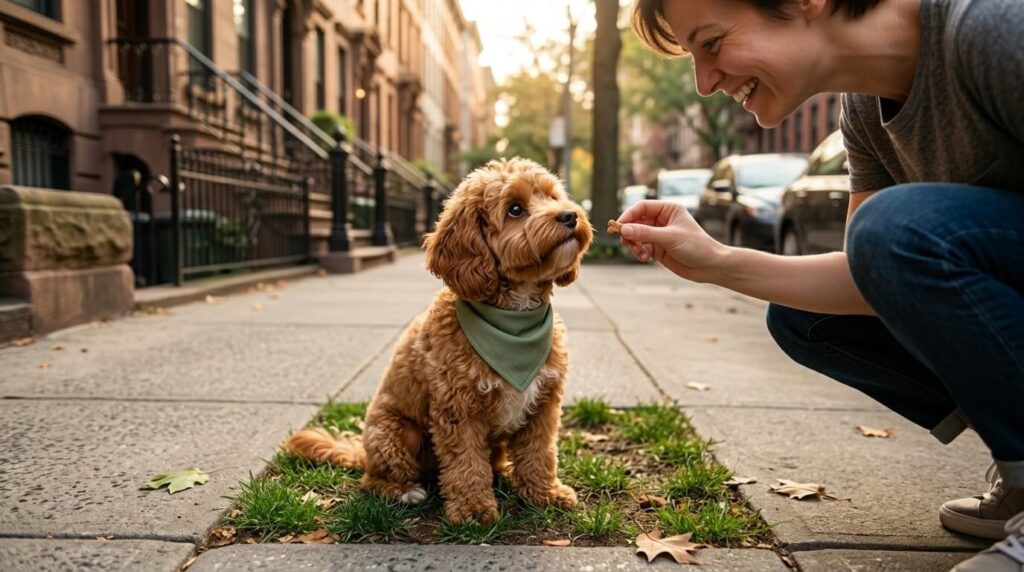
Bring small treats with you and reward immediately after your dog finishes. Use a simple phrase like “go potty” while your dog is sniffing or preparing, then quietly praise and treat when the potty is complete. The timing matters more than the speech.
After the reward, give your dog a short sniff break if it is safe. This teaches an important lesson: potty first, then explore. If the walk always ends the second your dog goes, some dogs learn to delay pottying so the outside time lasts longer.
6. Handle Accidents Without Drama
Accidents are information. They usually mean the schedule was too loose, supervision failed, the route took too long, the dog was confused, or a health issue needs attention. Punishment does not teach a clear bathroom plan. It often teaches the dog to hide accidents.
If you catch your dog starting to potty indoors, interrupt calmly with a neutral sound, pick up or guide the dog to the correct spot, and reward if they finish there. If you find the accident later, clean it and adjust the plan. Your dog will not connect punishment with an accident that happened minutes or hours earlier.
Use an enzymatic cleaner made for pet accidents. Regular household cleaners may remove the visible stain while leaving odor cues your dog can still detect. Avoid ammonia-heavy products on urine spots because the smell can be confusingly similar to urine.
7. Reduce Help Slowly
Do not relax the plan after two good days. Apartment potty training needs enough repetition to become automatic. Once your dog has had one clean week, you can slowly increase freedom, stretch intervals, or reduce the emergency backup.
Change only one thing at a time. For example, do not extend the schedule, remove the pen, move the pad, and start leaving the dog alone for longer hours in the same week. If accidents return, go back to the last successful step for several days.
Sample Apartment Potty Schedule
Use this as a starting point, then adjust based on age, meals, sleep, and your building layout.
| Time | Action | Apartment Note |
|---|---|---|
| Wake-up | Immediate potty trip | Carry young puppies if the elevator is slow |
| After breakfast | Potty trip within 5 to 20 minutes | Keep leash ready before feeding |
| Mid-morning | Scheduled trip or supervised check | Short and boring if you are working from home |
| After nap or play | Immediate trip | Zoomies often trigger urgency |
| After dinner | Potty trip and calm walk | Reward potty before exploring |
| Before bed | Final quiet potty trip | Use the same door and route every night |
If your dog is also being left alone during the workday, connect the potty plan with your alone-time routine. The guide on how long you can leave a dog alone in an apartment can help you decide whether you need a midday dog walker, neighbor help, daycare, or a temporary indoor backup.
Should You Use Pee Pads or Indoor Grass?
Pee pads and indoor grass can be useful, but they should not be used casually. They solve one apartment problem while creating another: your dog may learn that pottying indoors is sometimes correct.
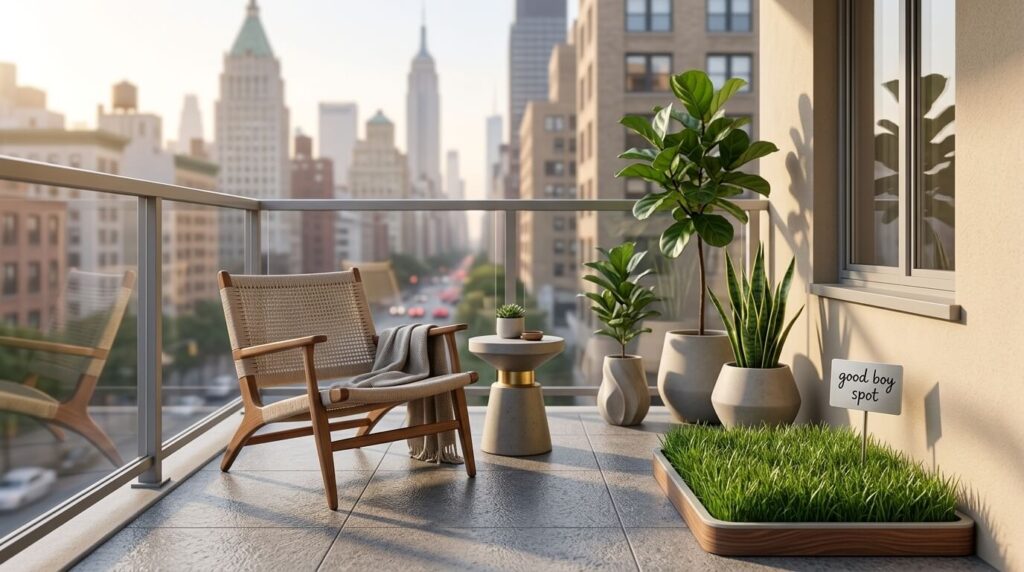
Use an indoor backup when it genuinely protects the dog and the apartment. Examples include a young puppy who cannot safely access outdoor areas yet, a high-rise where elevator delays are long, a senior dog with limited mobility, a storm or snow emergency, or a medical situation your veterinarian is helping you manage.
If your long-term goal is outdoor potty, place the backup spot near the exit path rather than deep inside the apartment. Reward the backup only when needed, and continue rewarding outdoor potty as the main success. Once your dog can reliably make outdoor trips, fade the backup gradually.
For product decisions, keep the training plan first. If you need to compare pads, grass patches, litter boxes, trays, or balcony-style setups, use best indoor dog potty solutions after you know what problem the backup potty area is supposed to solve.
High-Rise Potty Training Tips
High-rise apartments need extra planning because the elevator is unpredictable. A good routine can still work, but you need to build in time.
- Take your dog out earlier than a ground-floor owner would.
- Carry young puppies through the elevator phase if needed.
- Keep a small treat pouch and waste bags by the door at all times.
- Use the same outdoor spot at first so your dog recognizes the goal quickly.
- Avoid letting every neighbor greeting interrupt urgent potty trips.
- Have a backup plan for elevator outages or extreme weather.
If your dog is nervous in elevators, pair elevator practice with calm rewards outside urgent potty times. Do not wait until your dog is desperate to practice scary building skills.
Potty Training a Rescue or Adult Dog in an Apartment
Adult dogs can learn apartment potty habits, but the plan should be respectful of their history. A rescue dog may have lived in a house, shelter, kennel, foster home, yard, or another apartment with different rules. Some adult dogs were punished for accidents and may hide when they need to go.
For the first two weeks, treat the dog as untrained in this specific home. That does not mean the dog knows nothing. It means the dog does not yet know your door, your elevator, your schedule, your surface rules, or your reward system.
Use the same prevention plan: limited freedom, frequent trips, immediate rewards, careful cleaning, and a written log. If the dog has accidents only when alone, when startled, or when you leave, consider whether separation distress, fear, or medical issues are involved. Potty training should be practical, not blame-based.
What to Track for 7 Days
A simple log can show patterns faster than memory. Track these items for one week:
- Meal times.
- Water changes or heavy drinking.
- Nap and wake times.
- Outdoor potty times.
- Accident times and locations.
- Whether the accident was pee, poop, or both.
- What happened in the 30 minutes before the accident.
Patterns will usually appear. Maybe accidents happen after evening play. Maybe the dog cannot make it from wake-up to elevator. Maybe the lunch trip is too late. Maybe the living room rug is the repeated target. Once you see the pattern, you can fix the schedule instead of guessing.
If the Plan Works for Two Days and Then Falls Apart
Do not panic. This is common in apartments. A dog may do well on quiet weekdays and then struggle when Saturday brings guests, laundry trips, delivery noise, rain, or longer elevator waits. Look for the one variable that changed before you decide the whole plan failed.
| What Changed | What It May Mean | What to Try First |
|---|---|---|
| Accidents after play | Play triggered urgency | Take a potty trip immediately after active indoor games |
| Accidents near the door | The dog understood the goal but could not wait | Leave earlier and keep the leash station ready |
| Accidents only when alone | The window may be too long, or stress may be involved | Shorten absences and review alone-time behavior |
| Accidents on one rug | Odor or surface preference may be pulling the dog back | Remove access temporarily and clean with an enzymatic cleaner |
| Sudden frequent accidents | Health may be part of the problem | Call your veterinarian before treating it as training |
Keep the tone calm. Dogs do not learn faster because the apartment feels urgent to us. They learn faster when the pattern is easy to repeat and the reward is clear.
Common Apartment Potty Training Mistakes
Mistake 1: Giving Full Freedom Too Early
A dog who is still learning should not have unsupervised access to the whole apartment. Freedom is earned through reliability. Use baby gates, a pen, a crate, or a leash tether when you cannot watch closely.
Mistake 2: Rewarding After You Get Back Inside
Reward at the potty spot, immediately after the correct behavior. Late rewards are one of the easiest ways to make training slower.
Mistake 3: Moving Pads Around the Apartment
If you use a pad or grass tray, keep the location consistent. Moving it from bathroom to kitchen to balcony can confuse the dog and create new accident zones.
Mistake 4: Cleaning With the Wrong Product
Use enzymatic cleaner and follow the label directions. Quick surface cleaning may not remove odor cues well enough for a dog’s nose.
Mistake 5: Waiting for the Dog to Ask
Some dogs do not naturally bark, scratch, or ring a bell when they need to go. Teach the schedule first. Door signals can come later.
Mistake 6: Ignoring Health Changes
Frequent urination, straining, blood, diarrhea, sudden accidents, pain, excessive thirst, or major behavior changes are not ordinary training problems. Call your veterinarian.
When to Call a Vet or Trainer
Call your veterinarian if accidents start suddenly, your dog seems painful, urine frequency changes, stool quality changes, your puppy cannot hold it at all, or your senior dog is declining. Medical problems can look like training problems from the outside.
Call a qualified trainer or behavior professional if your dog is fearful in the hallway, panics in the elevator, hides to eliminate, guards accident areas, or cannot settle enough to complete the routine. Apartment potty training sometimes overlaps with anxiety, noise sensitivity, and building stress.
Veterinary house-training resources consistently separate ordinary training mistakes from medical or behavior changes. Training should not replace medical care when symptoms point beyond ordinary house training.
FAQ
How long does it take to potty train a dog in an apartment?
Some dogs improve in one to two weeks, but many need several weeks of consistent apartment routines. Puppies, rescues, high-rise dogs, anxious dogs, and dogs with medical issues may need longer. A clean week is progress, not the finish line.
What is the first step in how to potty train a dog in an apartment?
The first step is choosing one main potty goal and setting up the apartment to prevent mistakes. Put leash, treats, keys, and bags by the exit door, limit unsupervised freedom, and start a strict schedule around wake-ups, meals, play, naps, and bedtime.
Should I use pee pads in an apartment?
Use pee pads only when they solve a real access problem, such as a very young puppy, high-rise delays, bad weather, senior mobility issues, or medical needs. If your goal is outdoor potty, do not let pads become the main habit by accident.
Should I carry my puppy outside?
Yes, carrying can help young puppies make it through hallways and elevators before they have enough control. As your puppy becomes reliable, transition toward walking the route calmly.
How do I stop my dog from peeing on the same rug?
Block access to the rug, clean it with an enzymatic cleaner, increase supervision, and take your dog out before the usual accident time. If the rug has repeated accidents, remove it temporarily during training.
Can an older dog learn apartment potty training?
Yes. Adult and senior dogs can learn new apartment routines, but sudden accidents should be checked medically. Older dogs may also need easier access, more frequent trips, or an indoor backup.
Should I punish my dog for accidents?
No. Punishment can make dogs hide accidents and become nervous around potty routines. Calm interruption, better supervision, faster trips, correct rewards, and proper cleaning are more useful.
Next Step
For the next seven days, follow one schedule, track every accident, and change only one variable at a time. That simple discipline is usually what turns apartment potty training from a frustrating guessing game into a routine your dog can understand.
If your dog has one clean week, do not celebrate by removing every support at once. Keep the same exit door, the same reward timing, and the same cleaning plan while you slowly add more freedom. Apartment potty training usually fails when people change four things after two good days. Let the habit become boring before you loosen the routine.