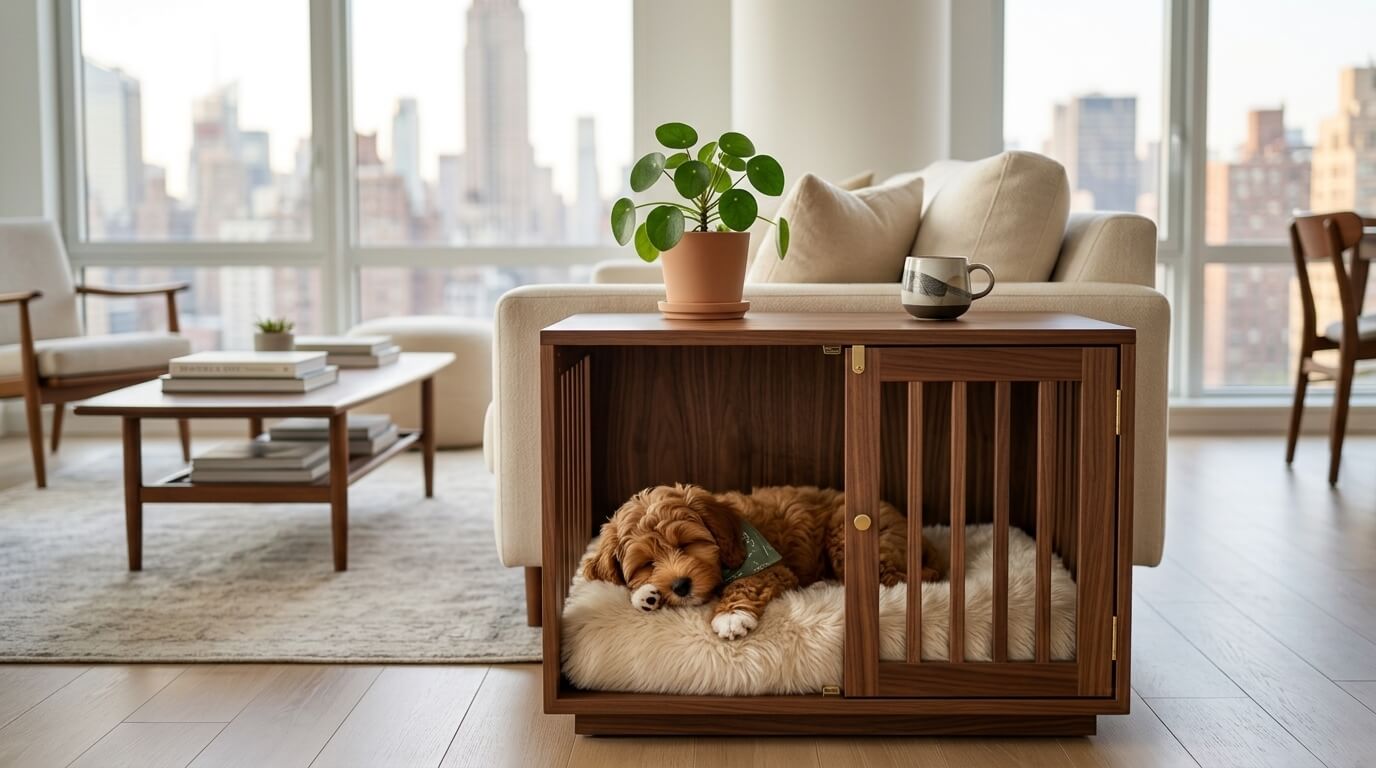
The best dog crates for apartments have to fit two bodies: your dog’s body and your apartment’s floor plan. A crate can be correctly sized for a dog yet still block a walkway, collide with a desk chair, rattle against a shared wall, or become impossible to store when guests arrive.
This guide compares five specific crates using manufacturer-published specifications. The products cover folding wire, modern steel, collapsible plastic, furniture-style, and hard-sided plastic designs. ApartmentDogExpert did not personally test these models, and this is not a laboratory ranking. Manufacturer facts are labeled as specifications; comments about room fit, visual bulk, placement, and renter use are editorial assessments.
If your dog is not comfortable entering and resting in a crate, product selection is only the first step. Use the crate training for apartment dogs guide for the gradual training process.
Quick Answer
For flexible apartment placement, the MidWest iCrate® — Double Door style combines two doors, a removable pan, rubber feet, and flat folding. The Diggs Evolv publishes unusually complete interior, exterior, and product-weight data and offers two configurable doors, but it does not fold flat. The KindTail PAWD is collapsible and sized for small dogs, but its current product page does not specify folded dimensions or product weight. The Fable Signature Crate works as permanent furniture but is heavy, nonfolding, final sale, and subject to important window-size safety limits. The Petmate Vari Kennel offers a contained plastic shell, a single front door, published size ranges, and easier wipe-down surfaces, but it occupies its full footprint unless disassembled.
Start by measuring your dog. Then tape each candidate’s exterior footprint on the floor and test the door swing, walking path, air vents, nearby furniture, and distance from shared walls.
Comparison at a Glance
| Product | Crate type | Footprint example | Doors | Foldable? | Tray / floor | Best apartment use case* |
|---|---|---|---|---|---|---|
| MidWest iCrate® Dog Crate — Double Door style | Folding wire | 29.6 × 18.59 in for 30-in size | Two | Yes | Removable plastic pan | Flexible placement and storage on a practical budget |
| Diggs Evolv Dog Crate | Modern steel | 31.7 × 21.4 in for Medium | Two | No; no-tool assembly | Removable tray | A permanent crate needing two-door access and published fit data |
| KindTail PAWD® Modern Collapsible Dog Crate | Collapsible plastic | 26 × 20 in for Medium | One | Yes; folded dimensions not specified | Not specified | Small dogs where collapsibility and a compact assembled footprint matter |
| Fable Signature Crate | Furniture-style bentwood | 26 × 20 in for Small | One sliding gate | No | Not specified | Calm, suitable dogs when the crate must remain visible as furniture |
| Petmate All Purpose Kennel – Vari | Hard-sided plastic | 32 × 22.5 in for 32-in size | One | No | Molded interior moat | Contained hard-sided setup and occasional transport |
*Best apartment use case is an editorial assessment based on the specifications below.
How These Crates Were Selected
Each product had to have an official manufacturer page with enough information to check its identity, basic construction, dimensions, door design, and apartment-relevant features. Products were not included merely because they were popular at a retailer.
The comparison uses eight apartment criteria:
- Dog fit: usable interior space and manufacturer sizing guidance.
- Floor footprint: the exterior length and width that occupy the room.
- Door access: whether the door can open without blocking furniture or a walkway.
- Storage: whether the crate folds, collapses, or must remain assembled.
- Cleaning: removable pan, molded floor, or surface-care instructions.
- Portability: published product weight, handles, and whether the structure packs down.
- Renter fit: floor contact, moisture containment, and ease of moving.
- Shared-wall reality: materials and loose parts that may require a mat or careful setup to limit rattling.
No product receives a made-up score. The right choice depends on the dog’s measurements, behavior, and comfort with confinement as well as the apartment layout.
Measure the Dog and the Apartment First
A crate should allow the dog to stand, turn around, and lie down naturally. Measure the dog’s standing height and the length from nose to the base of the tail, then follow the manufacturer’s instructions. Weight ranges can help narrow the list, but two dogs of the same weight may have different body proportions.
Next, measure the room rather than trusting the word “compact.” Use painter’s tape to mark the product’s exterior length and width on the floor. Check:
- the crate door in its fully open position;
- the path from the front door to the main room;
- closet, balcony, and bathroom doors;
- desk-chair movement;
- heating and cooling vents;
- direct sun and drafts;
- the closest shared wall; and
- space needed to remove a tray or clean around the crate.
A 30-inch crate is not simply 30 inches of floor. The door, human access, and cleaning clearance are part of its practical footprint.
1. MidWest iCrate® Dog Crate — Double Door style
Why It May Fit an Apartment
The iCrate is the most conventional option in this group, but its two-door configuration solves a real small-space problem. If a front door would open into a walkway, the side door may let you rotate the crate against a wall or beside a sofa. MidWest offers seven double-door sizes, from a 17.86 × 11.7-inch footprint to a 47.76 × 29.6-inch footprint.
Key Manufacturer Specifications
MidWest lists a metal wire frame, double-door availability, slide-bolt latches, a divider panel, rubber feet, and a removable leak-proof plastic pan. The crate folds flat and includes a carrying handle intended for use while folded. The manufacturer does not publish folded dimensions or product weights on the reviewed product materials, so both are Not specified. MidWest continues to list the product, sizes, and both door styles, while purchase links are routed through retail channels; this article does not claim direct manufacturer stock.
The current 30-inch double-door version measures 29.6 × 18.59 × 21.5 inches externally. The current 36-inch version measures 35.6 × 21.9 × 24.5 inches. Check the full size table before ordering; the nominal size in the product name is not the complete footprint.
Storage, Cleaning, and Placement Notes
Flat folding makes this suitable for renters who may store the crate after the dog has progressed or move it between apartments. The removable pan should simplify routine cleanup, and the rubber feet are relevant on rental floors. Leave enough clearance to pull out the pan.
Wire doors, a pan, and a divider can create movement noise. MidWest’s instructions suggest material beneath the pan to reduce noise. Editorially, a stable non-slip mat under the entire crate may also help protect the floor, but it must not block ventilation or create a chew hazard.
Limitations
The open wire frame has more visual bulk than a furniture crate and may transmit hallway activity to a noise-sensitive dog. Product weight and folded height are not published in the reviewed manufacturer specifications. A folding handle does not mean an assembled crate should be lifted with the dog inside.
2. Diggs Evolv Dog Crate
Why It May Fit an Apartment
The Evolv is useful when the crate will stay assembled and two-door access matters. Diggs publishes both interior and exterior dimensions for five sizes, which makes it easier to compare dog fit with room fit before buying. Its configurable door orientation may help beside a bed, sofa, or desk where only one side can remain clear.
Key Manufacturer Specifications
Diggs lists a reinforced steel frame, nylon-coated steel wire, diamond-shaped mesh, rounded edges, two doors, dual locks, a removable tray, and no-tool assembly. The Medium measures 31.7 × 21.4 × 22.2 inches externally and 29.1 × 18.8 × 20.4 inches internally; it weighs 29 pounds. The Small weighs 24 pounds, while the Extra Large reaches 53 pounds.
The manufacturer lists collapsed dimensions as N/A. This is therefore a stationary or disassembled storage choice, not a flat-fold crate. Current availability is size-dependent: the selected variant may display in stock while the manufacturer banner identifies some Medium and Large variants as preorder or shipping soon. Do not describe every size as in stock.
Storage, Cleaning, and Placement Notes
The removable tray and open mesh should make routine access straightforward. Two doors provide more layout choices, but they also require deciding which opening will remain usable. Do not pay for placement flexibility and then block both doors with furniture.
The steel construction and published weights mean larger sizes may be inconvenient to move alone. In a small room, compare the exterior width carefully: the Large is 30.5 inches wide and the Extra Large is 32.4 inches wide.
Limitations
It does not fold for closet storage. A steel crate can still transmit impact or hardware noise; the manufacturer does not publish comparable sound levels, so this draft makes no quietness ranking. The puppy divider is sold separately. Manufacturer weight limits remain approximate, and body measurements still control fit.
3. KindTail PAWD® Modern Collapsible Dog Crate
Why It May Fit an Apartment
The PAWD is the collapsible plastic option in this shortlist. KindTail currently publishes compact assembled dimensions and says the crate folds flat in seconds, but it does not specify folded dimensions or product weight. It may suit a renter who needs a small-dog crate that can collapse for storage, provided the owner measures the intended storage space rather than assuming it will fit under furniture.
Key Manufacturer Specifications
The Small measures 21 × 15.75 × 16 inches. The Medium measures 26 × 20 × 21 inches. Current folded dimensions and product weights are Not specified. KindTail lists ABS plastic for Small and polypropylene for Medium, described by the manufacturer as BPA- and toxin-free.
The crate has one smart-latch door that can attach to the side while open. A separate floor pan or removable tray is Not specified. Interior dimensions are also Not specified.
Storage, Cleaning, and Placement Notes
The collapsible construction supports occasional storage, but the current page does not publish folded dimensions. Measure the real folded crate before planning under-bed, closet, or behind-furniture storage.
The single front door reduces placement flexibility compared with a double-door crate. Tape both the 26 × 20-inch Medium footprint and the open-door area on the floor. Because no removable tray is specified, confirm how the molded floor will be accessed and cleaned in the intended location.
Limitations
The available sizes serve small dogs. The current product selector labels Small for dogs up to 12 pounds and Medium for dogs up to 25 pounds, while the manufacturer warns that proportions matter. A tall, light dog may not fit. This option should not be stretched into a medium- or large-dog recommendation merely because the collapsed design suits the apartment.
4. Fable Signature Crate
Why It May Fit an Apartment
The Fable Signature Crate is designed to remain visible and double as a side table. That can improve space efficiency when an apartment cannot dedicate floor area to both a crate and a separate table. Its sliding gate can be stored within the unit rather than swinging into the room.
Key Manufacturer Specifications
Fable lists a bentwood body with a metal or clear acrylic gate. The Small measures approximately 26 × 20 × 23 inches externally and 24.5 × 18 × 20.5 inches internally. Medium is 34 × 24 × 25 inches externally, and Large is 42 × 29.5 × 34.4 inches. Dimensions may vary by about one inch because the product is handmade.
The manufacturer states that the top can support up to 300 pounds. That is a manufacturer specification, not permission to overload the surrounding floor or place unsafe objects above a dog. Product weight is Not specified; published box weights are shipping information and should not be presented as crate weights. The crate does not fold. Availability is variant-dependent: some size, gate, and finish combinations are marked in stock and others backordered. Because the current page carries an outdated seasonal shipping phrase, this article does not state a delivery date; readers should check the selected variant’s current shipping status.
Storage, Cleaning, and Placement Notes
This is a permanent furniture decision. Measure it as both a crate and a table, including access to the sliding gate and enough surrounding airflow. Fable recommends a clean damp cloth for routine care and an animal-safe wood cleaner for more serious messes. No removable tray is specified, so it may be less convenient for dogs with frequent accidents.
Limitations and Safety Boundaries
Fable states that the crate is not escape-proof, is not intended for travel, and may be unsuitable for destructive chewers. The manufacturer also gives a specific warning about the relationship between a dog’s head size and the crate’s ventilation-window size. Read that current warning for the exact size under consideration. The crate is final sale, making careful measurement especially important.
5. Petmate All Purpose Kennel – Vari
Why It May Fit an Apartment
The Vari Kennel offers a hard-sided shell with one front door and a molded interior moat. It may suit owners who prefer a more contained surface around shedding, damp paws, or minor spills. Smaller sizes include a carrying handle, so the same kennel may serve at home and for appropriate ground transport or vet trips.
Key Manufacturer Specifications
Petmate lists EcoTEC plastic containing at least 90 percent pre-consumer recycled plastic, a metal front door with an easy-open squeeze latch, side and rear ventilation, spiral wing nuts and bolts, and tool-free assembly. The 32-inch size measures 32 × 22.5 × 24 inches externally, 29.5 × 19.75 × 23.5 inches internally, weighs 16 pounds, and carries a 30–50-pound manufacturer range.
Sizes run from 19 to 40 inches. For the 19-inch model, the assembled exterior footprint is Not specified / manufacturer page inconsistent because the current exterior-height field conflicts with the published interior height. The 24- through 40-inch versions have published interior and exterior measurements and product weights. Folded dimensions are not applicable; it does not fold, although the two-piece shell can be disassembled.
Storage, Cleaning, and Placement Notes
The smooth plastic shell and interior moat may simplify wipe-down cleaning compared with a wood surface or open wire floor. There is no separate slide-out tray. Cleaning therefore requires reaching through the front opening or disassembling the shell when appropriate.
The opaque lower shell and more enclosed sides reduce visual exposure, which some dogs may prefer, but this is an editorial observation rather than a promise of calmer behavior. A single front door means the crate needs a clear approach path. The 32-, 36-, and 40-inch models use tie-down holes rather than the carrying handle found on smaller sizes.
Limitations
The kennel keeps its full footprint when assembled and offers less door-orientation flexibility. Petmate says it meets most air-travel requirements but instructs owners to check with the airline. This article does not present it as universally airline approved. Home use and travel approval are separate decisions.
Footprint, Door Layout, and Storage Compared
Apartment space is three-dimensional, but the floor plan usually fails first. Compare the exterior length and width for the exact size your dog needs. A product is not space efficient simply because its marketing calls it modern.
- Choose a two-door model when rotating the crate could keep an opening out of a walkway.
- Choose a genuinely collapsible model when the crate must be stored regularly.
- Choose a furniture crate only when it can remain in one place and the dog meets its behavior and safety limits.
- Choose a hard-sided kennel when a contained shell matters more than flat storage.
- Measure cleaning access. A removable pan needs withdrawal space; a fixed floor needs reachable surfaces.
Visual bulk also matters in a studio. Wire crates expose the room through the frame but create a grid across the sightline. Furniture crates look more like household objects but remain physically large. Plastic crates can feel visually solid. These are layout observations, not measurements of how a dog will feel.
Where to Put a Dog Crate in an Apartment
Good locations often include a quiet bedroom corner, a calm living-room wall, or a home-office zone away from the main walking path. Avoid blocking exits, closets, balcony doors, air vents, and access to utilities. Keep the crate away from direct sun, strong drafts, cooking heat, and any wall where elevator or hallway noise repeatedly triggers the dog.
Test placement with tape before ordering. Mark the exterior footprint, open the imaginary door, and walk through the room carrying laundry or groceries. If the setup works only when everyone turns sideways, it is not a workable apartment placement.
Do not isolate a dog solely to hide the crate. Early training often works better near normal household activity, followed by gradual testing of quieter locations. Placement cannot fix confinement panic.
Shared-Wall Noise and Floor Protection
No manufacturer in this shortlist provides directly comparable decibel testing, so none can be ranked as the lowest-noise option. Instead, consider the likely noise paths:
- wire panels, divider panels, latches, and loose pans may rattle;
- hard plastic can transmit scratching or impact;
- a furniture crate may reduce metal-panel movement but can still carry sound through the floor or wall;
- hard toys can strike any crate surface; and
- a crate touching a shared wall can transmit vibration.
Place a stable, washable, non-slip mat beneath the crate if it does not create a chewing or ventilation hazard. Confirm that the tray sits flat, secure loose dividers, and move the crate away from a shared bedroom wall when possible. Repeated slamming, frantic scratching, or escape attempts are behavior and welfare signals, not hardware noise to suppress.
When a Crate Is Not the Right Tool
A stronger or more expensive crate is not a treatment for panic. Stop and reassess if the dog persistently pants, drools, paces, eliminates despite fair potty access, vocalizes excessively, injures themselves, or repeatedly attempts to escape. Review the signs of separation anxiety and seek qualified veterinary or behavior help when appropriate.
Some dogs do better with a pen, gated dog-safe room, or a gradual alone-time plan. A crate should not be used to stretch an unfair schedule. If workday duration is the problem, review how long a dog can be left alone in an apartment before buying different hardware.
Crate Training Is a Separate Process
Even a well-matched crate must be introduced gradually. Let the dog investigate voluntarily, build a positive association, practice brief door movement, and increase duration in small steps. Do not use cry-it-out as the default response to escalating distress. The complete process belongs in the dedicated crate-training guide rather than this product comparison.
Buying Checklist Before You Order
- Measure the dog’s standing height and body length.
- Use interior dimensions for dog fit and exterior dimensions for room fit.
- Treat manufacturer weight ranges as guidance, not a substitute for measurements.
- Tape the exact footprint on the floor.
- Include the open door and tray-removal path.
- Check whether one or two doors suit the location.
- Confirm whether “foldable” includes published folded dimensions.
- Check the actual product weight before planning frequent moves.
- Identify whether cleaning uses a removable pan, fixed molded floor, or furniture surface.
- Confirm current materials, included divider, warranty, return policy, and safety warnings on the manufacturer page.
- Do not assume a travel claim satisfies a specific airline’s current requirements.
- Choose for the dog’s current behavior, not only the room’s appearance.
FAQ
Which crate in this comparison stores in the smallest published space?
KindTail and MidWest both describe their crates as collapsible or flat-folding, but neither current product page publishes folded dimensions. Measure the actual folded unit before assigning under-bed or closet storage.
Which options provide two doors?
The MidWest iCrate® — Double Door style and Diggs Evolv provide two-door access. That may make placement easier beside furniture or in a narrow room. Door count does not determine whether the crate fits the dog safely.
Which crate works as furniture?
The Fable Signature Crate is designed as a crate and side table. It does not fold, product weight is not specified, it is final sale, and the manufacturer publishes behavior and window-size safety limitations that must be checked before purchase.
Which option is easiest to clean?
There is no comparable manufacturer test proving one is easiest. The iCrate and Evolv specify removable trays. The Petmate Vari Kennel has a molded plastic floor with an interior moat. Fable provides surface-cleaning instructions but does not specify a removable pan, and KindTail does not specify a separate tray on the reviewed product page.
Is any crate proven to make the least noise through shared walls?
No. The manufacturers do not provide comparable sound testing. Reduce preventable noise with stable placement, a suitable mat, a flat tray, secured panels, and quiet crate-safe enrichment. Treat persistent banging or escape behavior as a reason to reassess training and distress.
Can a furniture crate replace crate training?
No. Appearance does not create comfort. A dog still needs voluntary entry, positive associations, and gradual duration building. Dogs who chew, panic, or attempt to escape may need a different containment plan and professional guidance.
Evidence Note and References
Specifications were checked on manufacturer-controlled pages on 2026-09-13. Product dimensions, materials, availability, instructions, and sizing guidance can change. Recheck the exact size and variant before publication and again before purchase. Where a manufacturer did not publish a requested specification, this draft says Not specified rather than filling the gap from a retailer or assumption.