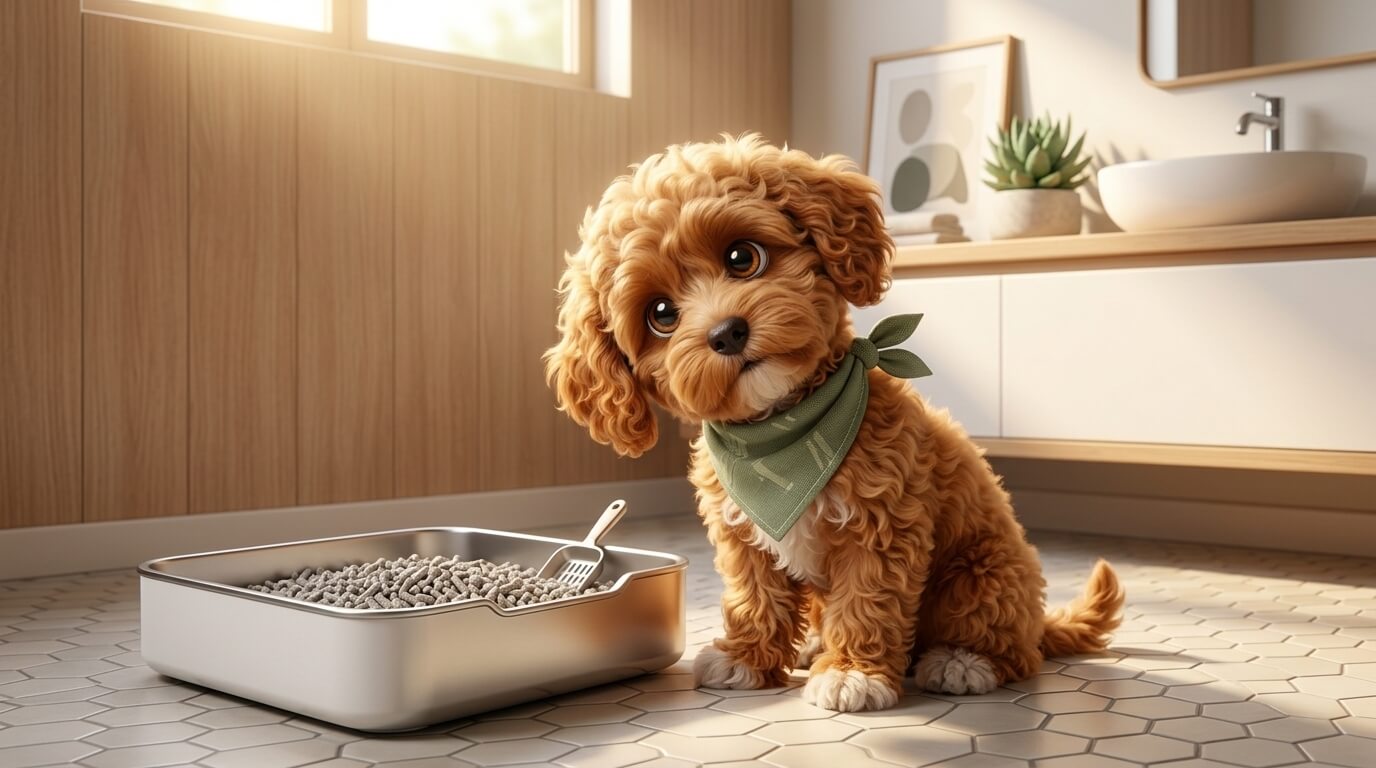
It was 2 AM on a Tuesday in February, and New York had decided to produce the specific kind of weather that makes you question every life decision that led to this moment. Freezing rain. The diagonal kind that defeats umbrellas entirely.
I was standing in my apartment hallway in a full winter coat, hood up, leash in hand, waiting for the elevator to take Ollie and me down 14 floors to the sidewalk, where he would sniff the same three square feet of wet concrete for four minutes before grudgingly doing his business.
My neighbor’s cat, meanwhile, was visible through her slightly open door, peacefully using her indoor litter box in a warm, dry apartment like a creature of sense and dignity. I pulled out my phone right there in the hallway and typed “litter box for dogs” with the desperate energy of someone who has run out of other options.

What I found that night sent me down a genuinely fascinating research spiral. Because the answer, it turns out, is neither a simple yes nor a simple no. It’s a “yes, but you need to understand some things first” — and those things are important enough that getting them wrong could actually harm your dog.
This is everything I learned, including what I eventually set up for Ollie and whether it actually worked.
Do You Need A Litter Box For Dogs? (Quick Answer)
Yes, a litter box for dogs actually works, particularly for small breeds under 20 pounds. However, you cannot use traditional clumping cat litter, which is toxic if ingested. Successful indoor dog potty systems use recycled paper pellets, real grass patches, or washable artificial turf paired with targeted training and a consistent elimination schedule.
The 2 AM Apartment Dream
Let me validate the fantasy before I complicate it, because the appeal of an indoor dog potty solution for apartment owners is completely legitimate and deserves to be taken seriously.
The reality of high-rise dog ownership includes things that house dog owners rarely think about:
- A single bathroom trip requires a minimum of 10–15 minutes from door to door, including elevator wait times, lobby navigation, and the return trip
- Late-night and early-morning elimination needs don’t disappear because the weather is dangerous or you’re sick
- Elderly dogs, puppies, and dogs with medical conditions may need to eliminate more frequently than outdoor-only access can comfortably support
- Emergency situations — a blizzard, a health episode, a building evacuation — can make outdoor access temporarily impossible
The concept of an indoor elimination option for dogs isn’t new or fringe. Working dog trainers, veterinary behaviorists, and apartment-focused dog care professionals have been recommending indoor potty solutions for small breeds for years. The question isn’t really whether it works conceptually — it’s whether it will work for your specific dog, and whether you can set it up safely and effectively.
Before we get to training and substrate options, though, there is one piece of information that is genuinely urgent and that I wish had appeared at the top of every search result I found that night.
Cat Litter vs. Dog Litter (The Toxic Truth)
When I first searched for indoor dog potty options, my brain immediately jumped to: “Can I just use a bigger litter box and normal cat litter?” It seemed logical. It is, unfortunately, potentially dangerous, and this is the myth-busting portion of this post.
Traditional clumping cat litter is not safe for dogs. The clumping mechanism in most clay-based cat litters relies on sodium bentonite — a swelling clay that can absorb up to 15 times its weight in liquid. If ingested, even in small quantities, it can cause serious gastrointestinal blockages in dogs. And dogs, unlike cats, do not have the instinctual burying behavior that keeps them from digging through, mouthing, or accidentally consuming litter material.
This brings us to a fundamental behavioral difference that explains why the cat litter box model doesn’t translate directly to dogs.
How Cats Eliminate vs. How Dogs Eliminate
Cats are instinctively driven to bury their waste. This behavior is rooted in a survival mechanism — wild felids bury their waste to mask their scent from predators and competing animals. Domestic cats retain this instinct strongly, which is why they consistently use litter boxes with minimal training and why they dig through the substrate before and after eliminating.
Dogs are completely different. Canine elimination behavior involves circling, sniffing, and position selection — but no burying instinct. Dogs are actually more concerned with scent marking than scent hiding. They eliminate in specific spots partly to communicate with other dogs, which is why a dog who has gone in one spot is significantly more likely to return to that same spot.
This behavioral difference has two practical implications:
- Dogs will dig in litter — not to bury, but out of general curiosity, substrate investigation, or because the texture is interesting. This increases ingestion risk significantly.
- Dogs can be trained to use a specific indoor spot using their own scent-return instinct, but the substrate doesn’t need to be something they can manipulate with their paws.
Some dogs might try to scratch the paper pellets out of the box in exactly this way, meaning you may have to simultaneously learn [how to stop a dog from digging the carpet][Internal Link to ID: 22] or flooring around the potty area — because the digging impulse doesn’t always stay contained to the box itself.
Cat litters that are dangerous for dogs include:
- ❌ Sodium bentonite clumping clay litter
- ❌ Scented litters containing essential oils (many are toxic to dogs, particularly tea tree)
- ❌ Crystal litters (silica gel) — ingestion risk and potential respiratory irritant
- ❌ Any litter containing deodorizing chemicals not specifically tested for canine safety
The 3 Best Indoor Potty Substrates
So if cat litter is out, what actually works? There are three options with meaningful track records, and each has a distinct set of advantages and trade-offs. The best choice depends on your dog’s size, your apartment layout, your tolerance for maintenance, and — critically — what substrate your dog takes to most naturally.
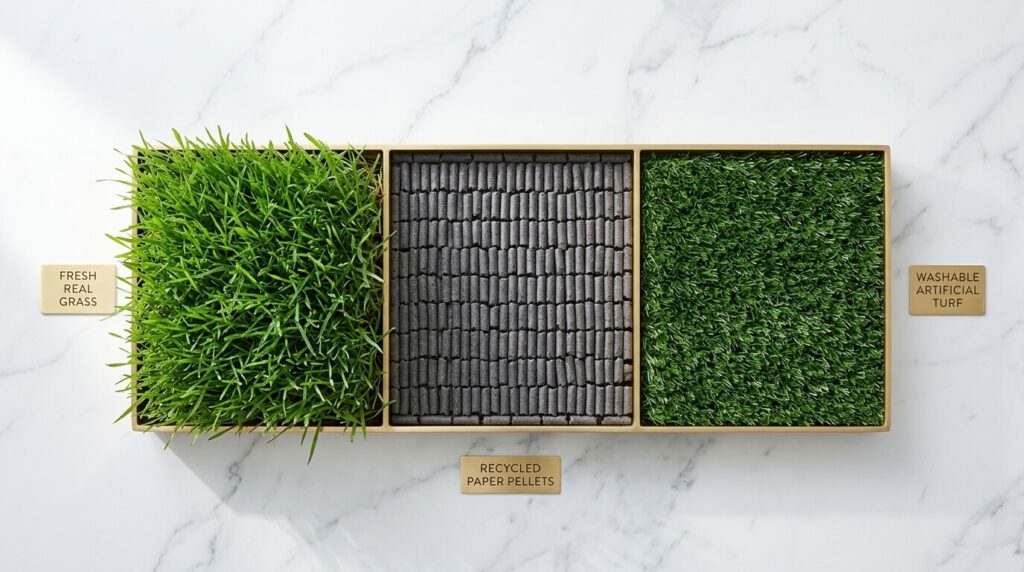
Option 1: Recycled Paper Pellets
What it is: Compressed recycled paper formed into small pellets — the same material used in many small animal beddings and some specialized dog litter products.
Why it works:
- Non-toxic if ingested in small amounts
- High absorbency with minimal tracking
- Low dust production, which matters in enclosed apartment spaces
- Biodegradable and relatively eco-friendly
- Available in unscented formulations that won’t interfere with your dog’s scent-marking instinct
Trade-offs:
- Needs to be fully replaced every 1–3 days depending on dog size and use frequency
- Some dogs find the texture unusual and need a longer acclimation period
- Less effective odor control compared to grass options over extended periods
Best for: Small breeds (under 15 pounds), dogs who need an indoor option but primarily eliminate outdoors, and owners in apartments where storage space for grass trays is limited.
Ollie’s response: Curious initially, slightly suspicious of the texture, but acclimated within about five days once I introduced it properly (more on that in the training section).
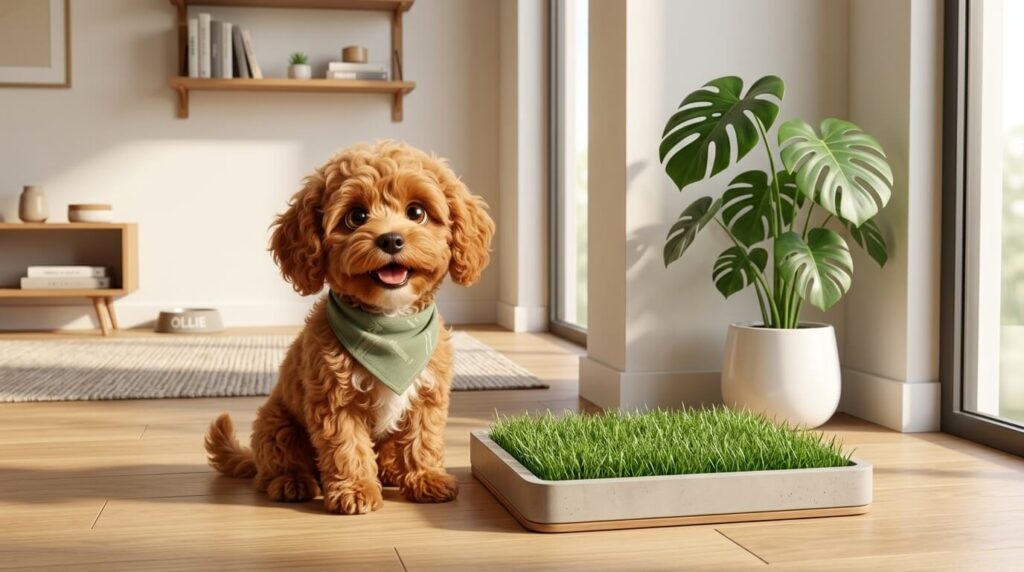
Option 2: Real Grass Patches
What it is: Living grass grown hydroponically on a biodegradable tray, sized to match your dog. Several subscription services (Fresh Patch is the most well-known) deliver fresh trays on a weekly or biweekly schedule.
Why it works:
- Dogs have a natural substrate preference for grass — it’s what they’ve eliminated on during outdoor training, which means the transition is significantly faster
- Real grass naturally neutralizes odor through bacterial processes in the soil
- The familiar texture and scent almost eliminate the training barrier
- Living grass is completely non-toxic
Trade-offs:
- The most expensive option on an ongoing basis (subscription costs range from $25–$55 per delivery depending on tray size)
- Requires disposal of the entire tray when saturated — typically every 1–2 weeks for small dogs, more frequently for larger dogs
- Can bring soil and grass debris into the apartment
- Not suitable for balconies or areas without good drainage management
Best for: Dogs who are already grass-trained outdoors, households with a balcony or bathroom space large enough for a tray, and owners who prioritize ease of training over cost.
Option 3: Synthetic Turf with Drainage
What it is: A washable artificial turf pad, usually placed over a tray or frame with a drainage layer beneath. The dog eliminates on the turf surface, and liquid drains through to a collection tray below.
Why it works:
- One-time cost with no ongoing subscription (the turf is washed and reused)
- Durable and long-lasting — quality products last years
- Visually similar to grass, which aids training
- Many designs are compact and purpose-built for apartment use
Trade-offs:
- Requires regular cleaning — the turf itself must be rinsed or washed every 1–3 days to prevent bacterial buildup and odor
- If not cleaned consistently, becomes the most odor-problematic of all three options
- Some lower-quality products trap urine rather than draining it properly, which accelerates odor issues dramatically
Best for: Cost-conscious owners willing to invest time in cleaning maintenance, dogs who have already shown comfort eliminating on artificial surfaces, and apartments where a drainage-friendly setup is possible.
Will It Confuse Their Outdoor Training?
This is the question I worried about most before setting up Ollie’s indoor option, and it’s the one I hear most frequently from other apartment dog owners considering this route.
The honest answer: it depends on how you introduce it and how you manage the training.
Dogs are highly context-dependent learners. They can, with proper training, understand that a specific location inside the apartment is an approved elimination spot without losing clarity about outdoor elimination expectations. This is not theoretical — service dog trainers and professional apartment dog trainers have successfully maintained both indoor and outdoor elimination behaviors in the same dog for years.
The risk of confusion arises when:
- The indoor substrate is too similar to surfaces the dog encounters outdoors (e.g., if your dog has been eliminating on a grass patch indoors and then shows reluctance to differentiate outdoor grass)
- Training is inconsistent and the dog receives unclear signals about when and where indoor elimination is acceptable
- The owner isn’t actively reinforcing outdoor elimination with the same enthusiasm as indoor use
The clarity factors that prevent confusion:
- A highly specific location for the indoor potty — a bathroom corner, a dedicated balcony spot — so the spatial context is completely distinct from outdoor settings
- Consistent verbal cues that differ from your outdoor elimination command. I use “go here” for the indoor box and “go outside” during outdoor walks. The different phrase genuinely helps.
- Maintaining the outdoor walk schedule even when using the indoor option — the box supplements, it doesn’t replace, outdoor access and the enrichment it provides
Setting up the box is only half the battle; you still need to follow a strict schedule for how to potty train a dog in an apartment to ensure they actually use it — because the indoor option works best as an extension of a clear training framework, not a replacement for one.
How to Train Your Dog to Use It
Training an indoor potty box requires the same principles as any canine elimination training: consistency, positive reinforcement, and strategic use of scent. Here is the step-by-step process I used with Ollie.
Step 1: Location Selection
Choose your location before the box arrives and commit to it. The spot should be:
- Easily accessible to your dog at all times
- Away from their food and water stations (dogs instinctively avoid eliminating near eating areas)
- In a consistent location that won’t move — changing the box location resets the learning process significantly
- Ideally near an existing outdoor exit route, which psychologically reinforces the “this is a potty area” association
For Ollie, I chose a corner of our bathroom — specifically because the bathroom scent context and the tile surface created a clear spatial distinction from the rest of the apartment.
Step 2: Scent Priming
This is the trick that cuts training time significantly and most guides skip entirely.
Dogs return to areas where they have previously eliminated because their own scent signals “this is an approved spot.” You can use this instinct to your advantage from day one.
- After an outdoor elimination, use a clean paper towel to collect a small amount of your dog’s urine
- Place this paper towel at the bottom of the indoor potty box, beneath whatever substrate you’re using
- Your dog’s scent is now present in the box, which communicates “this is an elimination location” in a language they understand immediately
For solid waste: if your dog eliminates outdoors, place the waste briefly in or near the indoor box for the first two to three days, then remove it after your dog has sniffed and recognized the scent association.
Step 3: Timed Introductions
Introduce your dog to the box at the moments when they are most likely to need to eliminate:
- Immediately after waking up in the morning
- Within 15–20 minutes after a meal
- After any period of active play
- Before and after extended alone time
Walk your dog to the box during these windows. Use a consistent verbal cue (“go here,” “use the box,” or any phrase you choose). Stand quietly and wait. Do not prompt repeatedly — this creates pressure that can actually inhibit elimination.
Step 4: Reward with Precision
The moment — and I mean the exact moment — your dog begins eliminating in the box, mark the behavior with a calm, quiet “yes” (not an excited shout, which can interrupt the process). The moment they finish, deliver a high-value treat reward immediately.
Timing is everything. A reward delivered 30 seconds after elimination is significantly less effective than one delivered the instant they finish. This precision is what builds the association between the specific behavior and the reward.
Step 5: Build Independence Gradually
Over one to two weeks, gradually reduce your physical presence during the introduction phase. Move from standing next to the box → standing in the doorway → sitting in the next room while your dog accesses the box independently.
The goal is for your dog to seek out the box when they need it — not to rely on you walking them to it every time. Most small breeds reach reliable independent use within two to four weeks of consistent training.
Even with perfect training, setbacks happen. If your dog suddenly stops using their spot, you must quickly diagnose the root cause of [litter box avoidance dogs] issues before it becomes a permanent habit.”
Frequently Asked Questions
Do dog litter boxes smell bad?
They can, if not maintained correctly — and “correctly” means more frequently than most people initially expect. For a small dog using a paper pellet box, full substrate replacement every two days and daily removal of solid waste keeps odor at a manageable level. Real grass patches are the most naturally odor-neutralizing option because living soil bacteria break down urine compounds actively.
Synthetic turf requires the most diligent cleaning — a rinse with an enzymatic cleaner every two days is the minimum for effective odor control. The single biggest odor mistake is waiting until you can smell it to clean it. By that point, odor compounds have already embedded into surfaces beyond the box itself.
What size litter box for dogs do I actually need?
The box should be large enough for your dog to step inside, turn a full circle, and position themselves comfortably without any part of their body extending beyond the edges. As a practical guideline, measure your dog’s length from nose to base of tail, and choose a box that is at least 1.5 times that length on its longest side. For Ollie at about 14 inches in body length, a box with a minimum 20–22 inch interior length is the comfortable minimum. Going slightly larger is always better than too small — a dog who feels cramped in their potty area will avoid using it.
Can large dogs use an indoor litter box for dogs?
It becomes significantly more challenging above approximately 25–30 pounds, for a few practical reasons. Larger dogs produce substantially higher urine volumes, which means any substrate reaches saturation much faster and requires replacement or cleaning multiple times daily. The box size required to comfortably accommodate a large breed becomes unwieldy in most apartment spaces.
And the training complexity increases because larger breeds typically have stronger, more established outdoor elimination habits. That said, large synthetic turf systems with commercial-grade drainage — some designed specifically for large breeds — can work in apartment buildings with appropriate drain access, such as a balcony with a floor drain. For most large breed apartment owners, though, a reliable dog walker schedule is a more practical solution than an indoor potty system.
References
- Houpt, K. A. (2018). Domestic Animal Behavior for Veterinarians and Animal Scientists (6th ed.). Wiley-Blackwell. Chapter 4: Eliminative Behavior. ISBN: 978-1119181538. Referenced for canine substrate preference and elimination behavior patterns in domestic dogs.
- Stolt, L., Pryor, P. A., & Hart, B. L. (2007). “Influence of urine odor and other substrates on location preference for urination in dogs.” Applied Animal Behaviour Science, 103(1–2), 97–105. https://doi.org/10.1016/j.applanim.2006.04.014
That frozen Tuesday night at 2 AM turned out to be genuinely useful. Ollie now has a paper pellet box in our bathroom that handles late-night and bad-weather moments without either of us having to brave the elements. He still gets his outdoor walks — every single day — because those are about far more than elimination. But knowing the backup exists has genuinely changed our quality of life. If you’re on the fence, I’d say: for small breeds in high-rise apartments, it’s absolutely worth trying.