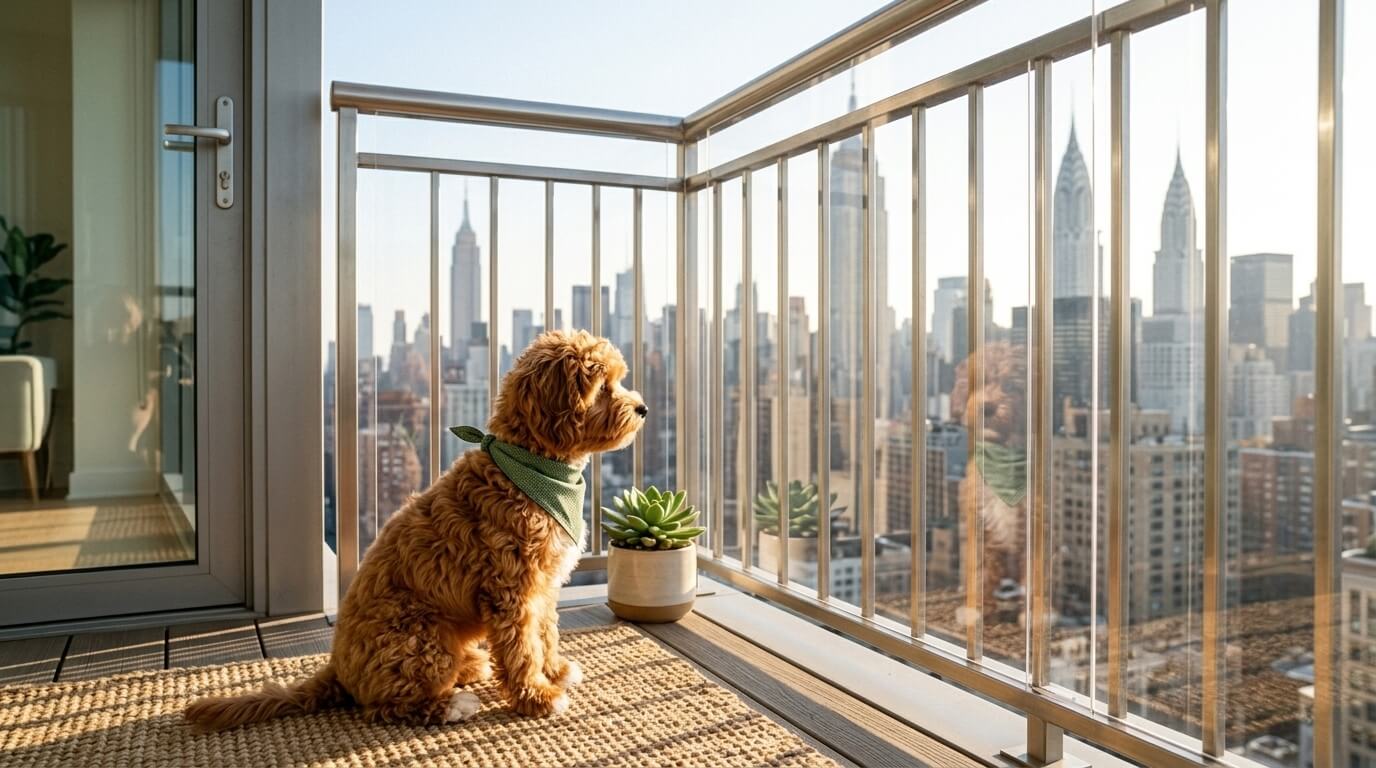
Dog proof balcony plans should begin with one honest sentence: an apartment balcony is never a casual dog room. It may look like a harmless sunny spot, but it can include railing gaps, climbable furniture, hot flooring, toxic plants, dropped objects, barking triggers, wind, slick surfaces, and the very human temptation to leave the dog “just for a minute.”
For some dogs, a balcony can be a supervised sniffing spot. For others, it should be off limits. A tiny dog who can slip under a rail, a young dog who jumps onto furniture, a dog who chases birds, a dog who panics at city noise, or a dog who chews barriers should not be treated like a design problem. That is a safety problem first.
This guide is written for renters and apartment owners who want practical risk reduction without drilling into railings or pretending a balcony can be made perfectly safe. The goal is not to create an outdoor kennel. The goal is to decide whether balcony access is appropriate, reduce obvious hazards, and supervise every use.
Table of Contents
Quick Answer
To dog proof a balcony, measure every gap, remove climbable furniture from railing areas, block openings with renter-safe materials approved by your lease, use non-slip flooring, remove toxic plants, prevent chewing hazards, manage heat and sun, avoid tethering to railings, supervise every visit, and keep the balcony off limits if your dog jumps, squeezes, panics, chews, barks intensely, or cannot be calmly recalled inside.
| Balcony Risk | Why It Matters | First Safer Move |
|---|---|---|
| Wide railing gaps | Small dogs can squeeze through or get stuck | Block gaps with secure, lease-safe panels |
| Furniture near railing | Creates a step-up or launch point | Move furniture away from all edges |
| Hot balcony floor | Concrete, tile, and metal can burn paws | Test surface temperature before access |
| Toxic plants | Curious dogs may chew leaves or soil | Check every plant against ASPCA toxicity lists |
| Barking at street or neighbors | Can create complaints and stress | Limit access and use training away from the railing |
| Unsupervised time | Small problems become serious quickly | Make balcony access supervised only |
If you are still setting up the whole rental, start with how to dog proof a rental apartment. Balcony safety should be part of the apartment plan, not a late weekend project after the dog has already learned to rush the door.
First Decide Whether Your Dog Should Use the Balcony
Before buying panels, mats, or outdoor beds, ask whether balcony access makes sense for your dog. Some dogs are calm observers. Some become immediately overstimulated. Some are too small for the railing design. Some are too athletic for comfort. Some bark at every passing dog, skateboard, delivery truck, or bird.
Balcony access is a privilege, not a basic need. Dogs need outdoor walks, sniffing, exercise, and bathroom opportunities, but they do not need unsupervised balcony time. If balcony access creates risk or stress, your dog can live a full apartment life without it.
Signs your dog is not ready include:
- Jumping onto chairs, planters, or storage boxes
- Putting paws on railing panels
- Barking intensely at people, dogs, birds, or vehicles
- Trying to squeeze under or through rails
- Chewing mesh, zip ties, plants, or furniture
- Ignoring recall when excited
- Pacing, trembling, or freezing outside
That list is not meant to scare you. It is meant to prevent the very common owner thought: “He seems fine out there.” Fine needs evidence.
Start With Permission, Structure, and an Exit Route
Before attaching anything, read the lease, balcony rules, and building notices. Some properties prohibit exterior coverings, visible screening, drilling, clamps, planters on railings, or any alteration that changes the building facade. Local building and fire requirements may be stricter than the lease. Written approval is safer than assuming a removable product is automatically allowed.
Do not attach a barrier to a loose, corroded, damaged, or questionable railing. A pet barrier cannot repair a structural problem. Report wobbling rails, cracked anchors, deteriorated concrete, loose glass panels, rust, or damaged balcony flooring to property management and keep the dog away until the building addresses it.
Protect the human escape route too. A panel, gate, planter, storage box, potty tray, or roll of artificial turf should not narrow the path to the door, cover a drain, obstruct a fire escape, prevent the door from opening fully, or create something people must climb over during an emergency. The U.S. Fire Administration recommends knowing how to leave an apartment during a fire; your dog setup must not make that harder.
If the balcony is part of a designated fire escape, shared egress route, or firefighter access point, do not place pet barriers or belongings there without explicit building authorization. When rules, structure, and pet safety conflict, keep the dog indoors.
The 9 Safety Checks
1. Measure every railing gap
Do not eyeball the railing. Measure the gap between vertical bars, under the bottom rail, around corners, beside posts, near the door track, and anywhere the balcony design changes. Small dogs can fit through spaces that look impossible until they turn sideways. Puppies grow, but they also explore first.
A dog does not have to fall all the way through for the setup to be unsafe. Getting a head, leg, or shoulder stuck can cause panic and injury. If your dog can put their nose or paw into a gap, treat it seriously.
Use solid or semi-solid barriers that cannot be chewed through, pushed loose, or pulled into the gap. Thin garden netting, decorative mesh, or loosely attached plastic may look reassuring while failing under pressure.
2. Remove the ladder effect
The balcony railing is not the only fall risk. Furniture creates height. A chair near a railing becomes a step. A storage bench becomes a platform. A planter stand becomes a ladder. A dog who would never clear the railing from the floor may easily reach it from a chair.
Move chairs, tables, storage boxes, plant stands, and outdoor beds away from every edge. If the balcony is too small to keep furniture away from the rail, do not let your dog use the balcony when furniture is out.
This is where aesthetics and safety often fight. The cozy bistro-chair balcony photo may not be compatible with your dog. Choose the dog.
3. Use renter-safe barriers only if they are truly secure
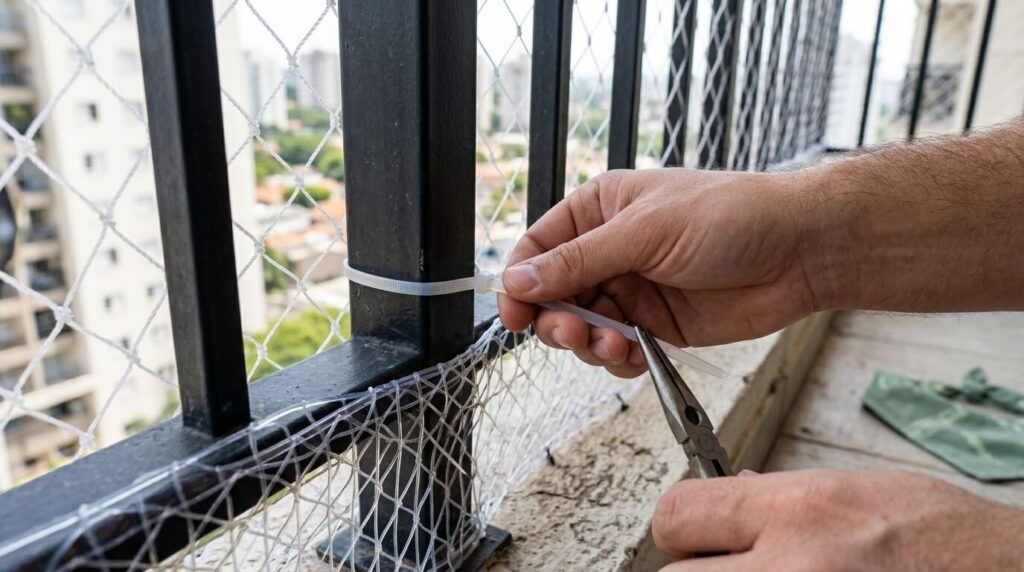
Clear panels, outdoor-rated mesh, lattice, or railing guards may reduce gaps, but they are only useful if allowed by your lease and installed securely without damaging the building. Do not drill, clamp, zip-tie, or attach anything to railings if your lease or building rules prohibit it.
Check the material from the dog’s perspective. Can they chew the edge? Can wind catch it? Can water collect behind it? Can it rattle and scare the dog? Can the dog push the bottom outward? Can a neighbor below be affected if anything comes loose?
Then check the whole perimeter, not just the center. The weak point is often a corner, bottom edge, overlap, cutout around a post, or attachment that slowly slides. A barrier that looks flat in a product photo may bow outward when a dog leans on it. Thin netting may stretch around a muzzle or paw. A rigid sheet may act like a sail in high wind. Plastic ties can become brittle with sunlight, heat, and cold.
There is no universal attachment schedule or material that fits every balcony. Railing type, height, wind exposure, dog weight, chewing behavior, building rules, and installation quality all matter. If the setup is carrying any meaningful load or preventing a fall, ask property management or an appropriately qualified local professional what the building permits. A pet-product label is not a structural approval.
Inspect before every use. Look for loose fasteners, sharp cut ends, widening gaps, UV cracking, rust, rattling, chewing marks, and any new space created after cleaning or moving furniture. If you can push the bottom or corner outward with one hand, do not rely on it to stop an excited dog.
If you need no-drill indoor barriers to keep the dog away from the balcony door, see no drill dog gates apartments. Sometimes the safest balcony proofing is a gate inside the apartment.
4. Fix slick or hot flooring
Balcony surfaces can be slippery when wet and painfully hot in sun. Concrete, tile, composite decking, and metal can heat up faster than owners expect. AAHA warns that surface temperatures can become much hotter than air temperatures and can burn paw pads quickly in hot weather.
Test the floor with your own hand or bare foot before letting your dog step out. If it is uncomfortable for you, it is not a good surface for paws. Add a secure outdoor mat only if it does not curl, slide, trap water, grow mold, or become a chew target.
In cold or wet weather, check traction. A dog rushing through a sliding door onto a slick balcony can slip, hit the railing, or injure a leg.
Do not cover a balcony blindly with foam tiles, turf, rugs, or decking. A covering can hide cracks, trap moisture, block drainage, grow mold, lift in wind, or become a chew hazard. Lift and inspect underneath it regularly. Keep drains and scuppers fully open, and remove any mat that shifts toward the railing or door.
5. Remove toxic plants and soil hazards
Balconies attract plants. Dogs attract plant problems. ASPCA’s toxic and non-toxic plant database is the safest place to check specific plant names. Do not rely on vague labels like “tropical plant” or “succulent mix.” Know the exact plant.
Common balcony plant risks can include sago palm, oleander, lilies, philodendron, pothos, azalea, cyclamen, kalanchoe, and other plants depending on region. Even plants considered non-toxic may still cause vomiting or stomach upset if a dog eats enough plant material or soil.
Also watch fertilizer, potting soil, cocoa mulch, insecticides, plant stakes, broken pots, and water trays. A dog does not need to eat the whole plant to create a problem.
For safer greenery ideas, use dog safe air purifying plants.
6. Do not tether to the railing
Do not tie your dog to the balcony railing. A tether can create strangulation, entanglement, panic, and fall risk. It can also encourage a dog to hit the end of the line when excited. A balcony is not a yard, and a tether does not turn it into one.
If you need your dog to stay in one area, use indoor management, a closed door, a gate, or supervised leash time with the leash in your hand. If holding the leash while on the balcony feels inconvenient, that is a clue that the balcony should not be part of your dog’s routine right now.
7. Control barking before it becomes a balcony habit
Balconies are perfect barking stages. Your dog can see dogs, people, bikes, birds, construction, delivery drivers, and neighbors below. Every bark may feel rewarding because the trigger keeps moving away. From your dog’s perspective, barking worked.
Do not allow long balcony lookout sessions if your dog is rehearsing barking. Use short supervised visits, reward quiet observation, and call your dog inside before they escalate. If barking is already a building issue, read stop dog barking in apartment before adding balcony access.
Be considerate of neighbors above, below, and beside you. Balcony barking travels differently than indoor barking. It can echo through courtyards and alleys.
8. Supervise every visit
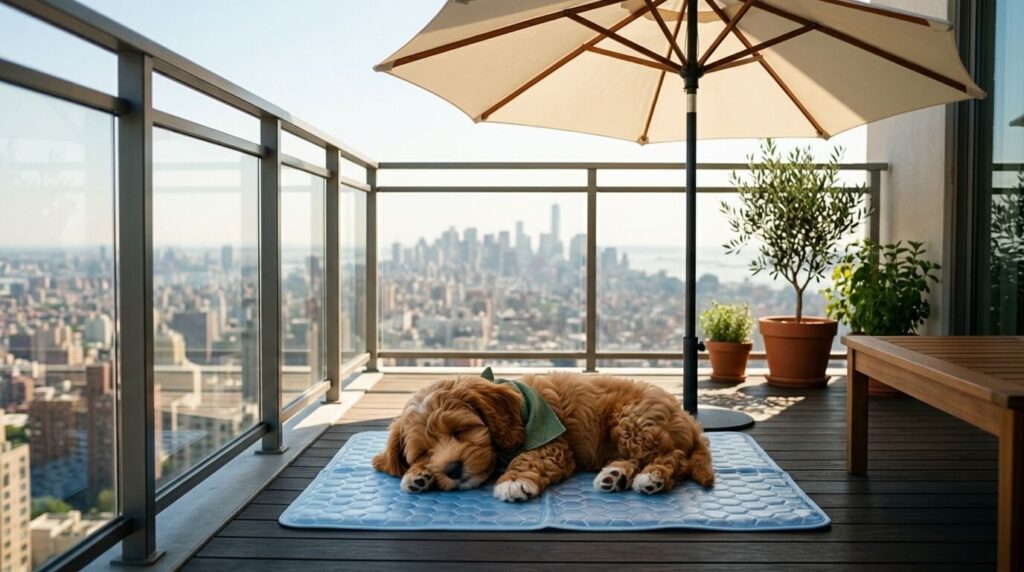
The balcony is not a dog-sitting tool. Do not leave your dog outside while you shower, take a call, cook, sleep, or leave the apartment. Wind can move items. A bird can land. A neighbor can appear. A dog can chew something loose. Heat can change. A calm dog can become excited.
Supervision means being present and able to intervene. It does not mean glancing through the window occasionally while your dog stands near the railing.
If your dog loves sunbathing, make an indoor sunny spot near a window instead. A mat in a safe room is less dramatic than a balcony view, but it is also less risky.
Direct supervision also means the balcony door remains usable and the dog is not locked outside. Carry your phone if you need it for emergencies, but do not turn a balcony visit into scrolling time. Position yourself between the dog and the highest-risk area, and bring the dog inside before opening an exterior storage box, moving furniture, watering plants, or doing anything that divides your attention.
9. Train the balcony door as a threshold
The dog should not rush the balcony door. Teach them to wait before going out and to come back in calmly. Practice with the door closed, then cracked, then open with the dog on leash. Reward waiting. Reward turning back to you. Keep the first sessions boring and short.
This is especially important if the balcony door opens directly from the living room. A dog who bolts through the sliding door can reach the railing before you have fully stepped outside.
If your dog struggles with threshold excitement generally, the same skill helps with elevators, hallways, and front doors. See dog elevator training for shared-building threshold practice.
When the Balcony Should Stay Off Limits
Keep the balcony off limits if your dog is a climber, jumper, chaser, barrier chewer, intense barker, panic-prone dog, tiny puppy, or dog who cannot be recalled away from triggers. Also skip balcony access during extreme heat, high wind, storms, construction noise, fireworks, parties, or any time you cannot supervise.
It is emotionally disappointing to close off a balcony you imagined sharing. That feeling is real. But your dog does not know they are missing a lifestyle photo. They know whether they feel safe, calm, and comfortable. If the balcony cannot provide that, the kindest choice is indoor enrichment, walks, and supervised outdoor time elsewhere.
For indoor enrichment on days when the balcony is off limits, use DIY dog enrichment ideas.
Balcony Setup by Apartment Type
High-rise balcony
High-rise balconies deserve the strictest rules. No unsupervised access. No climbable furniture. No weak mesh. No “he knows better.” Veterinary literature describes high-rise syndrome as injuries from falls from two or more stories, and dogs can be affected as well as cats. Prevention is the only sensible plan.
Low balcony or patio
Lower does not mean harmless. A fall can still injure a dog, and patios may introduce new hazards: gaps under fencing, plants, insects, fertilizers, trash, and neighbor dogs. Treat it as a controlled outdoor area, not a free yard.
Juliet balcony or narrow ledge
If there is no real floor space, do not treat it as a dog area. Keep dogs away from open doors or windows where they can lean, jump, or squeeze. Use screens, gates, and door control.
Shared balcony or roof deck
Shared spaces add other dogs, food, dropped items, furniture, grills, and people who may not understand your dog. Use leash control and etiquette. The guide on apartment dog social etiquette is useful for shared outdoor areas.
Do Not Build a Balcony Bathroom Without Thinking
Some owners want to turn the balcony into a potty area. This can work in certain apartments, but it can also create odor, drainage issues, neighbor complaints, insect problems, lease problems, and confusion for the dog. Urine running toward a balcony drain or dripping below is not acceptable.
If you need an indoor or semi-outdoor potty option, use a proper system and understand cleaning requirements. See indoor dog porch potty before placing turf or pads outside.
Never let potty convenience override balcony safety. A dog should not be alone on a balcony because you want an easier late-night bathroom routine.
Emergency Plan
If your dog falls, gets stuck, eats a plant, overheats, burns paws, or is injured on the balcony, contact your veterinarian or emergency clinic immediately. Do not wait to see whether a fall “looks fine.” Some injuries are not obvious right away.
For suspected plant ingestion, identify the plant and contact your veterinarian or poison control. ASPCA maintains a plant toxicity database and poison control resources. If your dog is vomiting, weak, trembling, drooling, or acting abnormal, treat it as urgent.
For heat concerns, move your dog to a cooler place and call your veterinarian. Heat illness can progress quickly. A balcony with no shade and poor airflow can become dangerous even when the apartment itself feels manageable.
If a dog is hanging, trapped, or beyond the railing
Call emergency services and building management immediately. Do not lean over a railing, climb onto furniture, cross to another balcony, or put another person at risk in an improvised rescue. Keep other pets and people away from the area. Follow instructions from emergency responders, who can assess fall protection and access from above or below.
If a barrier or object falls from the balcony
Bring the dog inside, close the door, and alert building management. Do not reach over the edge to retrieve anything. A fallen panel, planter, clip, or tool can injure people below even if the dog was never in danger. This is one reason exterior attachments and railing-mounted objects need building approval.
Prepare for evacuation before there is smoke
Keep a leash and properly fitted harness near the apartment exit, not on the balcony. Know where the carrier is for a very small or mobility-limited dog. Practice getting the dog away from the balcony and toward the main exit without relying on an elevator. Never store the emergency leash behind a pet gate that may be difficult to open under stress.
Common Mistakes
Trusting the dog instead of the setup
“My dog would never” is not a safety plan. Dogs react to birds, noises, people, dogs, wind, and sudden excitement. Build the environment for the worst ordinary moment, not the calmest one.
Using weak netting
Thin decorative netting can tear, stretch, or become a chew toy. If a barrier cannot handle pressure, weather, and inspection, it should not be relied on.
Leaving furniture near the railing
Furniture creates height. Height changes everything. Move climbable items away from edges or keep the dog off the balcony.
Forgetting heat
Balcony floors can become much hotter than air temperature. Test surfaces and provide shade, water, and short supervised visits only when conditions are safe.
Letting barking become entertainment
A dog who practices barking from a balcony can quickly create complaints and stress. Bring the dog inside before the behavior becomes the balcony routine.
A Real-Life Balcony Door Routine
The hardest part of balcony safety is not buying a barrier. It is changing the tiny routine that happens when you open the door. Most problems start in a casual moment: you are carrying laundry, answering a phone, watering a plant, or letting fresh air into the apartment. The dog slips through because the door opening has become an invitation.
I would treat the balcony door like an apartment front door. Before it opens, ask for a sit, a pause, or a mat behavior. If your dog cannot hold that behavior, use a leash or baby gate before opening the balcony door. This is not about making life strict. It is about removing the single rushed moment where a dog can make a bad decision faster than you can react.
A simple routine can look like this:
- Ask your dog to wait several feet away from the door.
- Open the door only a few inches at first.
- Step out before inviting the dog through.
- Keep the first minute calm, with no chasing birds or barking at people below.
- End the visit before the dog becomes excited, hot, frustrated, or fixated.
That last point matters. Many apartment dogs do fine for three quiet minutes and then fall apart at minute eight because a delivery driver appears, another dog walks past, or the wind moves something. A safe balcony visit is often shorter than owners expect.
Match the Rules to Your Dog’s Personality
Not every dog needs the same balcony rules. A slow senior who lies in one shaded spot is different from a young herding dog who scans the street for movement. A small dog is not automatically safe either. Small dogs can slip through gaps, get paws caught, chew weak material, or panic when lifted by wind, noise, or unfamiliar people nearby.
If your dog is a jumper, climber, escape artist, intense barker, bird chaser, or door dasher, the balcony should be treated as a controlled training space, not a casual lounging area. That may feel disappointing. Many renters imagine a peaceful balcony morning with coffee and a dog at their feet. Real life sometimes says, “This dog is safer inside with enrichment and a window view.”
If your dog is nervous, do not force balcony time as socialization. High views, traffic noise, construction, children yelling below, and neighboring balconies can be overwhelming. Let the dog choose distance. A dog who backs away from the railing, freezes at the doorway, or tries to hide is not being stubborn. The balcony may simply be too much sensory information at once.
If your dog is calm but curious, you still need rules. Calm dogs can surprise owners when a bird lands nearby or a neighbor’s dog appears across the courtyard. The goal is not to predict every trigger. The goal is to build a setup where one sudden trigger does not become a fall, escape, or complaint.
What I Would Check Before Calling It Ready
Before allowing regular balcony time, do one boring inspection without the dog present. Push gently on barriers. Look for bottom gaps. Check corners. Move chairs and planters away from edges. Touch the floor during the warmest part of the day. Look for dropped screws, plant tags, fertilizer pellets, cigarette butts, mulch, or anything your dog might grab before you notice.
Then do one supervised visit with the dog on leash. Watch what your dog notices first. Some dogs go straight to the railing. Some sniff plants. Some stare downward and start whining. Some ignore the view but react to hallway sounds behind them. That first visit tells you more than a product description ever will.
If anything feels wrong, pause. There is no prize for using the balcony today. For many apartment dog owners, the most responsible balcony decision is a smaller one: open the door for air, keep the dog behind a gate, and use indoor enrichment instead.
A Balcony Risk Audit You Can Repeat
Balcony safety is not a one-time installation. Weather, cleaning, furniture changes, puppy growth, and repeated nudging can change a setup. Run this short audit at the beginning of each season and after storms, maintenance visits, or any change to the balcony.
| Audit point | Pass condition | Stop condition |
|---|---|---|
| Permission | Current lease and building approval are clear | Rules are unknown or alteration is prohibited |
| Structure | Railing and floor appear intact and management has no restriction | Loose rail, cracks, rust, damaged glass, or active repair |
| Barrier | No bowing, loose edge, chew damage, sharp point, or reachable gap | Any part shifts, stretches, cracks, rattles loose, or traps a paw |
| Escape and drainage | Door, walking path, drain, and required egress remain clear | Gate, mat, potty tray, or storage obstructs movement or drainage |
| Weather | Floor is comfortable, shade and ventilation are adequate, wind is calm | Hot surface, high humidity, strong wind, storm, smoke, or extreme cold |
| Dog behavior | Dog can disengage, respond, and remain four paws on the floor | Jumping, climbing, squeezing, chewing, fixation, panic, or intense barking |
| Supervision | An adult is present, attentive, and able to bring the dog inside | Owner needs to cook, shower, sleep, leave, or focus elsewhere |
One failed item is enough to postpone access. The audit is deliberately strict because balcony failures are low-frequency but potentially catastrophic. The goal is not to make a risky setup feel acceptable through a high score.
FAQ
Can a dog jump over a balcony railing?
Yes, some dogs can jump, climb, or use furniture to reach railings. Do not assume railing height alone is enough, especially for athletic, excited, or prey-driven dogs.
How do I dog proof balcony railings as a renter?
Measure gaps, check lease rules, use secure no-drill or lease-approved barriers, remove climbable furniture, and supervise every visit. If you cannot secure gaps safely, keep your dog off the balcony.
Is balcony netting safe for dogs?
Only if it is strong, secure, weather-appropriate, chew-resistant for your dog, and allowed by your building. Thin garden or bird netting is often not enough for dog safety.
Can I leave my dog alone on the balcony?
No. Balcony access should be supervised. Heat, wind, noise, chewing, jumping, barking, and sudden triggers can change the situation quickly.
Are balcony plants safe for dogs?
Only if you know the exact plant and have checked it against a reliable toxicity resource such as ASPCA’s plant database. Also consider soil, fertilizer, mulch, and plant containers.
Can I make my balcony a dog potty area?
Sometimes, but it requires a proper contained system, cleaning plan, drainage awareness, lease compliance, and neighbor consideration. It should never involve unsupervised balcony access.
The Safest Final Decision
Stand on the balcony without your dog and look for gaps, climb points, wind exposure, heat, plants, loose objects, blocked drainage, fire access, and noise triggers. Then repeat the inspection at dog height. If you cannot make those risks boring and manageable with building-approved measures, keep the balcony door closed and create a safer indoor sunny spot instead.
A barrier is only one layer. The stronger system is permission, intact structure, cleared furniture, weather checks, door training, direct supervision, and a willingness to stop access when the dog or environment changes. A dog-safe apartment is better than a balcony you are nervous about every time you turn your back.