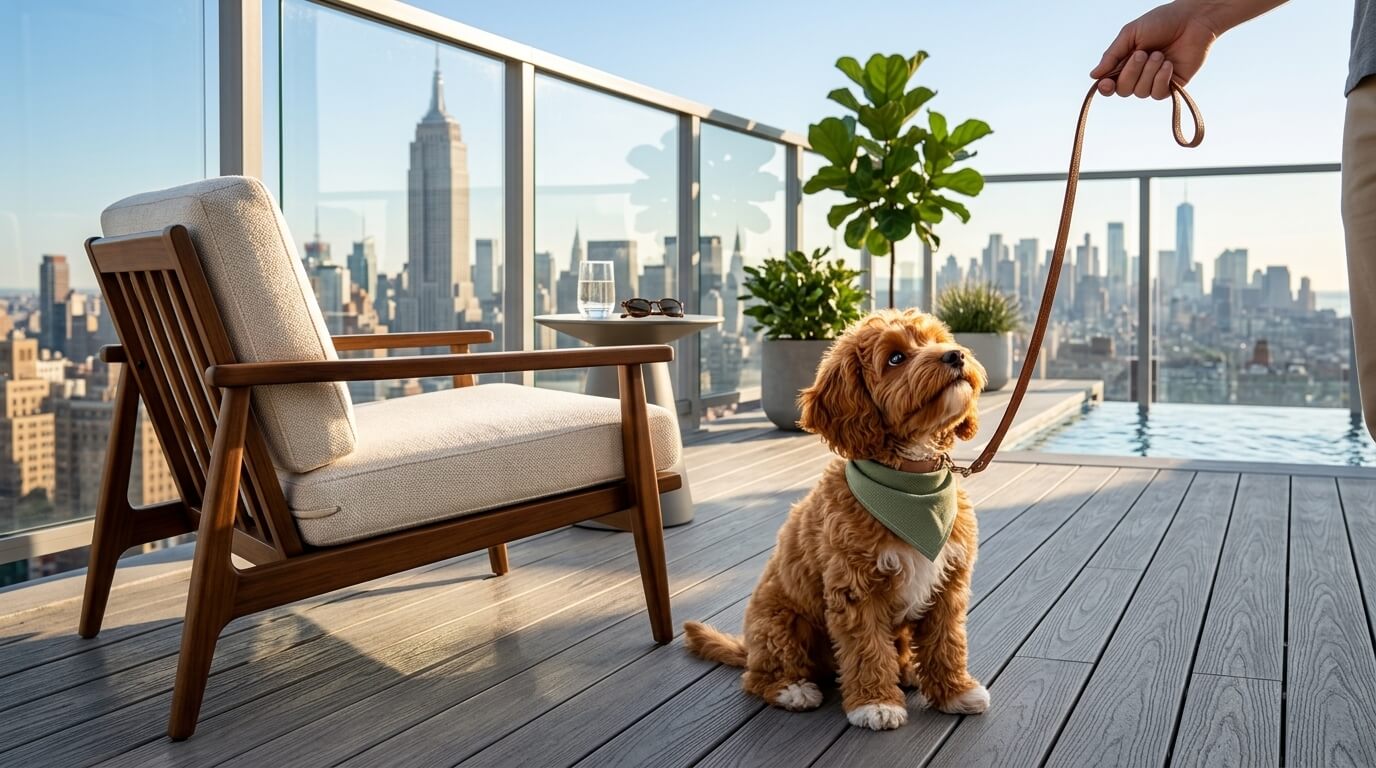
Apartment dog social etiquette is not about making your dog invisible. It is about helping your dog live close to other people without turning every elevator ride, hallway pass, roof deck visit, or lobby crossing into a stressful event. In an apartment building, your dog’s behavior affects more than your household. It affects neighbors, maintenance staff, delivery workers, children, other dogs, and people who may not like dogs at all.
That can feel like a lot of pressure. Many apartment dog owners are already trying hard. You may be juggling keys, leash, coffee, poop bags, packages, a nervous dog, and a neighbor who wants to chat right as the elevator opens. Good etiquette has to work in those real moments, not just in a perfect training video.
This guide is written for renters and city dog owners. It does not assume your dog is perfectly calm. It assumes your dog may bark sometimes, pull sometimes, get excited by food smells, dislike certain dogs, or become overwhelmed in shared spaces. The goal is not perfection. The goal is being predictable, considerate, and quick to step in before small problems become building complaints.
Quick Answer
Good apartment dog social etiquette means keeping your dog close in shared areas, asking before greetings, cleaning up immediately, managing barking, respecting food zones, giving other residents space, and leaving early when your dog is too excited or stressed. The best neighbor is not the owner with the most obedient dog. It is the owner who notices other people and takes responsibility quickly.
| Shared Space | Better Etiquette | What It Prevents |
|---|---|---|
| Elevator | Short leash, wait to enter, create distance | Face-to-face dog conflict and crowding |
| Hallway | Move to one side and keep greetings brief | Blocked neighbors and doorway tension |
| Lobby | Keep moving unless your dog is settled | Barking, jumping, and leash tangles |
| Roof deck | Stay away from food, grills, and crowded seating | Begging, stealing, complaints, and stress |
| Shared potty area | Pick up fully and rinse or report messes when required | Odor, hygiene issues, and angry notices |
If elevator rides are the hardest part of your routine, start with dog elevator training. If barking has already led to tension with neighbors, pair this guide with dog neighbor noise complaint.
If a city trip requires your dog to remain fully enclosed, compare carrier dimensions and route constraints in our dog carriers for public transit guide before leaving the building.
Table of Contents
Why Apartment Etiquette Feels Different
Apartment buildings compress private and public life. Your front door opens into a shared hallway. Your potty route may pass ten other units. Your dog may meet the same neighbor’s dog every morning whether either dog wants that relationship or not. A roof deck can feel like a park, but it is still a shared amenity with people eating, relaxing, working, and hosting guests.
Dogs also experience apartment spaces differently from humans. A hallway is narrow and echoing. An elevator is a moving box with sudden openings. A lobby has luggage wheels, food delivery bags, children, wet umbrellas, and other dogs entering from several directions. A calm dog upstairs may be much less calm in that mix.
Good etiquette starts with that reality. Instead of assuming your dog should handle everything, build routines that make shared spaces easier: shorter leashes, more distance, fewer forced greetings, better timing, and clear exits.
The 9 Easy Essential Rules
1. Keep the leash short, not tight
In shared apartment areas, your dog should not be at the end of a long leash. A short leash helps you prevent jumping, sniffing strangers, wrapping around legs, charging elevator doors, and reaching another dog without permission.
Short does not mean tight. A tight leash can increase tension, especially around other dogs. Aim for close and calm. Keep your dog near your side, reward check-ins, and move your own body to create space instead of just pulling backward.
Retractable leashes are a poor fit for elevators, lobbies, package rooms, and roof decks. They create too much distance before you can respond. Save longer freedom for appropriate outdoor areas, not shared building paths.
2. Ask before dog-to-dog greetings
Not every dog wants to say hello. Not every owner wants an interaction. Some dogs are recovering from surgery. Some are fearful. Some are elderly. Some are in training. Some are fine outdoors but not in a hallway or elevator.
The polite question is simple: “Is your dog saying hi today?” This gives the other owner room to say no without sounding rude. If they say no, believe them immediately and create space. Do not say, “Mine is friendly” as if that solves the other dog’s feelings.
Even when both owners agree, keep greetings short. Three seconds is often enough. Let dogs sniff, then move on while the interaction is still calm. Long leash greetings in narrow apartment spaces often become tangled, stiff, or too intense.
3. Treat the elevator like a narrow doorway, not a social room
Elevators are one of the most common etiquette trouble spots. The doors open suddenly, dogs are face-to-face, people are holding bags, and nobody has much room to turn around. If another dog is inside, ask before entering or wait for the next elevator.
Stand between your dog and the opening when possible. Keep your dog close, face them toward you or a side wall, and reward quiet waiting. If your dog struggles with elevators, avoid rush-hour practice. Work at quiet times first.
There is no shame in saying, “We’ll take the next one.” That one sentence can prevent a bark, lunge, leash tangle, or awkward ride with a neighbor you see every week.
4. Move through hallways with purpose
Hallways are not dog parks. They are shared traffic lanes. Do not let your dog stop at every door, sniff under thresholds, jump on walls, bark at sounds, or pull toward other residents. Keep moving unless there is a reason to pause.
If you meet someone in a narrow hallway, step aside, shorten the leash, and give them room. If your dog is nervous, turn around before the pass becomes too tight. If your dog is excited, ask for a simple behavior such as hand target, treat scatter, or walking behind you.
This is especially important near doors. A dog staring at another resident’s door may be harmless in your mind, but it can feel intrusive to the person inside.
5. Keep dogs away from food and grill zones
Roof decks and courtyards often include grills, tables, picnic benches, trash cans, dropped food, and people carrying plates. Even a friendly dog can become annoying fast if they beg, sniff bags, lick plates, or hover near children eating.
Stay outside food zones unless your dog can settle quietly. Bring a mat if your dog knows how to relax on one. If your dog is obsessed with food, skip busy meal hours and visit shared spaces at quieter times.
Food zones can also be safety risks. Bones, skewers, foil, chocolate, grapes, alcohol, and greasy scraps may appear at social events. A polite dog is still a dog. Do not rely on hope around party food.
6. Clean up like the building cameras are watching
Pick up waste fully, every time. If your dog has loose stool, do the best possible cleanup and use water if your building expects it. Do not leave bags in hallways, stairwells, package rooms, elevator corners, or on top of shared trash areas.
CDC notes that dog waste can carry germs and recommends cleaning up after dogs and proper disposal. In apartment buildings, waste is not only a hygiene issue. It becomes a neighbor-trust issue. One bad mess can make all dog owners in the building look careless.
Carry more bags than you think you need. If your dog has frequent accidents near the lobby or elevator, revisit potty timing with how to potty train a dog in an apartment.
7. Manage barking before it becomes a building story
A single bark is not a failure. Repeated barking in shared spaces is different. If your dog barks at every person, dog, elevator sound, or hallway movement, treat it as information. The dog may be overexcited, worried, territorial, under-exercised, or rehearsing a habit that works.
Do not stand in the lobby waiting for the dog to stop while everyone watches. Move away, create distance, and reset. Practice easier versions later. Reward quiet observation before barking starts.
If barking is mainly inside your unit, use stop dog barking in apartment. If city sounds are part of the problem, read dog city noise anxiety.
8. Leave shared spaces before your dog is done coping
One of the most expert-looking things an owner can do is leave early. Not dramatically. Not apologetically. Just early. If your dog is scanning, whining, panting, barking, stealing food, staring at another dog, ignoring cues, or unable to settle, the visit is over.
This is hard because owners often want to enjoy the roof deck, finish a conversation, or prove the dog can handle it. But shared spaces are not the best place to test limits. They are places to practice success.
Plan exits before you need them. Know which stairwell is quiet, where you can step aside, and what phrase you will use with people: “We’re going to give him a break.” That is enough.
9. Be kind, but do not make your dog everyone else’s problem
Some neighbors will love your dog. Some will not. Some may be afraid of dogs, allergic, elderly, carrying groceries, managing children, or simply not in the mood. Apartment etiquette means your dog does not get automatic access to other people’s bodies, bags, food, or attention.
If someone wants to pet your dog, ask your dog too. A dog who turns away, ducks, licks lips, tucks the tail, or backs up is saying no. You can say, “Not today, thanks.” Protecting your dog from unwanted touch also protects the person from a bad interaction.
AVSAB emphasizes humane, reward-based training. In apartment terms, that means teaching the dog what to do in shared spaces instead of correcting every mistake after the dog is already overwhelmed.
Roof Deck Etiquette
Roof decks feel relaxed to humans, but they can be intense for dogs. There are views, wind, food smells, close seating, unfamiliar guests, other dogs, music, children, grills, and edges. A dog who is wonderful in your unit may be restless on the roof.
Before bringing your dog, check your building rules. Some buildings allow dogs on roof decks only during certain times or not at all. Some require leashes, ban pets near grills, or have specific waste rules. Follow the posted rules even if other residents ignore them.
Bring a small kit: leash, poop bags, water, collapsible bowl, a mat, high-value treats, and an exit plan. Do not bring high-value chews unless your dog will be separated from other dogs and people. A chew that seems calming can become a guarding trigger in a crowded space.
If the deck is busy, keep the visit short. Your goal may be five calm minutes, not an hour. Let your dog succeed and leave while people still think, “That dog was easy to be around.”
Lobby and Package Room Etiquette
The lobby is where apartment life gets messy. People are entering, leaving, signing for packages, holding coffee, greeting guests, waiting for rides, and trying to get somewhere. Your dog may be excited because the lobby predicts walks. Other dogs may appear without warning.
Keep your dog out of the path of doors. Do not let them sniff grocery bags, delivery stacks, strollers, luggage, or strangers’ clothing. If you need to check mail or pick up packages, ask your dog to wait beside you or return to your unit first and come back without the dog.
Package rooms can be tight, noisy, and full of tempting cardboard smells. If your dog grabs packages, jumps on shelves, or blocks other residents, skip the “quick package pickup” with the dog attached. It rarely feels quick once something goes wrong.

Shared Dog Run or Pet Relief Area Etiquette
Some apartment buildings have dog runs or pet relief areas. These are helpful, but they are not free-for-all spaces. Enter slowly, check who is already there, and do not release your dog into another dog’s face. If the area is too small for safe movement, wait.
Pick up waste immediately. If the turf smells, drains poorly, or creates paw irritation, report the issue politely instead of letting frustration build. If your dog uses a porch potty or indoor solution, compare cleaning routines with indoor dog porch potty.
Do not use the shared run as the only exercise plan. Many apartment dog runs are too small, too dirty, or too socially intense for daily decompression. A sniff walk outside the building may be healthier than twenty minutes of chaotic dog traffic.
How to Handle Conflict Gracefully
Even careful owners have awkward moments. Your dog barks. Another dog lunges. Someone complains about hair in the elevator. A neighbor says your dog scared their child. The first response matters.
Keep it short and responsible: “I’m sorry. We will give you more space.” Or, “Thank you for telling me. I will adjust our routine.” You do not have to accept unfair blame, but arguing in the hallway rarely helps. A calm response protects your reputation and gives you time to solve the real issue.
If a complaint is valid, make a visible change. Use the stairs at rush hour, wait for an empty elevator, add a leash tab, change potty timing, avoid the roof deck during parties, or work with a trainer. Neighbors tend to calm down when they can see you taking action.
If a complaint is not valid, document calmly. Save dates, times, and what happened. Talk to management without attacking the neighbor. The goal is to keep your housing stable, not win a hallway debate.
Adjust for Different Neighbors
Good etiquette changes depending on who is sharing the space. A dog-loving neighbor may enjoy a quick hello, but the person carrying groceries may not want nose prints on their bags. A child may want to pet your dog but move in a way your dog finds confusing. A maintenance worker may need to enter the hallway with tools, carts, and noise. A resident with a reactive dog may be doing their best just to get outside.
For children, slow everything down. Ask the adult first, then watch your dog. Do not let children crowd, hug, lean over, or grab your dog in the lobby. CDC reminds owners to supervise children around dogs, even trusted family pets. In apartment spaces, supervision needs to happen faster because there is less room to back away.
For elderly neighbors or people with mobility aids, give extra space without making it awkward. Move your dog to the side, shorten the leash, and let the person pass. A small dog weaving near a cane, walker, or rolling cart can be a real fall risk.
For neighbors with dogs who react, do not take it personally if they avoid you. They may be protecting both dogs by choosing distance. A polite nod and a little space can be more helpful than trying to prove your dog is friendly.
The Emotional Side of Being the Dog Owner
Apartment dog ownership can make people self-conscious. You hear one bark and imagine every neighbor judging you. Your dog pulls toward someone and you feel embarrassed before anyone says a word. You may avoid shared spaces because you do not want to be “that dog person.”
That stress is real, and it can travel down the leash. The answer is not pretending you do not care. The answer is building routines that make you feel less exposed: exit phrases, shorter visits, quiet-hour practice, better gear, and a clear plan for hard locations.
Etiquette is not about shame. It is about repair. If something goes wrong, you notice, adjust, and keep going. Most neighbors do not need your dog to be perfect. They need to see that you are paying attention.
Common Mistakes
Letting friendly dogs rush people
Friendly is not the same as polite. A dog can love people and still scare someone by jumping, sniffing, licking, or blocking the path.
Using the roof deck as a dog park
A roof deck is a shared resident space first. Unless your building specifically allows off-leash play, keep your dog leashed and controlled.
Ignoring body language
Stiff posture, tucked tail, lip licking, hard staring, yawning, pulling away, and sudden stillness all matter. Etiquette includes helping your dog before they need to bark, snap, or flee.
Assuming everyone knows your dog
Your regular neighbors may know your dog. Guests, delivery workers, cleaners, contractors, and new tenants do not. Manage your dog for the person who has never met them.
Only training in emergencies
If the only time you ask for calm is when the elevator is full, the skill will feel impossible. Practice at quiet times so the dog has a chance to learn.

FAQ
What is good apartment dog social etiquette in elevators?
Wait before entering, keep your dog close, ask before sharing with another dog, and take the next elevator if space is too tight. Reward calm behavior and practice during quiet times if your dog struggles.
Should I let my dog greet every dog in the building?
No. Ask first, keep greetings short, and skip greetings in tight spaces. Regular forced greetings can create tension, especially when dogs are leashed, crowded, or surprised.
Can I bring my dog to the roof deck?
Only if your building allows it and your dog can stay controlled around food, people, other dogs, edges, and noise. Keep visits short at first and leave before your dog becomes overwhelmed.
What should I do if my dog barks in the lobby?
Create distance, move out of traffic, and reset. Later, practice quieter lobby moments with rewards. If barking is frequent, look at the cause: excitement, fear, frustration, hallway noise, or lack of practice.
How do I handle neighbors who want to pet my dog?
It is okay to say no. Use a simple phrase such as, “Not today, we are training.” If your dog enjoys greetings, keep them short and watch your dog’s body language.
What if another resident’s dog is rude?
Protect your dog first. Create distance, take another elevator, or leave the area. If there is a safety issue or repeated off-leash problem, document it calmly and contact building management.
Next Step
Pick one shared space that causes the most stress: elevator, hallway, lobby, roof deck, or dog run. For one week, make that space easier instead of harder. Go at quieter times, use a shorter leash, reward calm behavior early, and leave before your dog loses composure. That is apartment dog social etiquette in practice.