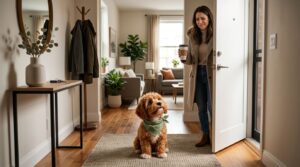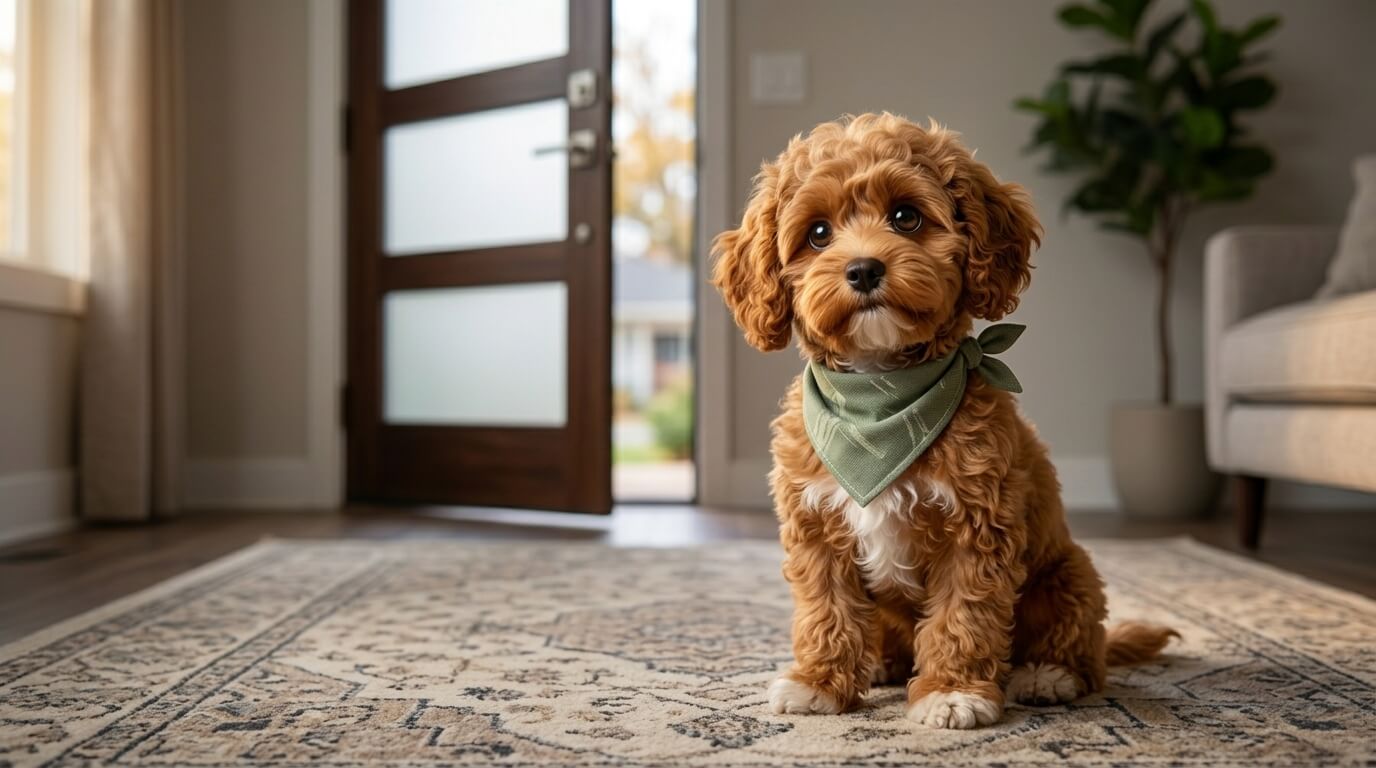
My first day back at the office after bringing Ollie home was, objectively, one of my least productive workdays in recent memory.
I checked the pet camera seventeen times before 10 AM. I texted my neighbor asking if she could hear anything. I ate lunch at my desk so I could rush home at noon, sprint up four flights of stairs (the elevator felt too slow), burst through the door expecting chaos—and found Ollie on his bed, deeply asleep, sage green bandana slightly askew, looking like he’d been unconscious for hours.
He looked up at me with the slow, sleepy blink of a dog who had absolutely no idea why I was panting and frantic. Then he put his head back down.
The guilt spiral of wondering how long can you leave a dog alone in an apartment is one of the most universal experiences of apartment dog ownership, and it’s almost always more painful for the owner than for the dog. Almost. The honest answer has some important nuances—by age, by individual temperament, and by how well you’ve set things up before you leave—and that’s what we’re covering today.
How Long Can You Leave A Dog Alone In An Apartment (Quick Answer)
When wondering how long can you leave a dog alone in an apartment, the general guideline is a maximum of 4-6 hours for adult dogs in ideal conditions, with 8 hours being the absolute upper limit for a healthy, well-exercised adult dog on an occasional basis. Puppies under 6 months cannot hold their bladder for more than 2-4 hours. Success depends on pre-departure exercise, environmental enrichment, and a reliable midday break system.
The Bladder Math (Age vs. Time Limits)
Let’s start with the physiological reality, because feelings aside, your dog’s bladder operates on biology, not guilt.
The general formula for bladder capacity is: your dog can hold it approximately one hour for every month of age, up to a maximum of about 8 hours in healthy adult dogs. This is a rough guideline, not a precise calculation—individual variation is real and significant.
Age-Based Time Limits
| Age | Maximum Alone Time | Notes |
|---|---|---|
| 8-10 weeks | 1-2 hours | Barely any bladder control |
| 3 months | 2-3 hours | Still developing rapidly |
| 4-5 months | 3-4 hours | Improving but unreliable |
| 6 months | 4-5 hours | Beginning to approach puppy adult capacity |
| 1 year+ (adult) | 6-8 hours max | With caveats (see below) |
| Senior dogs (8+) | Varies | Often decreases with age |
The 8-hour caveat:
Eight hours is the maximum I’d ever recommend for an adult dog, and only under good conditions:
- The dog has had a solid 30-45 minute exercise session before you leave
- There are enrichment items available (frozen Kong, puzzle toy)
- The dog has no underlying health conditions affecting bladder control
- This is a routine situation, not a daily 10-hour abandonment
Eight hours occasionally is manageable. Eight hours every day, Monday through Friday, without a midday break is a welfare issue—and honestly, it’s also just asking your apartment to pay the price.
Medical Factors That Change The Equation
Several health conditions reduce the time your dog can be comfortable alone:
- Urinary tract infections: Frequent urination regardless of age
- Kidney disease: Increased urination and water intake
- Diabetes: Similar increased urination pattern
- Certain medications: Diuretics and steroids increase urination
- Gastrointestinal conditions: Unpredictable bowel needs
If your dog has any of these conditions, the standard time guidelines don’t apply. Consult your veterinarian for a specific recommendation.
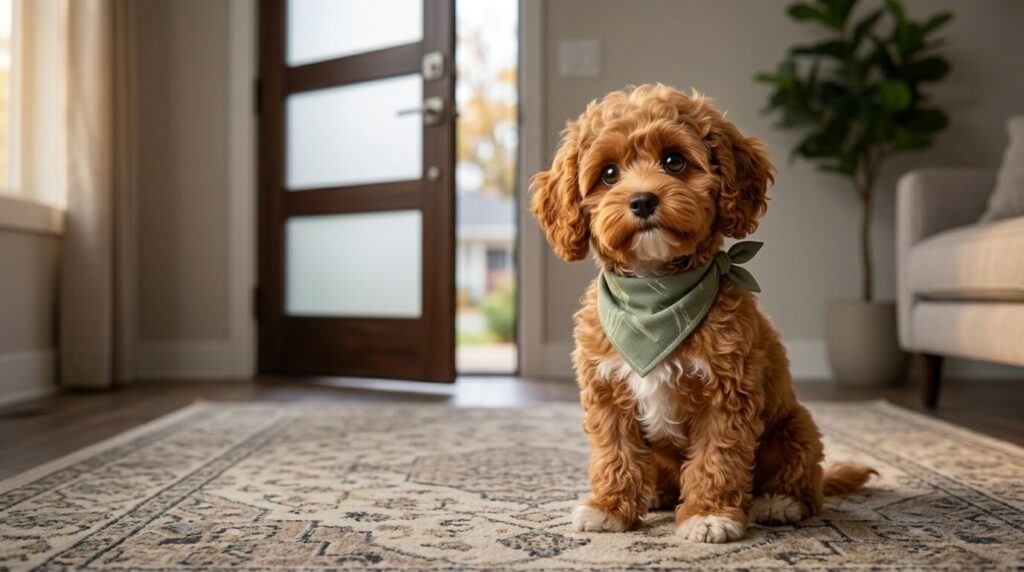
Boredom vs. Physical Needs
Here’s a distinction that matters enormously for apartment dog owners, and one that most articles blur together.
Bladder capacity and boredom tolerance are completely separate problems with different solutions.
A dog can physically hold their bladder for 6 hours and still be climbing the walls with boredom and frustration by hour two. Conversely, a dog can have a full enrichment schedule but need a bathroom break every three hours due to age or health.
You need to solve both problems independently.
The Boredom Problem
In my veterinary behaviorist’s terms: a dog’s mind doesn’t rest just because their body is still.
Cognitive energy accumulates even during sleep cycles. A dog who wakes up from a nap after two hours alone doesn’t go back to sleep—they look for something to do. In an apartment with nothing interesting available, that something often involves your belongings.
Signs your dog is struggling with boredom rather than bladder pressure:
- Destruction is scattered (multiple items, not concentrated at one exit point)
- Destruction happens to novel or interesting objects (your shoes, not the door frame)
- Pet camera footage shows exploration, then destruction, not panic from minute one
- No vocalization on the camera, just focused dismantling of something expensive
If your dog panics and destroys the apartment specifically at exit points from the moment you leave, that’s a very different issue—that pattern points toward dog separation anxiety rather than boredom, which requires a completely different intervention approach. [Dog Separation Anxiety Apartments: Signs And Solutions]
And if your pet camera footage includes a barking marathon that the whole building can hear, you need a proactive strategy to stop dog barking in an apartment while you’re at work before your neighbors solve the problem for you through the building manager. [Internal Link to ID: 12]
The Physical Need Problem
Physical needs during alone time include:
- Bladder relief: The primary time-limiting factor
- Water access: Fresh water should always be available
- Stretch and movement: Long static periods cause discomfort
- Safety: The space must be secure and hazard-free
These needs are largely addressed by your pre-departure setup and midday break system.
Setting Up the Ultimate “Safe Zone”
The difference between a dog who rests peacefully through a workday and one who methodically dismantles your mid-century modern furniture is largely in the setup.
The Confinement Question
This is where owners often have strong feelings: “I don’t want to crate my dog all day” is one of the most common things I hear from apartment owners.
I agree with that instinct. All-day crate confinement is not appropriate for working hours. A crate is a sleeping space and a short-term safety tool—it is not a storage solution for your dog while you’re at the office.
What works better for most apartment dogs is gated access to a limited portion of the apartment:
- Living room + hallway + one other room
- Enough space to move around, stretch, access water
- Small enough that they feel secure rather than overwhelmed
- Free of hazards that a bored, unsupervised dog might find interesting
For Ollie, this is the living room and hallway. Kitchen is gated (because the trash can is in there and he is an opportunist), bedroom is gated (because the laundry hamper is in there and see previous note about opportunism).
To make the crate a place of comfort rather than punishment, you must follow a strict protocol for [crate training apartment dogs].
The Enrichment Pre-Load
Before I leave every morning, I set up Ollie’s alone-time environment with specific intention:
The departure protocol:
- Frozen Kong: Prepared the night before, pulled from the freezer as I leave. Takes approximately 15-20 minutes to work through, which bridges the hardest transitional period right after I leave
- Puzzle feeder for breakfast: Rather than a bowl, his morning meal is in a puzzle feeder. Eating takes 15 minutes instead of 45 seconds
- White noise machine: Running continuously—masks hallway sounds that trigger alert barking
- Blackout curtains partially closed: Reduces window-triggered reactivity from street activity
- A worn item of clothing: My gym shirt on his bed. My scent is genuinely calming and research supports this
What I don’t do: leave the television on. Dogs don’t find TV particularly engaging, and certain sounds (doorbells, other dogs, excited voices) can actually increase arousal rather than provide comfort.
The Pet Camera: Sanity or Obsession?
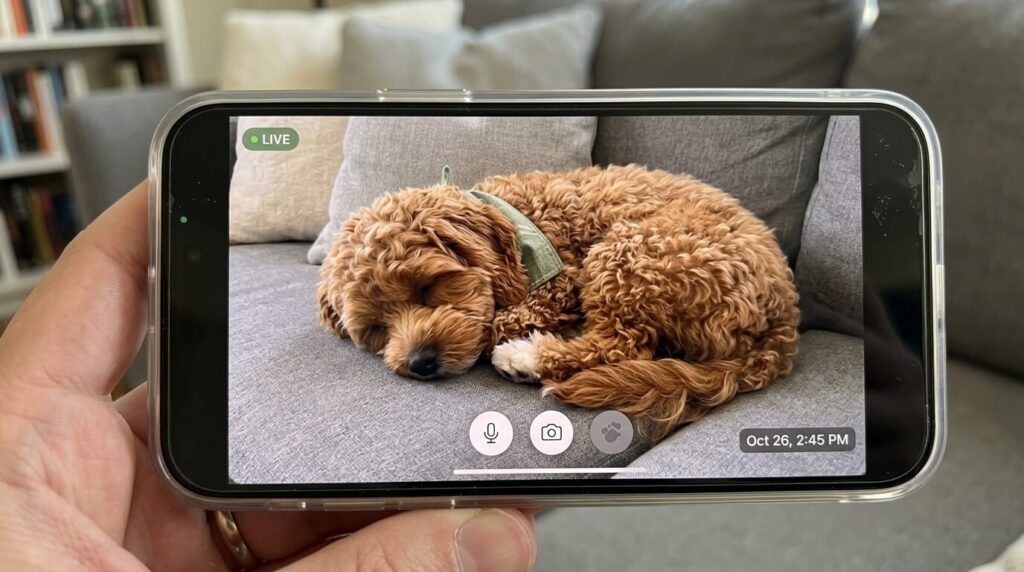
I have a pet camera. I have made my peace with what it revealed about me in those early months.
Pet cameras are genuinely useful when used correctly:
- Verify your setup works (did the Kong entertain him? Is he calm?)
- Identify patterns (does he seem distressed at a specific time each day?)
- Catch problems early (unusual behavior, distress signals)
- Gradually wean yourself off checking as confidence builds
Where pet cameras become counterproductive: checking every 20 minutes, interpreting every yawn as distress, and never developing the confidence that your dog is actually okay.
My current practice: I check once around 11 AM. If Ollie is sleeping (he almost always is), I close the app and get back to work. That took about four months to achieve. It felt impossible in month one.
What Do Dogs Actually Do All Day?
This is the question that deserves an honest answer, because the answer is considerably more boring than our anxiety suggests.
Research using pet cameras and behavioral observation has consistently documented what dogs do during owner-absent periods. The results are genuinely reassuring.
Typical owner-absent behavior patterns for well-adjusted adult dogs:
- Hour 1: Often active—sniffing, exploring, processing your departure
- Hours 2-6: Primarily sleeping, with brief alert periods when building sounds occur
- Hour 6+: Increasing restlessness as bladder pressure builds and they begin anticipating your return
Dogs sleep between 12-14 hours per day on average, with some individuals sleeping 16+ hours. In your absence, they’re doing approximately what they do when you’re home and ignoring them: sleeping.
The suffering we imagine—the long, lonely vigil at the front door, the separation agony, the desperate waiting—is real for dogs with genuine separation anxiety. For well-adjusted, confident dogs in a good setup, the reality is far more prosaic: they had a Kong, they took a nap, they had another nap, you came home.
The distinction matters because we often make our own guilt worse by projecting our feelings onto the dog’s experience.
Solutions for 9-to-5 Workers
If you work outside the home five days a week, here is the realistic system that works—not the idealized version, the actual one.
The Midday Break Non-Negotiation
For dogs under a year old, this is mandatory. For adult dogs who are alone for more than 6 hours, this is strongly recommended. The midday break is not a luxury.
Your options:
Option 1: Professional dog walker
- Most reliable long-term solution
- Cost: $20-35 per visit in most major cities; $100-175/week
- Ensures consistency even when your schedule changes
- Good walkers become trusted relationships over time
Option 2: Doggy daycare (2-3 days/week)
- Provides socialization alongside bathroom break
- Cost: $25-50/day depending on city
- Works well as a partial-week solution combined with home days
- Not suitable for all dogs (some find it overstimulating)
Option 3: Trusted neighbor arrangement
- Reciprocal or paid agreement with a neighbor who’s home during the day
- Requires relationship-building and clear agreements
- Not always reliable long-term
Option 4: Work-from-home hybrid schedule
- If your employer allows hybrid work, even 2-3 WFH days dramatically reduces the problem
- Worth having the conversation explicitly framed around pet welfare
For owners who work extremely long shifts or unpredictable hours, some desperate situations lead to exploring creative solutions—and some people even wonder if indoor dog potty systems could bridge the gap, which is actually a more interesting option than it sounds. [Litter Box For Dogs: Does It Actually Work? (The Vet Truth)]
If you think getting a second dog will cure their loneliness, make sure you know exactly [how to introduce second dog in small apartment] safely before leaving them alone together.
The Pre-Departure Exercise Protocol
This is the highest-leverage thing you can do for alone-time success, and it costs nothing but time.
A dog who is physically tired before you leave is a dog who will sleep for the first several hours you’re gone. A dog who is pent-up when you leave will be problem-solving their boredom within twenty minutes.
If you are struggling to build a morning routine, make sure to review our ultimate [first time dog owner apartment guide] for a complete daily schedule.
My morning protocol before work:
- Wake up 45 minutes earlier than you think you need to
- 30-minute walk—brisk pace, high sniff opportunities
- Breakfast via puzzle feeder (not bowl)
- 5-minute training session (mentally tiring)
- Departure within 10 minutes of the training session ending
When Ollie has had this morning program, the pet camera at 11 AM shows one thing: a sleeping dog. When I’ve skipped the training session, the 11 AM check looks more eventful.
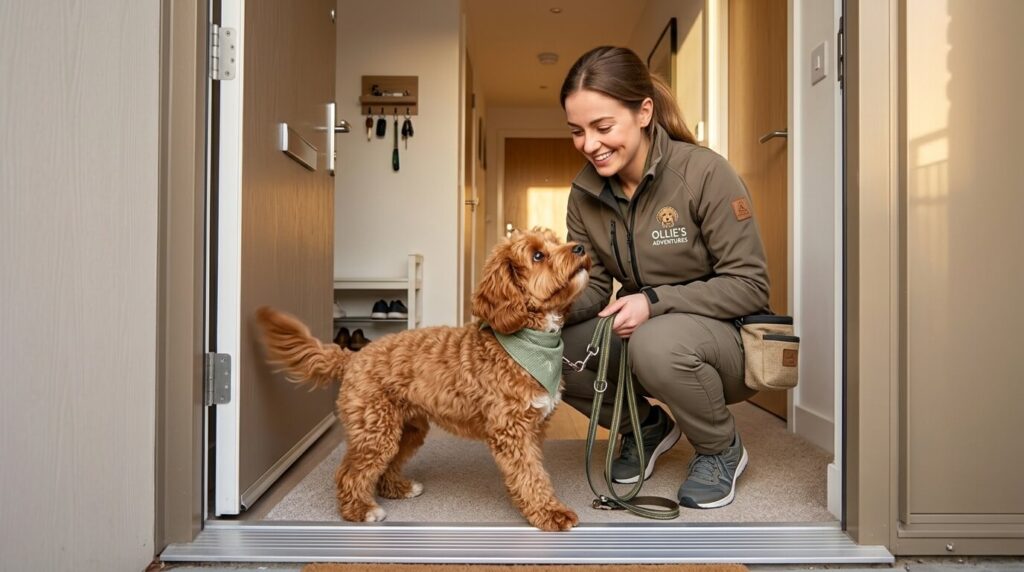
The Return Home Protocol
How you come home matters more than most people realize.
The instinct is to burst through the door with effusive greetings—”I MISSED YOU SO MUCH, WERE YOU GOOD?”—which spikes your dog’s arousal to the ceiling and reinforces the idea that your departures and returns are dramatically significant events.
What actually helps:
- Enter calmly, without fanfare
- Acknowledge Ollie briefly but neutrally
- Change your shoes, put your bag down, do a normal person thing
- After 2-3 minutes, greet him warmly and put on his leash for a bathroom trip
This approach treats your return as normal rather than exceptional. Over time, it reduces the intensity of both the greeting and the anticipatory anxiety before you arrive.
A Word About Guilt
I want to say something directly, because the guilt is real and it deserves addressing.
A dog sleeping in a well-set-up apartment while you work is not suffering. They are a loved animal in a warm, safe environment with water, enrichment, and the scent of their person everywhere. They will have a walk when you return, dinner, training, couch time, and everything good that comes from your life together.
Compare that to the alternative for dogs without homes.
The guilt is coming from your empathy, which is a good thing. But it’s being misdirected. The question isn’t “am I failing my dog by going to work?” The question is “am I setting things up well enough that my dog is comfortable while I do?”
Answer that second question honestly and practically—the midday break, the exercise, the enrichment, the setup—and the answer to the first question takes care of itself.
FAQ
How long can you leave a dog alone in an apartment if you work full-time?
For most healthy adult dogs, a workday of 7-8 hours is manageable with the right setup: a solid pre-departure exercise session, enrichment items like a frozen Kong, access to water, and ideally a midday break via dog walker or neighbor. Without a midday break, the upper limit for physical comfort is approximately 6-8 hours for healthy adult dogs, and considerably less for puppies or senior dogs. Think of the midday break as the single most impactful thing a full-time working dog owner can implement.
Is 10 hours too long to leave a dog alone?
Ten hours exceeds what most veterinary behaviorists and animal welfare organizations recommend as an appropriate alone time for any dog, including healthy adults. Beyond the physical discomfort of bladder pressure for 10 hours, the behavioral and psychological impact of extended isolation without stimulation accumulates over time.
If your schedule regularly requires 10-hour absences, a midday dog walker is not optional—it’s a welfare requirement. Doggy daycare on long days is another solution that addresses both the physical and social needs simultaneously.
What do dogs do when left alone in an apartment all day?
Research using behavioral monitoring and pet cameras consistently shows that well-adjusted adult dogs spend the majority of their alone time sleeping—often 12-14 hours of their day is sleep.
The typical pattern involves an active period immediately after owner departure (sniffing, processing), followed by several hours of sleep with brief alert periods during building sounds, followed by increasing restlessness as the day extends and bladder pressure builds.
Dogs who do not follow this pattern—who show distress, vocalization, or destruction from the first moments of alone time—likely have separation anxiety rather than simply being alone.
References
- American Veterinary Medical Association (AVMA). (2023). Dog Behavior and Training. Retrieved from https://www.avma.org/resources/pet-owners/petcare/dog-behavior-and-training. The AVMA’s guidelines on canine behavior and welfare address appropriate confinement periods, environmental enrichment requirements, and the physiological basis for age-related time limits in unsupervised dogs.
- Rehn, T., & Keeling, L. J. (2011). The effect of time left alone at home on dog welfare. Applied Animal Behaviour Science, 129(2-4), 129-135. This peer-reviewed study directly examined the behavioral and physiological stress responses of dogs left alone for varying durations, finding that dogs left for longer periods showed increased cortisol levels and behavioral indicators of stress upon owner return, providing the evidence base for recommended maximum alone-time guidelines.