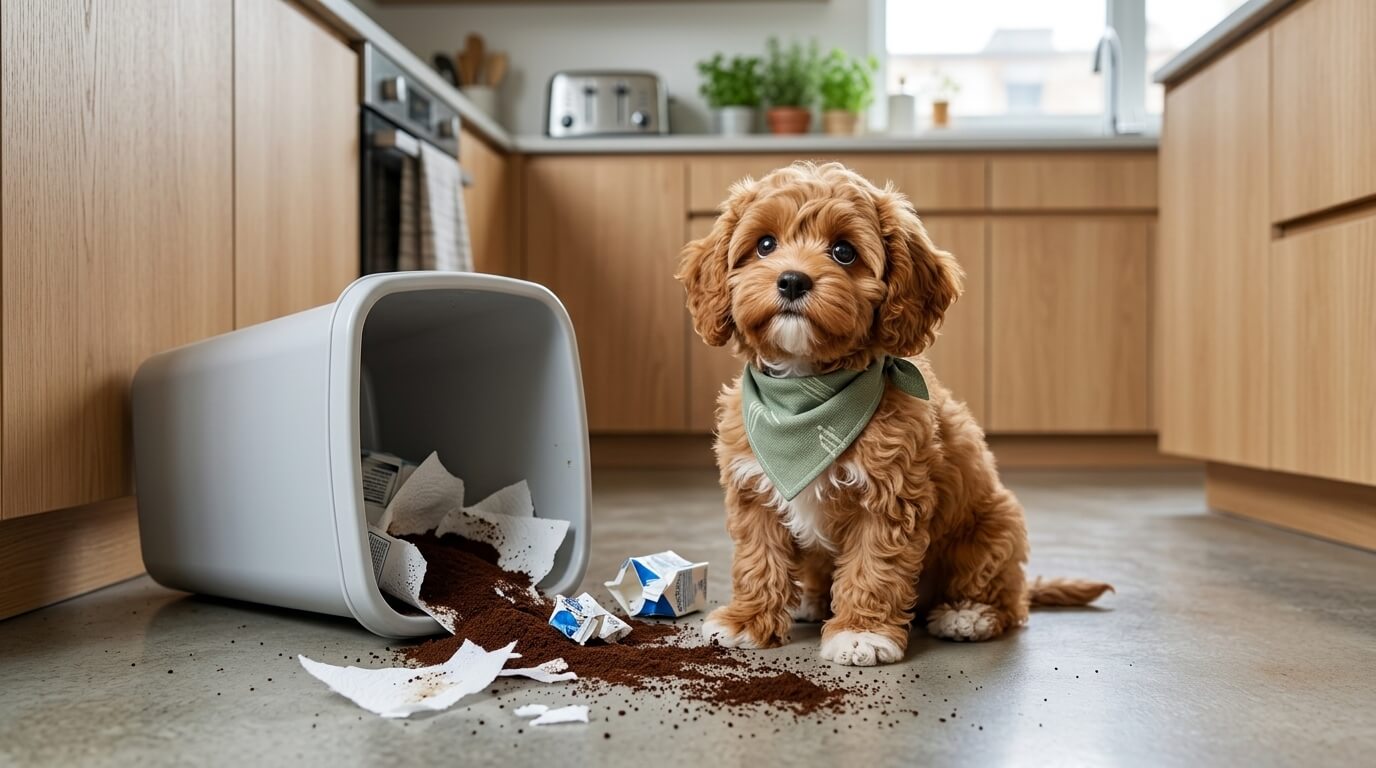
A trash can that works in an apartment with a dog needs more than a tidy appearance. The lid must resist the way your dog tries to reach food waste, the bin must fit a small kitchen, and the opening method should not create a new nuisance beside a shared wall or in a narrow walkway.
This comparison covers five specific trash cans or containment systems using current manufacturer information. Specifications such as dimensions, capacity, locks, materials, and liner systems come from the manufacturers. Apartment-fit comments are editorial assessments based on those published details. We did not conduct hands-on strength, noise, odor, or tip-resistance testing.
Quick Answer
The best dog-resistant trash can for an apartment is one whose access-control method matches your dog’s behavior and your available space. A manual lid lock may help with a dog that noses up lids. A sensor control can disable automatic opening, while a secured cabinet pullout can move waste behind another barrier. Measure the bin’s full footprint and open-lid height, and consider whether your dog pushes, tips, chews, or learns to use pedals.
No household trash can should be assumed completely dog-proof for every dog. A lock that stops the lid from opening may not stop a large or persistent dog from tipping the whole bin, damaging plastic parts, or opening an unsecured cabinet. Placement, supervision, waste handling, and training still matter.
Comparison Table
The last column is an editorial apartment-use assessment, not a manufacturer claim.
| Product | Capacity | Lock / Lid Type | Footprint | Liner Fit | Installation | Apartment Use Case |
|---|---|---|---|---|---|---|
| Rubbermaid Premier® Series IV | 13 gal | Manual lid lock, step pedal, slow-close lid | 16 × 12.25 × 24.63 in; orientation not labeled | LinerLock and venting channels | Freestanding | Straightforward manual-lock option for renters who want no batteries or cabinet work |
| EKO 45L / 12 Gal Pet-Lock Kitchen Trash Can | 45 L / 12 gal | Secure locking lid, step pedal, soft-close lid | Not specified | Bag fixer; EKO Code F bags | Freestanding | Resin step can for a compact kitchen, after confirming dimensions before ordering |
| iTouchless DZT13PL | 50 L / 13 gal | Motion sensor plus PetGuard control that disables sensor opening | 12.7 × 10.8 × 27.2 in; 35.6 in open height | Standard 13-gallon bags | Freestanding; batteries or optional adapter | Relatively narrow touch-free option when sensor placement and power needs are manageable |
| Step N’ Sort PG50LB / PG50LW | 50 L / 13 gal | Secure side locks, step pedal, slow-close lid | 19 × 13 × 27 in | Integrated liner rings | Freestanding | Manual-lock plastic option for homes that value simple controls |
| Rev-A-Shelf 4WCOX-24DMSC-1 | Two 35-qt bins plus 1.7-qt container | Cabinet containment / pullout system; no integrated pet lock | Conflicting official documentation / Not specified | Matching lids included; bag compatibility not specified | Permanent cabinet-floor and door mounting | Concealed system for an approved 24-in base cabinet when the cabinet door can also be secured |
What “Dog-Proof” Means Here
“Dog-proof trash can” is common search language, but it is not a universal performance standard. In this guide, dog-resistant means that a product has a lock, latch, controlled opening system, or cabinet barrier that may make normal access more difficult. It does not mean impossible to open, impossible to tip, or safe to leave with every dog without supervision.
- A dog that lifts lids needs a latch or lock that stays engaged between uses.
- A dog that activates motion sensors needs a way to disable sensor opening.
- A dog that presses pedals may need a locked lid or a different placement.
- A dog that tips bins needs stable placement or a secured enclosure; a lid lock alone is not a tip test.
- A dog that opens cabinets needs a separate, suitable cabinet latch even if the waste bin is hidden inside.
How We Selected These Options
We required a current manufacturer product page and enough first-party detail to identify the exact model and its access-control method. We compared capacity, published dimensions, liner handling, installation, material, lid behavior, and apartment placement. When a manufacturer did not publish a specification, this guide says Not specified. We did not fill gaps with unverified retail copy.
None of these products receives a universal “best overall” label. The suitable option depends on your dog, kitchen layout, rental restrictions, and willingness to engage a lock after every use.
1. Rubbermaid Premier® Series IV Step-On Trash Can
Why it may work in an apartment
The Rubbermaid Premier Series IV combines a foot pedal with a separate lid lock. That gives renters a freestanding option without batteries, wiring, or cabinet installation. Rubbermaid says the lock can hold the lid open for longer tasks or closed to help keep pets and children out.
The manufacturer describes a slow-close lid intended to reduce unwanted noise and a flared base intended to increase stability. Those features are relevant in a small kitchen, but they are not dog-specific tip or noise tests.
Manufacturer-supported details
- Model: 2124164
- Capacity: 13 gallons
- Published dimensions: 16 × 12.25 × 24.63 inches; orientation is not labeled
- Material: resin body with stainless-steel lid, rim, and pedal
- Opening: wide stainless-steel foot pedal
- Access control: lid lock with open and closed positions
- Lid behavior: slow close
- Liner system: LinerLock bands and venting channels
- Weight: 6.20 pounds
- Warranty: one-year limited warranty
Measure both horizontal dimensions against the proposed space rather than assuming which side will face the wall. The lid lock only helps when someone engages it. The product page does not establish that the bin cannot be tipped, chewed, or forced open by a determined dog. Cleaning instructions are not specified.
2. EKO 45L / 12 Gal Pet-Lock Kitchen Trash Can with Lid
Why it may work in an apartment
EKO’s model is a resin step can with a locking lid and no inner bucket. The manufacturer describes the lock as a way to help keep dogs, cats, and curious pets away from waste. It may suit a renter who wants a freestanding manual control without a motion sensor.
The lid can be moved manually to a 90-degree stay-open position. EKO describes its closing action as soft and “whisper-quiet.” That is a manufacturer description, not a comparative sound test, so this guide does not rank it as the quietest option.
Manufacturer-supported details
- Capacity: 45 liters / 12 gallons
- External dimensions: Not specified
- Material: premium resin with stainless-steel pedal
- Opening: step pedal
- Access control: secure locking lid
- Lid behavior: soft close and manual 90-degree stay-open position
- Liner system: plastic bag fixer; EKO Code F bags listed as compatible
- Cleaning method: Not specified
- Warranty: Not specified; the listed 30-day return policy is not a warranty
Because the official page does not publish external dimensions, obtain current measurements before ordering. This is especially important beside a refrigerator, in a galley kitchen, or under a shelf. The lock still depends on consistent use, and the manufacturer does not provide a tip-resistance or dog-strength rating.
3. iTouchless DZT13PL Sensor Trash Can with PetGuard
Why it may work in an apartment
iTouchless combines touch-free opening with a PetGuard control that disables sensor opening. The manufacturer uses “Dog-Proof” in the full product name and says PetGuard prevents pets from opening the lid. For apartment use, this should be understood as a sensor-control feature rather than a guarantee against tipping or physical force.
Its published 12.7-by-10.8-inch horizontal dimensions create a relatively narrow floor envelope in this comparison. The 35.6-inch open height matters beneath counters or shelves. Place the sensor where a dog walking past will not repeatedly activate it before PetGuard is engaged.
Manufacturer-supported details
- SKU: DZT13PL
- Capacity: 50 liters / 13 gallons
- Dimensions: 12.7 inches long × 10.8 inches wide × 27.2 inches high
- Open-lid height: 35.6 inches
- Material: stainless-steel body with ABS plastic lid
- Opening: motion sensor
- Access control: PetGuard control disables sensor opening
- Odor component: one AbsorbX natural carbon odor filter included
- Liner compatibility: standard 13-gallon bags
- Power: four D batteries, not included, or an optional AC adapter
- Cleaning method: Not specified
- Warranty term: Not specified on the reviewed product page
The manufacturer product page remains active, but direct availability is currently limited; availability may vary by retailer. At the time of review, the manufacturer page showed the item as sold out while a current retailer listing showed the exact DZT13PL model available to order. That is retailer availability, not manufacturer availability.
PetGuard controls sensor opening. The manufacturer page does not provide a tip-resistance guarantee. Standard bag compatibility makes liners easier to source, while the carbon filter supports odor management without replacing prompt waste removal. See our guide to controlling dog odor in an apartment for the broader routine.
4. Step N’ Sort Tall Plastic Trash Can with Steel Pedal and Secure Slide Lock
Why it may work in an apartment
This 13-gallon plastic step can uses security locks at the sides of the lid. The manufacturer says these locks help keep trash away from children and pets. Manual controls avoid sensor placement and battery concerns, while the slow-close and stay-open functions support everyday kitchen use.
Manufacturer-supported details
- Models: PG50LB in black and PG50LW in white
- Capacity: 50 liters / 13 gallons
- Dimensions: 19 × 13 × 27 inches
- Weight: 8 pounds
- Material: dent-resistant recycled plastic with stainless-steel pedal
- Opening: step pedal
- Access control: secure side locks
- Lid behavior: slow close and stay-open function
- Base: anti-slip
- Liner system: integrated rings hold bags in place
- Cleaning method: Not specified
- Warranty: Not specified
Confirm that the 19-by-13-inch horizontal envelope fits without narrowing the kitchen path. The side locks need enough clearance to operate. Users must engage them after every opening. The manufacturer does not claim the can is impossible to tip or force open, and direct-purchase availability is not specified.
5. Rev-A-Shelf 4WCOX-24DMSC-1 Wood Bottom Mount Waste Container System
Why it may work in an apartment
For an apartment with a suitable base cabinet, a pullout system can remove food waste from the open kitchen floor and place it behind a cabinet door. Cabinet containment may reduce direct access. The system includes two 35-quart bins with matching lids and a smaller 1.7-quart container, while full-extension soft-close slides move the bins with the cabinet door.
This is a cabinet containment / pullout waste system, not a locking trash can. It has no integrated pet lock and must not be treated as dog-proof or pet-locking. It only adds meaningful resistance when the cabinet door itself stays secured with an appropriate, permitted control.
Manufacturer-supported details
- Model: 4WCOX-24DMSC-1
- Containers: two 35-quart white BPA-free polymer bins with matching lids, plus one 1.7-quart OXO container
- Structure: natural maple
- Slides: bottom-mounted, full-extension, soft close
- Cabinet fit: designed for a 24-inch door/drawer base cabinet; manufacturer catalog lists a 21-inch minimum opening
- Installation: mounts to the cabinet floor and existing cabinet door; hardware and mounting brackets included
- Integrated pet lock: None
- Current dimensions: Conflicting official documentation / Not specified
- Liner compatibility: Not specified
- Cleaning method: Not specified
- Warranty: Not specified on the current product page
Before purchase, verify the current manufacturer spec sheet, cabinet opening, plumbing, hinges, and drawer clearances. Installation changes the cabinet interior and connects the pullout to the door. Renters should obtain required permission before drilling or altering cabinetry. Our dog-proof rental apartment guide covers broader renter-friendly planning.
How to Choose a Dog-Resistant Trash Can for an Apartment
Match the access control to your dog
A lock only helps if it blocks the behavior your dog uses. Does the dog nose under a lid, push the bin over, step on the pedal, trigger a sensor, or open a cabinet? Choose for that action rather than relying on a “pet” product name. Manual locks must be engaged every time. Sensor controls do not necessarily secure the full lid assembly. Cabinet systems add a barrier only when the cabinet door also resists access.
Measure the working space
Record the floor space, height under shelves, open-lid height, pedal clearance, side-lock clearance, and walking path around the bin. In a galley kitchen, a few inches can determine whether a can becomes a daily obstruction. For sensor models, account for the activation zone and power source. For pullouts, measure the cabinet opening and check for pipes, hinges, shelves, and door hardware.
Consider noise without inventing a winner
Slow-close lids may reduce slamming, but none of the reviewed manufacturers supplies comparable decibel testing. Pedal clicks, locks, cabinet slides, loose liners, and a dog knocking the bin can all create noise. Manufacturer-described soft-close features are one factor, not proof of silent operation.
Treat tip resistance separately
A locked lid does not automatically make a freestanding bin stable. Do not wedge a can where it blocks an exit or damages a wall. If a dog can tip it, move it into a controlled area, use a suitable enclosure, or choose a properly secured cabinet solution. None of the five products has been editorially tested against a dog tipping it.
Check liner and cleaning practicality
A secure liner reduces slippage and mess, but leaks still require prompt cleaning. Choose a capacity you can empty before odor and residue build up. Follow current manufacturer care instructions where available. When care directions are not specified, do not assume a surface tolerates bleach, abrasives, or a dishwasher.
For a complete room-by-room system, use our full apartment cleaning routine for dog owners rather than turning the trash-can setup into the whole cleaning plan.
Food Trash Is a Safety Risk, Not Just a Mess
Trash may contain foods, packaging, bones, medications, cleaning products, or sharp objects that can injure a dog. The ASPCA lists several human foods that can be hazardous to pets, and the FDA recommends safe handling and storage of pet food and treats. Seal risky waste, remove it promptly, and contact a veterinarian or animal poison resource when ingestion may have occurred.
Do not depend on odor control to make dangerous waste safe. A carbon filter or closed lid may reduce smell for people while the contents remain highly motivating to a dog.
Placement, Renter Rules, and Daily Use
Place the bin where people can operate the lock consistently and where the dog cannot use nearby furniture for leverage. Avoid blocking ventilation, doors, walkways, or appliance access. Renters should review their lease before drilling into cabinets or attaching hardware.
The lock should become part of the routine: close the lid, engage the lock, check for waste on the floor, and empty the bin before overfilling interferes with the latch. A lock that is inconvenient enough to skip will not deliver consistent resistance.
Training Still Matters
Management prevents access while training teaches the dog what to do instead. Keep high-value waste out of reach, reward the dog for moving away from the bin, and teach a reliable “leave it” without deliberately baiting the dog with dangerous trash.
If trash raiding is sudden, intense, or accompanied by unusual hunger, vomiting, diarrhea, weight change, or other symptoms, consult a veterinarian. Do not assume every new scavenging behavior is a training failure.
Frequently Asked Questions
Is any trash can completely dog-proof?
No household bin should be assumed completely dog-proof for every dog. Locks and barriers may reduce access, but dog size, persistence, learned behavior, placement, and tip resistance all affect the result.
Is a sensor trash can better for dogs?
Only in some homes. A sensor offers hands-free use, but a dog may trigger it unless the model has a control that disables opening. A sensor lock does not necessarily stop tipping or physical force.
Is a cabinet pullout automatically dog-resistant?
No. A pullout hides waste behind a cabinet door, but it does not stop a dog that can open that door. The cabinet may need a separate suitable latch, and renters may need permission before installation.
Should I choose a smaller trash can for an apartment?
A smaller can may fit better and encourage frequent emptying, but it can also overflow sooner. Balance floor space, household waste volume, lock design, and how often you can remove food trash.
What should I do if my dog gets into the trash?
Move the dog away without creating a chase, identify what may have been swallowed, and contact a veterinarian or animal poison service when the contents could be harmful. Secure the waste and reassess both placement and access control before using the setup again.
Final Choice
Choose by mechanism and fit rather than a universal ranking. Rubbermaid and Step N’ Sort provide manual locking step-can approaches. EKO offers another manually locked resin design but requires pre-purchase dimension confirmation. iTouchless adds touch-free opening and a sensor-disabling PetGuard control, with current availability requiring a recheck. Rev-A-Shelf moves waste into a cabinet but needs installation and a separately secured cabinet door.
Whichever model you choose, measure first, engage the lock every time, keep hazardous waste out of reach, and treat the product as one layer of prevention rather than a guarantee.