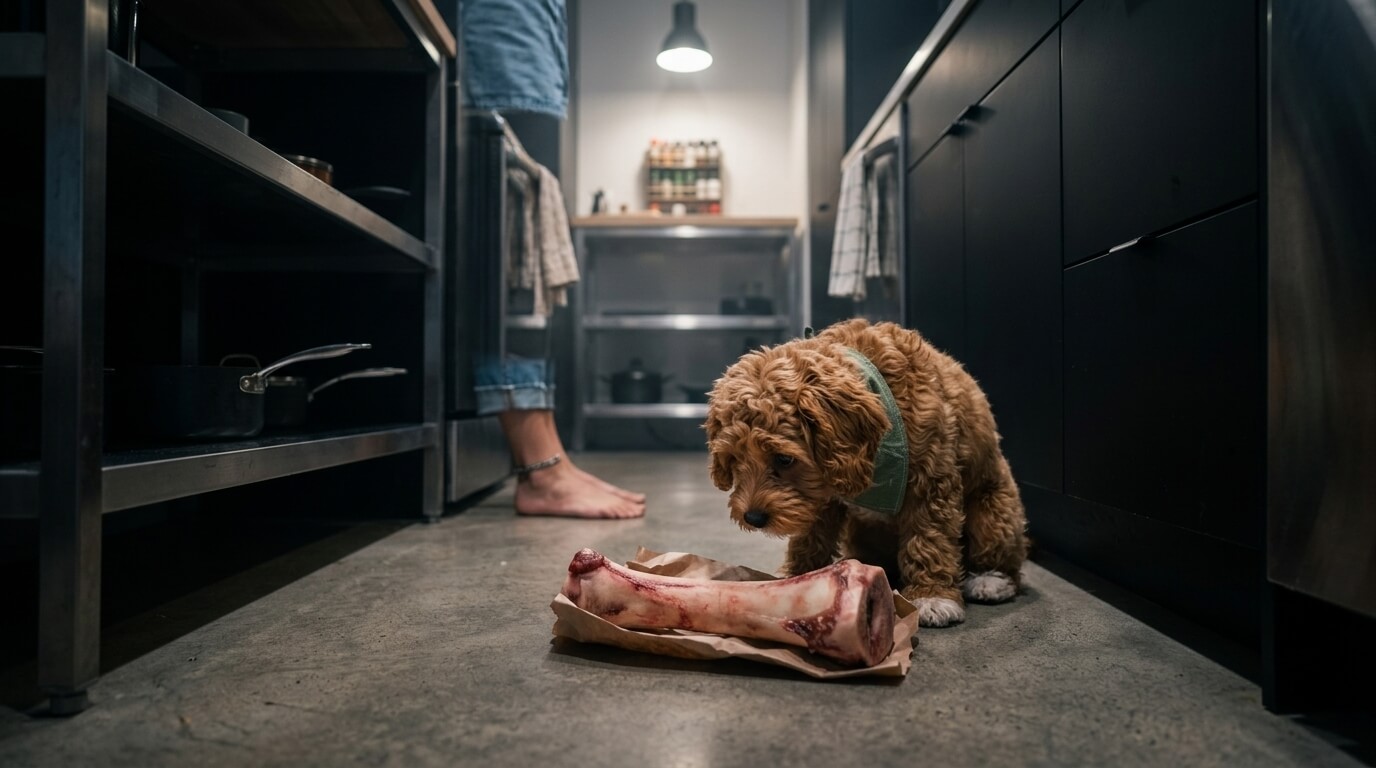
Dog resource guarding training in an apartment has to start with safety. Resource guarding means a dog becomes tense, freezes, growls, snaps, bites, or blocks access when they believe a person or animal may take something valuable. The guarded item might be food, a chew, a toy, a bed, a crate, a person, a doorway, or even a small patch of floor in a tight home.
In a house, you may have more distance and more doors. In a small apartment, conflict can happen fast. A food bowl may be two steps from the sofa. A hallway may be too narrow for two dogs to pass. A child may walk near a chew without realizing the dog is worried. That is why apartment resource guarding should not be handled with confrontation, punishment, or “taking things to show who is in charge.” If you are still setting up the home, start with the broader dog proof rental apartment guide so fewer tempting items are available in the first place.
This guide explains how to manage resource guarding in small spaces, how to teach safer trade and distance routines, when to stop DIY training, and what warning signs mean you should work with a veterinarian, certified trainer, or veterinary behavior professional.
Dog Resource Guarding Training: Quick Answer
For dog resource guarding training, first prevent conflict by managing food, chews, toys, beds, children, guests, and other pets. Then teach low-pressure trade games, add distance around valuable items, reward calm approaches, and avoid grabbing items from the dog. If the dog has bitten, snaps, stiffens intensely, guards from children, or guards multiple resources, get professional help before attempting training.
| Guarding Situation | Immediate Apartment Management | Training Direction |
|---|---|---|
| Food bowl guarding | Feed in a quiet separated area | Distance work and professional guidance if intense |
| Chew or toy guarding | Use high-value chews only in controlled spaces | Trade-up games with low-value items first |
| Bed or crate guarding | Do not reach into the resting space | Teach voluntary exits and safe boundaries |
| Guarding from another dog | Separate feeding and chews completely | Parallel routines, not shared resources |
| Guarding from children | Separate immediately with physical barriers | Professional help required |
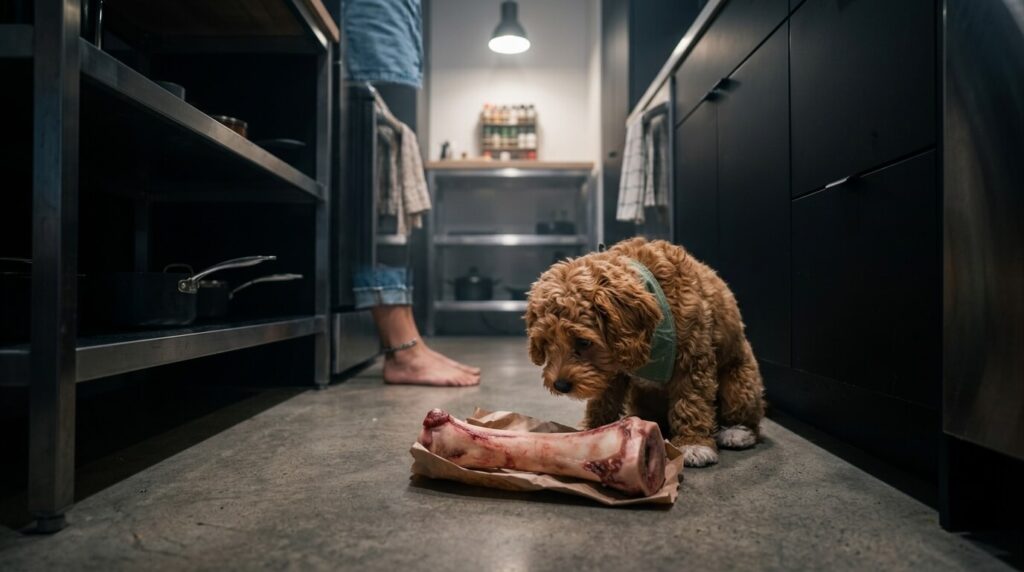
Table of Contents
What Resource Guarding Looks Like
Resource guarding is not always dramatic at first. Many dogs give small warnings before they growl or bite. In apartments, those early signs are easy to miss because people move close to the dog all day. The dog may feel crowded before the owner realizes there is a problem.
Watch for freezing, hard staring, hovering over an item, eating faster when you approach, turning the body away, lowering the head over a chew, whale eye, lip lifting, growling, snapping, or carrying items to hidden corners. Some dogs guard only from other dogs. Some guard only from children. Some guard only stolen items, such as socks, tissues, food wrappers, or trash. If trash is a repeated trigger, fix the access point first with a safer dog proof trash can apartments setup.
A growl is not the real problem. A growl is information. It tells you the dog is uncomfortable and needs distance. Punishing the growl can remove the warning without changing the fear, which may make future bites less predictable.
Why Resource Guarding Is Harder in Apartments
Small spaces reduce escape options. A dog guarding a chew under the coffee table may have people stepping around them constantly. A second dog may pass too close because there is no wider route. A guest may sit on the sofa near the dog’s favorite bed. A child may drop food and then reach for it.
Apartment routines can also increase competition. Food may be stored in one cabinet. Toys may stay in one basket. Beds may be close together. Dogs may be fed near the kitchen because there is nowhere else to put bowls. These details matter more than generic training advice.
The first goal is not to prove the dog wrong. The first goal is to lower the number of situations where the dog feels forced to defend something.
The 7 Safe Steps
1. Stop Rehearsing Conflict
Before training, change the setup. If your dog guards food, feed them in a quiet area where nobody walks by. If your dog guards chews, do not leave chews loose in the living room. If your dog guards toys from another dog, pick up toys before both dogs share the space. If your dog guards the sofa, use gates, leashes, or bed training to prevent repeated confrontations.
Every guarded episode teaches the dog that guarding works. The dog growls, the person backs away, the dog keeps the item. From the dog’s perspective, the strategy succeeded. Management prevents that loop while you build safer behavior.
2. List the Resources and Triggers
Write down exactly what the dog guards. Be specific. “Food” is too broad. Does the dog guard the empty bowl, the full bowl, wet food, dropped food, chews, trash, stolen socks, the crate, your lap, the bed, or the space under the table?
Then write who triggers the guarding: adults, children, guests, another dog, a cat, or only certain people. Record distance too. Does the dog tense when someone is six feet away, three feet away, or reaching directly toward the item?
This log tells you whether the issue is mild and narrow or broad and risky. A dog who guards one low-value toy from another dog is a different case from a dog who guards food from children and has already bitten.
3. Create Safe Feeding and Chew Zones
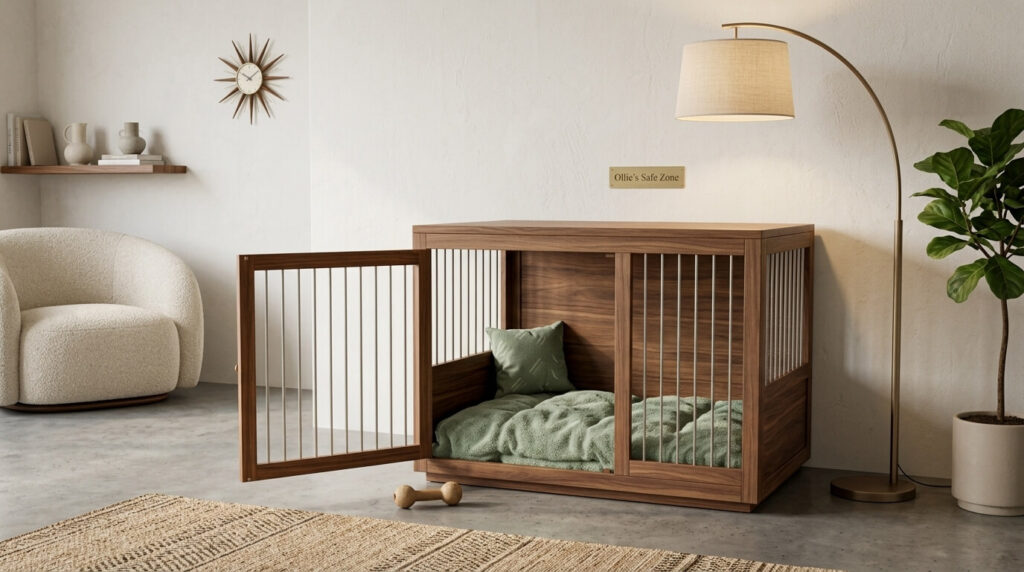
Apartment resource guarding improves faster when valuable items have predictable locations. Feed the dog in a low-traffic corner, crate, pen, bedroom, or behind a baby gate if the dog is comfortable there. Do not feed multiple dogs shoulder-to-shoulder. Do not let children walk near the bowl. Do not remove the bowl while the dog is eating.
For chews, use a rule: high-value chews happen only in separated, supervised spaces. When the chew session is over, trade for food or call the dog away before removing leftovers. Avoid walking up and grabbing the chew from the dog’s mouth.
If you have two dogs in a small apartment, separation is not optional for high-value items. Feed separately, give chews separately, and pick up leftovers before dogs rejoin. For the broader household routine, use the two dogs in small apartment guide alongside this resource-guarding plan.
4. Teach Trade-Up With Low-Value Items
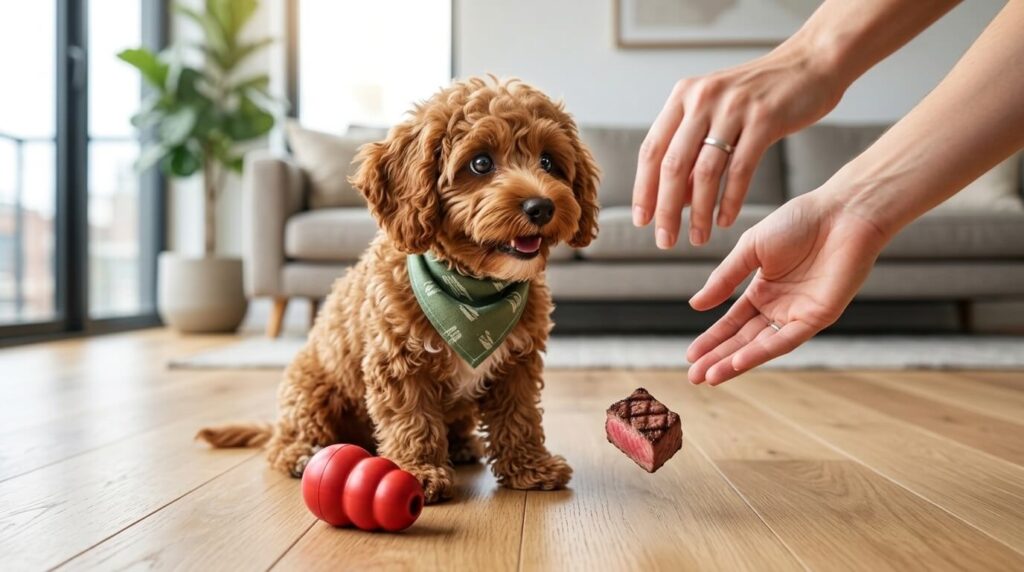
Trade training teaches the dog that giving something up can make better things happen. Start with an item your dog does not guard strongly, such as a boring toy. Offer a better treat, say “trade,” let the dog drop the item, give the treat, then return the item when safe. Returning the item matters because the dog learns you are not always taking things away forever.
Do not start with a stolen chicken bone, a bully stick, or the most valuable chew in the house. Start easy. If your dog freezes, growls, or eats faster, the item is too valuable or you are too close.
Practice short sessions. Three good trades are better than a long session that ends with tension. Over time, the dog should hear “trade” and feel expectation, not threat.
5. Add Approach-and-Retreat Work Carefully
For mild cases, you can teach the dog that a person approaching the resource predicts something good and then distance returns. For example, while the dog has a low-value chew, walk by at a distance where the dog stays loose, toss a high-value treat, and walk away. You are not reaching. You are not taking. You are changing the meaning of approach.
Only work at distances where the dog remains relaxed. If the dog stiffens, lowers their head, or stops eating, you are too close. Move farther away. The dog should think, “A person nearby makes food appear,” not “A person is coming to take my thing.”
This kind of work can be powerful, but it is also where owners often move too fast. If guarding is intense, skip DIY approach training and get professional help.
6. Teach Apartment Movement Cues
Small apartments need movement cues because people and dogs constantly share tight spaces. Teach simple cues such as “place,” “out,” “this way,” and “leave it” using rewards away from guarding situations first. These cues give you ways to move the dog without reaching into their mouth, collar, crate, or bed. If your dog also struggles in narrow shared spaces outside the unit, the dog elevator training guide can help with the same calm movement skills in hallways and lifts.
For example, if your dog is on the sofa with a toy, you can cue “place” and reward them on a bed instead of grabbing the toy. If your dog finds a wrapper, you can cue “trade” instead of chasing them through the living room. If two dogs approach a narrow hallway, you can cue one dog to a mat before tension starts.
These cues are not dominance tools. They are traffic-management tools for a small home.
7. Know When to Get Professional Help
Some resource guarding cases should not be handled alone. Get help if your dog has bitten, snaps at people, guards from children, guards from multiple household members, guards many objects, becomes stiff when approached from across the room, blocks doorways, guards a person, or shows escalating aggression.
Professional help is also important if there are children, elderly residents, guests, roommates, or multiple pets in a small apartment. The risk is not just the dog’s behavior; it is the limited space and number of people who may accidentally trigger the dog.
Start with your veterinarian if the guarding is new, sudden, or worse than before. Pain and medical problems can make dogs more defensive. A trainer or behavior professional can then help build a plan that fits your apartment layout.
What Not to Do
Avoid taking food away to “teach the dog to accept it.” Avoid putting your hands in the bowl. Avoid alpha rolls, yelling, grabbing the collar, cornering the dog, or punishing growls. These methods can increase fear and make the dog more likely to guard without warning.
Also avoid chasing the dog when they steal something. Chasing can make stolen items more valuable and more exciting. Instead, manage access to tempting items and teach trade with safe practice items before an emergency happens.
Apartment Setup for Resource Guarding
Your layout can make training easier or harder. In a studio, create zones with pens, gates, furniture placement, and storage. In a one-bedroom, use the bedroom door during meals or chews. In a multi-dog apartment, use separate rooms, crates, or gates for all high-value resources. If you are building your setup from scratch, the new dog owner checklist can help you organize bowls, gates, storage, cleaners, and safe rest areas before problems repeat.
Keep trash secured. Put laundry away. Store food, chews, and toys in closed bins. Do not leave high-value bones, puzzle toys, or food toys on the floor after the session ends. A tidy apartment is not just aesthetic. It removes triggers.
If your dog guards resting spaces, give them a bed that is off the main walking path. Do not place the bed in a doorway, hallway, or under a table where feet constantly pass close. A dog who is startled in a cramped resting spot may guard more.
How Serious Is the Guarding?
Not every resource guarding case has the same risk. A dog who briefly stiffens over a stolen tissue is not the same as a dog who bites when a child walks past the food bowl. Before choosing a training plan, sort the behavior into a rough risk level.
Lower-Risk Signs
Lower-risk cases are narrow, predictable, and easy to manage. The dog may guard one specific toy, only from another dog, or only when a very high-value chew is involved. The dog gives clear early warnings, can be called away from the item, and has not snapped or bitten.
Even lower-risk cases deserve management, but they may be suitable for careful trade training and apartment setup changes. Keep the sessions easy and avoid testing the dog with higher-value items too quickly.
Medium-Risk Signs
Medium-risk cases involve more tension, more resources, or shorter distances. The dog may freeze when someone walks by, growl over food, guard from guests, or become possessive around the sofa or bed. The dog may be difficult to call away once they have the item.
For medium-risk cases, management should be strict. Use gates, separated feeding, controlled chew sessions, and a written log. Professional coaching is strongly recommended, especially if multiple people live in the apartment.
High-Risk Signs
High-risk cases include snapping, biting, guarding from children, guarding from across the room, blocking access to people or doorways, guarding many items, or guarding that is getting worse. These cases are not good DIY projects.
If your dog is in this category, stop testing and stop taking items. Create physical separation, remove predictable triggers, and contact a veterinarian or qualified behavior professional. The goal is to prevent another rehearsal while you get a safer plan.
If the guarding appeared right after a move, do not treat it as a random personality change. A new apartment can change sleep, smells, food routines, walking routes, and access to favorite resting spots. In that case, pair this plan with the moving to apartment with dog guide so the dog has a calmer transition overall.
7-Day Apartment Management Plan
This 7-day plan is not a cure and not a replacement for professional help. It is a way to make the apartment safer while you collect information and begin low-risk routines.
Day 1: Remove Loose Triggers
Walk through the apartment and remove predictable triggers. Put laundry away, secure trash, store chews in a closed container, pick up food toys, and remove high-value toys from shared spaces. Do not leave tempting objects on the floor and then blame the dog for guarding them.
Day 2: Separate Food and Chews
Choose a consistent feeding spot. If there are multiple pets, feed behind closed doors or barriers. If the dog guards chews, give chews only during planned sessions and only when the dog has space. Pick up leftovers after calling the dog away or trading, not by grabbing.
Day 3: Start the Trigger Log
Record the resource, person or animal nearby, distance, and body language. Do not provoke the dog to collect data. Only write down what naturally happens during managed routines.
Day 4: Practice Easy Trades
Use a boring toy or low-value item. Say “trade,” offer a better treat, let the dog release the item, then give the item back if safe. End while the dog is relaxed. Do not practice with food bowls, bones, stolen trash, or anything the dog already guards strongly.
Day 5: Add Movement Cues
Teach “place,” “out,” or “this way” away from guarding situations. Reward generously. These cues help you move the dog through a small apartment without reaching into guarded spaces.
Day 6: Review Risk Level
Look at the log. Is the guarding narrow and predictable, or does it involve several resources and people? Are there children, guests, or other pets? Has the dog snapped or bitten? Use the answers to decide whether you need professional help before doing more.
Day 7: Build the Long-Term Rule Set
Write simple household rules: where the dog eats, where chews happen, who can approach, when toys are picked up, how guests behave, and what to do if the dog gets a forbidden item. Rules make resource guarding less chaotic because everyone responds the same way.
Resource Guarding With Children, Guests, or Roommates
Resource guarding around children is a professional-help situation. Children move unpredictably, drop food, reach quickly, and may not understand dog body language. Do not rely on a child to follow training instructions around a guarding dog. Use physical separation.
Guests and roommates also need simple rules. Do not touch the dog’s bowl. Do not take toys. Do not reach into the crate. Do not sit on the dog’s bed. Do not tease the dog with food. If guests cannot follow those rules, put the dog in a safe separated space with something appropriate to do.
In a small apartment, prevention is kinder than testing. The dog does not need to prove they can tolerate every person near every object. If the dog also panics or vocalizes when separated from people, read the dog separation anxiety apartments guide before using closed doors or crates as your only management tool.
Two-Dog Apartments and Resource Guarding
Multi-dog resource guarding is common because dogs compete over space, food, attention, and resting spots. Do not assume dogs will “work it out.” In a small apartment, fights can happen quickly and be hard to interrupt safely.
Feed dogs separately. Give chews separately. Pick up bowls. Pick up high-value toys. Use parallel beds with enough distance. Watch body blocking, staring, hovering, stealing, and one dog avoiding an area because the other dog controls it.
If fights have happened, get professional help. Do not attempt to force sharing. Many peaceful multi-dog homes work because owners manage resources clearly, not because the dogs share everything naturally.
Daily Training Log
A training log keeps you honest. Resource guarding can improve slowly, and memory is unreliable. Use a simple table for two weeks.
| Date | Resource | Trigger | Distance | Dog Response | Next Step |
|---|---|---|---|---|---|
| Example | Food bowl | Adult walking by | 6 feet | Loose body, kept eating | Repeat same distance |
| Example | Chew | Other dog entered room | 10 feet | Stiffened and stared | Use full separation for chews |
Look for patterns. If the dog guards only one resource, management may be straightforward. If guarding spreads to more items or shorter distances, pause and get help.
FAQ
Can resource guarding be trained out of a dog?
Resource guarding can often be improved with management, trade training, distance work, and professional help when needed. It should not be treated as something to punish out of the dog. The goal is safer behavior and lower stress, not forcing the dog to tolerate unsafe handling.
Should I take my dog’s food away to prevent guarding?
No. Taking food away repeatedly can teach the dog that people near the bowl are a threat. Instead, feed in a safe area, avoid bothering the dog while eating, and use professional guidance for bowl-guarding cases.
Why does my dog guard stolen items?
Stolen items become valuable because they smell interesting, get attention, or trigger chase games. Manage access to socks, trash, wrappers, and tissues. Teach trade with low-value items before trying it during a real stolen-item moment.
Is growling during resource guarding bad?
Growling is a warning sign. Take it seriously, create distance, and adjust the plan. Do not punish the growl, because the dog may stop warning before they are actually comfortable.
How do I stop my dog guarding toys from another dog?
Start with management. Pick up high-value toys when dogs are together, give chews separately, and supervise play. If there is stiff body language, snapping, or fights, get professional help before trying shared-toy training.
When should I call a trainer for resource guarding?
Call a qualified trainer or behavior professional if the dog has bitten, snaps, guards from children, guards multiple items, guards from far away, blocks spaces, or lives with other pets in a small apartment. Call a veterinarian if the behavior is sudden or worsening.
Next Step
Today, do not start by testing your dog. Start by making the apartment safer. Feed in a quiet place, remove loose high-value items, separate dogs for chews, keep children away from resources, and stop grabbing things from your dog’s mouth.
Then begin dog resource guarding training with low-value trade games and a written log. If the guarding is intense, involves children, or has already led to snapping or biting, pause the DIY plan and get professional support. In a small apartment, the safest training plan is the one that prevents conflict before it has a chance to repeat.