
Dog city noise anxiety can make apartment life feel unfair. Your dog may be fine in the living room, then fall apart when a garbage truck stops outside, a siren passes between buildings, someone drops a package in the hallway, or the elevator dings at the wrong moment. From the outside, it can look like overreacting. From the dog’s point of view, the city is loud, sudden, close, and hard to predict.
This is especially hard for apartment owners because you cannot control the soundscape. You cannot ask the city to stop construction at 7 a.m., tell your neighbor not to roll a suitcase past your door, or make a fire truck choose another street. What you can do is lower your dog’s overall stress, change how you handle noise moments, and build a plan that fits real apartment life.
This guide is written for city renters and small-space dog owners. It does not promise that every dog will become relaxed around every noise. Some dogs need veterinary behavior support. Some need medication as part of a plan. Many improve when their owner stops pushing through noise and starts working under threshold.
Quick Answer
For dog city noise anxiety, start by reducing exposure during the worst noise windows, creating a predictable indoor resting spot, and using short reward-based sound practice only at a level where your dog can still eat, sniff, respond, and recover. Do not flood your dog with loud recordings, force street walks during panic, punish barking or shaking, or expect one product to solve the problem.
| Noise Situation | Better First Response | What to Avoid |
|---|---|---|
| Garbage truck outside | Move away from windows and scatter treats on the floor | Dragging the dog to the window to “show them it is fine” |
| Sirens during a walk | Increase distance, step behind a parked car or building edge, feed calmly | Holding the leash tight and forcing forward movement |
| Hallway door slams | Use white noise, a mat station, and predictable door routines | Yelling at the dog for barking after the sound |
| Construction days | Shorten walks, use indoor enrichment, and choose quieter routes | Keeping the normal schedule if your dog is already overwhelmed |
| Fireworks or storms | Talk to your veterinarian early and prepare a safe room | Waiting until the dog is panicking before asking for help |
If your dog reacts mostly by barking at hallway sounds, also read stop dog barking in apartment. If the problem starts in elevators or lobbies, pair this guide with dog elevator training.

Table of Contents
Why City Noise Feels Different to Dogs
City noise is not just loud. It is layered. A dog in an apartment may hear people above, dogs below, trucks outside, doors in the hallway, elevators, plumbing, construction, motorcycles, sirens, skateboards, and rolling carts. Many of those sounds arrive without a visible source. That matters because dogs often cope better when they can understand where something is coming from.
Apartment buildings also change sound. A hallway can make footsteps echo. A courtyard can bounce barking from another unit. A high-rise can carry sirens upward and make them seem closer than they are. A dog may not be reacting to one clean sound. They may be reacting to a confusing mix of vibration, echo, pressure, and movement.
That is why the answer is rarely “just expose them more.” More exposure can help only when the dog is below threshold and the exposure is carefully controlled. If your dog is trembling, lunging, hiding, panting, refusing food, trying to flee, or unable to respond to you, the lesson is not “city sounds are normal.” The lesson may become “city sounds are too much and I have no escape.”
Trigger Stacking: The Part Owners Often Miss
Many city dogs do not react because of one noise. They react because the noise lands on top of an already difficult day. A dog may tolerate one siren after breakfast, then lose control later because they also had a rushed elevator ride, a delivery person at the door, a strange dog in the lobby, and construction outside the building.
This is called trigger stacking in everyday training language. It means stress adds up. The fifth sound may look like the cause, but the day was filling the cup long before that moment.
When an owner misses trigger stacking, they often feel confused or guilty. “He was fine yesterday.” “She handled that same truck last week.” That inconsistency is normal. Dogs are living bodies, not machines. Sleep, pain, hunger, weather, age, hormones, routine changes, and previous scary moments all change how much noise a dog can handle.
For apartment dogs, I like tracking three things for one week: the loudest noises, the time of day, and how quickly the dog recovered. Recovery is more useful than drama. A dog who startles and settles in ten seconds is in a different place from a dog who pants for an hour after one hallway bang.
The 7 Safe Steps
1. Make one quiet base inside the apartment
Your dog needs one place where noise practice does not happen. This can be a crate, bedroom corner, covered bed, interior hallway, bathroom, or spot away from windows. The point is not to hide your dog from the world forever. The point is to give the nervous system a predictable place to come down.
A good base has soft bedding, water nearby, familiar scent, and a little sound buffering. A fan, white noise machine, or steady music can help mask hallway and street sounds. Do not trap your dog there if confinement makes them more worried. The best resting spot is one your dog can use without feeling cornered.
If your dog is also struggling with alone time, read how long you can leave a dog alone in an apartment. Noise anxiety and isolation stress can feed each other, especially when the dog spends long hours listening to building sounds without you.
2. Stop rehearsing panic on the loudest routes
Some owners keep walking the same route because they want the dog to “get used to it.” If that route includes buses, metal grates, school dismissal, construction, and barking dogs behind fences, it may be too much right now. Repeated panic is not training. It is practice at being afraid.
For a few weeks, choose boring routes. Walk earlier, later, or on side streets. Use short potty walks instead of long exposure walks on loud days. If your building exit is the hard part, spend time near the lobby at quiet hours, then go back upstairs before your dog tips over threshold.
This is not avoidance in a lazy sense. It is management. Merck Veterinary Manual describes management and controlled behavior modification as part of behavior treatment. In plain owner language: stop making the dog fail while you teach the skills they need.
3. Pair quiet versions of city sounds with food
Sound practice should start so low that it feels almost silly. Play a city sound recording at a quiet volume while your dog eats treats, licks a mat, or plays an easy game. If your dog stops eating, scans the room, leaves, barks, or stiffens, the sound is too much.
Keep sessions short. One or two minutes is enough at first. The goal is not to finish a playlist. The goal is for your dog to hear a tiny version of the sound and think, “That predicts something good and I can still relax.”
Do not increase volume in a straight line every session. Real progress often looks uneven: softer one day, slightly louder another day, shorter after a stressful morning, easier again after good sleep. Good training follows the dog in front of you, not a chart you wish the dog would match.
4. Use food on walks before the dog explodes
Many owners wait until the dog reacts, then try to feed. At that point, food may not matter. Try feeding earlier: when your dog hears a distant siren, notices a truck, or looks toward a noise but can still think. Mark the moment with a soft “yes” or simply place food on the ground.
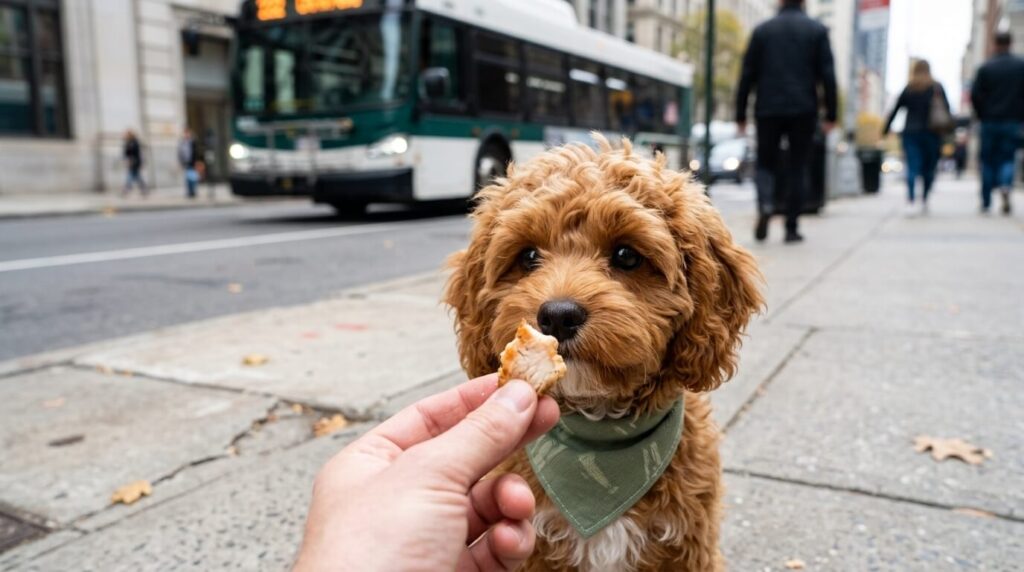
Ground feeding works well for many city dogs because sniffing lowers intensity. It also gives your hands something calmer to do than tightening the leash. If your dog will not take food outdoors, start on quieter blocks or use better food. If food still does not work, the environment is probably too hard.
This is where owners often feel embarrassed. The dog is barking, people are staring, and your brain says, “Just get out of here.” That is understandable. Still, the goal is to move with your dog, not against them. Increase distance, lower pressure, and try again in easier conditions.
5. Build a recovery routine after bad noise moments
Recovery is part of training. After a hard sound event, do not immediately ask for obedience, another walk, or more exposure. Give your dog a quiet reset: water, a chew, a familiar bed, a slow sniff game, or a few minutes in a darker room.
For apartment dogs, a post-noise routine can protect the rest of the day. A dog who has just shaken through construction outside may not need a busy dog park later. They may need a shorter walk and indoor decompression. The guide on DIY dog enrichment ideas can help you give the dog something useful to do without adding more city pressure.
6. Choose calming tools carefully
Some dogs benefit from ear-covering snoods, pressure wraps, pheromone products, calming music, puzzle feeders, or supplements. Some do not. Tools are support, not proof that the dog is okay. If a dog is frozen under a wrap or hiding in a snood, that is not calm. That is still stress.
Introduce any tool on an easy day, away from the problem noise. Let the dog sniff it, wear it briefly, and pair it with food. Do not pull out a brand-new wrap for the first time during fireworks or a thunderstorm and expect the dog to understand.
If you are considering supplements or medication, start with your veterinarian. The article on calming aids for dogs can help you think through categories, but your dog’s age, health, medication history, and severity matter.
7. Know when the problem needs professional help
Get help if your dog panics, injures themselves, cannot recover after noises, refuses to go outside, redirects onto you, becomes aggressive, stops eating around sound, or seems worse despite careful work. Also get help if you dread every walk. Owner stress matters too. A plan that only works for a perfect person on a perfect week is not a good apartment plan.
Your veterinarian can check for pain, hearing changes, cognitive changes, medication needs, and medical issues that may affect behavior. A qualified force-free trainer or veterinary behavior professional can help you set thresholds and practice safely.
Apartment Noise Problems by Location
Windows facing a busy street
Use visual blocking if motion adds to the noise reaction. Frosted window film, curtains, or moving a sofa away from the window can help. Many dogs are not reacting only to sound. They are reacting to the full event: the truck appears, brakes hiss, people shout, the building vibrates, and then the dog sees movement below.
Hallway sounds
Hallway noise feels personal to dogs because it happens near the home boundary. Pair hallway sounds with quiet food scatters before barking starts. If your dog patrols the door all day, create distance with a gate or furniture layout. For repeated complaints, connect this work with dog neighbor noise complaint.
Elevators and lobbies
Elevators combine sound, motion, confinement, strangers, and sudden door openings. A dog with city noise anxiety may be calm upstairs but unravel in the elevator. Practice at quiet times: approach, feed, leave; stand near the elevator, feed, leave; enter briefly when empty, feed, leave. Do not save all training for the busiest morning rush.
Construction outside the building
Construction is hard because it is unpredictable and often vibrates through floors and walls. On heavy construction days, lower your expectations. Close windows, use white noise, move the dog to an interior room, shorten walks, and avoid stacking extra challenges. If your dog is alone during construction, a pet camera may show whether they are sleeping, pacing, barking, or panicking.
What Not to Do
Do not punish fear. Scolding may stop noise for a second, but it can make the city feel even less safe. Do not drag your dog toward a sound to prove there is nothing there. Do not play recordings so loudly that your dog hides. Do not assume a dog who stops moving has relaxed. Freezing is not comfort.
Do not compare your dog to easier dogs in the building. Some dogs stroll past sirens like nothing happened. Others need six months to feel safe on one block. Your job is not to win the sidewalk. Your job is to help the dog in your apartment build a life they can handle.
Also be careful with social media advice. A short clip can make a behavior plan look simple. Real anxiety work is slower. It often includes dull decisions: quieter routes, better sleep, fewer stacked triggers, lower sound volume, and stopping before the dog melts down.
A Simple 14-Day Reset
If your dog has been having a rough city stretch, take two weeks to lower the baseline instead of chasing big progress.
| Days | Main Goal | What You Do |
|---|---|---|
| 1-3 | Reduce pressure | Use quiet potty routes, indoor enrichment, and a resting base |
| 4-7 | Observe patterns | Track the noises, times, and recovery speed |
| 8-10 | Start tiny sound practice | Use very quiet recordings with food for short sessions |
| 11-14 | Practice one easy real-world moment | Work near a mild trigger at distance, then end while your dog is still okay |
This reset is not a complete behavior program. It is a way to stop the spiral. Many owners notice that once the dog’s baseline drops, the dog can learn again.
How to Handle the Awkward Public Moments
City noise anxiety is not only hard on dogs. It is hard on owners because it often happens in public. Your dog may bark at a bus while someone waits behind you on the sidewalk. They may freeze in the lobby while a neighbor holds the elevator. They may spin at the curb while you are carrying coffee, keys, bags, and the leash. In those moments, it is easy to feel watched and start managing the strangers instead of helping the dog.
Prepare one calm sentence for people: “We are working on noise training, go ahead of us.” That is enough. You do not need to explain your dog’s history to every neighbor. You do not need to prove you are a good owner on the sidewalk. A simple sentence gives you permission to step aside, feed your dog, take distance, or go back inside.
Also prepare one exit move. For example, cross the street when the garbage truck appears, turn into a driveway opening, step behind a parked car, return to the lobby, or scatter food by your feet while the sound passes. When you already know your exit move, you are less likely to freeze with your dog.
If someone says, “He just needs to get used to it,” you can let that comment pass. Most people mean well, but they are not living with the dog later that night when the stress shows up as pacing, barking, clinginess, or refusing dinner. Your plan should be based on your dog’s body language, not a stranger’s confidence.
When Training Should Pause for the Day
A very human mistake is trying to recover the day after it has already gone sideways. Your dog reacts to construction in the morning, so you decide to practice sirens in the afternoon because you do not want to lose progress. But progress is not built by adding pressure to a tired nervous system.
Pause active training for the day if your dog has had a major scare, skipped food, had stomach upset, slept poorly, startled repeatedly, or cannot settle indoors. Use management instead: quieter potty breaks, lower lights, sound masking, a chew if safe for your dog, and fewer demands. This is not giving up. It is choosing the lesson your dog can actually learn today.
Owners often relax when they hear this because it removes the feeling that every day must be a training day. Some days are recovery days. In a city apartment, that may be the difference between a dog who slowly builds confidence and a dog who lives in a constant state of bracing for the next sound.

FAQ
Can dog city noise anxiety get worse over time?
Yes, it can, especially if the dog keeps experiencing intense fear without relief. Repeated overwhelming exposure can make some dogs more sensitive, not less. If your dog is getting worse, reduce exposure and ask your veterinarian or a qualified behavior professional for help.
Should I use city noise recordings for training?
Recordings can help when they are quiet enough that your dog stays relaxed. They are not useful if they make the dog bark, hide, shake, or refuse food. Start low, keep sessions short, and pair sounds with something your dog enjoys.
Is it okay to comfort my dog during loud noises?
Yes. Calm support does not reward fear in the way many owners worry about. Use a steady voice, create distance, offer food if the dog can eat, and help the dog settle. Avoid frantic touching if your dog dislikes it when stressed.
Will my dog ever get used to sirens?
Some dogs become much more comfortable. Some remain sensitive but recover faster. The realistic goal is not always total indifference. A good goal may be hearing a siren, looking to you, taking food, and moving on without a long stress crash.
Are calming supplements enough for noise anxiety?
Usually not by themselves. Supplements may support some dogs, but environment management, training, recovery time, and veterinary guidance matter more. Talk to your veterinarian before combining products or using anything for a dog with health issues.
Should I keep walking if my dog freezes at city noise?
Do not pull a frozen dog forward. Pause, create distance if possible, use food if the dog can take it, and choose an easier route next time. Freezing is a sign the dog may be over threshold.
Next Step
For the next week, do not try to solve every city sound. Pick one pattern: hallway bangs, garbage trucks, sirens, elevators, or construction. Lower the difficulty, track recovery, and practice below threshold. If your dog cannot recover from normal city noise or your own stress is climbing, bring your veterinarian into the plan.