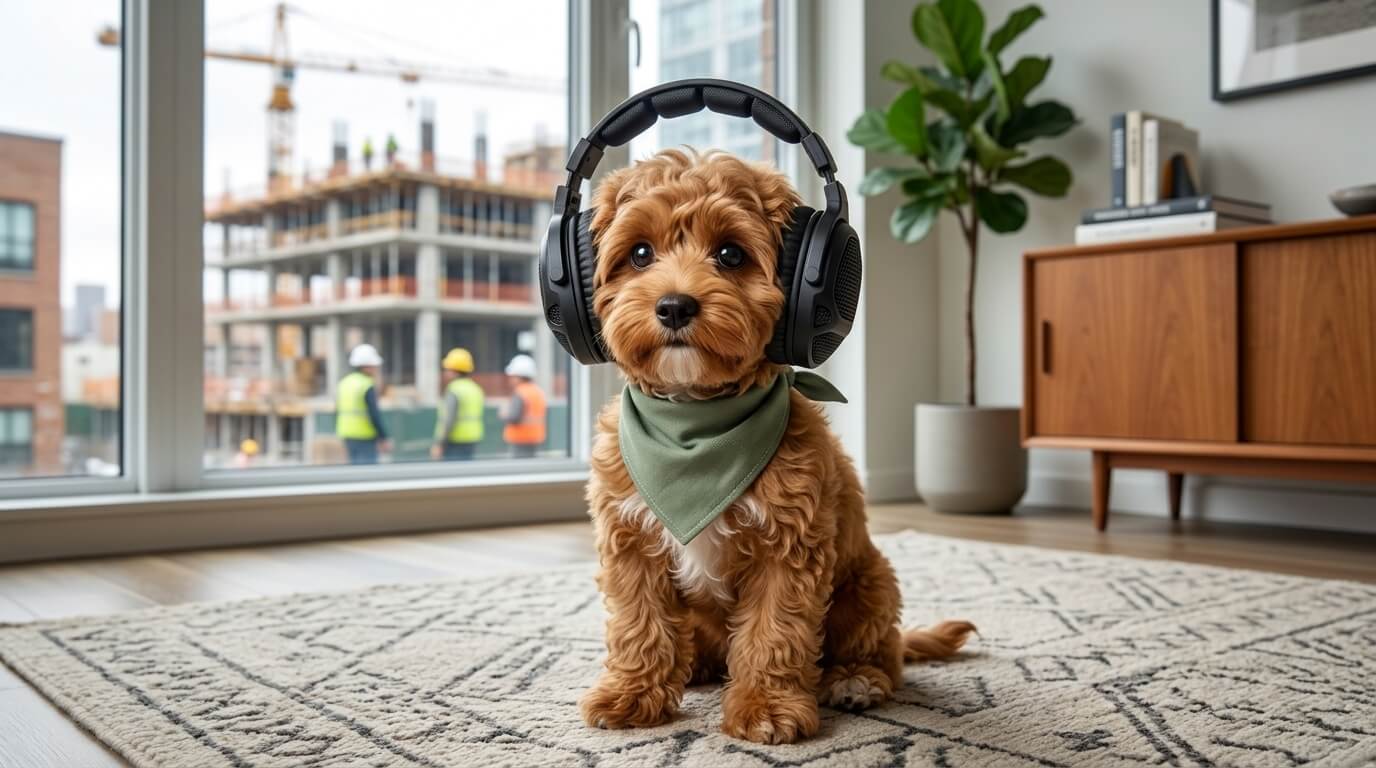
Dog hearing protection can be useful for a short, very loud, predictable event, but it is not a treatment for fear or chronic city-noise anxiety. The useful comparison is not simply which product publishes the largest number. It is whether the product is active noise cancelling or passive, whether its sound-reduction claim has a clear test context, whether it fits your dog securely, and whether your dog can wear it without distress.
This guide compares five current dog hearing-protection products using manufacturer-published information. Sound-reduction figures from different test systems are shown separately and are not ranked against one another. Where a manufacturer does not publish a value, the matrix says Not specified.
Quick Answer
For scheduled construction, nearby fireworks, loud maintenance work, or another unavoidable high-noise window, appropriately fitted dog hearing protection may reduce part of the airborne sound reaching the ears. It cannot stop vibration traveling through apartment floors and walls, guarantee calm behavior, or replace distance, a quieter room, gradual acclimation, and professional help when fear is severe.
If your dog mainly reacts to everyday sirens, traffic, hallway doors, elevators, or unfamiliar city sounds, start with our dog city noise anxiety guide. Those patterns usually need environmental management and behavior work rather than routine use of ear protection.
Terminology: These Products Do Not All Work the Same Way
- Active noise cancellation (ANC) uses electronics, microphones, and speakers to counter parts of incoming sound. In this comparison, only PAWNIX is presented by its manufacturer as an active noise-cancelling product.
- Passive attenuation uses a physical barrier, acoustic foam, sealed ear cups, or a fitted hood to reduce sound energy reaching the ear.
- Hearing protection describes the intended protective job. The strength of that claim depends on the product design and the quality and context of its attenuation evidence.
- Earmuffs describe a product shape. The word alone does not prove a specific noise reduction.
- Calming hoods or snoods cover the ears or head and may offer light muffling or gentle pressure, but they are not automatically hearing protection.
- Compression wraps are behavior-management accessories. They do not protect the ears unless a manufacturer provides separate, relevant sound-attenuation evidence.
First Decide: Hearing Hazard or Anxiety Trigger?
Hearing hazard or very loud event
Examples include sustained power tools in the building, nearby renovation equipment, fireworks close to the apartment, or another intense event that cannot be avoided immediately. The first choices are still distance and leaving the noise area when practical. Evidence-supported hearing protection may be an additional layer after correct fitting and quiet-time acclimation.
Startle, fear, or chronic city-noise anxiety
A dog who freezes at buses, barks at hallway doors, avoids the elevator, or panics when sirens pass may have a behavioral fear pattern rather than a hearing-protection problem. Priorities usually include more distance, a predictable environment, desensitization, counterconditioning, and veterinary or behavior support when appropriate. Ear gear must not be presented as a treatment for anxiety.
Dog Hearing Protection Comparison
Evidence note: The published figures below use different terms and test conditions. Rex Specs reports frequency-specific manufacturer-published testing, PROHEAR publishes an NRR, PAWNIX and Doggie Hush publish their own reduction claims, and PuroPup does not publish a numerical attenuation value. These numbers should not be converted into a quietest-to-loudest ranking.
| Product | Protection Type | Intended Use | Size Range | Fit System | Materials | Published Sound-Reduction Claim | Evidence / Test Type | Weight | Care | Dog Tolerance Considerations | Apartment Scenario | Main Safety Limitation |
|---|---|---|---|---|---|---|---|---|---|---|---|---|
| Rex Specs Ear Pro | Passive attenuation hood | High-noise work, travel, machinery, fireworks | Sizes 2, 3, 4; published head circumference ranges 13–21 in | Form-fitting hood; four-point stretch system | Four-way stretch fabric and sound-absorbing foam | 18–24 dBA at 20–120 Hz in manufacturer-published testing under specified conditions | Real-ear testing described by manufacturer; 95 dBA white-noise exposure; frequency-specific result | Not specified | Not specified | Must tolerate a hood passing over the head and ears | Scheduled renovation or nearby fireworks | Published result is test-condition specific and is not an NRR |
| PAWNIX Greyfriars Bobby Headset | Active noise cancellation plus passive foam | Fireworks, thunderstorms, travel, loud events | Xtra Small, Smedium, Medium, Large, Xtra Large | Full-head headset; collar-securement loop | Comfort foam; other exact materials not specified | Approx. ±30 dB reduction — manufacturer claim; not treated as standardized NRR | Manufacturer describes hybrid ANC with two microphones and one speaker per ear; full protocol not published on product page | Not specified | Not specified | Bulky electronic headset requires careful acclimation; check for slipping and heat | Predictable fireworks or renovation window after training | Do not use if the electronic unit produces crackling or high-pitched noise; manufacturer advises replacement |
| PROHEAR Adjustable Dog Ear Muffs | Passive earmuffs | Fireworks, thunderstorms, construction, travel | Small, Medium, Large | Multi-level adjustable elastic headband | High-density acoustic foam, ABS shell; foam or gel ear-pad option | NRR 28 dB — manufacturer published | Manufacturer-published NRR; reviewed product page does not provide a full dog-specific test report | Not specified | Not specified | Individual ear cups must stay aligned while the dog moves | Short construction or fireworks session | Protection depends on stable fit; monitor for shifting or pressure |
| PuroPup Dog Earmuffs | Passive earmuffs | Fireworks, thunderstorms, busy environments | XS, S, M, L | Adjustable straps | Soft, breathable materials; exact composition not specified | Not specified | Manufacturer describes sound-blocking technology but publishes no numerical attenuation or NRR | Not specified | Manufacturer states machine washable | Check strap pressure, cup alignment, and pawing | Portable option for a short, supervised noise event | No published numerical sound-reduction evidence |
| Doggie Hush | Passive noise-reducing earmuffs | Fireworks, thunder, travel, grooming and city noise | Exact ranges not specified in reviewed page text; size guide is image-based | Adjustable straps with stated 2–3 in adjustment range | Acoustic foam, sound-dampening fabric, waterproof outer shell; neoprene stated in care guidance | Up to approximately 32 dB — manufacturer claim | Manufacturer says lab-tested; reviewed page does not link the protocol, frequency data, or standardized NRR report | Not specified | Hand wash with mild soap and warm water; air dry; do not machine wash or tumble dry | Acclimate to the strap and ear cups; verify the dog can hear handling cues | Fireworks or loud maintenance after fit practice | Numerical claim lacks a linked test report; do not treat it as independently verified |
How the Five Options Differ
Rex Specs Ear Pro
Manufacturer specification: Rex Specs describes Ear Pro as a low-profile, form-fitting hood built with four-way stretch fabric and sound-absorbing foam. Its size guide covers published head circumferences from 13 to 21 inches. The manufacturer also publishes real-ear testing performed under a 95 dBA white-noise condition, with 18–24 dBA attenuation reported at 20–120 Hz.
Editorial assessment: This is the clearest frequency-specific test context among the five reviewed products, but it is still manufacturer-published product evidence and is not directly comparable with an NRR or a different manufacturer’s broad reduction claim. The hood design may be easier to keep aligned than separate cups, but only if the dog accepts close head coverage.
PAWNIX Greyfriars Bobby Headset
Manufacturer specification: PAWNIX describes a hybrid active noise-cancelling system with two microphones and one speaker per ear, passive comfort foam, Bluetooth 5.0, a volume cap stated at 50 dB, up to 30 hours of battery life, and five sizes. The manufacturer claims approximately ±30 dB reduction.
Editorial assessment: This is the only reviewed option explicitly presented as active noise cancelling. The published reduction figure is not treated as a standardized NRR. Because the product contains electronics near the ears, follow the manufacturer’s warning: do not put it on the dog if it produces crackling or high-pitched noise.
PROHEAR Adjustable Dog Ear Muffs
Manufacturer specification: PROHEAR lists an NRR of 28 dB, S/M/L sizes, an adjustable elastic headband, high-density acoustic foam, an ABS shell, and foam or gel ear-pad choices.
Editorial assessment: A published NRR is useful product evidence, but the reviewed product page does not provide a full dog-specific laboratory report. Separate ear cups also depend on staying centered while a dog turns, lies down, or paws at the equipment.
PuroPup Dog Earmuffs
Manufacturer specification: PuroPup is sold in XS, S, M, and L with adjustable straps and soft, breathable materials. The manufacturer describes sound-blocking technology and says the product is machine washable.
Editorial assessment: The product page does not publish an attenuation number, NRR, or test method. It may still be considered as an ear-covering product, but the matrix correctly lists sound reduction as Not specified rather than estimating protection.
Doggie Hush
Manufacturer specification: Doggie Hush describes passive ear cups with acoustic foam, sound-dampening fabric, a waterproof outer shell, adjustable straps, and hand-wash care. The manufacturer claims reduction up to approximately 32 dB.
Editorial assessment: The reviewed page says the product is lab-tested but does not link a full protocol, frequency graph, or standardized NRR report. The number should therefore remain a clearly labeled manufacturer claim, not a basis for calling this product stronger than another option.
Apartment Noise Scenarios
Fireworks in a dense neighborhood
Move to the most interior available room before the event, close windows and curtains, and begin steady background sound before the first booms. Hearing protection is an optional extra layer only if the dog has already learned to wear it calmly. A dog with severe fireworks panic may need a veterinary plan before the holiday.
Scheduled renovation or maintenance work
Ask for the expected work window, arrange time outside the building when possible, and choose the room farthest from the work. Ear protection may reduce part of the airborne sound, but drilling and hammering can also travel through the structure as vibration. No ear product stops floor-borne vibration.
Sirens, traffic, hallway doors, and elevator noise
These are often brief, repeated triggers rather than a continuous hearing hazard. Distance, route choice, predictable elevator routines, door management, and behavior training usually matter more than putting on earmuffs throughout the day. If a dog needs equipment for every ordinary sound, reassess the anxiety plan with a qualified professional.
Fire alarm
Emergency evacuation takes priority. Do not delay leaving the apartment to find, fit, or adjust hearing protection. Follow the building’s evacuation procedure and move the dog to safety.
How to Acclimate a Dog in a Small Apartment
- Leave the gear where the dog can investigate it during a quiet period.
- Reward looking at or approaching it without forcing contact.
- Practice brief head and ear handling separately.
- Touch the gear to the head, reward, and remove it.
- Build from one or two seconds of wear to short calm sessions.
- Add mild everyday sound only after the dog can wear the product comfortably.
- Stop if the dog freezes, paws frantically, tries to escape, pants heavily, overheats, or becomes more distressed.
Small apartments offer less distance from the training setup, so keep the floor clear and give the dog an obvious exit from the session. Store equipment dry and out of reach, and clean it according to the manufacturer’s instructions before odor, moisture, or debris makes the next fitting unpleasant.
Fit and Safety Checks
- Measure the exact location specified by the manufacturer; dog weight alone is not a reliable substitute.
- Check that ear cups or foam remain over the ear opening when the dog turns or lies down.
- Confirm that straps do not press the throat, eyes, jaw, or breathing structures.
- Use short, supervised sessions and check for heat and moisture.
- Do not use ear-covering equipment over an ear infection, painful ear, wound, or recent surgery without veterinary guidance.
- Remove the product if it changes breathing, balance, movement, or responsiveness.
- Do not assume reduced sound means the dog is emotionally comfortable.
Hearing Protection Does Not Treat Anxiety
Physical attenuation and emotional recovery are different outcomes. A product may reduce some sound while a dog continues to react to vibration, visual flashes, smells, changes in routine, or remembered fear. Conversely, a dog may appear calmer because the safe room and owner routine improved even when the product’s attenuation is unknown.
For chronic fear, use gradual desensitization and counterconditioning rather than waiting for a full-intensity event. VCA explains that exposure must remain low enough for learning, and ASPCA guidance emphasizes addressing the underlying behavior problem instead of relying on punishment or a single accessory.
FAQ
Are dog earmuffs the same as noise-cancelling headphones?
No. Most dog earmuffs are passive barriers. Active noise-cancelling products use electronics to counter parts of incoming sound. The terms should not be used interchangeably.
Does a snood protect a dog’s hearing?
Not automatically. A snood may cover the ears, provide light muffling, or offer gentle compression, but it should not be described as hearing protection without relevant manufacturer evidence.
Can I compare the published dB numbers directly?
No. An NRR, a frequency-specific attenuation result, an active-noise-cancellation claim, and an unlinked manufacturer laboratory claim are different forms of evidence. The test conditions and methods must be understood before drawing conclusions.
Can my dog wear hearing protection all day?
This guide does not recommend all-day wear. Use short, supervised sessions, follow the product instructions, and monitor heat, pressure, moisture, balance, and distress.
What if my dog refuses to wear it?
Do not force the equipment. Return to brief quiet-time exposure or use distance, a safer room, background sound, temporary care outside the building, and professional guidance when needed.
Manufacturer and Behavior Sources
- Rex Specs: Ear Pro for Dogs
- Rex Specs: Manufacturer-Published Ear Pro Performance
- PAWNIX: Greyfriars Bobby Headset
- PROHEAR: Adjustable Dog Ear Muffs
- Puro Sound Labs: PuroPup Dog Earmuffs
- Doggie Hush: Noise-Reducing Ear Muffs
- VCA Hospitals: Desensitization and Counterconditioning
- VCA Hospitals: Fears, Phobias, and Anxiety
- ASPCA: Common Dog Behavior Issues
Product specifications and availability were reviewed on August 30, 2026. Manufacturers can revise products, testing statements, sizing, and care instructions. Confirm the current manufacturer guidance before purchase or use.