
Wet food vs dry food for dogs is not a contest with one winner for every apartment dog. It is a feeding decision shaped by your dog’s health, life stage, appetite, teeth, stool, calorie needs, budget, storage space, and work schedule. Apartment life adds a few unglamorous details too: refrigerator space, bowl cleanup, food odors, pests, and whether a midday meal must sit in an automatic feeder.
Dry food is convenient, affordable, easy to measure, and simple to use in puzzle toys or automatic feeders. Wet food is higher in moisture, often more tempting for picky eaters, and sometimes easier for dogs with certain chewing or appetite issues. Mixed feeding can work beautifully for some dogs, but it can also create picky habits, calorie creep, messy bowls, and refrigerator leftovers that slowly become everyone’s problem.
The best answer is not “wet is healthier” or “dry cleans teeth.” The best answer is the one your dog can digest, your veterinarian supports, your apartment routine can maintain, and your budget can keep buying without drama.

Table of Contents
Quick Answer
For most healthy apartment dogs, either complete and balanced wet food or complete and balanced dry food can work. Dry food is usually easier for storage, measuring, enrichment toys, and workday feeding. Wet food may help with moisture intake, appetite, and texture preference, but it needs refrigeration after opening and faster cleanup. Many owners use a mixed approach: dry food as the base and wet food as a measured topper.
| Apartment Need | Often Easier Choice | Why |
|---|---|---|
| Long workday feeding | Dry food | Works better in automatic feeders and puzzle toys |
| Picky appetite | Wet food or measured topper | Often has stronger smell and softer texture |
| Small kitchen storage | Dry food in original bag inside bin | Less refrigeration and fewer open containers |
| Hydration support | Wet food | Contains much more moisture than kibble |
| Odor control | Dry food or careful wet-food cleanup | Wet leftovers smell faster in small rooms |
| Budget predictability | Dry food | Usually costs less per calorie |
If you want the broader nutrition framework, read best diet for apartment dogs. This article focuses specifically on food format and apartment routine.
Wet Food vs Dry Food for Dogs: Read the Label First
The format of a food tells you how it is packaged and how much water it contains. It does not, by itself, tell you whether the diet is nutritionally appropriate. A glossy wet food can be a complete diet, a topper, or a product intended only for intermittent feeding. The same is true of some refrigerated, freeze-dried, and specialty foods. Start with the nutritional adequacy statement rather than the photograph on the front.
For dogs in the United States, look for wording that identifies the food as complete and balanced for the correct life stage. The FDA explains that this claim generally means the diet either meets an AAFCO nutrient profile or passed a feeding trial using AAFCO procedures. Adult maintenance, growth, reproduction, and “all life stages” are not interchangeable labels. A growing puppy, a healthy adult, and a senior dog with a medical condition may need different nutritional decisions.
Also check whether the product is described as a treat, topper, supplement, or food for intermittent or supplemental feeding only. Those products can be useful, but they should not quietly replace a complete diet. The small can that looks perfect for a picky dog may provide flavor without being designed to supply every required nutrient.
Do not compare the guaranteed analysis at face value
Wet food contains far more water than dry food, so the protein and fat percentages printed on the two packages are not directly comparable. The FDA notes that canned pet food is commonly about 75% to 78% moisture, while dry food is commonly about 10% to 12% moisture. Comparing the “as-fed” protein numbers without accounting for water can make a canned food look much lower in protein even when that is not true on a dry-matter basis.
If a nutrient comparison matters for your dog, ask the manufacturer or your veterinarian for a typical nutrient analysis on a dry-matter or calorie basis. This is especially important when managing kidney disease, pancreatitis, urinary problems, food-responsive disease, growth, or another condition where one nutrient may matter more than the marketing category “wet” or “dry.”
Look beyond the ingredient list
Ingredient lists are useful for identifying ingredients, but they do not show the finished diet’s nutrient balance, digestibility, quality-control testing, or the expertise behind the formulation. WSAVA’s pet-food selection guidance suggests asking who formulates the diet, whether the company employs appropriately qualified nutrition experts, what quality-control process is used, whether finished products are analyzed, and whether the company can provide calorie and nutrient information.
This is a better filter than choosing a bag because “real meat” appears first or rejecting a food because one unfamiliar ingredient sounds technical. Nutrition is the performance of the entire diet, not a contest between two ingredient lists.
The Real Question Is Routine
Most owners ask, “Which food is better?” A better apartment question is, “Which food can I feed correctly every day?” That includes measuring, storing, washing bowls, handling leftovers, keeping pests away, and noticing when the dog’s body disagrees.
A beautiful wet-food plan fails if you forget open cans in the fridge, leave bowls crusted in the sink, or keep switching flavors because your dog learned to wait for something better. A dry-food plan fails if you free-feed an overweight dog, store kibble in a warm humid closet, or assume crunchy food means you can skip dental care.
Feeding is emotional too. Apartment owners often feel guilty. Guilty for leaving the dog during work. Guilty for not cooking fresh meals. Guilty when the dog sniffs kibble and walks away. Guilty when wet food costs more than expected. Try to separate guilt from useful observation. Your dog does not need the most dramatic bowl. They need a safe, complete diet and a routine that does not quietly make life harder.
What Dry Food Does Well
Dry food is popular because it is practical. It stores well, measures easily, travels easily, and usually costs less per calorie than wet food. It is also useful for training, snuffle mats, scatter feeding, and puzzle toys. For apartment owners, that matters because food can become part of the day’s enrichment without making the floor sticky.
Kibble’s practical advantage is that it is easier to portion, transport, and use in unattended feeders when stored according to the package instructions. That convenience is not shallow. For many working owners, convenience is what makes consistent feeding possible. Buy a bag size your dog can finish while the food still smells and looks fresh, and keep the lot number in case of a recall or complaint.
Dry food also works better with many automatic feeders. If your schedule depends on timed meals, dry food is usually simpler. See best automatic dog feeders if work hours are shaping the food decision.
Where Dry Food Disappoints
Dry food is not automatically better for teeth. Tufts Cummings School of Veterinary Medicine explains that the old belief that dry kibble is better for teeth is fiction: both kibble and wet food contribute to plaque, although specially formulated dental diets may help. That means brushing, dental checks, and appropriate dental products still matter.
Dry food can also be less exciting for picky dogs, harder for dogs with mouth pain, and lower in moisture than wet food. Some dogs gulp kibble too quickly. Some small dogs scatter it under furniture. Some owners leave a full bowl out all day and then cannot tell how much the dog actually ate.
If your dog suddenly stops eating dry food, do not assume they are being stubborn. Check teeth, mouth pain, nausea, stress, medication changes, and food freshness. Sudden appetite changes deserve a veterinary lens, especially if they come with vomiting, diarrhea, lethargy, weight loss, or behavior changes.
For dental care, use dog dental care at home. Food texture is not a full dental plan.
What Wet Food Does Well
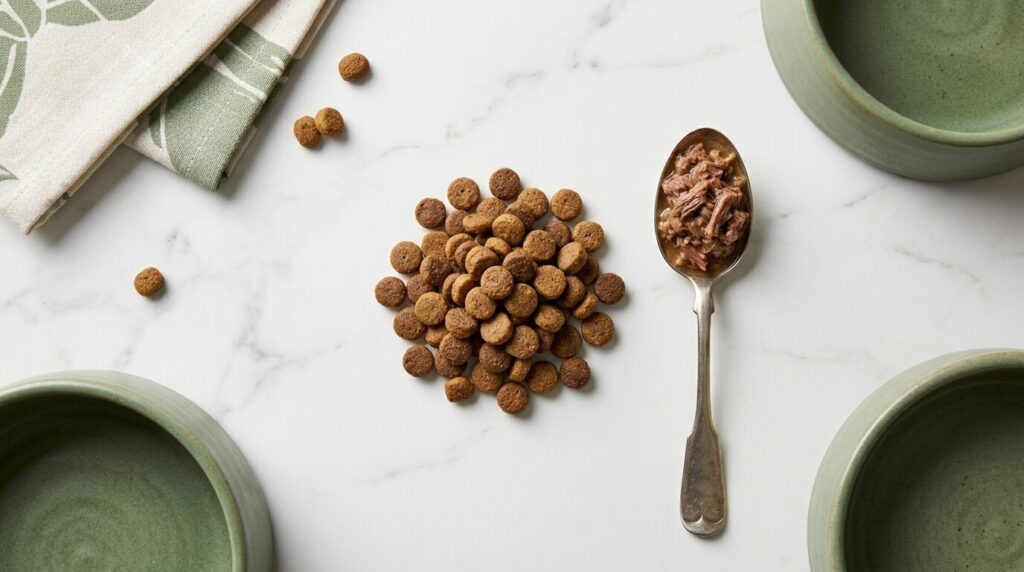
Wet food’s biggest practical difference is moisture. The FDA’s comparison of pet-food labels notes the large moisture difference between typical canned and dry products. Dry food is often more calorie dense by volume, while many dogs find the aroma and soft texture of wet food appealing. For some dogs, that extra moisture and aroma make meals easier and more inviting.
Wet food may be useful for picky eaters, dogs with reduced appetite, some senior dogs, dogs with dental discomfort, dogs who need more moisture in the diet under veterinary guidance, or dogs who simply do better with softer texture. It can also be a helpful measured topper when used carefully.
In apartments, wet food has another emotional benefit: it can make feeding feel more satisfying to the owner. Opening a can feels more “real” than scooping kibble. That feeling is understandable. Just make sure the emotional satisfaction does not lead to overfeeding or constant flavor switching.
Where Wet Food Gets Messy
Wet food is less forgiving. It needs refrigeration after opening. It can smell in a small kitchen. It sticks to bowls. It may attract pests if leftovers sit out. It is harder to use in many automatic feeders and some puzzle toys. It can be more expensive, especially for medium and large dogs.
The FDA advises promptly refrigerating or discarding unused canned or pouched pet food and keeping the refrigerator at 40 F or below. It also recommends washing and drying pet food bowls after each use. In a small apartment, those steps are not optional details. They are what keep the feeding area from smelling sour.
Wet food can also change stool depending on the dog and formula. If you switch too quickly, your dog may develop soft stool or digestive upset. If stool becomes persistent diarrhea, bloody, black, very pale, greasy, or paired with vomiting or lethargy, call your veterinarian.
If smell is already a household issue, pair feeding changes with how to control dog odor in a small apartment.
Mixed Feeding: Often Practical, Sometimes Slippery
Mixed feeding can be a very apartment-friendly compromise. Dry food provides convenience and portion control. Wet food adds aroma, moisture, and interest. For many dogs, a spoonful of wet food mixed into measured kibble is enough.
The slippery part is measurement. Owners often add wet food “just as a topper” without reducing the dry portion. Over weeks, that can become steady weight gain. Small dogs are especially vulnerable because a little extra food is a larger percentage of their daily calories.
If you mix, decide the formula:
- Measure the dry food.
- Measure the wet food.
- Adjust total calories.
- Keep the ratio consistent for a few weeks.
- Watch stool, appetite, weight, and skin.
Do not turn the bowl into a negotiation table. If your dog learns that refusing breakfast earns a better topper every day, you may accidentally train picky eating. For dogs who truly lack appetite, talk with your veterinarian instead of endlessly upgrading the bowl.
Mixed feeding needs calorie math, not a visual guess
A cup of kibble and a can of wet food are not standard calorie units. One dry formula may contain far more calories per cup than another, and cans of the same physical size can differ substantially. Read the calorie statement on both packages. It may list kilocalories per cup, can, tray, pouch, kilogram, or serving.
Here is a simple example, not a feeding prescription. Suppose your veterinarian-approved daily target is 400 calories. The kibble provides 360 calories per cup, and the wet food provides 200 calories per can. If you add half a can, that contributes 100 calories. You would then need about 300 calories from the kibble, which is roughly 0.83 cup of that specific food. Serving the old full cup plus the topper would provide about 460 calories, or 15% more than the intended target.
| Part of the meal | Label information | Amount used | Calories |
|---|---|---|---|
| Wet food | 200 kcal per can | 1/2 can | 100 kcal |
| Dry food | 360 kcal per cup | About 0.83 cup | About 300 kcal |
| Total | Daily target set with veterinary guidance | Combined meal plan | About 400 kcal |
Your dog’s actual calorie requirement cannot be determined from this example. Body condition, age, neuter status, activity, medications, and health all matter. Use the package as a starting estimate, then ask your veterinarian to help set a target and adjust it using weight and body-condition trends.
The 7 Apartment Choices
1. Choose dry food if your schedule needs automation
If you rely on timed meals while at work, dry food usually fits best. It is easier to portion and safer for many automatic feeders. Wet food can work in specific chilled feeders, but cleanup, temperature, and food safety become more important.
This does not mean a working owner must feed dry food only. It means dry food may be the base, while wet food is used when you are home and can clean the bowl promptly.
2. Choose wet food if appetite or moisture is the main issue
If your dog struggles to eat enough, has a veterinarian-supported need for more moisture, or does better with soft texture, wet food may be worth the cost and cleanup. This is especially true for some seniors or dogs with mouth discomfort.
But appetite problems should not be handled by flavor escalation alone. If your dog’s appetite changes suddenly, schedule a veterinary check. Food format can help comfort, but it should not hide illness.
3. Choose mixed feeding if both dog and apartment benefit
Mixed feeding works when it is measured. It can make kibble more appealing without committing the whole budget and fridge to wet food. It also gives owners flexibility: kibble for puzzles, wet food for meals, or a small topper on days when appetite needs support.
Write down the ratio. A casual spoonful is fine until the spoonful becomes larger every week.
4. Choose storage before buying bulk
Bulk dry food looks economical, but it is not a bargain if it goes stale in a warm closet. FDA recommends storing pet food and treats in the original container or bag and, if using another container, placing the entire bag inside the container so product information and lot numbers remain available. It also recommends storing dry food and unopened canned food in a cool, dry place below 80 F.
Apartment closets can be humid, warm, or shared with cleaning supplies. Choose a bag size you can finish while fresh. For wet food, check whether you truly have refrigerator space for opened cans and sealed leftovers.
5. Choose odor control if your kitchen is tiny
Wet food smell does not make it bad. It makes it noticeable. In a small apartment, noticeability matters. Use smaller cans if leftovers are a problem. Cover and refrigerate promptly. Wash bowls after each meal. Take trash out before empty cans sit too long.
Dry food can smell too if fats go stale, crumbs collect in a bin, or bowls are not washed. The cleanest feeding routine is not always the driest food. It is the routine you maintain.
6. Choose dental care separately from food format
Do not choose kibble only because you hope it cleans teeth. Standard kibble is not a substitute for brushing, dental exams, or products designed for dental health. If dental health is a concern, ask your veterinarian about brushing, dental diets, dental chews that meet recognized standards, and professional cleanings when needed.
This one misconception creates a lot of owner guilt. Someone feeds wet food and worries they are ruining teeth. Someone feeds dry food and assumes teeth are handled. Neither feeling is useful. Dental care needs its own plan.
7. Choose the food your dog’s body agrees with
Marketing claims matter less than your dog’s response. Watch stool, skin, coat, weight, energy, appetite, gas, vomiting, and itching. A food that sounds perfect but creates chronic soft stool is not perfect for your dog. A food that looks boring but keeps your dog healthy may be doing its job.
Keep changes slow and documented. If your dog has medical conditions, do not switch formats casually. Ask your veterinary team how wet, dry, or mixed feeding fits the specific condition.
How to Transition Without Apartment Chaos
Switch gradually unless your veterinarian tells you otherwise. A common approach is to mix a small amount of the new food into the old food and increase over several days. Sensitive dogs may need more time. If stool softens, pause or slow down.
Apartment transition tip: do not start a food change the night before a work trip, guest visit, or carpet cleaning. Digestive surprises are easier to handle when you are home and the routine is calm.
If accidents appear during or after a food change, consider timing, stool quality, urgency, and health. For true potty regression, see adult dog potty training regression.
When You Should Not Experiment on Your Own
A format change is not always a casual lifestyle choice. Call your veterinarian before changing the diet of a puppy with growth concerns, a pregnant or nursing dog, or a dog being treated for kidney disease, heart disease, diabetes, pancreatitis, bladder stones, chronic gastrointestinal disease, severe allergies, or another condition managed partly through nutrition. Prescription or therapeutic diets are designed around specific nutrient targets; adding a large amount of an ordinary topper may dilute the plan.
Wet food is not automatically appropriate for kidney disease merely because it contains more water. Dry food is not automatically wrong for a diabetic dog merely because it is dry. The relevant factors may include phosphorus, sodium, fat, fiber, carbohydrate profile, energy density, digestibility, urine goals, and how the individual dog responds. Those questions belong with the veterinary team that knows the diagnosis and laboratory results.
A sudden appetite change also deserves more respect than a new flavor. Seek veterinary advice promptly if refusal to eat is accompanied by repeated vomiting, a swollen or painful abdomen, marked lethargy, weakness, difficulty breathing, pale gums, black or bloody stool, repeated unproductive retching, or inability to keep water down. Puppies, toy breeds, seniors, and dogs with chronic disease may become unstable faster than a healthy adult.
For a dog who approaches the bowl but drops food, chews on one side, paws at the mouth, has new bad breath, or suddenly rejects crunchy food, consider oral pain rather than “pickiness.” A softer meal may make eating easier temporarily, but it does not diagnose or treat a fractured tooth, periodontal disease, or another painful condition.
Real Apartment Feeding Scenarios

The tiny-kitchen owner
If your kitchen has two cabinets and a half shelf in the fridge, food format is partly a storage decision. A medium bag of dry food kept in the original bag inside a sealed bin may be easier than stacked cans and open leftovers. If you prefer wet food, buy smaller cans or pouches so the refrigerator does not become a rotating collection of half-used meals.
The picky small dog
Small dogs can train owners very quickly. A dog skips kibble once, the owner panics, adds wet food, then chicken, then another flavor, then hand feeding. Sometimes the dog truly needs help eating. Sometimes the owner accidentally teaches a daily upgrade game. If your dog is healthy and your veterinarian is not worried, use a measured plan and avoid changing the bowl every time your dog hesitates.
The long-workday owner
Dry food may make the weekday routine calmer because it works with portioned meals, puzzle toys, and many timed feeders. Wet food can still be used at breakfast or dinner when you are home. This hybrid approach often feels less stressful than trying to make wet food fit an unattended midday schedule.
The odor-sensitive studio renter
Wet food is not wrong, but it demands faster cleanup in a studio. Wash the bowl right away, seal leftovers, and take out empty cans before the smell settles into the trash area. If your apartment already struggles with dog odor, start with smaller wet portions rather than switching the whole diet overnight.
The senior dog household
Senior dogs may benefit from softer texture, stronger aroma, or extra moisture, but appetite changes in older dogs deserve attention. Do not assume age alone explains picky eating. Mouth pain, nausea, kidney disease, medication effects, cognitive changes, and other medical issues can change feeding behavior. Ask your veterinarian before treating wet food as the whole solution.
The enrichment-focused owner
Dry food is easier for snuffle mats, scatter feeding, and many puzzle toys. Wet food is better for lick mats and stuffing certain toys. If enrichment is a big part of your apartment routine, you may not want one format only. Use the format that matches the activity and keep total calories measured. For low-noise feeding games, see DIY dog enrichment ideas for apartments.
Compare Cost Per Day, Not Bag Price Versus Can Price
A bag and a case of cans are not directly comparable because they contain different amounts of water and calories. The useful budget question is: how much does it cost to provide the calories and nutrition your dog needs for one day? Find the calories per cup or container, calculate how much of that product your dog would actually eat, and divide the package price by the number of feeding days.
Include waste. A large can is not economical if half repeatedly dries out in the refrigerator. An oversized bag is not economical if a small dog takes months to finish it and the food becomes stale. Smaller packages may cost more per ounce but waste less in a studio household. A measured wet topper can also be more affordable than feeding wet food as the entire diet.
Do not respond to a tight month by repeatedly switching among unrelated foods based only on sale prices. Frequent abrupt changes can disturb digestion and make it difficult to identify what caused a problem. If cost is threatening the consistency of the diet, ask your veterinarian for nutritionally appropriate options at several price points.
Build an Apartment Feeding Station That Is Easy to Maintain
The best format still fails in a poorly designed routine. Give the food one dry, cool storage location away from household chemicals. Keep the original packaging and lot information, even if the bag sits inside a sealed container. Store opened wet food covered in the refrigerator according to the product instructions, and label it with the opening date if several people feed the dog.
Use at least two washable bowls so a clean one is available when the other is drying. Place the feeding area on a washable mat, but do not let food collect underneath it. In homes with ants or cockroaches, sweep crumbs after enrichment games and avoid leaving bowls down overnight. If two dogs eat different diets or guard food, feed them behind separate barriers and pick up both bowls before reopening the space.
For workdays, decide in advance which food can safely be left in the chosen feeder and for how long. A chilled feeder is not automatically safe merely because it has an ice pack; follow the manufacturer’s instructions and discuss food-safety concerns with your veterinarian. When in doubt, schedule wet meals for times when you are home and use an appropriate measured dry meal for an unattended feeder.
Common Mistakes
Believing wet food is always healthier
Wet food can be excellent, but moisture and smell do not automatically mean better nutrition. Look for complete and balanced food appropriate for your dog’s life stage and health needs.
Believing dry food always cleans teeth
Standard dry food is not a full dental plan. Dental health needs brushing, veterinary exams, and products specifically designed for oral care when appropriate.
Free-feeding in a small apartment without tracking
Leaving dry food out all day may work for some dogs, but it makes appetite and portion tracking harder. If weight, appetite, or schedule matters, measured meals are clearer.
Letting toppers grow without noticing
A topper should be measured. If it keeps getting bigger because your dog looks disappointed, the bowl may be training you.
Ignoring storage and bowl hygiene
Food safety is part of nutrition. Old kibble, warm storage, open cans, dirty bowls, and greasy containers can create problems even when the food choice itself is fine. Clean feeding habits matter more in small rooms because smells and crumbs spread quickly.
FAQ
Is wet food or dry food better for dogs?
Neither is automatically better for every dog. Complete and balanced wet or dry food can both work. The better choice depends on your dog’s health, appetite, moisture needs, dental plan, budget, storage, and routine.
Can I mix wet and dry dog food?
Yes, many dogs do well with mixed feeding. Measure both parts and adjust total calories so a topper does not become accidental overfeeding.
Does dry dog food clean teeth?
Standard kibble should not be treated as a dental plan. Tufts notes that both kibble and wet food contribute to plaque, although specially formulated dental diets may help. Ask your veterinarian about dental care.
Is wet food better for picky dogs?
Wet food is often more appealing because of smell and texture, but sudden picky eating can signal illness, pain, stress, or food freshness issues. Do not rely only on tastier food if appetite changes suddenly.
Does wet food make apartments smell?
It can if bowls, cans, trash, or leftovers are not handled promptly. Smaller portions, covered refrigeration, quick bowl washing, and trash control make wet food much easier to live with.
Can I leave wet food out while I am at work?
Wet food is not ideal for long unattended periods. Follow food safety guidance and your veterinarian’s advice. For workday feeding, dry food or a properly designed feeder may be safer and easier.
A Practical Decision Rule
Choose based on the problem you are actually solving. If you need automation and easy measuring, a complete dry food may be the practical base. If appetite, chewing comfort, or moisture is the priority, discuss a complete wet food with your veterinarian. If both formats help, use a measured mixed-feeding plan and subtract the added calories rather than stacking one meal on top of another.
Keep one short feeding record during the transition: exact product and amount, treats and toppers, appetite, stool, vomiting, itching, body weight, and anything that changed in the household. The goal is not to prove that one format wins. It is to find a nutritionally appropriate routine that your dog tolerates and that you can maintain cleanly and consistently in the apartment.
References
VCA Animal Hospitals: Nutrition, General Feeding Guidelines for Dogs
FDA: Complete and Balanced Pet Food
WSAVA Global Nutrition Committee: Guidelines on Selecting Pet Foods
FDA: Proper Storage of Pet Food and Treats
Tufts Cummings School of Veterinary Medicine: Pet Dental Health Fact or Fiction