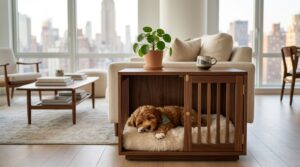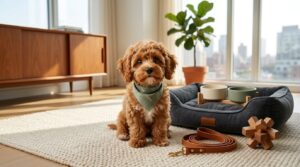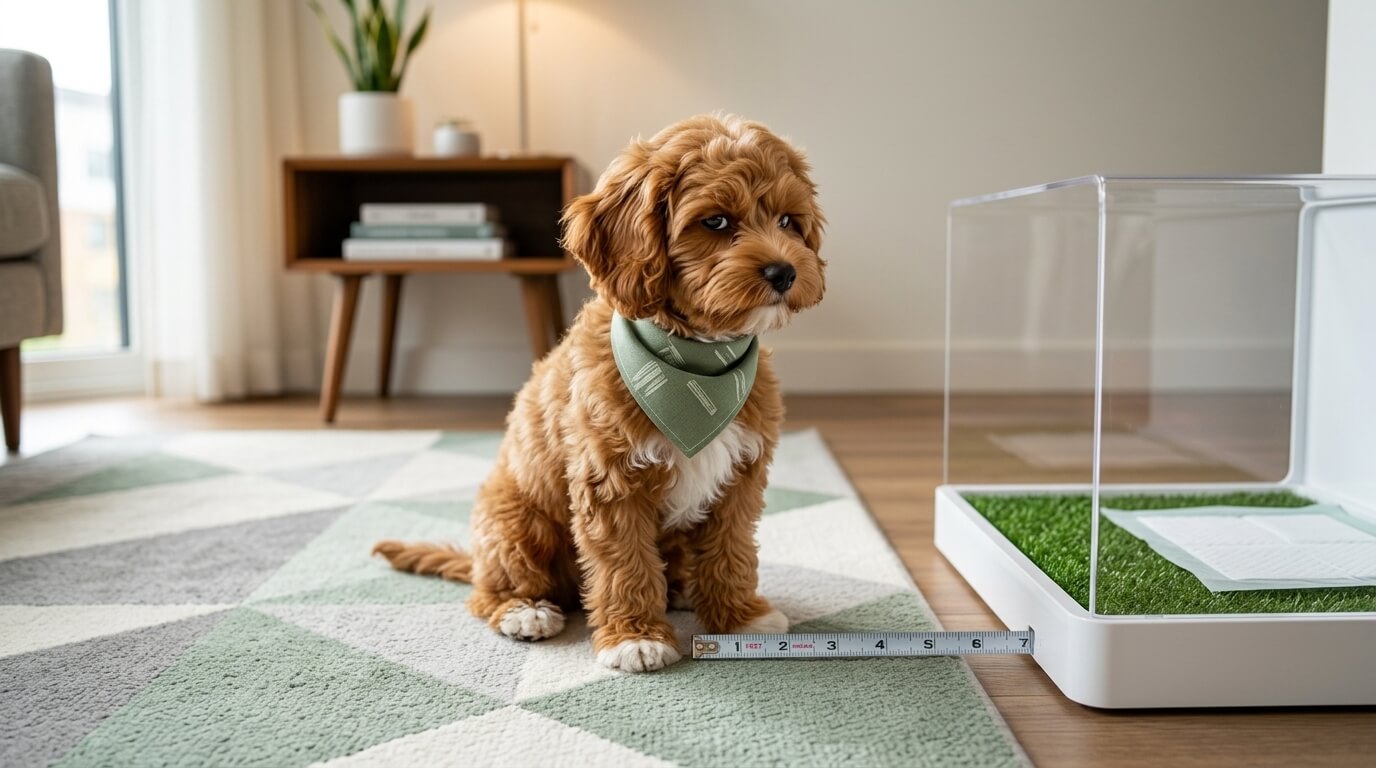
I did everything right. I researched the best indoor dog potty options for apartment living, selected a sleek real-grass patch system that fit perfectly in my bathroom corner, placed it at a reasonable distance from Ollie’s food and water, and introduced it with what I believed was appropriate enthusiasm.
Ollie — my caramel-colored Cavapoo in his sage green bandana — approached it with what I initially interpreted as interest. He sniffed the edge. He looked at me. He took two steps to the left and urinated directly onto my bathroom rug with the calm confidence of a dog who had made a considered decision and was comfortable with it.
The problem of litter box avoidance dogs experience is more common than most apartment dog owners realize, and the reasons behind it are more specific — and more solvable — than “my dog is stubborn.”
What I discovered through researching canine elimination psychology — and through the humbling process of troubleshooting Ollie’s indoor potty resistance — is that when a dog refuses an indoor potty system, they’re almost never being willfully difficult.
They’re communicating a specific preference or discomfort that, once identified, can usually be addressed. This post covers the six most common reasons indoor potty rejection happens, what the behavioral science tells us about each one, and how to systematically work through them.
Litter Box Avoidance Dogs (Quick Answer)
The main causes of litter box avoidance dogs experience include a box that is too small to allow normal circling behavior, an unfamiliar or aversive substrate texture, and placement in a high-traffic or noisy location. Other significant reasons include inadequate cleaning frequency, underlying medical issues like UTIs causing painful elimination, and negative associations formed during training attempts.
The “Two Feet Away” Frustration
Before addressing the individual reasons, I want to acknowledge the specific frustration of the “two feet away” scenario — because it’s the version of indoor potty rejection that most apartment dog owners experience, and it’s the one that feels most personal.
When a dog eliminates directly adjacent to the potty system rather than inside it, it’s not random and it’s not spite. It’s actually a meaningful behavioral signal: the dog is in the right location, at the right time, with the right elimination urge — and something about the specific target is causing them to redirect at the last moment.
The “two feet away” rejection is almost always caused by:
- A substrate texture that feels wrong underfoot at the moment of commitment
- A size constraint that prevents the completion of normal pre-elimination behavior
- A scent signal (or absence of one) that doesn’t communicate “appropriate elimination location”
Understanding which of these three is operating for your specific dog narrows the troubleshooting significantly. The six reasons below provide the full framework.
6 Reasons Your Dog Hates The Box
Reason 1: The Box Is Too Small for Normal Circling Behavior
This is the most underappreciated cause of indoor potty rejection, and it’s the one with the clearest behavioral science explanation.
The pre-elimination circling behavior — the spinning, pawing, and repositioning that dogs perform before elimination — is not a quirky habit. It’s a functional behavioral sequence with documented evolutionary origins. Circling allows a dog to assess the substrate for stability and safety, orient their body relative to environmental cues including the Earth’s magnetic field (documented in canine elimination research), and compress and flatten the elimination area.
The critical point: If a dog cannot complete their full pre-elimination circling sequence, many will not eliminate in that location. The box is not the problem — the inability to engage in the required preparatory behavior is the problem.
How to assess whether size is the issue:
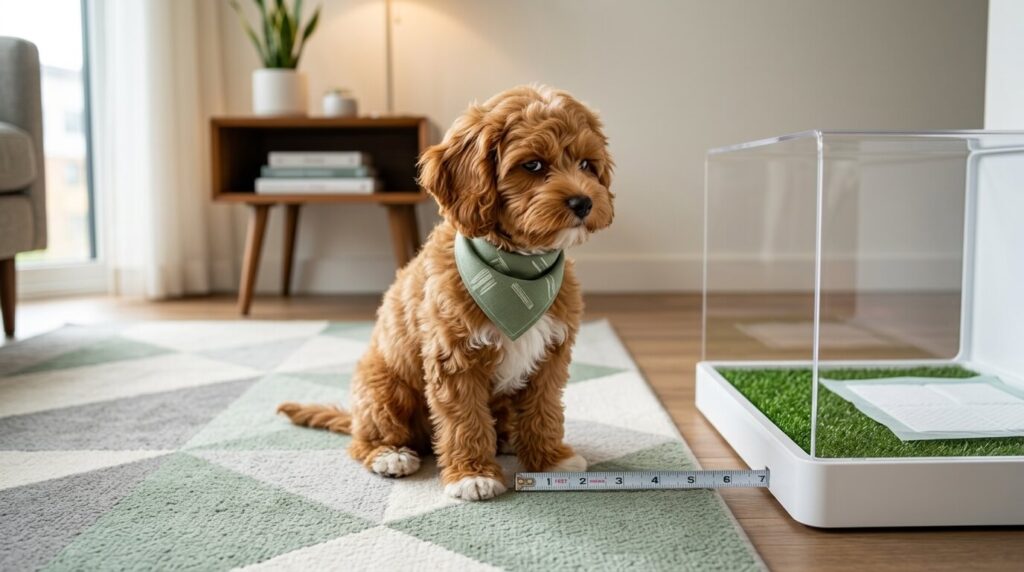
Measure your dog’s length from nose tip to base of tail. The indoor potty surface should be a minimum of 1.5 times that length in both dimensions to allow a complete circle without the dog’s body contacting the edges. For Ollie at roughly 14 inches body length, that means a minimum 21-inch square surface — and I had initially purchased a system that was 18 inches square. Two inches of missing space prevented a complete circle and, consequently, eliminated his motivation to use it.
Signs that size is the issue:
- The dog approaches the box, steps partially onto it, and then steps off
- The dog sniffs the box perimeter but doesn’t enter
- The dog attempts to circle but steps off the edge and then eliminates adjacent to the box
Reason 2: The Substrate Texture Is Wrong
This is the most nuanced cause of litter box avoidance dogs exhibit, and it’s the one that requires the most specific troubleshooting because dogs have individual substrate preferences that were established during their early elimination learning.
How substrate preferences form:
Dogs develop substrate preferences for elimination during their earliest weeks of life — the material under their paws during their first elimination experiences becomes the template for what “appropriate elimination surface” feels like. Puppies raised on newspaper develop paper preferences. Puppies raised on grass develop grass preferences. The preference is not breed-based or size-based — it’s experiential, and it’s formed before most owners ever meet their puppy.
The substrates and their common rejection reasons:
| Substrate | Why Dogs Reject It |
|---|---|
| Synthetic turf | Too stiff; paw pressure feedback different from real grass |
| Paper pellets | Unfamiliar texture underfoot; no outdoor surface equivalent |
| Real grass patch | Correct texture but sometimes wrong scent if no prior outdoor grass experience |
| Pee pads | Too slippery; surface instability during circling |
Testing substrate preference:
If your dog has an established outdoor elimination surface preference — grass, concrete, mulch — the indoor substrate should match it as closely as possible. For confirmed grass eliminators, a real grass patch will outperform synthetic turf almost every time despite the higher cost and maintenance requirement.
Reason 3: The Location Doesn’t Feel Safe
Dogs are behaviorally vulnerable during elimination — they are stationary, focused, and unable to monitor their environment for threats. This vulnerability drive is ancestral and remains fully intact in domestic dogs regardless of how safe their actual environment is.
What makes a location feel unsafe for elimination:
- High foot traffic — a litter box positioned where family members regularly walk past creates the constant movement stimulus that triggers alert behavior rather than the relaxed parasympathetic state required for elimination
- Noise proximity — placement near a washing machine, HVAC unit, dishwasher, or external traffic source creates unpredictable sound events that interrupt the elimination sequence
- Insufficient privacy — unlike cats, dogs don’t require complete visual privacy, but they do prefer locations where they can monitor their surroundings from a position that isn’t a pinch point
- Too close to sleeping or eating areas — dogs have strong instinctive aversions to eliminating near their resting and feeding locations, inherited from ancestors for whom contaminating their den was a hygiene and predator-attraction risk
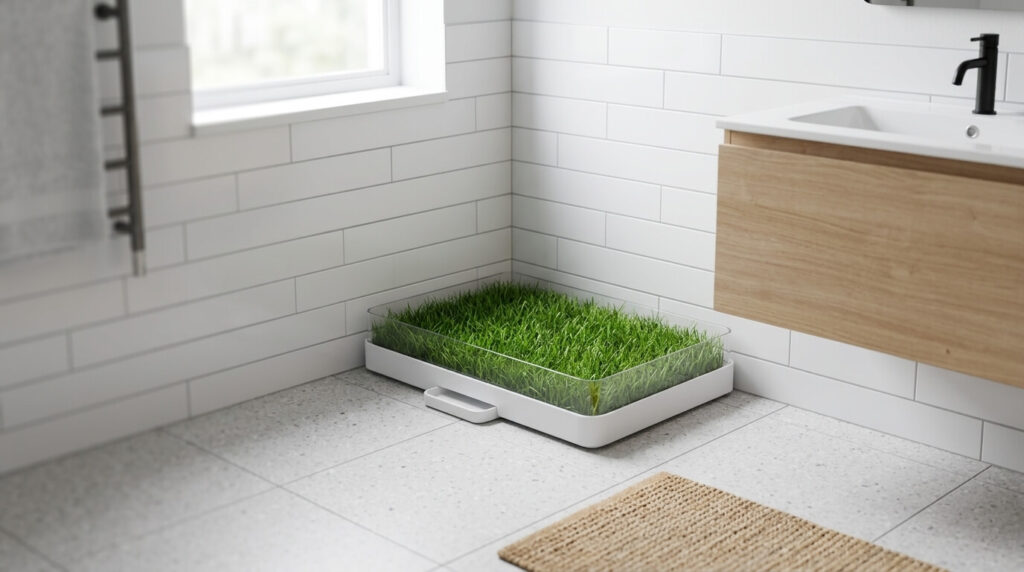
The ideal indoor potty location:
- A quiet bathroom corner, away from the door
- Consistent — never moved once the dog has begun using it
- Away from food, water, and sleeping areas by at least six feet where apartment layout allows
- With sufficient surrounding space that the dog doesn’t feel the walls create a trap
Reason 4: The Box Isn’t Being Cleaned Frequently Enough
This reason surprises most owners because the intuitive assumption is that a dog who eliminates outside would prefer their indoor potty to be clean. The actual behavioral reality is more nuanced.
The scent signaling dynamic:
Dogs use their own elimination scent as a location marker — the residual scent of prior elimination communicates “this is an appropriate elimination site” through olfactory signals that reinforce return visits. A completely odorless indoor potty that has been cleaned with strong chemical deodorizers has lost the scent signal that makes it an identified elimination location.
The balance required:
- A potty that is too soiled (unremoved solid waste, saturated substrate) triggers hygiene avoidance — dogs will not eliminate on top of unremoved waste
- A potty that is too chemically clean has no residual scent signal identifying it as an elimination location
- The ideal maintenance keeps the surface clean and odor-controlled to human perception while retaining the trace scent that communicates “elimination location” to the dog
Practical maintenance guidelines:
- Remove solid waste immediately after each occurrence
- Liquid waste: synthetic turf should be rinsed daily; real grass managed per the subscription service schedule; paper pellets replaced every 24–48 hours
- Deep clean with an enzymatic cleaner that neutralizes ammonia without adding strong chemical scent — not bleach or disinfectant-based products
- For the first two weeks of potty training, use the scent-priming technique: after outdoor elimination, collect a small amount on a paper towel and place it in the indoor potty to establish the scent signal
Reason 5: An Underlying Medical Issue
This is the reason that is most important not to miss, and it’s the one that requires a veterinary conversation rather than a training adjustment.
When litter box avoidance is a pain response:
A dog who has previously been using an indoor potty successfully and suddenly begins avoiding it — particularly if they are also showing other changes in elimination behavior (frequency, posturing, vocalization during elimination) — may be associating the act of elimination with pain. Urinary tract infections, bladder stones, gastrointestinal discomfort, and orthopedic pain that makes assuming elimination posture uncomfortable are all medical causes that present as what appears to be behavioral potty avoidance.
Signs that medical evaluation is needed:
- Sudden onset of avoidance in a previously reliable user
- Frequent attempts to eliminate with little or no output
- Vocalization or obvious discomfort during elimination
- Blood in urine or stool
- Unusual posturing during elimination attempts
- Significant increase or decrease in elimination frequency
The specific orthopedic consideration:
For some dogs, the substrate of the indoor potty creates a surface that is uncomfortable to stand on with arthritic or tender joints — particularly synthetic turf with stiff fibers, or paper pellets that create an unstable surface. Older dogs who have successfully used an indoor potty may begin avoiding it as joint pain develops, because the act of standing on an unfamiliar or unstable surface while in the vulnerable elimination posture has become painful.
Reason 6: A Negative Association Was Formed During Training
This is the cause that is most often inadvertently created by well-intentioned owners, and it’s the most common reason that a dog who initially used an indoor potty begins refusing it after a period of apparent success.
How negative associations form:
The most common source: the owner has used the potty introduction period to place the dog on the potty and then remained standing over them — close, attentive, sometimes anxiously observant — waiting for them to eliminate. For many dogs, this level of direct human proximity during elimination creates anxiety rather than encouragement.
Other common negative association triggers:
- Startling the dog during an elimination attempt (an unexpected noise, a sudden movement)
- Previous punishment for accidents delivered near the potty location — the dog generalizes the punishment context to the spatial area rather than the specific behavior
- A negative physical experience on the potty surface (slipping on synthetic turf, stepping on an edge that flexed unexpectedly)
- Forcing or lifting the dog onto the potty when they were resistant — creating a pressure association with the location
The reset requirement:
Once a negative association has formed, the potty location and sometimes the potty type need to be changed before retraining can be effective. Attempting to retrain using the same setup that produced the aversion often results in continued resistance because the environmental cues associated with the negative experience are still present.
How to Reset the Indoor Potty Habit
If you’ve identified the likely cause from the six reasons above, here is the systematic reset protocol.
Step 1: Change what needs changing based on your diagnosis
- Size issue: replace with a larger surface before retraining begins
- Substrate issue: switch to the substrate that matches your dog’s established outdoor preference
- Location issue: move to a quieter, more private location
- Cleanliness issue: establish the maintenance protocol above and prime with scent before retraining
- Negative association: relocate the potty entirely and introduce the new location as a fresh start
Step 2: Return to baseline training
You will need to go back to basics and review exactly how to potty train a dog in an apartment using high-value rewards — because a reset requires the same systematic reinforcement protocol as initial training, not an abbreviated version.
Step 3: Use scent priming
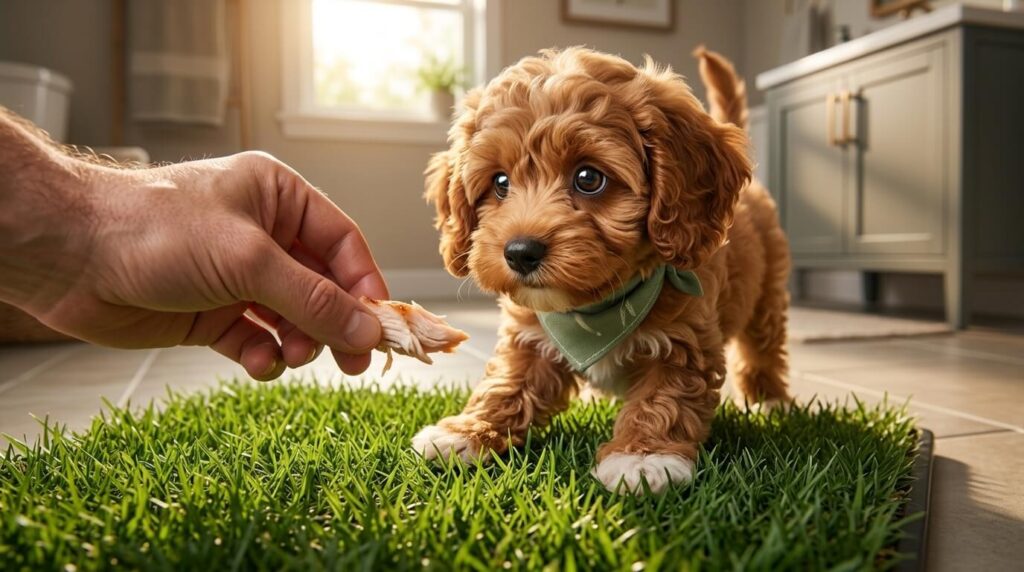
Before any retraining session, prime the new potty with the scent signal that communicates “elimination location.” After an outdoor elimination, use a paper towel to collect a small amount and place it on the potty surface. This single intervention has produced the fastest turnaround in retraining cases — the scent signal does more work than any luring or prompting sequence.
Step 4: Remove access to alternative surfaces
The rug that Ollie chose instead of the potty was removed from the bathroom for the retraining period. A dog who has identified an alternative surface as an acceptable elimination location will continue choosing it over the potty unless that option is physically unavailable.
Step 5: Capture and reward immediately
Return to timed introductions — taking your dog to the potty at the moments of highest elimination likelihood (post-sleep, post-meal, after play). Stand back, give a one-word cue, and wait silently. The moment elimination begins, mark with a calm “yes” and reward with a high-value treat immediately upon finishing. Not after you’ve walked to the kitchen to get the treat — the treat should be in your hand before the potty introduction.
When to Give Up and Go Outside
Indoor potty systems are not appropriate for every dog, and recognizing when outdoor-only elimination is the better solution saves significant time, money, and flooring.
Signs that an indoor potty system is unlikely to succeed:
- Your dog has a strong, established outdoor substrate preference that cannot be replicated indoors (some dogs will only eliminate on natural grass, soil, or specific outdoor surfaces)
- Your dog is a large breed for whom no practically sized indoor surface provides adequate circling space
- Your dog has shown significant anxiety responses to indoor elimination attempts across multiple substrate and location combinations
- Your dog’s primary behavioral profile indicates high environmental sensitivity that makes indoor elimination feel unsafe regardless of setup
The practical alternative:
For apartment dogs who won’t use indoor potties, the realistic management system is a robust outdoor schedule with enough consistency that accidents become rare rather than routine. This means understanding your dog’s elimination timeline precisely, maintaining consistent daily walk times, and identifying the nearest outdoor elimination opportunities for emergency situations.
The weather solution:
For the specific problem of bad weather making outdoor trips impractical, a covered outdoor space — a building entrance overhang, a parking garage, a building courtyard — is often more acceptable to a grass-committed dog than any indoor substrate. Sometimes the answer is not indoor potty training but better outdoor access management.
Frequently Asked Questions
What are the main causes of litter box avoidance dogs commonly experience?
The six causes in this post cover the vast majority of cases: inadequate size for circling behavior, substrate texture mismatch with established outdoor preferences, location that doesn’t feel safe or private, cleanliness either too poor or too aggressively deodorized, underlying medical issues causing painful elimination, and negative associations formed during or after training.
The cause that’s most frequently overlooked is size — most owners purchase indoor potties that are appropriately sized for their dog’s weight class but don’t provide the additional lateral space that normal circling requires. If you can only troubleshoot one factor first, measure the available circling space relative to your dog’s body length and address that before anything else.
How big should an indoor dog potty be?
The functional minimum is 1.5 times your dog’s body length (nose to tail base) in both dimensions. For a 12-inch body length dog, that’s an 18-inch square minimum — and slightly larger is always better. For dogs who circle multiple times before eliminating (which is normal — most dogs circle two to four times), the margin above the functional minimum matters.
Width is more commonly problematic than length because many indoor potty systems are designed as narrow rectangles that fit in bathroom corners, sacrificing width for the ability to fit in tight spaces. If your dog consistently exits the potty sideways rather than backing out, the width is insufficient for comfortable use.
Will my dog ever reliably use an indoor potty?
Most dogs with persistent substrate preferences can be reliably trained to an indoor potty when the substrate matches their established outdoor preference, the surface is adequately sized, the location is genuinely private and low-traffic, and the training protocol uses high-value rewards with precise timing.
The dogs who tend not to succeed with indoor potties are those with extremely strong environmental specificity — dogs who have consistently eliminated only on one specific substrate type outdoors and show high anxiety responses to any indoor elimination attempt.
This is a minority but a real one, and recognizing it early saves months of frustrating retraining attempts. Two to three weeks of consistent, properly designed protocol is an adequate trial period. If reliable use hasn’t emerged in that time with all the factors addressed, outdoor-only management is likely the better long-term solution for that specific dog.
References
- Hart, B. L., & Hart, L. A. (1985). “Selecting pet dogs on the basis of cluster analysis of breed behavior profiles and gender.” Journal of the American Veterinary Medical Association, 186(11), 1181–1185. Referenced for canine substrate preference formation and elimination behavior patterns in domestic dogs. PMID: 3997380.
- Houpt, K. A. (2018). Domestic Animal Behavior for Veterinarians and Animal Scientists (6th ed.). Wiley-Blackwell. Chapter 4: Eliminative Behavior — referenced for circling pre-elimination behavior, substrate preference development, and the behavioral science of canine indoor elimination training. ISBN: 978-1119181538.
Ollie now uses his indoor potty reliably on rainy mornings and late nights. The bathroom rug was replaced with a non-absorbent mat during the retraining period and only returned once reliable use was established. The real grass patch is 24 inches square — six inches wider than my original purchase. That six inches made all the difference.