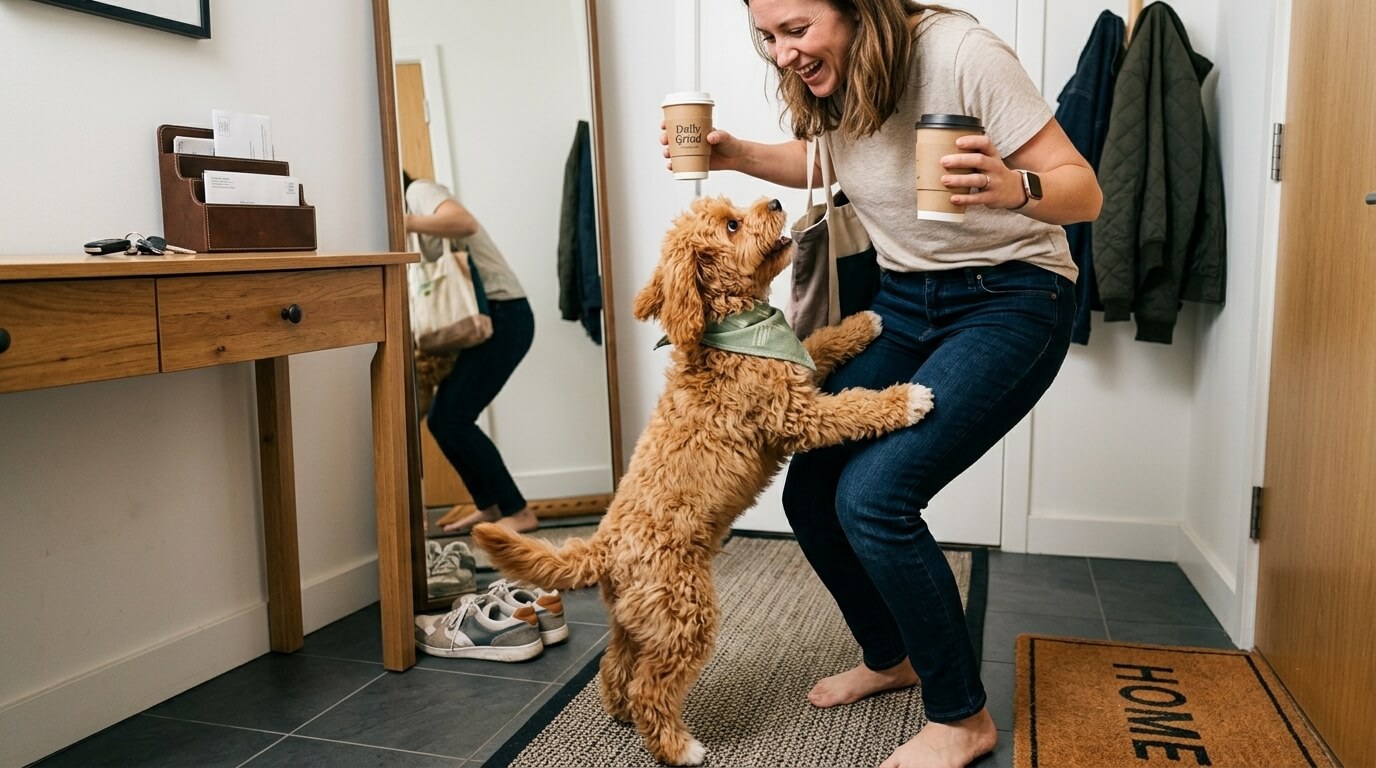
My friend Sarah arrived at my apartment on a Saturday afternoon wearing a cream linen jumpsuit that she had, by her own description, been “saving for the right occasion.” The right occasion turned out to be the occasion on which Ollie — my caramel-colored Cavapoo in his sage green bandana, who had been vibrating near the door for forty-five seconds after hearing the elevator — launched himself at her with the full aerodynamic commitment of a dog who has identified a target and committed entirely to the trajectory.
Both front paws connected with her midsection. There was drool. There were paw prints that did not respect the fabric’s dry-clean-only status. Sarah, to her eternal credit, laughed. I, standing approximately three feet away in my tiny apartment entryway, absolutely did not. I had been trying to stop dog jumping on guests for months, and the cream linen jumpsuit incident was the moment I accepted that the gentle suggestions I’d been implementing were not, in fact, a training plan.
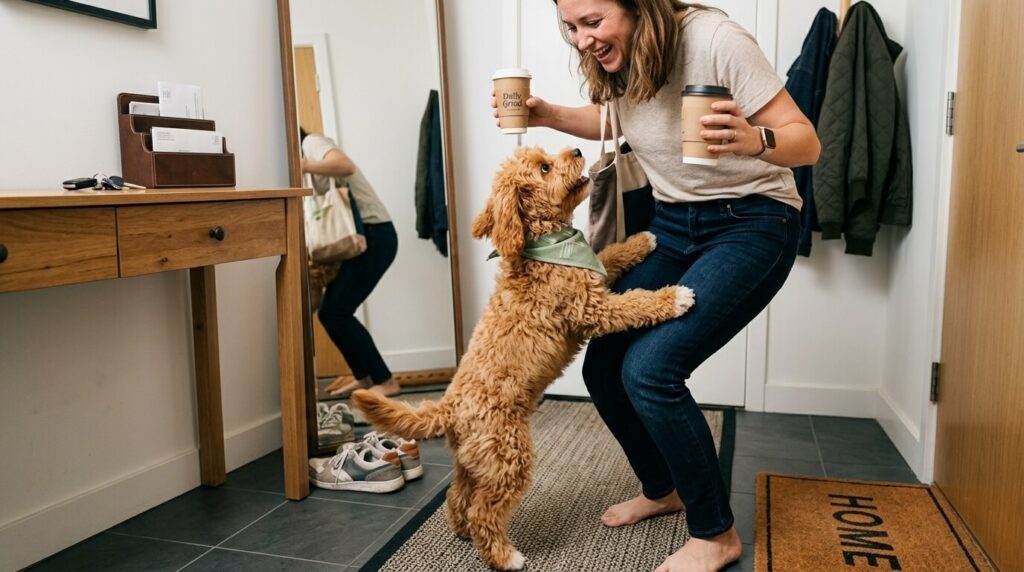
What followed was a genuine, structured behavioral intervention — the kind that required understanding why the jumping was happening, building a replacement behavior from the ground up, and — the hardest part — training my guests as much as training my dog. Six weeks later, Ollie sat at the door when Sarah came back for dinner. She wore the cream linen jumpsuit again, specifically to test him. He passed.
This is the complete system.
How To Stop Dog Jumping On Guests (Quick Answer)
To successfully stop dog jumping on guests, you must completely remove the reward of attention during the jumping behavior. Instruct all guests to turn their back, cross their arms, and avoid eye contact the moment paws leave the floor. Manage the door using a leash or pet gate, and reward your dog immediately and enthusiastically the moment all four paws return to the floor.
The Entryway Torpedo (Why They Jump)
Before building the fix, understanding the actual mechanism of jumping behavior is worth the time — because the most common explanation (“he’s being dominant” or “she’s trying to be the boss”) is behaviorally inaccurate and leads to intervention strategies that make the problem worse.
Dogs jump for one primary reason: it has worked.
Jumping is an attention-seeking behavior rooted in normal canine social communication. Puppies jump up toward their mother’s face as a food-soliciting behavior. Adult dogs jump toward the faces of humans they’re greeting because our faces — where our attention, expressions, and vocalizations originate — are significantly higher than their natural reach. Jumping is an attempt to access the face of the person they want to engage with.
The reinforcement history of jumping is almost always accidental:
- The first time a puppy jumps, most owners laugh, make eye contact, and reach down to pet them
- Even negative responses — pushing the dog away, saying “no,” looking down — involve attention and physical contact, which are both rewarding to a dog whose goal was to generate interaction
- Inconsistent responses (sometimes ignored, sometimes engaged with) actually produce the most durable behavioral patterns through the mechanism of variable reinforcement — the same psychological principle that makes gambling compelling
The apartment context intensifies this because the entryway is a confined space with no room to create distance, guests arrive with high social energy, and the dog has typically been alone (and therefore under-stimulated) before the guest’s arrival.
If this frantic energy happens every time you come home, you must evaluate if you are dealing with dog separation anxiety apartments symptoms — because sometimes what looks like greeting enthusiasm is actually an anxiety-discharge response, and the intervention for anxiety-driven jumping differs from the intervention for pure attention-seeking jumping.
The “Four on the Floor” Rule
Before describing the seven steps, I want to establish the foundational principle that every step is built on. This principle is simple enough to explain in one sentence and genuinely difficult to execute consistently:
Your dog receives zero attention — zero — when any paw is off the floor, and immediate, enthusiastic attention the moment all four paws return to the ground.
That’s the entire behavioral principle. Jumping produces nothing. Four feet on the floor produces everything the dog is looking for: eye contact, voice, touch, treats, play. The replacement behavior — standing or sitting with all paws grounded — becomes the new strategy for generating human attention because it is the only strategy that actually works.
Why this is harder than it sounds:
The rule requires perfect consistency across every person who interacts with your dog. One guest who laughs, looks down, and says “oh, it’s okay!” while the dog jumps on them resets a significant amount of training progress. The behavioral research on extinction (removing reinforcement from a previously rewarded behavior) is clear: intermittent reinforcement during the extinction process dramatically extends the time required to eliminate the behavior. Every person who rewards jumping, even once, is extending your training timeline.
7 Steps To Stop The Bouncing
These steps are sequential during the training phase — implement all of them simultaneously rather than trying one at a time.
Step 1: Manage the Entry Point
The entryway of a small apartment is the highest-risk location for jumping behavior, and the single most effective short-term intervention is removing your dog’s unsupervised access to it during guest arrivals.
Options for entry management:
- Leash your dog before opening the door — clip the leash to your dog’s collar or harness before any guest arrives. Hold the leash with enough length that your dog can move normally but cannot physically reach the guest’s torso or face.
- Pet gate across the entryway — a freestanding gate positioned to block the first 4–6 feet of your apartment entrance gives guests a buffer zone to enter without triggering the jumping.
- The “go to place” setup — position your dog’s designated mat several feet back from the door before guests arrive (more on this in Step 4).
For Ollie, the leash-at-the-door approach was the immediate management solution that stopped the physical jumping while the training was being built. It doesn’t teach the dog anything on its own — it just creates the conditions under which the training can occur without the behavior being rehearsed and reinforced between sessions.
A critical note: Rehearsal matters. Every time your dog successfully jumps and receives any form of attention, the behavior is practiced and potentially reinforced. Management tools that prevent the jumping during the training period are not a crutch — they’re protecting the integrity of the training.
Step 2: The Turn-Away Method
This is the primary extinction technique and the one that needs to be demonstrated to every person who enters your home.
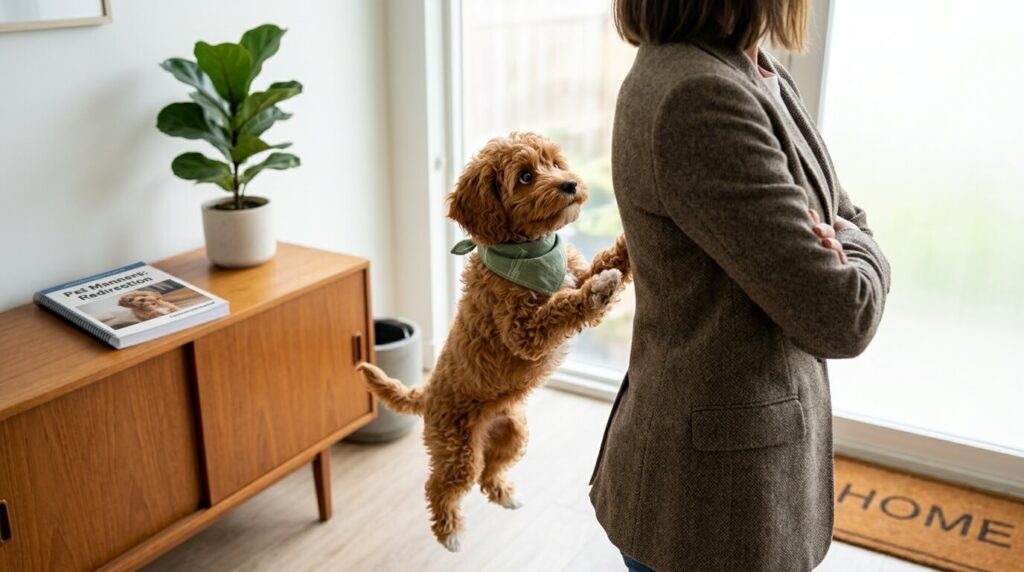
The exact protocol:
- The moment your dog’s front paws leave the floor — before they make contact — turn your back completely. Not a half-turn. Not a sideways glance. A full 180-degree rotation away from the dog.
- Cross your arms at chest level. This removes the natural instinct to reach down and push the dog away (which is contact, which is attention).
- Avoid all eye contact — look upward or forward, not down at the dog.
- Stay silent. No “no,” no “down,” no “off.” Silence removes the vocal attention component.
- Wait. Your dog will continue jumping for a period — possibly a long period if the behavior is well-established. This is called an extinction burst: the behavior intensifies briefly when it stops producing its expected result, before declining.
- The instant all four paws hit the floor, turn back around immediately with calm but genuine positive attention — soft voice, eye contact, a treat if you have one ready.
The timing of Step 6 is everything. The marker (your attention returning) must land within one to two seconds of all four paws touching the floor. A longer delay means your dog doesn’t connect the return of your attention with the specific behavior of having four feet on the ground.
Step 3: Build the Sit as the Default Greeting
Once your dog understands that jumping produces no attention, you need to build an incompatible replacement behavior — something the dog can do instead of jumping that physically cannot coexist with jumping at the same time.
A sit is the most practical replacement behavior for greetings because it is incompatible with jumping (a sitting dog cannot simultaneously have their paws off the ground), it is a behavior most dogs already know, and it gives the dog an active way to earn the attention they’re seeking.
How to build the greeting sit:
- Practice sit-for-greeting scenarios repeatedly outside of actual guest arrivals — using family members, yourself entering from another room, anyone who will cooperate with the training protocol
- As you approach the dog, ask for the sit before they have the chance to initiate jumping
- The moment the sit happens, deliver attention immediately and warmly — not a perfunctory pat, but genuine engagement
- If the dog breaks the sit to jump, the attention withdraws immediately via the turn-away method
- Ask for the sit again only once — if the dog doesn’t offer it, withhold attention and wait for them to offer it independently
Over time and with consistent practice, the dog learns that approaching humans sits = attention arrives, and jumping = attention disappears. The sit becomes the automatic greeting behavior because it is the only greeting behavior that consistently produces the desired outcome.
Step 4: The “Place” Command
The “place” command — teaching your dog to go to and remain on a specific mat or bed on cue — is one of the most apartment-friendly solutions to door-jumping because it solves the problem before the dog is in proximity to the guest at all.
How to teach “place”:
- Place a specific mat or dog bed several feet from your front door
- Use high-value treats to lure your dog onto the mat and reward heavily the moment all four paws are on it
- Add the verbal cue “place” as the dog begins moving toward the mat reliably
- Build duration: reward the dog for remaining on the mat for 5 seconds, then 10, then 30, gradually extending the time before the reward arrives
- Practice with low-level distractions first (you moving around the room), then escalate to higher distractions (knocking on walls, the sound of your doorbell, then actual door openings)
Using “place” during actual guest arrivals:
- When the doorbell sounds or you hear the elevator, cue “place” before opening the door
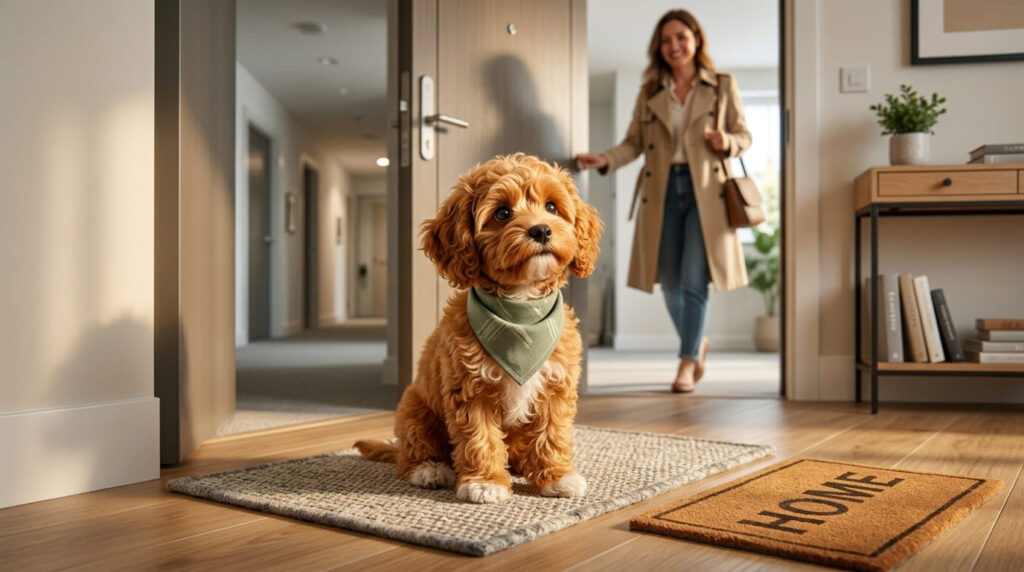
- Open the door with your dog on the mat — guests enter into a dog-free entryway
- Guests can approach the dog on the mat and greet them there, with the dog receiving treats and attention for remaining in place
This approach solves the entryway problem at the environmental level rather than trying to interrupt behavior once it has already started building momentum.
Step 5: Threshold Desensitization
For dogs whose jumping is most intensely triggered by the sound of the doorbell or the specific sounds of someone arriving at the door, desensitizing to the arrival cues reduces the arousal that precedes the jumping.
The desensitization protocol:
- Record your doorbell or use a doorbell app on your phone
- Play the sound at very low volume while your dog is calm and in a relaxed state
- Deliver a treat immediately — the sound predicts the treat, not the arrival of a person
- Gradually increase the volume over multiple sessions
- Introduce the knock sound separately and desensitize in the same way
- Eventually, the arrival sounds produce a conditioned relaxation response (because they predict treats) rather than a conditioned arousal response (because they predict exciting guests)
This step requires patience and multiple short sessions over several days, but it addresses the arousal escalation that makes the jumping difficult to interrupt once it has started.
Step 6: Practice Controlled Mock Arrivals
Real guest arrivals are high-stakes, variable training environments — too many uncontrolled factors for effective learning during the actual behavior modification phase. Deliberate practice with cooperative “guests” in controlled conditions is where real training progress happens.
The mock arrival protocol:
- Ask a friend, partner, or family member to participate in structured training sessions
- They leave the apartment, wait, knock or ring the bell, and enter exactly as a real guest would
- You manage your dog (leash or place command) during the entry
- Both you and your helper use the turn-away method consistently
- Repeat 5–10 times per session
- Gradually reduce leash management as your dog’s four-on-the-floor behavior becomes more reliable
Frustrated dogs often redirect this energy into destructive habits, which is why you must also know how to stop dog chewing furniture when guests are visiting — because a dog who is successfully blocked from jumping but receives no behavioral outlet for that energy will find another way to express it, and your furniture is usually the nearest available option.
Step 7: Generalize Across People and Contexts
The final step — and often the one that takes longest — is ensuring that the four-on-the-floor behavior holds across all people, not just the ones who have been trained in the protocol.
Generalization strategies:
- Practice with as many different people as possible — different heights, different energy levels, different clothing
- Practice in different locations within your apartment — not just the entryway
- Practice with guests who arrive simultaneously (more than one person at once is significantly harder for most dogs)
- Practice when guests are carrying items (groceries, bags, umbrellas) — these change the visual silhouette and can re-trigger jumping
Each new person and each new context is essentially a new training scenario for your dog. The behavior generalizes over time and exposure, but it requires patience rather than the assumption that training with one person transfers automatically to all people.
Training Your Guests (The Hardest Part)
I want to spend real time here because this is where most jumping training fails — not because the owner hasn’t done the work, but because guests arrive with a set of pre-existing dog interaction habits that completely undermine the protocol.
The specific behaviors that reset your training:
- Looking down at the dog when they jump
- Saying “oh, it’s okay!” while the dog has paws on their clothing
- Reaching down to push the dog away (contact = attention)
- Laughing at or narrating the jumping (“he’s so excited!”)
- Allowing children to engage with the jumping dog
- Saying “sit” while the dog is mid-jump (rewarding the command but not the behavior)
How I handle guest training:
Before any guest enters my apartment, they receive a thirty-second briefing. I deliver it the same way every time:
“Ollie is in training for greeting behavior. When you come in, if he jumps, just turn your back and ignore him completely — no eye contact, no talking, cross your arms. The second his feet are on the floor, you can say hi normally. It works really fast if everyone does it consistently.”
Most guests are completely willing to participate. The key is briefing them before the door opens, not after Ollie has already launched. Once the jumping has started and a guest is already reacting, the instructional moment has passed.
What NOT To Do (Why Kneeing the Chest Fails)
Several jumping correction methods are widely circulated and consistently counterproductive. I want to address them specifically because they’re the approaches most people have heard of, and understanding why they fail protects your training from these detours.
❌ Kneeing the Dog in the Chest
This is the most commonly suggested jumping correction and it fails for several reasons. First, the timing required to deliver a knee correction at the exact moment a dog’s paws leave the ground is nearly impossible in practice — most people connect with the dog mid-jump or after contact, which teaches the dog nothing useful about the takeoff decision.
Second, physical correction in the greeting context introduces pain and startlement from the person the dog is trying to connect with, which can generate confusion, fear, and in some dogs, defensive aggression over time.
❌ Grabbing the Paws and Holding Them Up
Some sources recommend holding a jumping dog’s paws in the air until they’re uncomfortable, at the logic that the dog will stop enjoying jumping. This produces discomfort and potentially fear, doesn’t teach a replacement behavior, and requires physical coordination that most owners can’t execute safely or consistently in a small entryway.
❌ Saying “Off” or “Down” Repeatedly
Verbal commands during the jumping behavior require the dog to understand the command, decide to comply, and overcome an active arousal response — all simultaneously. For a dog in full greeting arousal, this is not a realistic expectation. More practically: if “off” isn’t already a trained behavior with a strong reinforcement history in low-arousal contexts, saying it during jumping teaches nothing and adds noise to the environment.
❌ Punishing After the Fact
If a guest has already been jumped on, has already reacted, and you now come over to correct your dog — you are delivering a consequence that is disconnected from the behavior by too much time and too many events to produce learning. The dog does not understand what the punishment is for, and may associate it with the guest’s presence rather than with the jumping.
Frequently Asked Questions
What is the fastest way to stop dog jumping on guests permanently?
The fastest path to permanent behavior change is the combination of consistent extinction (zero reinforcement for jumping from every person, every time) and enthusiastic positive reinforcement for the replacement behavior (four on the floor, or a trained sit).
The extinction alone — just ignoring the jumping — works slowly because dogs will offer the behavior for a long time before abandoning it. Adding a clear, consistently rewarded replacement behavior accelerates the timeline significantly because the dog now has an active strategy for getting what they want.
In practice, most dogs with non-anxiety-based greeting jumping show meaningful improvement within two to three weeks of a fully consistent protocol, and reliable behavior change within four to six weeks. “Permanent” depends on maintenance — occasional refresher training around any new people who haven’t learned the protocol is part of the long-term management.
Should I knee my dog in the chest to stop jumping?
No — and this is worth explaining rather than just asserting. The knee-to-chest correction fails on multiple levels. The timing required to land the correction at the behavioral decision point (the moment the dog decides to jump, before takeoff) is nearly impossible for most people in a real greeting scenario.
The correction delivered mid-jump or after contact teaches the dog that jumping sometimes produces an unpleasant physical experience from humans — but doesn’t teach what behavior produces a pleasant experience instead. For sensitive dogs, it can generate fear or defensive responses that create a more serious behavioral problem than the original jumping.
For resilient dogs, it simply isn’t aversive enough to function as a deterrent. The behavioral science on extinction and positive reinforcement for replacement behaviors is far more consistent in its outcomes and carries no risk of creating secondary problems.
My dog only jumps on some guests and not others — why?
This is an extremely common pattern and it tells you something specific about what is driving the behavior. Dogs are excellent readers of human body language and energy, and they jump most on guests who inadvertently invite the behavior — high-pitched voices, excited body language, leaning forward, making eye contact and reaching toward the dog.
Guests who are calm, upright, and less immediately reactive to the dog’s approach receive proportionally less jumping. This variability is actually useful information: it tells you that the jumping is learned and context-dependent, not a fixed personality trait — which means it is fully trainable. It also tells you exactly who in your guest pool needs the thirty-second briefing most urgently.
References
- Herron, M. E., Shofer, F. S., & Reisner, I. R. (2009). “Survey of the use and outcome of confrontational and non-confrontational training methods in client-owned dogs showing undesired behaviors.” Applied Animal Behaviour Science, 117(1–2), 47–54. https://doi.org/10.1016/j.applanim.2008.12.011
- American Veterinary Society of Animal Behavior (AVSAB). (2021). AVSAB Position Statement on Humane Dog Training. Available at: https://avsab.org/wp-content/uploads/2021/08/AVSAB-Humane-Dog-Training-Position-Statement-2021.pdf
Sarah wore the cream linen jumpsuit to dinner two weeks after the protocol was fully in place. Ollie sat at the door when she walked in. She gave him a treat. He stayed sitting. I genuinely almost cried. Dog training wins are small and enormous at the same time — and this one, after months of paw prints and apologies, felt like both.