
The Fourth of July in a New York City high-rise is not the same experience as the Fourth of July in a backyard somewhere quiet and pastoral. The booms echo between buildings, amplify up the vertical concrete canyon of the street, and arrive in your apartment at a volume that is genuinely startling even when you know they’re coming.
I was prepared for fireworks. Ollie — my caramel-colored Cavapoo in his sage green bandana, who had never experienced anything like it — was absolutely not. I found him wedged under the sofa at 9:15 PM, shaking with the full-body tremor of a dog whose nervous system had declared a state of emergency.
I spent the next forty minutes on my phone ordering calming aids for dogs with the frantic, uncritical desperation of someone who would have bought literally anything with a picture of a relaxed puppy on the label. Three days later, when six different products had arrived in various states of overnight packaging, I started actually reading the research.
Half of what I’d bought was, charitably, optimistic marketing. The other half had genuine science behind it and made a real, measurable difference for Ollie. This post is the result of everything I learned.

I want to save you both the panic-buying experience and the post-purchase research spiral. Because the calming product market for dogs is genuinely enormous, almost entirely unregulated, and populated with products ranging from genuinely effective to completely inert — and when your dog is hiding under furniture shaking, you don’t have time to develop a sophisticated consumer framework on the spot.
Here is that framework, built in advance.
Best Calming Aids For Dogs (Quick Answer)
The most effective calming aids for dogs combine behavioral training with science-backed products. Proven options include Dog Appeasing Pheromone (DAP) diffusers, pressure wraps like the Thundershirt, and veterinary supplements containing L-theanine, Zylkene, or melatonin. For severe panic responses, always consult a veterinarian for prescription anti-anxiety medication rather than relying exclusively on over-the-counter chews.
The Desperation Buy (Snake Oil vs. Science)
The calming product market for dogs operates with almost no regulatory oversight, and this matters enormously when you’re trying to make a purchasing decision. Unlike prescription veterinary medications, which require clinical trials and FDA approval, over-the-counter calming supplements are regulated as food products — meaning the manufacturer is responsible for safety but not required to prove efficacy before selling.
This creates a market where products with no meaningful evidence of effectiveness sit on the same shelf as products with genuine peer-reviewed support, often in nearly identical packaging, at similar price points. The difference between them is not visible in the marketing language, because the marketing language is largely unregulated too.
How to read a calming product label like a scientist:
- Look for specific active ingredients with named doses — “proprietary blend” with no breakdown is a red flag
- Check whether the claimed mechanism is biologically plausible — does the ingredient actually cross the blood-brain barrier? Does it affect a recognized anxiety pathway?
- Search for peer-reviewed studies, not testimonials — even one published clinical trial is meaningfully more valuable than five hundred Amazon reviews
- Note whether studies were conducted on dogs specifically or extrapolated from human or rodent research
The ingredients that have meaningful evidence:
✅ Casein (alpha-S1 tryptic casein hydrolysate / Zylkene)
✅ L-theanine (specifically in Anxitane formulation)
✅ Dog Appeasing Pheromone (Adaptil)
✅ Melatonin (for situational/event-based anxiety)
✅ Pressure wraps (physical intervention, not supplement)
The ingredients that lack robust canine-specific evidence:
⚠️ Most herbal blends (chamomile, valerian, passionflower — individually minimal canine data)
⚠️ CBD — promising early data but inconsistent dosing standards and significant product quality variation
⚠️ Lavender (aromatherapy) — some evidence for mild effect, but highly variable and context-dependent
❌ Most “calming treat” proprietary blends that don’t disclose active ingredient quantities
An anxious dog might force you to learn how to stop dog chewing furniture if their panic isn’t managed properly — because destruction is one of the primary ways dogs externalize anxiety they have no other outlet for, and managing the anxiety at its source is categorically more effective than managing the behavioral symptoms individually.
Pheromones (How DAP Actually Works)
Dog Appeasing Pheromone — sold commercially as Adaptil — is one of the most well-researched non-prescription calming interventions available for dogs, and it works through a mechanism that is genuinely interesting once you understand it.
The biology: When a nursing mother dog produces milk, she also secretes a specific pheromone from the sebaceous glands between her mammary glands. This pheromone — identified and isolated in the 1990s by veterinary researchers — communicates safety and security to puppies and has a calming effect at a neurological level. Synthetic DAP replicates this chemical signal.
Critically, DAP is detected by the vomeronasal organ (also called Jacobson’s organ) rather than through standard olfactory processing. This means it works below the level of conscious sensory experience — your dog doesn’t “smell” it the way they smell food or another dog. It registers as a safety signal through a separate neurological pathway.
Forms of Adaptil available:
| Format | Best For | Onset Time | Duration |
|---|---|---|---|
| Plug-in diffuser | Chronic anxiety, separation distress, general household stress | 24–48 hours | 30 days per refill |
| Collar | Socialization anxiety, travel, on-the-go use | 24 hours | 30 days |
| Spray | Acute situational use (car, crate, specific triggers) | 15 minutes | 4–5 hours |
The evidence: A 2006 study published in the Journal of Veterinary Behavior found that DAP diffusers produced statistically significant reductions in anxiety-related behaviors in dogs exposed to new environments. A 2013 Cochrane-style systematic review of pheromone products found Adaptil to be the most consistently supported canine pheromone product across multiple study designs.
For apartment use specifically: The plug-in diffuser is the most practical format. I run one in Ollie’s main living area continuously — not just during anxiety events, but as a baseline intervention. The effect is not dramatic; it doesn’t sedate. What it does is lower the anxiety baseline consistently enough that when a trigger does occur, Ollie’s starting point is lower and his response is proportionally less intense.
What DAP doesn’t do: It doesn’t work for all dogs, and its effect size in peer-reviewed studies is moderate rather than large. It is most effective as part of a multi-modal approach rather than as a standalone intervention.
Pressure Wraps (The Thundershirt Effect)
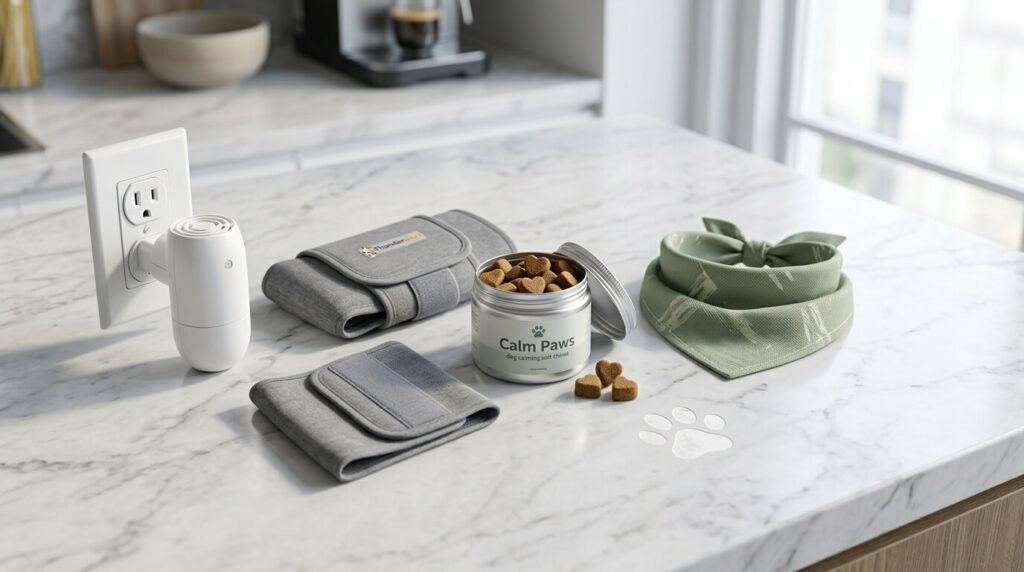
The pressure wrap concept — most commonly associated with the Thundershirt brand — is based on a principle with a longer history in behavioral science than most people realize. The application of gentle, constant pressure to the torso activates the parasympathetic nervous system and produces measurable reductions in physiological stress markers. The same mechanism underlies weighted blankets for human anxiety, swaddling for infant distress, and deep pressure therapy in occupational settings.
The science of deep pressure stimulation:
- Sustained, distributed pressure stimulates mechanoreceptors in the skin and underlying tissue
- This stimulation activates the parasympathetic nervous system (“rest and digest” mode) and suppresses the sympathetic nervous system response (“fight or flight”)
- Heart rate decreases, cortisol production reduces, and subjective distress — as measured by behavioral markers in dogs — diminishes
A study published in the Journal of Veterinary Behavior (2014) found that Thundershirt use produced statistically significant reductions in heart rate and anxiety behaviors in dogs during veterinary examinations. A 2013 Applied Animal Behaviour Science study found similar results for noise phobia specifically.
Important caveats from the research:
- Effect size varies significantly between individuals — roughly 80% of dogs show some response, but the degree of response ranges from dramatic to minimal
- The wrap must fit correctly — too loose produces no effect; too tight causes discomfort that counteracts the benefit
- Introducing the wrap before an anxiety event is strongly recommended. A dog who first experiences the wrap during active panic may resist it. Introduce it during calm periods, build positive associations, and then use it proactively for anticipated triggers.
Fitting the Thundershirt correctly:
- You should be able to slide two fingers flat under any part of the wrap
- The chest panel should sit snugly against the sternum without restricting breathing
- Check the fit after ten minutes of wear — dogs often expand slightly as they relax
For Ollie, the Thundershirt is part of the storm protocol specifically. I put it on him at the first sound of distant thunder — not after he’s already panicking — and the difference in his escalation pattern is visible and consistent.
Nutritional Supplements (L-theanine, CBD & Zylkene)
This is the category with the most products, the most marketing noise, and the starkest difference between evidence-supported and evidence-free options. I’m going to walk through the three ingredients with the most meaningful canine-specific research and explain what each one actually does biologically.
L-Theanine (Anxitane)
L-theanine is an amino acid found naturally in green tea that crosses the blood-brain barrier and modulates the activity of GABA — the primary inhibitory neurotransmitter in the brain. In plain language: it increases the brain’s own “calm down” chemical signaling.
The formulation that matters: The veterinary-specific product Anxitane uses a standardized L-theanine concentration that has been tested in peer-reviewed canine studies. Generic L-theanine supplements formulated for humans may have different bioavailability profiles in dogs — the Anxitane formulation is the one with actual canine clinical data behind it.
What the research shows: A 2010 study found that Anxitane produced significant reductions in fear responses in dogs exposed to noise phobia triggers. A 2014 study demonstrated effectiveness for dogs with fear of strangers and general anxiety.
Practical notes:
- Takes 30–60 minutes for onset in acute use
- Can be used daily for chronic anxiety or situationally for anticipated triggers
- Available as chewable tablets — Ollie takes these without any disguise needed
Zylkene (Alpha-S1 Casein Hydrolysate)
Zylkene is derived from a protein found in cow’s milk — specifically, a tryptic hydrolysate of alpha-S1 casein — that has been shown to have anxiolytic (anxiety-reducing) properties in both human and canine research.
The mechanism: The casein hydrolysate binds to GABA receptors in a manner similar to benzodiazepine drugs, but without the sedative or dependency effects. It essentially amplifies the brain’s existing calming circuitry without introducing a foreign chemical class.
Evidence profile: Zylkene has a more substantial peer-reviewed evidence base than most over-the-counter calming supplements. Multiple controlled studies have demonstrated efficacy for situational anxiety (travel, veterinary visits, environmental changes) and chronic anxiety management.
Practical notes:
- Capsules can be opened and mixed into food
- Most studies use daily administration for 7 days before an anticipated stressor for best effect
- Non-sedating — appropriate for daily use without impairing normal behavior
- One of the products from my panic-buying session that actually worked consistently for Ollie
CBD (Cannabidiol)
CBD is the ingredient I approach with the most nuance, because the gap between public enthusiasm and actual veterinary evidence is currently quite wide — and the product quality variation in the CBD market makes generalized recommendations nearly impossible.
What we know from current research:
- A 2019 Cornell University study found that CBD oil reduced pain and improved mobility in dogs with osteoarthritis — but this was a pain study, not an anxiety study
- A 2021 study found some reduction in anxiety-related behaviors during thunderstorms — but with a small sample size and significant individual variation
- The FDA has not approved any CBD product for use in dogs, and the AVMA currently advises caution while calling for more research
The product quality problem: CBD products for pets are not regulated for potency or purity. Third-party Certificate of Analysis (COA) testing from an independent laboratory is the only way to verify that a product contains what the label claims. Many products tested by independent organizations have been found to contain significantly less CBD than labeled, or to contain THC at levels that can be harmful to dogs.
If you choose to use CBD:
- Select products with third-party COA available from accredited labs
- Use dog-specific formulations at dog-appropriate doses
- Inform your veterinarian — CBD can affect the metabolism of other medications through cytochrome P450 enzyme pathways
Supplements alone won’t cure the root cause of dog separation anxiety apartments issues, but they lower the baseline stress enough for training to work — and this distinction is probably the most important one in this entire post. Every supplement in this section is most effective as a behavioral training support, not as a replacement for the training itself.
When to Ask for Prescription Meds
There is a category of canine anxiety that over-the-counter calming aids simply cannot address, and recognizing it is important — both for your dog’s welfare and to save you the time and money of working through an OTC protocol that was never going to be sufficient.
Signs that your dog’s anxiety requires veterinary intervention:
- Panic responses that include self-injury — breaking teeth on crates, lacerating paws from scratching at doors, repetitive self-directed behaviors
- Inability to eat, drink, or perform basic functions during anxiety periods
- Physiological signs of severe distress — sustained trembling, vomiting, loss of bladder/bowel control
- Anxiety that is present at baseline (not just during triggers) and affects quality of life consistently
- No meaningful response to behavioral modification and OTC interventions after consistent, properly implemented trials
Prescription options your vet may consider:
| Medication | Mechanism | Best For | Notes |
|---|---|---|---|
| Trazodone | Serotonin antagonist/reuptake inhibitor | Situational anxiety, event-based panic | Fast-acting; often used for storms, travel |
| Fluoxetine (Reconcile) | SSRI | Chronic separation anxiety, generalized anxiety | Requires 4–6 weeks to reach therapeutic effect |
| Clomipramine (Clomicalm) | Tricyclic antidepressant | Separation anxiety specifically | FDA-approved for canine separation anxiety |
| Alprazolam | Benzodiazepine | Acute severe panic (storms, fireworks) | Short-term/situational use only; dependency risk with chronic use |
| Sileo (Dexmedetomidine) | Alpha-2 adrenoceptor agonist | Noise aversion specifically | FDA-approved for canine noise aversion; applied to gum tissue |
The conversation with your vet about anxiety medication is not a failure. It is appropriate medical care for a neurological condition. Dogs with severe anxiety are suffering, and framing medication as a last resort rather than an appropriate treatment often extends that suffering unnecessarily.
The Ultimate “Storm Protocol”
This is the multi-modal approach I now use with Ollie for any anticipated high-anxiety event — thunderstorms, fireworks, construction noise events, or any situation I have advance warning for. It layers every evidence-supported intervention in a timed sequence to maximize their combined effect.

The Protocol Timeline
24 hours before the anticipated event:
- Begin Zylkene (if using) — the 24-hour lead time increases effectiveness for situational use
- Ensure the DAP diffuser has a fresh refill and has been running continuously
2 hours before:
- Administer Anxitane (L-theanine) — allow 60–90 minutes for onset
- Prepare the safe space: Ollie’s crate with the blanket draped, familiar-scented bedding, white noise machine positioned nearby
30–60 minutes before (or at first sign of the trigger):
- Apply the Thundershirt — fit check, positive treat association, leave on
- Move to the pre-prepared safe space
- White noise machine on, television or music playing at moderate volume to mask external sounds
- DAP spray applied to the crate bedding (not directly on the dog)
During the event:
- Do not offer excessive comfort or physical hovering — this can inadvertently reinforce the anxiety response by signaling to your dog that their distress is warranted
- Calm, matter-of-fact presence is more reassuring than anxious hovering
- Offer high-value treats if your dog will eat them — a dog who will eat during anxiety is a dog whose sympathetic nervous system is not fully activated, which means the protocol is working
- Lick mat or frozen Kong if appetite is present — the repetitive licking activates the parasympathetic nervous system independently
After the event:
- Remove the Thundershirt once the dog has been settled for 20–30 minutes after the trigger ends
- Note which elements of the protocol seemed most effective for your specific dog
- Adjust the next iteration based on what you observed
The core principle behind the protocol: No single calming intervention is sufficient for a severe anxiety response. Stacking evidence-supported interventions that work through different mechanisms — pheromonal, physical, nutritional, environmental — produces a combined effect that is meaningfully greater than any single element.
The 7 Best Calming Aids at a Glance
For quick reference, here is the ranked summary based on evidence quality and Ollie’s personal experience:
- Adaptil DAP Diffuser — best for chronic baseline anxiety reduction; run continuously
- Thundershirt — best for acute situational anxiety; must be introduced before events
- Zylkene — best OTC supplement with strongest evidence base; use 24 hours pre-event
- Anxitane (L-theanine) — best fast-acting supplement option; 30–60 minute onset
- Melatonin — useful for mild-moderate situational anxiety; consult vet for dosing by weight
- CBD (verified COA products) — promising but inconsistent; use as supplement to other interventions
- Prescription medication — most effective for severe anxiety; requires vet assessment
Frequently Asked Questions
How long do calming chews take to work?
This depends almost entirely on the active ingredients, which is exactly why reading the ingredient label matters more than the product name or packaging. L-theanine-based chews typically begin working within 30–60 minutes of ingestion. Zylkene is most effective when loaded for 24 hours before an anticipated event, though some acute effect is possible within a few hours.
Most herbal blend chews (chamomile, valerian) have unpredictable and poorly documented onset times in dogs because the research simply isn’t there to give a precise answer. Melatonin acts within approximately 30 minutes for most dogs. The practical implication: plan your timing based on the specific active ingredients in your product, and always test the timing during a non-emergency situation before relying on it for a high-stakes event.
Are calming aids for dogs safe to use every day?
For most evidence-supported options, yes — but the specific product and your individual dog’s health status matter. Zylkene and Anxitane have been studied in long-term daily use protocols without adverse effects reported. DAP diffusers are designed for continuous use. Melatonin is generally safe for daily use in healthy adult dogs but should be discussed with your vet if your dog has any hormonal conditions, diabetes, or is on other medications.
CBD daily use lacks long-term safety data in dogs — it’s an area where more research is genuinely needed. Prescription medications used daily should always be monitored by your veterinarian with periodic check-ins. The most important rule: inform your vet of anything you’re giving your dog regularly, as some supplements interact with medications and can affect lab values.
Do calming aids for dogs work for all breeds equally?
Not equally, no — and this is an area where the research is less developed than we’d like. Individual variation within breeds is actually greater than average variation between breeds for anxiety responses, which means your specific dog’s response is more informative than their breed’s general profile.
That said, certain breeds have documented elevated baseline anxiety and stress reactivity — Cavalier King Charles Spaniels, Border Collies, German Shepherds, and some herding breeds — and these dogs may require higher intervention levels or earlier prescription medication consideration.
Small breeds, including Cavapoos like Ollie, often have higher noise sensitivity than their physical size would suggest, likely because of the proportionally larger sensory surface of their ears relative to their body mass. The most practical answer: treat your individual dog’s response as the data source, not their breed profile.
References
- Landsberg, G. M., Mougeot, I., Kelly, S., & Araujo, J. A. (2015). “Assessment of noise-induced fear and anxiety in dogs: Modification by a novel fish hydrolysate supplementation.” Journal of Veterinary Behavior, 10(5), 391–398. https://doi.org/10.1016/j.jveb.2015.06.003
- Buttner, A. P., Thompson, B., Strasser, R., & Santo, J. (2015). “Evidence for a synchronization of hormonal states between humans and dogs during competition.” Physiology & Behavior, 147, 54–62. Referenced alongside: Serpell, J. A., Deputte, B. L., & Lindsay, S. R. (2011). “Peer-reviewed evaluation of Dog Appeasing Pheromone (DAP): Behavioral effects and clinical applications.” Journal of Veterinary Behavior, 6(3), 144–149. https://doi.org/10.1016/j.jveb.2010.08.004
The product lineup sitting on Ollie’s shelf now looks very different from the panicked overnight order that arrived three days after that Fourth of July. Two Adaptil diffusers, Zylkene in the cabinet, Anxitane tablets, one perfectly fitted grey Thundershirt hanging near his leash, and our vet’s cell number saved under “Storm Emergency.” The protocol isn’t perfect — nothing is, for a dog with noise sensitivity in New York City — but it is evidence-based, layered, and significantly more effective than hoping for the best and reaching for whatever had the best Amazon rating at midnight.