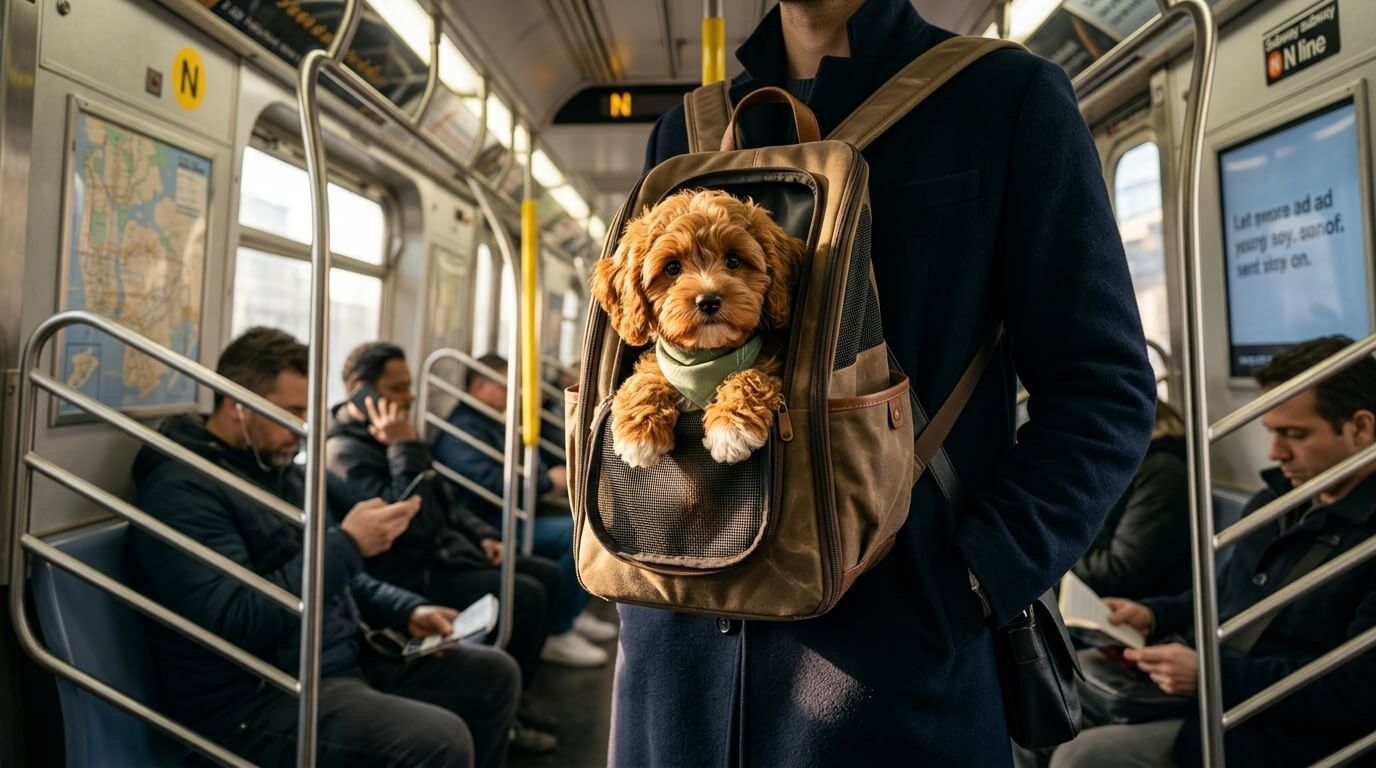
Public transit turns a short dog trip into a chain of constraints: the carrier must suit the dog, the person carrying it, the station route, and the rules of the specific operator. A bag can have excellent materials and still be impractical for a crowded platform or outside an operator’s size limit.
This guide compares five current carriers using published manufacturer specifications, then shows how to check those specifications against U.S. transit rules. Manufacturer product specifications do not equal transit-operator approval. No carrier on this page is described as universally subway-, bus-, or train-approved.
Quick Answer
Start with the rule for the exact operator and trip. Then choose a carrier that fully contains your dog, closes securely, provides ventilation, and is comfortable for both of you from apartment door to platform. Measure your dog and the carrier rather than relying on a weight limit alone. For city travel, also consider the combined dog-and-carrier weight, stair access, aisle space, cleaning, and where the carrier will be stored at home.
Evidence note: “Evidence-checked” means the product details below were checked against current manufacturer pages on September 4, 2026. It does not mean Apartment Dog Expert performed hands-on or laboratory testing. Product specifications are labeled separately from editorial assessments.
Five Dog Carriers Compared
| Product | Carrier Format | Exterior Dimensions | Interior Dimensions | Carrier Weight | Pet Weight Guidance | Material | Ventilation | Openings | Closure System | Liner / Cleaning | Foldability / Storage | Carrying Modes | Relevant Transit Constraints | Manufacturer Safety Instructions | Apartment / City Fit | Main Limitation |
|---|---|---|---|---|---|---|---|---|---|---|---|---|---|---|---|---|
| Sherpa Original Deluxe | Soft-sided carrier | Not specified on the reviewed product page | Not specified | Not specified | Measure the pet first; the reviewed page did not expose a numeric limit | Not specified | Mesh panels | Top and side entry | Locking zippers | Removable machine-washable faux-lambskin liner; waterproof interior base | Flexible soft-sided construction; exact folded size not specified | Hand handles or shoulder strap; luggage/seatbelt strap | Confirm the selected size and total carried weight against the operator before travel | Select size from pet measurements and keep the carrier securely closed | Editorial assessment: straightforward for short trips where a soft carrier is permitted and the selected size fits the route | Key numeric dimensions and weight guidance were not visible on the reviewed official page |
| Sleepypod Air | Compressible soft-sided carrier | 16–22 L × 10.5 W × 10.5 H in | 15–21 L × 9.5 W × 9.5 H in | 4.5 lb with privacy shield; 4.9 lb with shield and shoulder strap | Recommended for pets up to 18 lb | Not specified | Mesh on four sides | Top and side access | Zippered enclosure | Removable, machine-washable bedding | Ends compress from 22 to 16 in; trolley pocket | Shoulder strap and hand carry | Compare the 10.5-in height and 16–22-in adjustable length with operator maximums; Amtrak also limits combined pet-and-carrier weight | Use the manufacturer sizing guidance and secure the pet inside | Editorial assessment: useful when a trip involves a published under-seat limit, provided the dog fits comfortably | Higher carrier weight than basic soft bags reduces the remaining combined-weight allowance |
| SturdiBag Pro 3.0 | Flexible soft-sided carrier | Large: 18 D × 11.5 W × 11.5 H in | Not specified | Large: 3.8 lb | Large: up to 30 lb | 600D fabric, YKK zippers, reinforced mesh | Reinforced mesh panels | Multiple access points | Zippers with clips | Machine-washable fleece pad; carrier can be machine washed after removable parts are taken out, then air dried | Flexible-height construction; exact folded footprint not specified | Handles and shoulder strap | The 11.5-in height exceeds some published under-seat limits; compare the chosen size with the exact operator and vehicle | Use the internal tether as directed and secure zipper clips | Editorial assessment: flexible structure can help in tight city storage, but size selection must be rule-specific | A manufacturer pet-weight limit does not prove the dog has adequate usable space |
| Kurgo G-Train | Backpack that converts to a carrier | 13 W × 21 H × 10 D in | Not specified | Not specified | Up to 25 lb | Not specified; waterproof, muckproof Armorsole base | Ventilated mesh back and side panels | Zip-open access; exact opening dimensions not specified | Zippers and interior tether | Removable liner: machine wash gentle and air dry; pack: spot clean or hand wash and air dry | Shoulder straps stow away; optional fiberglass rods can be removed | Backpack or horizontal hand carry | Its 21-in backpack height is not the same as a compliant under-seat orientation; verify the dimensions in the actual carried position | Attach the dog to the interior tether as directed and follow the stated 25-lb limit | Editorial assessment: hands-free carrying may help on stairs and during an elevator-to-platform route | Carrier weight is not specified, which matters where an operator uses a combined limit |
| Snoozer Roll Around 4-in-1 | Wheeled carrier, backpack, car seat and pet bed | Medium: 20 H × 13 W × 10 D in; Large: 22 H × 15 W × 12 D in | Not specified | Not specified | Medium: up to 15 lb; Large: up to 30 lb | Not specified | Mesh on three sides | Not specified | Zippered enclosure; exact closure details not specified | Not specified | Not specified | Rolling, backpack, car seat and bed modes | Wheels and the 20- or 22-in vertical dimension require route-specific checking; stairs and narrow aisles may be limiting | Use the internal harness clip and stay within the published size guidance | Editorial assessment: rolling mode may reduce carrying strain on step-free routes | Bulk, stairs and platform gaps can make a wheeled format less practical than it appears at home |
How to read the matrix: dimensions, materials, care instructions, and stated limits are manufacturer specifications. “Apartment / City Fit,” “Relevant Transit Constraints,” and “Main Limitation” are editorial assessments based on those specifications and the route demands described below.
Product Notes: What Each Carrier Does Differently
Sherpa Original Deluxe
Manufacturer specification: Sherpa describes mesh ventilation, top and side entry, locking zippers, a waterproof interior base, and a removable machine-washable faux-lambskin liner. It can be carried by its handles or shoulder strap.
Editorial assessment: This is the simplest traditional soft-carrier format in the group. That can work well for short subway or bus trips, but the lack of clearly exposed numeric specifications on the reviewed page means buyers should confirm the selected size directly before comparing it with an operator rule.
Sleepypod Air
Manufacturer specification: Sleepypod publishes adjustable exterior and interior lengths, an 18-lb pet recommendation, four-sided mesh, top and side access, and removable machine-washable bedding. The ends compress from 22 inches to 16 inches.
Editorial assessment: The published measurements make pre-trip rule checking easier. Compression may help with a defined under-seat space, but it must not leave the dog unable to stand naturally, turn, or settle comfortably.
SturdiBag Pro 3.0
Manufacturer specification: The Large size is listed at 18 by 11.5 by 11.5 inches, 3.8 pounds, with guidance up to 30 pounds. The official page describes 600D fabric, YKK zippers, reinforced mesh, zipper clips, and a washable fleece pad.
Editorial assessment: The flexible structure and multiple sizes are useful, but a stated 30-lb limit is not a promise that every 30-lb dog will fit. Body length, chest width, and resting posture matter more than weight alone.
Kurgo G-Train
Manufacturer specification: Kurgo lists a 25-lb limit, 13-by-21-by-10-inch exterior dimensions, ventilated mesh panels, a waterproof base, an interior tether, and stow-away shoulder straps that convert the backpack to a carrier.
Editorial assessment: Backpack carry can free both hands for doors, station stairs, tickets, and railings. The tradeoff is that its upright backpack height does not automatically match an operator’s under-seat rule. Check the orientation required for the trip.
Snoozer Roll Around 4-in-1
Manufacturer specification: Snoozer publishes Medium and Large sizes, weight guidance of 15 and 30 pounds respectively, mesh on three sides, an internal harness clip, and four modes: rolling carrier, backpack, car seat, and pet bed.
Editorial assessment: Rolling can reduce shoulder strain on a step-free trip. In an older station, the same wheels and frame can become a burden at stairs, platform gaps, and crowded doors. Map the route before choosing this format.
Public Transit Rules: Check the Operator, Not a Product Label
U.S. transit policies are not interchangeable. City systems, commuter rail, intercity rail, and buses can apply different enclosure, size, and trip rules. Even a familiar policy can change, so verify it before every trip.
| Operator | Applicable System / Region | Rule Summary | Date Checked | Official Source | Verify Before Travel |
|---|---|---|---|---|---|
| MTA | New York City subway and bus rules | Animals generally must be enclosed in a container and carried in a way that does not annoy other passengers; stated exceptions include law-enforcement and service animals. | September 4, 2026 | MTA Rules of Conduct | Check the current rule and service status for the exact route. |
| WMATA | Washington, D.C.-area Metro | Pets must be in a secure container. Service animals may ride unconfined. | September 4, 2026 | WMATA Metro manners | Confirm current conditions and any station-specific instructions. |
| Amtrak | Eligible U.S. intercity rail routes | Dogs and cats are accepted on many routes with restrictions. The combined pet-and-carrier limit is 20 lb, trips are limited to seven hours, the maximum carrier size is 19 × 14 × 10.5 in, and the pet must remain fully enclosed under the seat. | September 4, 2026 | Amtrak pet policy | Check route eligibility, reservation availability, current fees and restrictions. |
| FTA / ADA guidance | U.S. public transit civil-rights framework | Transit providers must permit trained service animals. Emotional-support or comfort animals are not automatically treated as service animals under the ADA. Pet accommodation is decided by the local provider. | September 4, 2026 | FTA ADA FAQ | Use the local operator’s current pet policy; do not apply pet-carrier rules to a qualifying service animal. |
Service Animals Are a Separate Category
Ordinary pet rules and ADA service-animal rules should not be blended. A carrier may be useful for some trips, but a qualifying service animal is not simply a pet with a different bag. Review the operator’s accessibility information and the federal guidance that applies to the trip. Amtrak also publishes a separate service-animal policy.
How to Choose for an Apartment-to-Platform Trip
1. Measure the dog, then the route
Your dog should be able to stand naturally, turn comfortably, and rest without being compressed against the carrier walls. Next, map elevator dimensions, lobby doors, station stairs, turnstiles, and the expected under-seat or floor space. A carrier that fits the dog but cannot be handled safely through the route is not a practical city choice.
2. Add dog and carrier weight
A 16-lb dog in a 4.9-lb carrier is over a 20-lb combined limit. Even when the operator does not publish a combined limit, carry the loaded bag around the apartment and hallway before attempting transit. If you cannot control it while opening a door or holding a rail, choose a different format or route.
3. Prioritize secure closure and airflow
Look for a fully closing enclosure, ventilation that will not be blocked by your body or luggage, and a base that stays stable when the vehicle moves. An interior tether can be a backup connection when the manufacturer instructs its use, but it does not replace a closed carrier on systems that require one.
4. Choose a cleaning plan you can do in a small home
Rain, platform dirt, hair, and accidents are easier to manage with a removable liner and a base that can be wiped down. Before buying, check whether the liner, the whole bag, or only selected parts are washable. Plan where a damp carrier can air dry without blocking a narrow entryway.
5. Compare storage footprint with travel convenience
Structured wheels and frames can be useful on a long, step-free route but consume more closet space. A soft carrier may store more easily but can sag if its base is weak. The right compromise depends on your floor plan and how often you travel.
Practice Before the First Ride
- Leave the carrier open at home with a familiar mat and reward voluntary investigation.
- Practice closing it for a few seconds, then reopen before the dog becomes distressed.
- Carry the dog through the apartment, hallway, and elevator at quiet times.
- Try the route without boarding: lobby, sidewalk, station entrance, and back home.
- Begin with a short off-peak ride and leave if the dog cannot settle.
If elevator movement is the difficult step, use a separate dog elevator training plan before combining it with a carrier and transit trip. For crowded shared spaces, the practical expectations in apartment dog social etiquette can help you plan doorways, passing distance, and neighbor interactions.
Watch for persistent panting, drooling, frantic scratching, escape attempts, repeated barking, or refusal to enter. Those signs call for a slower plan, a different carrier, or professional behavior or veterinary guidance—not simply a longer forced ride.
Apartment-to-Platform Workflow
- At home: confirm the rule, reservation if required, carrier closure, liner, identification, and dog fit.
- Elevator and lobby: keep the carrier closed and close to your body; do not block doors or invite greetings in a bottleneck.
- Sidewalk and station: avoid setting a soft carrier near traffic, curb water, escalator edges, or platform gaps.
- On board: follow the operator’s placement rule, preserve ventilation, and keep aisles and exits clear.
- After the trip: inspect closures and mesh, clean the liner and base, and let the carrier dry before storage.
If transit is part of a move, include carrier practice in the wider moving-to-an-apartment plan rather than introducing the carrier, station, and new home on the same day.
Frequently Asked Questions
Is any dog carrier approved for every U.S. subway, bus, and train?
No. Manufacturers publish product specifications; transit operators publish the rules for their systems. Compare the selected carrier’s exact dimensions, structure, and loaded weight with the current rule for each leg of the trip.
Can a backpack carrier be used on public transit?
Sometimes, if it fully contains the dog and meets the operator’s current rule. A backpack’s upright dimensions may not match an under-seat requirement, so check the dimensions in the position used on board.
Does a pet weight limit prove the carrier is large enough?
No. Dogs of the same weight can have very different body lengths and chest widths. Confirm that the dog can stand, turn, and settle comfortably within the usable interior.
Are wheeled carriers better for city travel?
They can reduce carrying strain on a step-free route, but wheels and frames add bulk and can be awkward on stairs, platform gaps, or crowded vehicles. Evaluate the complete route, not only the distance.
What should I verify on travel day?
Recheck the operator’s pet policy, service changes, reservations, trip-duration limits, and any carrier-size or combined-weight rule. Inspect the carrier’s mesh, base, closures, straps, wheels, and tether before leaving home.