
Best calming products for dogs are support tools, not stand-alone answers. In an apartment, they may help with hallway noise, construction sounds, guests, fireworks, vet visits, grooming, travel, or mild alone-time stress, but they work best when paired with routine, training, predictable enrichment, and veterinary guidance when anxiety is intense.
The safest way to choose a calming product is to start with the situation. A dog who startles at elevator noise may need sound management and a safe resting area. A dog who pants during thunderstorms may need a plan before the storm starts. A dog who destroys the door when alone needs a separation-anxiety plan, not just a chew or diffuser. A dog who becomes stiff, growly, or defensive around people may need professional behavior help before any product is useful.
This guide is written for apartment dog owners who want practical options without exaggerated promises. It covers seven product categories, what they may help with, where they can fail, and when to call your veterinarian or a qualified behavior professional.
Quick Answer
For apartment dogs, the most useful calming products are usually quiet enrichment toys, lick mats, pheromone diffusers, pressure wraps, white-noise support, safe resting zones, and veterinarian-guided supplements or medications when appropriate. Start with low-risk environmental tools before buying supplements, CBD products, or anything that claims to quickly fix anxiety.
| Product Type | Best For | Important Limit |
|---|---|---|
| Lick mat or stuffed food toy | Mild stress, grooming, short settling routines | Not safe for all chewers; supervise at first |
| Snuffle mat or food puzzle | Restless dogs who need quiet mental work | Can frustrate dogs if too difficult |
| Pheromone diffuser | Background support in one room | Effects vary; placement and timing matter |
| Pressure wrap | Some noise-sensitive or travel-sensitive dogs | Must be introduced before scary events |
| White noise or sound masking | Hallway sounds, elevator noise, construction | Does not teach coping by itself |
| Safe-zone setup | Dogs who need a predictable retreat | Should not become isolation punishment |
| Vet-guided calming supplement or medication | Situational or more serious anxiety plans | Use professional guidance; avoid unsupported claims |
If your dog already has a broader anxiety plan, compare this article with calming aids for dogs. This page focuses on product categories and renter-friendly selection; the broader guide helps you think through routines and warning signs.

Table of Contents
What a Calming Product Can and Cannot Do
A calming product can change the environment, slow your dog’s body down, add a soothing activity, or reduce the intensity of a trigger. It cannot erase fear, remove pain, replace training, or promise quiet behavior in an apartment building.
This distinction matters because anxious dogs do not all look the same. Some bark. Some hide. Some pace. Some freeze. Some chew the door. Some follow the owner from room to room. Some appear quiet but are still distressed. VCA’s article on anxiety wraps notes that behavior professionals caution owners not to mistake stillness for emotional comfort. A dog can be less active and still be uncomfortable.
Use products as support, then watch your dog’s body language. Helpful signs include softer posture, easier resting, normal breathing, willingness to eat, and quicker recovery after a trigger. Concerning signs include panting, trembling, drooling, frantic scratching, repeated escape attempts, growling, snapping, hiding that worsens, or loss of appetite.
How to Choose Safely in an Apartment
Start with the lowest-risk option that matches the trigger. For hallway noise, sound masking and distance from the door may help. For grooming stress, a lick mat and cooperative handling may help. For mild restlessness during work calls, a food puzzle may help. For thunderstorms, introduce a safe zone and pressure wrap before the storm season, not during the loudest thunderclap.
Ask these questions before buying:
- What exact situation am I trying to make easier?
- Is my dog mildly unsettled or truly panicking?
- Could pain, illness, hunger, or lack of exercise be involved?
- Will this product be safe if my dog chews, paws, or swallows pieces?
- Can I introduce it during calm practice sessions first?
- Do I need veterinary guidance before using supplements or medication?
If your dog is reacting to being left alone, start with the article on how long you can leave a dog alone in an apartment. Alone-time distress is one of the places where product-only solutions often disappoint.
The 7 Best Calming Product Categories for Dogs
1. Lick Mats and Stuffed Food Toys
Licking can be soothing for many dogs, and lick mats or stuffed rubber toys can create a predictable settling activity. They are useful during grooming practice, short work calls, quiet evenings, crate rest when appropriate, or after a walk when your dog needs help shifting down.
Use part of your dog’s normal food allowance or dog-safe spreads recommended by your veterinarian. Keep calories in mind. Freeze only after your dog understands the activity; a frozen toy that is too hard can frustrate some dogs.
Safety matters. Supervise new toys, especially with strong chewers. Remove the item if your dog tears pieces, guards it, or becomes frantic. For toy selection, the best dog puzzle toys guide explains how to match difficulty and chewing style.
2. Snuffle Mats and Food Puzzles
Snuffle mats and beginner food puzzles turn mealtime into quiet sniffing and problem solving. For apartment dogs, this can be better than high-energy indoor play because it is usually quieter and less likely to disturb neighbors below.
Choose easy puzzles first. If a dog barks at the puzzle, flips it aggressively, or chews the edges, the task may be too hard. Make it easier by using visible food, fewer compartments, or a simpler mat. The goal is calm engagement, not a test of intelligence.
Snuffle mats need cleaning. In a small apartment, fabric that holds drool and food crumbs can become an odor source. Shake, wash, and dry the mat regularly.
3. Pheromone Diffusers or Collars
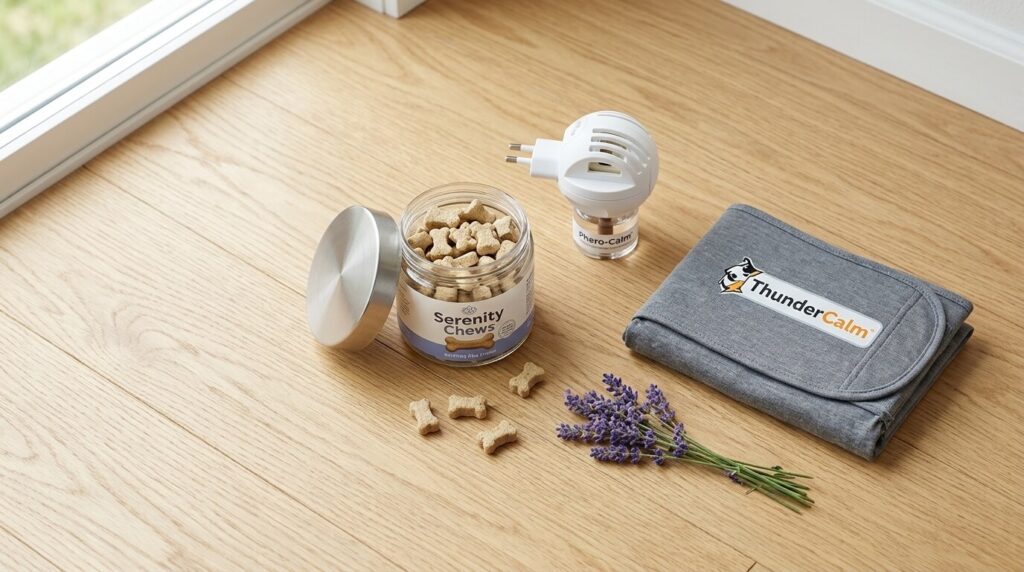
Dog appeasing pheromone products are designed to provide a calming signal in the environment. They may be used as background support for some dogs during transitions, new apartments, visitors, noise sensitivity, or general unease. They are not sedatives, and they do not teach a dog what to do during a trigger.
Diffusers work best when placed in the room where your dog actually rests. Do not hide one behind furniture or expect it to cover the whole apartment if the layout is open or large. Collars may be more portable, but they still need to be used according to directions and monitored for skin irritation.
For dogs adjusting after a move, pair environmental support with the first-48-hours setup in moving dog into new apartment.
4. Pressure Wraps
A pressure wrap is a snug garment designed to apply gentle pressure around the torso. Some dogs appear calmer with a wrap during thunderstorms, fireworks, travel, or grooming practice. Others dislike the feeling or become still without truly feeling better.
Introduce a wrap during pleasant, low-stress moments. Put it on briefly, feed treats, play gently, then remove it. Do not use it for the first time during fireworks or construction noise. VCA recommends acclimating dogs to wraps during positive times so the wrap is not only associated with scary events.
Check fit carefully. It should not restrict breathing, movement, urination, or comfortable lying down. Remove it after the stressful event or practice session. Do not leave a dog unsupervised in a wrap unless you know it is safe for that dog.
5. White Noise and Sound Masking
Apartment dogs often react to sounds humans cannot control: elevator doors, stairwell footsteps, hallway conversations, delivery carts, garbage trucks, construction, and neighbor dogs. White noise, fans, air purifiers, or soft background audio can reduce sudden contrast and make these sounds less sharp.
Place sound masking between your dog and the trigger when possible. If the front door is the problem, a sound source near the entry may help more than one across the room. Keep volume comfortable. The goal is masking, not blasting.
If barking at hallway noise is the main issue, use sound support alongside how to stop dog barking in an apartment. Sound masking can reduce triggers, but training changes the routine.
6. Safe-Zone Beds, Crates, or Gated Areas
Some dogs calm faster when they have a predictable resting zone. This might be an open crate, a dog bed beside your desk, a gated bedroom corner, or a mat away from the front door. The product is not just the bed or crate; it is the routine around it.
A safe zone should feel voluntary and comfortable whenever possible. Add water access when appropriate, a familiar blanket, a chew-safe item, and enough distance from triggers. Do not use the zone only when your dog is already in trouble. Practice calm moments there every day.
If you use a crate, make sure it is introduced gradually. The guide to crate training apartment dogs can help you decide whether a crate is a calming space or a source of stress for your dog.
7. Vet-Guided Supplements or Medication
Some dogs may benefit from calming supplements or prescription medication, especially when anxiety is frequent, intense, or dangerous. This is where veterinary guidance matters. Ingredients, dosing, interactions, medical history, and product quality all affect safety.
Be especially cautious with CBD products marketed for pets. The FDA states that it has not approved cannabis products for any use in animals and cannot ensure the safety or effectiveness of such products. If you are considering CBD or any supplement, talk with your veterinarian first.
Medication is not a failure. For some dogs, the most humane plan combines behavior modification, environmental management, and veterinarian-prescribed medication. Products like wraps, diffusers, toys, and sound masking can still support that plan, but they should not delay proper care when a dog is suffering.
A 7-Day Product Test Plan
Apartment owners often judge calming products too quickly. They try a chew during fireworks, plug in a diffuser after barking starts, or put on a pressure wrap when the dog is already shaking. A better approach is to test one product at a time during ordinary days and track what actually changes.
Use a simple seven-day test before deciding whether a product belongs in your routine. Choose one trigger, one product, and one measurable goal. For example, the trigger might be hallway footsteps. The product might be white noise near the entry. The goal might be shorter recovery time after a hallway sound.
| Day | What to Do | What to Watch |
|---|---|---|
| 1 | Observe without changing anything. | How often does the trigger happen, and how does your dog respond? |
| 2 | Introduce the product during a calm time. | Does your dog investigate, avoid, relax, or become suspicious? |
| 3 | Use the product before a mild version of the trigger. | Is recovery faster than usual? |
| 4 | Repeat with the same setup. | Is the response consistent, or was yesterday a one-off? |
| 5 | Add a small routine cue, such as mat, treat, or safe zone. | Does the product work better with structure? |
| 6 | Skip the product but keep the routine. | Was the routine itself doing most of the work? |
| 7 | Decide whether to keep, adjust, or retire it. | Did stress intensity, recovery time, or daily life improve? |
This kind of test prevents product stacking. If you add a diffuser, chew, wrap, white noise, and food toy all at once, you will not know what helped. You may also miss side effects, digestive changes, or signs that your dog was simply too tired, too full, or too inhibited to react normally.
Keep notes plain: trigger, time, product used, body language, and recovery time. If the problem is serious enough that you are tracking panic, injury, or repeated destruction, bring those notes to your veterinarian. They can make the appointment more useful than a vague description such as “he is anxious at home.”
How to Avoid Product Stacking
It is tempting to combine several calming products because apartment problems feel urgent. A neighbor complains, construction starts, or your dog barks through a work call, and the fastest answer seems to be buying everything at once. But stacking products can create confusion, extra calories, digestive upset, over-sedation concerns, or a false sense that the situation is handled.
Use a ladder instead. Start with environmental support: distance from the trigger, sound masking, curtains, a comfortable bed, and a predictable safe zone. Add quiet enrichment if your dog can eat and think calmly. Try a pressure wrap only after practice. Consider pheromone products as background support. Talk with your veterinarian before adding supplements, CBD products, or medication.
The ladder keeps the plan readable. If your dog improves with sound masking and a better bed location, you may not need supplements. If your dog does not improve with environmental changes, that tells you the anxiety may be deeper than a product page can solve.
When Not to Buy Another Calming Product
Do not buy another product if the current problem involves injury, escape attempts, biting, repeated panic, or sudden behavior change. Do not keep switching chews or drops if your dog has vomiting, diarrhea, sedation, agitation, or appetite changes. Do not rely on calming tools when your dog is reacting because of pain, poor sleep, lack of exercise, or an unsafe environment. In those cases, spend the next dollar on veterinary or behavior guidance before adding more products to the apartment.
Calming Product Plan by Apartment Trigger
Hallway noise
Try sound masking, moving the bed away from the door, visual barriers, and a quiet food puzzle during predictable noisy periods. Avoid letting your dog rehearse door monitoring all day. Reward them for settling away from the entry.
Thunderstorms or fireworks
Prepare before the event. Set up a safe zone, close curtains, add sound masking, use a pressure wrap only if your dog has already been acclimated, and ask your veterinarian about a plan if your dog panics. Do not wait until the storm is severe before trying a new product.
Construction noise
For temporary construction, combine sound masking, daytime enrichment, curtains, and a room farther from the noise source. If the construction will last weeks, build a sustainable routine rather than relying on chews every day.
Guests and visitors
Use a safe zone, gate, mat, or food toy before guests enter. Do not hand a nervous dog to visitors and expect a calming product to make the interaction safe. If your dog growls, lunges, or snaps, get professional help.
Grooming or nail trims
Use a lick mat, treats, a non-slip mat, and short cooperative sessions. If your dog panics around nail tools, start with sound and paw handling separately. The guide to best dog nail grinder explains how sound and vibration affect apartment dogs.
Common Mistakes
Mistake 1: Buying the strongest product first
Start with the situation and the dog’s body language. A mild hallway-startle problem may need sound masking and a better bed location. A dog who injures themselves during storms needs veterinary help, not a shopping cart full of calming chews.
Mistake 2: Trying a product for the first time during panic
New products should be introduced during calm practice. A wrap, diffuser, toy, or safe zone may fail if the first exposure happens during fireworks, construction, or a visitor rush.
Mistake 3: Mistaking quiet for calm
A dog who becomes still may not be relaxed. Watch breathing, posture, appetite, willingness to move, recovery time, and whether the dog chooses the product again later.
Mistake 4: Using food products without calorie planning
Lick mats, chews, puzzle toys, and stuffed toys can add calories quickly. Use part of the daily ration when possible, especially for small apartment dogs who may have limited exercise opportunities.
Mistake 5: Ignoring pain or medical causes
Restlessness, irritability, night pacing, sudden clinginess, or sensitivity to touch can have medical causes. If behavior changes suddenly, schedule a veterinary check before assuming anxiety is the only issue.
When to Call Your Veterinarian
Call your veterinarian if your dog’s anxiety includes panic, self-injury, destructive escape attempts, refusal to eat, heavy drooling, repeated accidents, sudden behavior change, aggression, or distress that happens often. Also ask before using supplements, CBD products, sedatives, or products that could interact with medication.
If your dog is alone for long periods and shows signs of distress, a pet camera may help you understand what is happening, but it should not become the whole plan. Use best pet camera for dogs as a monitoring tool, not a replacement for veterinary or behavior support.

FAQ
What are the best calming products for dogs in apartments?
The best options for many apartment dogs are lick mats, snuffle mats, pheromone support, pressure wraps, sound masking, safe-zone setups, and veterinarian-guided supplements or medication when appropriate. The right choice depends on the trigger and the dog’s stress level.
Do calming chews really work?
Some owners report benefits, especially for mild situational stress, but evidence and product quality vary. Talk with your veterinarian before using calming chews, especially if your dog has health issues or takes medication.
Are CBD calming products safe for dogs?
The FDA has not approved cannabis products for use in animals and cautions owners because safety and effectiveness are not assured. Ask your veterinarian before using CBD or hemp products for your dog.
Can a pressure wrap help with fireworks?
It may help some dogs, but it should be introduced during calm times before fireworks season. A wrap alone may not be enough for dogs with severe noise fear.
What can I use for hallway noise barking?
Try sound masking, moving the resting area away from the door, rewarding quiet behavior, and giving your dog a predictable job before busy hallway times. If barking continues, use a structured barking plan.
Can calming products replace training?
No. Products can make training easier by lowering stress or adding structure, but they do not teach coping skills by themselves. Training, management, routine, and professional help may still be needed.
Next Step
Pick the trigger first, then choose one low-risk product to test during calm practice. For most apartment dogs, start with environmental support such as sound masking, a safe resting spot, and quiet enrichment. If anxiety is intense, frequent, or dangerous, talk with your veterinarian before stacking products or trying supplements.