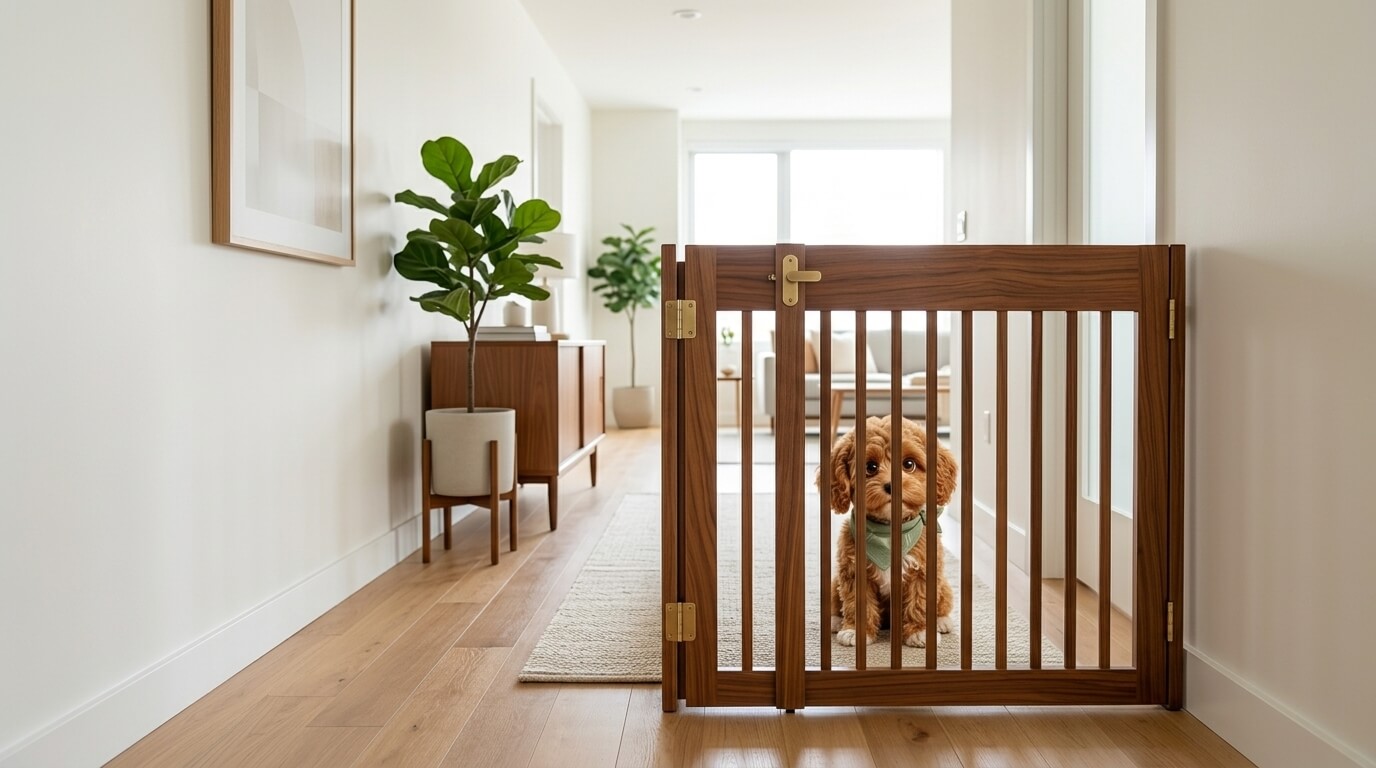
No Drill Dog Gates Apartments: 7 Critical Safety Checks
No drill dog gates apartments can use safely are not just about blocking a doorway. In a rental, the gate has to match the opening and the dog’s behavior, protect walls and trim, keep an exit route usable, and avoid creating a trip, pinch, entrapment, or push-through hazard.
The best choice is usually not the prettiest gate or the strongest-looking gate. It is the gate that matches your dog’s size, jumping style, chewing habits, doorway width, flooring, baseboards, and lease rules. A small senior dog who wanders into the kitchen needs a different setup from a young dog who body-checks barriers during evening zoomies. A pressure-mounted walk-through gate may be perfect in one apartment doorway and a terrible idea at the top of stairs or beside a slick landing.
This guide treats a no-drill dog gate as a renter tool, not a magic fix. A gate can help protect a trash can, separate dogs during meals, create a calm recovery area after a move, or keep a puppy out of cords and plants. It should not replace training, supervision, exercise, or a realistic plan for anxiety, chewing, barking, or resource guarding. If your dog is panicking, escaping, biting, or crashing into barriers, the right next step is a safer management plan and professional support, not a taller gate alone.
Quick Answer
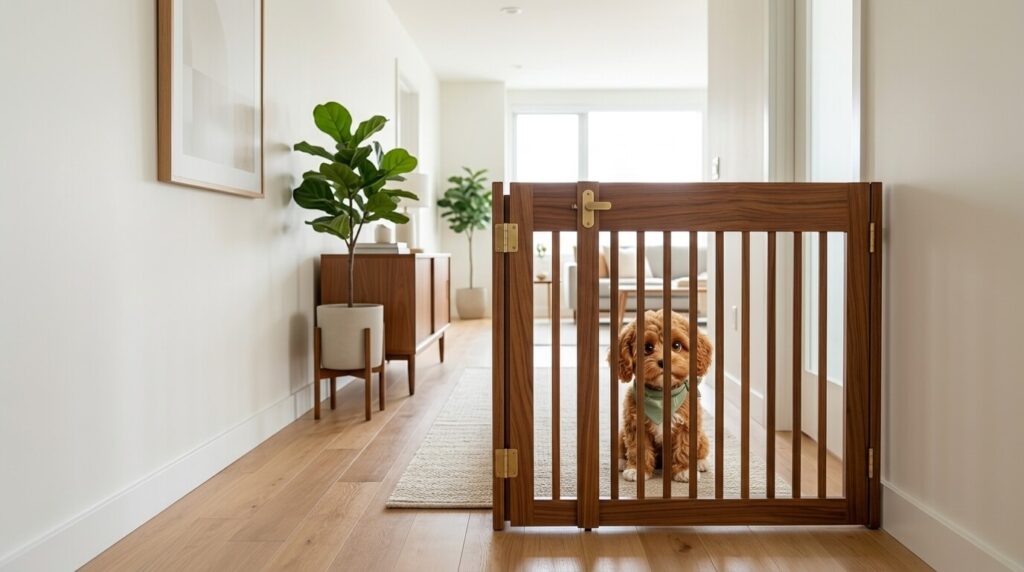
For many apartment renters, a pressure-mounted walk-through gate can work in a flat, structurally sound doorway when the manufacturer’s allowed width, extensions, wall-contact hardware, and installation indicators are followed exactly. For wider rooms or awkward open layouts, a stable freestanding or modular barrier may be more practical than forcing a tension gate into a poor fit. Neither option is automatically safe for stairs, determined escape behavior, or unsupervised confinement.
Use this short version before you shop:
| Apartment Situation | Better Gate Type | Why It Works |
|---|---|---|
| Standard kitchen or bedroom doorway | Pressure-mounted walk-through gate | Easy daily use, no drilling, good for routine room boundaries |
| Wide opening between living room and dining area | Freestanding or modular panel gate | Does not depend on perfect doorframe pressure |
| Small dog who squeezes through gaps | Gate with narrow bar spacing or solid lower panel | Reduces slipping through or getting stuck |
| Large dog who leans or jumps | Tall, extra-stable gate with strong latch | Better resistance to pushing, leaning, and casual jumping |
| Temporary meal separation | Freestanding panel or doorway gate | Helps create space without turning feeding into a conflict |
| Stairs inside a rental unit | Manufacturer-approved stair gate | Pressure gates are often not appropriate for stair fall-risk areas |
If you want the simplest renter-safe rule: use pressure gates for ordinary room boundaries, freestanding gates for awkward spaces, and avoid relying on a no-drill pressure gate anywhere a fall could happen if the gate shifts.
Why Apartment Dog Gates Are Different
A house with owned walls gives you more freedom. You can drill hardware into studs, add permanent barriers, and move a gate if the first location does not work. Apartment renters have a smaller margin. You may have painted drywall, hollow door trim, uneven baseboards, slick floors, narrow hallways, and a lease that treats wall damage seriously.
Apartment dog gates also get used more often. In a small home, one gate might protect the kitchen during cooking, the front door during package deliveries, the bathroom during cleaning, and the bedroom when guests visit. If the latch is annoying, you will stop using it. If the gate is hard to step over, you may trip while carrying groceries or laundry. If the pads scuff paint, the “no-drill” setup still costs you at move-out.
The gate also changes how your dog experiences the apartment. A barrier can give a dog a predictable safe zone, but it can also create frustration if the dog sees food, guests, another pet, or the hallway and cannot reach it. That is why the best setup combines the physical gate with calm routines, enrichment, and a reason for your dog to settle on their side of the barrier.
If you are still deciding whether your apartment can realistically support a dog, read the renter-focused planning guide on getting a dog while living in an apartment. A gate is useful, but it is only one part of your daily management system.
The 7 Critical Checks Before Buying
1. Match the gate to your dog’s real behavior
Start with your dog, not the product photo. Some dogs respect a visual boundary immediately. Others paw, chew, jump, climb, bark at the barrier, or squeeze through gaps. A calm small dog may only need a lightweight freestanding panel across a kitchen opening. A young athletic dog may need a taller gate with vertical bars, a secure latch, and no footholds.
Watch your dog around existing barriers for a day. Do they push doors with their shoulder? Paw at baby gates in other homes? Put front paws on counters? Try to follow you through every doorway? Freeze when separated? The answer matters more than the weight printed on a product listing.
If your dog chews baseboards, doorframes, or furniture, a gate may help by limiting access, but it will not solve the chewing pattern by itself. Pair the barrier with the plan in dog chewing furniture apartment fixes, especially if the chewing happens when you leave.
2. Measure the opening in three places
Measure the width at the top, middle, and bottom of the opening. Apartment doorframes and hallway edges are not always square, especially in older buildings. A pressure gate that fits at the top but barely touches near the baseboards can shift when your dog leans on it. A gate that fits the bottom but over-compresses near the top can damage paint or trim.
Also measure baseboard depth. Thick baseboards can prevent the gate pads from sitting flat against the wall. If the gate only touches the raised trim, pressure may concentrate on a narrow area and leave dents. For some rentals, wall protector cups or wider rubber pads make a meaningful difference.
Do not forget swing clearance. A walk-through gate needs room for the door panel to open. In a narrow galley kitchen, behind a front door, or near a closet, a swing gate can become more annoying than useful. In those spots, a freestanding panel or a gate that opens both directions may work better.
Write down the narrowest and widest measurements rather than rounding to the nearest familiar doorway size. Check the manufacturer’s permitted range for the exact gate plus the exact extension combination; do not stack improvised spacers or use an extension from another model. Measure the height and shape of the baseboard, the depth of trim, and whether both contact surfaces are solid, parallel, and permitted by the instructions.
| Measurement | Why It Matters | Common Rental Surprise |
|---|---|---|
| Top, middle, and bottom width | Reveals an opening that is not square | Older trim narrows near the floor |
| Baseboard depth | Changes how pressure pads contact the wall | Upper pads touch drywall while lower pads sit on trim |
| Gate swing radius | Keeps doors, cabinets, and walking paths usable | Gate door collides with the apartment entry door |
| Bar and bottom gap | Helps assess head, paw, and body entrapment risk | A small dog can enter a space the product photo hides |
| Threshold height | Shows the trip exposure in daily traffic | Dark hallway or groceries make the bar hard to see |
3. Choose the right gate type
Most no-drill dog gates for apartments fall into three practical groups: pressure-mounted gates, freestanding gates, and modular panel gates.
A pressure-mounted gate uses tension between two walls or doorframe sides. It is usually the cleanest choice for a normal doorway. Look for a walk-through door, a latch you can operate with one hand, and pads that spread pressure rather than digging into paint.
A freestanding gate does not attach to the wall. It works well for wide openings, temporary boundaries, or spaces where a pressure gate cannot seat evenly. The tradeoff is stability. A determined dog may push or drag a lightweight freestanding gate unless it has wide feet, enough weight, or a shape that resists tipping.
A modular panel gate can bend around odd spaces, block a corner, or create a small pen. This is useful in studios and open-plan apartments, but the panels need enough floor space. If you are already tight on walking paths, a modular setup can make the apartment feel cluttered.
Retractable mesh barriers deserve separate caution. They save space, but flexible material, bottom gaps, locking mechanisms, and suitability for stairs vary by product. A dog who paws, chews, pushes under fabric, or launches at a barrier may defeat a setup that looks tidy in a listing. Use only the locations and mounting method the manufacturer permits, and do not treat “retractable” or “pet gate” as proof of containment.
4. Treat stairs and raised landings as a separate safety problem
No-drill does not automatically mean safe everywhere. Stair areas deserve special caution because a shifting gate can create a fall hazard. The U.S. Consumer Product Safety Commission notes that safety gates are used to prevent falls and specifically says top-of-stairs gates should be screwed to the wall in child-safety contexts. Dog gates are not identical to child safety gates, but the fall-risk logic still matters in an apartment with interior stairs, loft steps, or a raised landing.
If you need to block stairs, follow the gate manufacturer’s instructions exactly and choose a product explicitly rated for that location. Do not improvise with a pressure gate at the top of stairs just because drilling is inconvenient. In a rental, it may be better to ask the landlord for permission to install a small number of properly patched hardware points than to rely on a barrier that can shift under pressure.
For ordinary flat doorways, no-drill gates can be practical. For fall-risk locations, the standard is higher.
5. Check the bottom bar and trip risk
Many pressure-mounted walk-through gates have a bottom threshold bar. It helps the gate stay square, but it can become a daily trip point. That matters in apartments where you carry laundry, groceries, a leash, or a dog bowl through the same opening every day.
A bottom bar is not automatically bad. It may be fine in a kitchen doorway you cross slowly. It may be a poor choice at the entrance to a dark hallway, beside the front door, or anywhere guests will walk without expecting it. If you choose a bottom-bar gate, make sure the contrast is visible and keep the area well lit.
For older adults, anyone with mobility concerns, or homes where a small dog is underfoot, a gate with a low-profile threshold or a freestanding panel that can be moved during busy moments may be safer.
6. Think about wall protection before the first installation
A no-drill gate can still leave marks. Pressure pads can polish paint, dent soft drywall, rub trim, or leave dark circles on matte finishes. Before installing, clean the wall contact points, test a small area if possible, and use manufacturer-approved wall cups or protectors.
Do not over-tighten the gate to compensate for a poor fit. If the gate wobbles at normal pressure, the answer is usually a different location, an extension kit, a wider pad, or a different gate style. Over-tightening can bow the frame, make the latch misalign, or damage the wall.
After installation, photograph the gate area. This is not dramatic; it is practical renter housekeeping. If you move the gate later, you will know which marks were already there and which ones need touch-up before inspection.
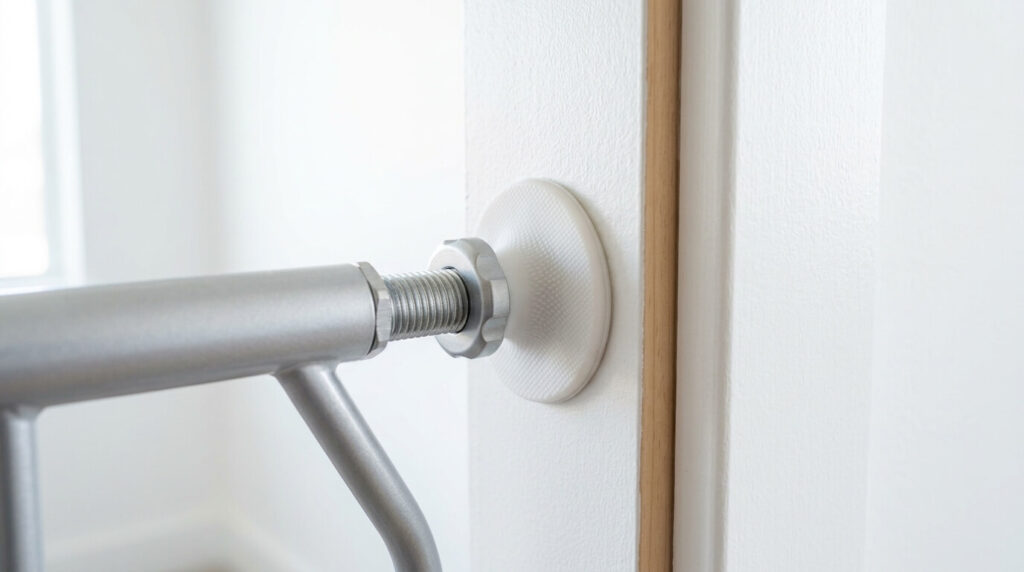
Wall cups, adhesive protectors, and rubber pads are not automatically damage-free. Adhesive can pull paint, soft pads can transfer color, and wide cups can still compress weak drywall. Check the lease, obtain permission when required, and use only accessories approved for that model. “No drill” describes the fastener method; it is not a guarantee that the installation leaves no trace.
7. Plan for daily use, not just first-day setup
The right gate should make your routine easier. If it slows you down too much, you will leave it open. If your dog learns that barking makes you open it, the gate becomes part of the barking loop. If you only use it when something stressful happens, your dog may start to dislike the barrier.
Use the gate during calm moments first. Toss a treat or chew on the dog’s side, step through, return before your dog worries, and reward quiet waiting. Build short repetitions before you rely on the gate during cooking, cleaning, guest arrivals, or work calls.
For dogs who explode with energy in tight spaces, a gate may help you manage zones, but you still need an outlet. The guide to dog zoomies in apartments can help you reduce the kind of evening energy that turns a gate into a hurdle.
Test the Installed Gate Before Trusting It
Installation is not complete when the gate stands upright. Follow the manual, confirm every latch and pressure indicator, and then test from both sides without the dog present. Apply controlled hand pressure at the center, near the lower corners, and in the direction your dog is likely to push. The gate should not walk across the floor, rotate out of square, release a pad, or change latch alignment.
Next, observe the dog on leash or from close range. Stop if the dog puts a head through an opening, hooks a paw, bites the bars, climbs, repeatedly slams the gate, or becomes distressed. A barrier that survives gentle adult hand pressure may still be wrong for a dog who rehearses escape behavior. Do not “test” failure by provoking the dog or leaving them alone to see what happens.
Recheck the installation after the first day, after anyone moves it, and whenever temperature, humidity, cleaning, or repeated use changes the contact points. A gate is a piece of management equipment, not permanent architecture.
Best No-Drill Gate Types by Apartment Scenario
Best for standard kitchen doorways
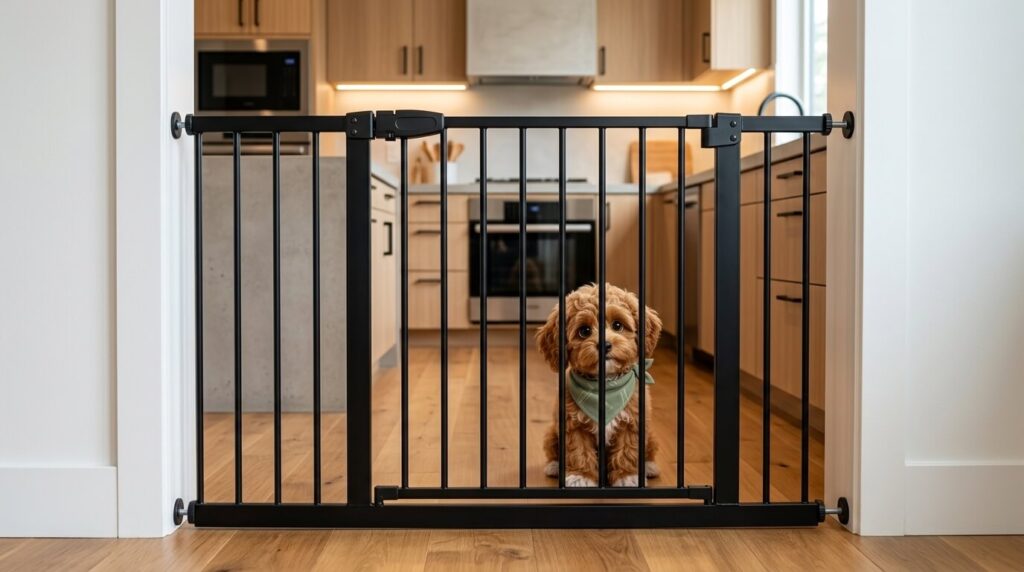
Use a pressure-mounted walk-through gate with a secure latch and wall-protective pads. This is the classic apartment setup because kitchens often contain trash, dropped food, hot pans, cleaning supplies, and fragile routines. A walk-through door matters because you will cross the kitchen boundary many times per day.
Choose height based on your dog’s behavior, not just breed size. Some small dogs jump surprisingly well. Some large dogs never challenge a barrier. If your dog places paws on the top rail, choose a taller gate or move to a different management plan.
Best for studio apartments
Use a freestanding or modular panel gate to carve out a zone without pretending the studio has normal doorways. This can separate the bed area, desk area, potty station, or front door path. The key is to keep human walking paths open. A gate that makes you step sideways all day will not last.
If you have an indoor potty area, avoid placing the gate so close that your dog feels trapped beside it. For setup ideas, see indoor dog porch potty planning.
Best for entry doors and package deliveries
Use a gate that creates a second boundary behind the front door. This is especially useful for dogs who rush the hallway, bark at neighbors, or get excited when delivery drivers knock. The gate should be far enough from the door that you can step inside, close the door, and manage your dog without squeezing through a dangerous gap.
If barking is part of the front-door pattern, pair the gate with the training steps in how to stop dog barking in an apartment. The physical barrier gives you time; training changes the routine.
Best for meal separation
Use a doorway gate, freestanding panel, or modular barrier that gives each dog enough space to eat without being watched closely by another pet. Do not use the gate to create a tense face-to-face standoff. If one dog guards food, the barrier should reduce pressure, not force them to stare at the other dog through bars.
For guarding concerns, read resource guarding in small spaces. Gates can support safety, but serious guarding needs a careful behavior plan.
Best for moving week
Use a simple temporary gate to keep your dog away from open doors, movers, boxes, cleaning products, and loose hardware. Moving week is not the time to test a complicated setup. Put the dog’s bed, water, chew, and familiar blanket behind the barrier before the apartment becomes chaotic.
If you are relocating soon, the guide to moving into a new apartment with a dog pairs well with a temporary gate plan.
Common Mistakes Renters Make
Mistake 1: Buying for the doorway, not the dog
A gate can fit the doorway and still fail the dog. A calm dog may respect a short visual divider. A climber may treat that same divider as a toy. A nervous dog may bark or chew because separation behind a gate feels confusing. Before choosing, ask what behavior you need the gate to manage: wandering, trash access, jumping on guests, counter surfing, front-door rushing, potty mistakes, or conflict between pets.
Mistake 2: Ignoring the floor
Freestanding gates behave differently on carpet, hardwood, vinyl, and tile. Slick floors can let a lightweight gate slide. Thick rugs can make panels uneven. If you use a freestanding gate on a hard floor, look for non-slip feet and test it with gentle pressure before trusting it with your dog.
Mistake 3: Creating a frustration window
Some gates let a dog see everything they cannot reach: food prep, guests, other pets, or the hallway. Visibility can be helpful for calm dogs and frustrating for reactive dogs. If your dog barks through the gate, try increasing distance, adding a mat or bed behind the gate, offering a chew, or using a partial visual barrier for short periods.
Mistake 4: Using the gate only during trouble
If the gate appears only when guests arrive, food drops, or you are about to leave, the dog may associate it with stress. Use the gate during neutral moments too. Feed a treat behind it, open it again, and keep the mood ordinary. The goal is for the gate to feel like furniture, not punishment.
Mistake 5: Forgetting the landlord’s version of “damage”
Renters often focus on holes, but landlords may also notice paint rubs, dents, chipped trim, and scratched floors. Use wall protectors, avoid dragging freestanding gate feet, and check contact points weekly. A no-drill gate should still be treated as an installed object.
How to Introduce a No-Drill Gate to Your Dog
Install the gate when you are not rushed. Let your dog sniff it while it is open or while you are nearby. Reward calm interest. Then place your dog on the intended side with a familiar bed, chew, or stuffed food toy. Step away for a few seconds and return before your dog escalates.
Repeat short sessions over several days. Do not start with a full workday separation. If your dog whines briefly and then settles, keep sessions easy and predictable. If your dog panics, paws frantically, bites the bars, drools, urinates, or injures themselves, stop treating the gate as a simple product issue. Those signs can point to distress, confinement fear, or separation-related problems.
VCA’s behavior resources on destructive chewing and enrichment emphasize that dogs need appropriate outlets, routine, and management. A gate works better when the dog also has enough exercise, chewing options, rest, and predictable human interaction.
When a No-Drill Gate Is Not Enough
Skip the simple gate solution if your dog has already broken barriers, hurt themselves trying to escape, redirected aggression toward a person or pet, or reacts intensely whenever separated. Also be cautious if your dog can jump high enough to land awkwardly on the other side. In those cases, a taller barrier can increase injury risk if the dog attempts the jump anyway.
A gate is also not enough for severe separation anxiety. If your dog becomes destructive only when alone, records show panic behavior, or neighbors report prolonged distress, a barrier may protect one room but worsen the emotional problem. Work with your veterinarian or a qualified behavior professional to build a plan.
For puppies, a gate is often part of a larger starter setup. Pair it with safe chew options, potty routines, and a practical supply list such as the new apartment dog owner checklist.
Use an Editorial Checklist Instead of Star Ratings
This guide does not claim hands-on testing of every gate and does not rank products from marketplace descriptions alone. Before buying, compare the current manufacturer manual and specifications for the exact model. Retailer titles can merge several sizes or generations, and customer photos may show installations the manufacturer does not approve.
- Allowed opening range: exact minimum and maximum with approved extensions.
- Permitted locations: flat doorway, bottom of stairs, top of stairs, or explicitly prohibited areas.
- Installation feedback: pressure indicator, wall cups, leveling method, and retightening instructions.
- Dog fit: total height, bar spacing, footholds, lower gaps, chewable parts, and expected behavior.
- Human fit: latch operation, opening width, threshold, emergency egress, and mobility needs.
- Rental fit: wall material, trim, flooring, adhesive restrictions, and documented landlord permission.
- Support: accessible manual, replacement parts, extension compatibility, and a workable return policy.
Do not rely on a weight label as if it predicts containment. Dog behavior, leverage, jumping, installation surface, and maintenance matter. A calm heavy dog may respect a modest barrier; a lighter athletic dog may climb it. The gate must fit the actual dog and location.
FAQ
Are no drill dog gates for apartments safe for large dogs?
They can be safe for some large dogs, but only if the gate matches the dog’s behavior and the opening. A calm large dog who respects boundaries may do well with a tall pressure-mounted gate in a flat doorway. A dog who jumps, rams, climbs, or panics may need a different management plan.
Can I use a pressure-mounted dog gate at the top of stairs?
Do not assume that you can. Stair locations carry fall risk. Use only a gate that the manufacturer specifically approves for that location, and follow installation instructions exactly. In many cases, hardware-mounted options are safer for top-of-stairs use.
Will a no-drill gate damage apartment walls?
It can. Pressure pads may leave marks or dents, especially on soft paint, drywall, or narrow trim. Use wall cups or protectors when appropriate, avoid over-tightening, and inspect the contact points regularly.
What height should I choose?
Choose a height your dog cannot comfortably jump, lean over, or climb. For small calm dogs, a lower gate may be fine. For athletic dogs, choose a taller gate and avoid horizontal footholds. If your dog attempts to scale barriers, do not rely on height alone.
Are freestanding gates better than pressure gates?
Freestanding gates are better for wide or awkward openings. Pressure gates are usually better for standard doorways where the frame is even and the gate can seat securely. Neither type is best everywhere.
Can a dog gate stop chewing, barking, or accidents?
A gate can reduce access to problem areas, but it does not fix the underlying behavior. Chewing may need enrichment and prevention. Barking may need a front-door routine. Accidents may need potty training or a vet check. Use the gate as one layer, not the whole plan.
Make the Purchase Decision From the Opening and the Dog
Before buying, measure the opening at the top, middle, and bottom, photograph the trim and baseboards, and write down the exact behavior you need to manage. Read the current manual for the exact model before ordering. Reject any option that requires an improvised extension, blocks emergency movement, creates an unacceptable trip point, or depends on your dog never testing it.
After correct installation, test the gate without the dog, introduce it during calm supervised sessions, and recheck all contact points. If the dog climbs, panics, chews, rams, becomes trapped, or redirects aggression, stop relying on the barrier and get qualified help. Renter-friendly should mean appropriate for the lease and the space, not weaker safety standards.