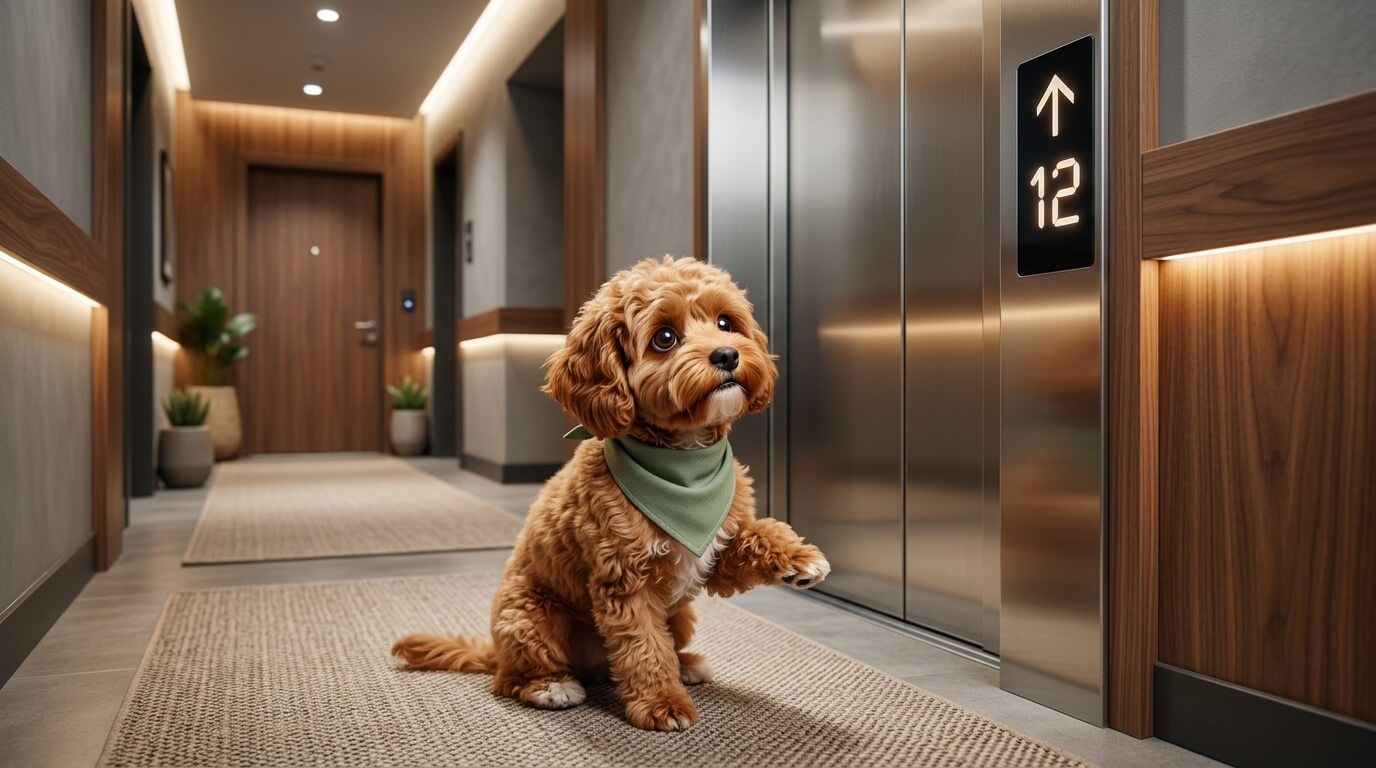
By a dog parent who has done the elevator math at 3 AM in pajamas and lost.
You do the calculation the moment you feel the wiggling intensify. You’re on the fourteenth floor. The elevator takes approximately forty-five seconds to arrive, another thirty seconds to descend, and then there’s the lobby crossing, the vestibule door, and finally the twelve feet of sidewalk between you and the nearest patch of grass. That’s two minutes minimum under perfect conditions — no neighbors holding the door, no slow lobby crossing, no ice on the sidewalk.
Ollie, my caramel Cavapoo in his sage green bandana, was approximately ninety seconds of bladder capacity at ten weeks old. I learned very quickly that figuring out how to potty train a dog in an apartment building is a fundamentally different challenge from house training in a home with a backyard door, and that the elevator is your primary enemy. This guide is built around that specific reality.
How To Potty Train A Dog In An Apartment (Quick Answer)
Learning how to potty train a dog in an apartment requires managing the math between bladder capacity and building exit time. Install an indoor backup system (real grass pad or pee pad) for emergencies, follow a rigid schedule timed around sleep and meals, heavily reward outdoor success within three seconds of the event, and use enzymatic cleaner on every indoor accident to chemically eliminate the scent that draws dogs back to the same spot.
The “Elevator Math” Problem
Let me explain why apartment potty training is harder before I explain how to fix it.
In a house, the back door is fifteen seconds from the kitchen. In a high-rise apartment building in New York, the exit is an elevator ride, a lobby crossing, and a sidewalk away from where you’re standing.
A ten-week-old puppy can hold their bladder for approximately one hour per month of age — meaning Ollie at ten weeks had a reliable window of maybe two to two and a half hours between urgent needs. That window shrinks to almost nothing immediately after sleeping, eating, or playing. The moment Ollie woke up from a nap, I had perhaps sixty to ninety seconds before the need became urgent — and the elevator alone consumed half of that.
The math works against you in three specific scenarios:
- Post-nap urgency — dogs wake up needing to go immediately, with no warning period
- Post-meal urgency — the gastrocolic reflex triggers bowel movement within fifteen to thirty minutes of eating
- Excitement urgency — high arousal from play or greetings triggers immediate bladder release in puppies
The solution to the elevator math problem is not to rush the elevator. It’s to have a backup plan that removes the time pressure entirely while you build the schedule that makes outdoor training work.
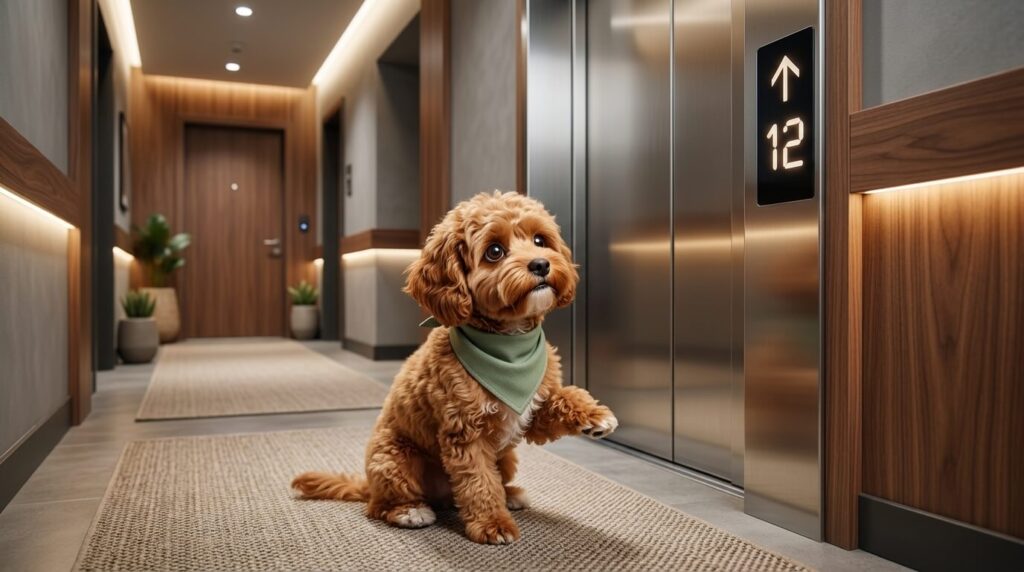
Phase 1: The Indoor Backup System
The indoor backup system is not failure. It is engineering. You are solving a physics problem, not taking a shortcut.
The backup system exists for exactly three situations: middle-of-the-night urgency when a full elevator-to-street trip isn’t safe or realistic, immediate post-wake urgency when the window is too short, and high-rise weather situations (ice, heavy rain) that make a fast trip genuinely dangerous.
Real Grass Pads vs. Synthetic Pee Pads
This is the decision that affects how smoothly you transition to outdoor-only training later.
Synthetic pee pads:
- Immediately available, low cost, easy to find
- The significant problem: the scent attractants in synthetic pads teach your puppy that any absorbent surface indoors is an appropriate bathroom location
- Many dogs trained on synthetic pads struggle to distinguish between the pad and the carpet, creating a longer-term problem
Real grass pads:
- Fresh or preserved real grass squares, typically delivered by subscription
- The advantage: Real grass smells like outdoor grass, which means the transition to outdoor toileting is neurologically seamless — Ollie is always learning “grass = bathroom,” whether that grass is on your balcony or in the park
- More expensive and require replacement, but produce significantly better outdoor transition results
My recommendation: Real grass if you have a balcony or any outdoor-adjacent space. If neither is possible, synthetic pads positioned as far from carpet as possible (hard floor, bathroom, laundry area) to create maximum surface-type distinction.
If you buy a pad and your puppy absolutely refuses to step on it, you are likely dealing with one of the 6 core reasons for [litter box avoidance dogs] experience.”

Phase 2: The Strict High-Rise Schedule
The schedule is the entire game. Everything else is supporting infrastructure.
Puppies cannot develop reliable habits from inconsistent timing — their bladder control is developing in parallel with their behavioral learning, and both need repetition to consolidate. Inconsistent scheduling produces inconsistent results, which owners frequently misread as the puppy being difficult.
The High-Rise Potty Schedule
Under 12 weeks:
- Immediately upon waking (every time — naps included)
- Within 15 minutes of finishing every meal
- After every play session over 10 minutes
- Every 2 hours during waking periods
- Immediately before bed
12–16 weeks:
- Immediately upon waking
- Within 20 minutes of meals
- Every 2.5–3 hours during waking periods
- Before bed
4–6 months:
- Morning, midday, afternoon, evening, before bed
- Immediately after meals
The High-Rise Execution Protocol
Because the elevator adds time, you must anticipate rather than react:
- Learn Ollie’s pre-potty signals — circling, sniffing the floor, sudden stillness, heading toward the door
- The moment you see any signal, move immediately — pick up and carry for young puppies, leash and move for older ones
- Press the elevator button before you put on shoes — every second counts
- Have a dedicated “going down” leash hung by the door, already attached to a collar that lives there permanently
Tip 3: Carry Your Puppy in the Elevator
This tip prevents accidents and protects your puppy’s health simultaneously.
Until Ollie was fully vaccinated (typically sixteen weeks), I carried him through the lobby and elevator rather than allowing floor contact. The lobby floor of a New York apartment building contacts hundreds of dogs — including dogs carrying parvovirus, which is fatal to unvaccinated puppies and survives on surfaces for months.
The practical benefit: A carried puppy cannot squat and go in the elevator. You maintain control of the situation entirely.
How to carry safely:
- Hold them against your chest with one arm supporting their hindquarters
- Have the leash already attached before leaving the apartment — snap it on while they’re still in your arms
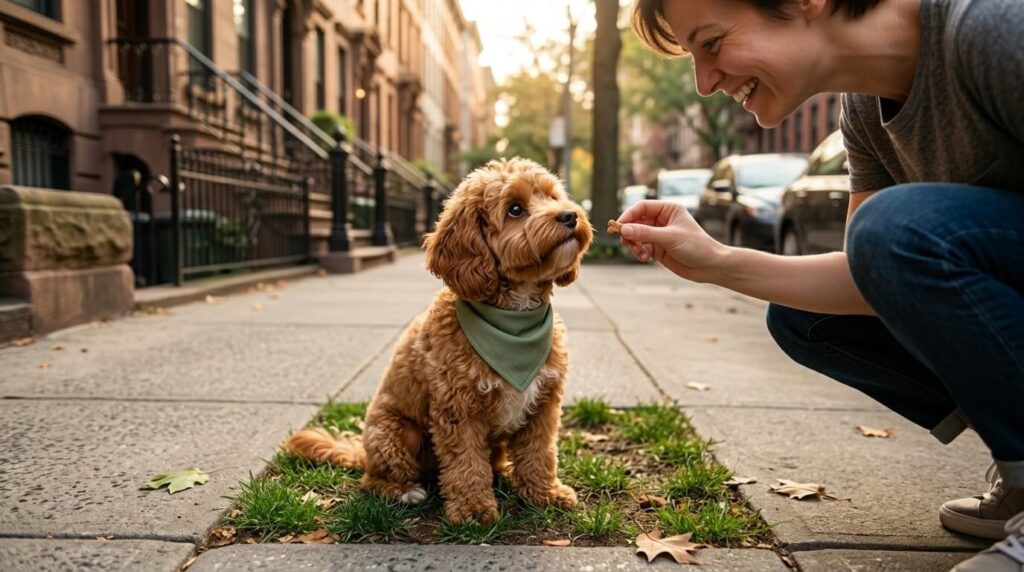
- Place them on the grass immediately upon setting them down outside
Tip 4: The Outdoor Reward Protocol
This is the piece that most owners get subtly wrong, and it’s the piece that most directly affects how quickly training consolidates.
The three-second rule: The reward must be delivered within three seconds of the desired behavior. Not after you’ve walked back inside, not after you’ve praised and walked to your pocket — within three seconds of the last squat.
This means:
- High-value treats in your pocket or a treat pouch before you leave the apartment — not retrieved from a bag after the fact
- The marker word or clicker used at the exact moment they finish — “yes!” at the moment of completion, treat delivered immediately after
- Enthusiastic verbal praise — Ollie’s response to “good boy!” delivered at genuine enthusiasm is visible and immediate
What counts as high-value: Not their regular kibble. Small pieces of cooked chicken, freeze-dried meat treats, or commercial high-value training treats. The outdoor bathroom behavior should be the most rewarded behavior in their entire day, consistently.
Tip 5: How to Handle Accidents Correctly
The accident happened. Now what you do in the next sixty seconds determines whether it happens in that spot again.
What not to do:
- Do not yell, scold, or show the dog the accident — they cannot connect your displeasure to an event that happened even thirty seconds ago
- Do not use any cleaner that contains ammonia — ammonia smells like urine to a dog and actively marks the spot as a bathroom location
- Do not rub their nose in it — this is not a training technique; it is distressing and counterproductive
What to do:
- Calmly interrupt if you catch them in the act — a calm “outside” and an immediate carry to the door
- Clean with an enzymatic cleaner — these products contain enzymes that chemically break down the uric acid compounds in dog urine; standard cleaners remove the visible stain but leave the scent molecules that draw dogs back to the same spot
- Apply the enzymatic cleaner generously, allow it to fully saturate the area, and leave it to dwell for the time directed on the label before blotting
- Note the location — if accidents cluster in the same spot, that area has residual scent despite cleaning and may need repeated enzymatic treatment or temporary blocking with furniture
As I outlined in my ultimate first time dog owner apartment guide, this is the hardest phase, but it passes — the period of frequent accidents is finite, and your cleaning protocol during this period directly affects how quickly it ends.
One additional challenge: when dogs have accidents on soft surfaces and sense your displeasure, they sometimes try to conceal future accidents in hidden locations — under furniture, in closet corners — which means you might suddenly need to learn how to stop a dog from digging the carpet as they attempt to bury or hide evidence. [How To Stop Dog Digging Carpet (7 Proven Fixes)]
Tip 6: The Midnight Run Reality
I’m not going to tell you the midnight runs aren’t miserable. They are.
At ten to twelve weeks, Ollie needed a middle-of-the-night trip outside at least once — sometimes twice. This is biologically non-negotiable; puppies cannot hold through the night until approximately twelve to sixteen weeks, and sometimes later.
Making the midnight runs survivable:
- Keep the trip boring — no play, no praise beyond the marker, no extended outdoor time; go out, do the business, come in, back to bed immediately
- Keep a specific “night” leash by the bed with a clip-on bag dispenser already attached
- Set an alarm for the middle of the night rather than waiting to be woken by whining — anticipating the need is less disruptive than responding to a developing accident
- Have shoes by the door — fumbling for shoes at 2 AM costs thirty seconds you may not have
The midnight phase is temporary. Most puppies consolidate to sleeping through the night without a bathroom break between twelve and sixteen weeks with consistent daytime scheduling.
Tip 7: Transitioning Fully Outdoors
The goal of the indoor backup system is to buy you time, not to be a permanent solution. Here is how to phase it out cleanly.
The transition signal: When Ollie is consistently going to the indoor grass pad reliably (rather than having random floor accidents), and consistently going outside on schedule, he is ready to begin phasing out the indoor option.
The phase-out protocol:
- Move the grass pad progressively closer to the door over one to two weeks
- Then move it outside the door into the hallway briefly, then to the elevator lobby
- Then eliminate it — at this point, the outdoor habit is established and the indoor backup is no longer providing accident prevention; it’s providing permission to skip the outdoor trip
Signs the transition is working:
- ☐ Ollie moves toward the door unprompted when he needs to go
- ☐ No accidents indoors for two full weeks
- ☐ Consistent signaling behavior (sitting at the door, whining at the door, bringing you the leash)
Installing a signal bell: Some owners teach their dogs to ring a bell hung at nose height on the door to signal needing to go outside. This is a straightforward shaping exercise using positive reinforcement and eliminates the ambiguity of subtle pre-potty signals.
The ultimate goal of learning how to potty train a dog in an apartment is moving away from the indoor pad entirely.
A Note on Breed and Size Considerations
Ollie is a Cavapoo — a small-to-medium mixed breed with a relatively small bladder capacity that directly affects the schedule required.
Small breeds (under 15 pounds):
- Smaller bladder = shorter hold times = more frequent trips
- May need to maintain more frequent scheduling than the standard guidelines suggest
- Often take longer to fully train than medium or large breeds
Large breeds:
- Greater bladder capacity = longer potential hold times
- Often faster to consolidate once the outdoor habit is established
- Still require the same schedule discipline during the initial training period
Adjust your schedule expectations to your specific dog’s biology rather than generic “puppies are trained in two weeks” claims you may find elsewhere.
FAQ
What is the most complete approach to how to potty train a dog in an apartment building on a high floor?
The most effective approach to how to potty train a dog in an apartment building specifically addresses the exit time problem. Install a real grass indoor backup system on your balcony or bathroom, follow an age-appropriate schedule that anticipates the post-sleep and post-meal urgency windows, carry your puppy through the elevator and lobby until vaccination is complete, and use high-value treats delivered within three seconds of outdoor success. The elevator delay is managed by pre-staging (leash by the door, shoes on before pressing the elevator button) rather than by rushing.
Should I carry my puppy down the elevator to prevent accidents?
Yes — for two reasons. First, it physically prevents an elevator accident by keeping the puppy off the floor. Second, and more important for their health, an unvaccinated puppy (typically under sixteen weeks) should not have contact with lobby or elevator floors that hundreds of other dogs — including potentially unvaccinated or ill dogs — have walked across. Parvovirus survives on surfaces for months and is fatal to unvaccinated puppies. Carry your puppy from your apartment door to the outdoor grass until their vaccination series is complete.
How long does apartment potty training actually take?
Most puppies show significant reliability — meaning you can predict their schedule and accidents are rare rather than daily — between twelve and sixteen weeks of age with consistent training. Full reliability (no accidents for two consecutive weeks) typically occurs between four and six months. Small breeds like Cavapoos sometimes take slightly longer due to bladder size. If you are still experiencing daily accidents after six months of consistent positive reinforcement training, consult your veterinarian to rule out medical causes (urinary tract infection, bladder anomaly) before assuming it’s a behavioral problem.
References
- American Veterinary Society of Animal Behavior (AVSAB). (2021). AVSAB Position Statement on Humane Dog Training. Retrieved from https://avsab.org/resources/position-statements/
- Overall, K. L. (2013). Manual of Clinical Behavioral Medicine for Dogs and Cats. Elsevier. (Chapter on housetraining and elimination behavior in dogs, covering reinforcement schedules and substrate preferences in puppies.)
Disclaimer: This article reflects the personal experience of a dog owner and draws on published canine behavioral science and veterinary guidelines. It is not a substitute for individualized veterinary or professional behavioral assessment. If your puppy is having accidents despite a consistent training protocol, or if you notice any unusual urinary patterns (frequent small amounts, blood, crying during elimination), please consult a licensed veterinarian to rule out medical causes.