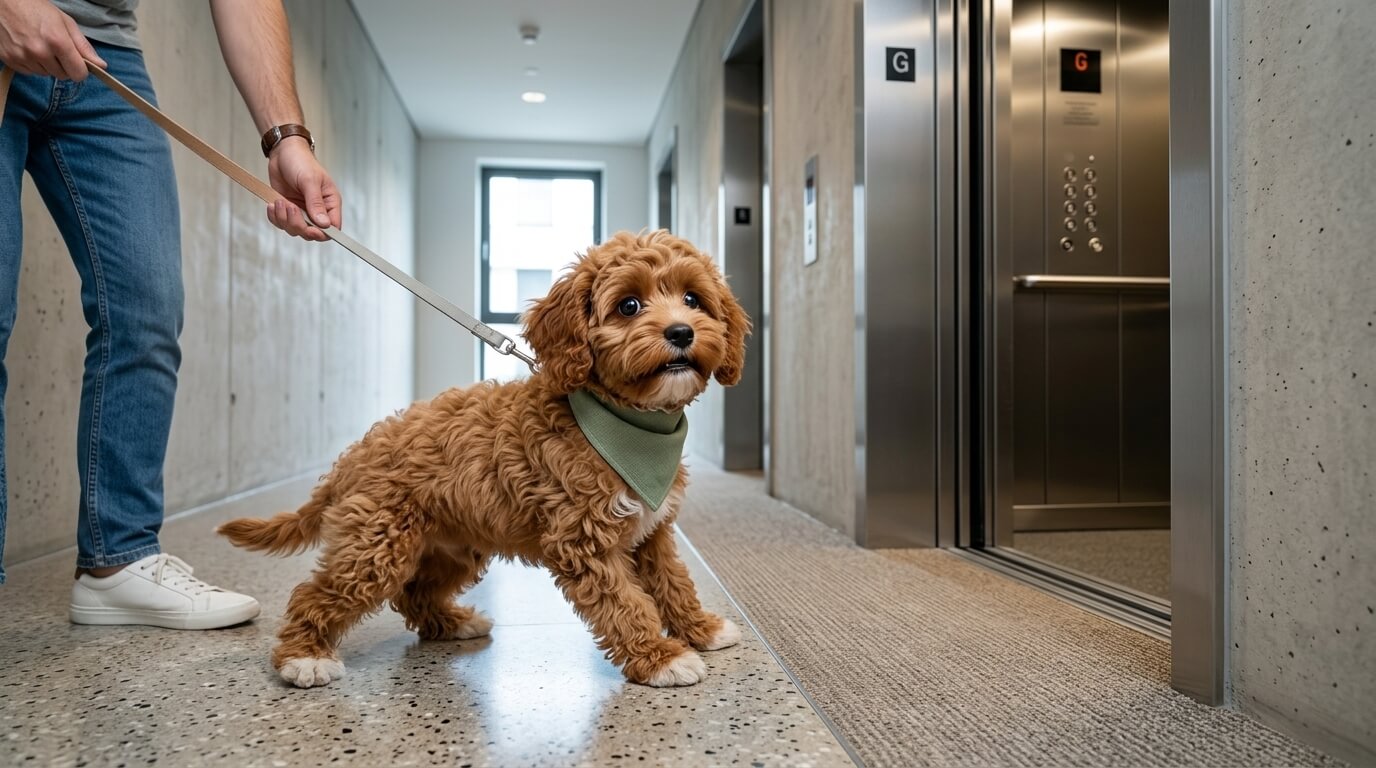
Dog scared of elevators? The refusal often begins before the ride. Your dog may slow down at the hallway corner, flatten when the chime sounds, plant their feet at the metal threshold, or enter willingly and panic only when the floor moves.
Those are different fear points, and they need different practice. Pulling a dog through the doors may complete today’s potty trip, but it does not teach the dog that the elevator is safe. A better plan breaks the trip into pieces small enough that your dog can notice the elevator without losing the ability to eat, move, and respond.
This guide is specifically about elevator fear: freezing, retreating, trembling, refusing to enter, trying to escape, or becoming distressed during motion. For ordinary waiting, entering, and exiting manners, use the broader dog elevator training routine. If your dog mainly barks or lunges when someone appears in the doorway, follow the elevator-door lunging safety plan.
Table of Contents
First Find the Exact Moment Your Dog Becomes Worried
“Afraid of the elevator” can describe five separate experiences. Watch one ordinary approach without coaxing your dog forward. The first change in pace, posture, breathing, or willingness to eat is more useful than the point where the dog finally refuses.
| What you notice | Likely difficult part | Where to begin |
|---|---|---|
| Slows or turns back in the hallway | The location or prediction of a ride | Practice before the hallway corner |
| Startles at the chime or moving doors | Sound and sudden movement | Watch from farther away without boarding |
| Stops at the metal strip | Threshold, gap, surface, or confinement | One-paw approach and retreat practice |
| Enters but braces when doors close | Confinement or door movement | Stationary in-and-out practice |
| Panics only after the car moves | Vibration, balance, or motion | One-floor rides after a veterinary check if sudden |
Fear can look quiet. A dog who stands completely still may be more distressed than a dog who barks. Watch for a lowered body, ears held back, lip licking, panting when it is not hot, trembling, leaning away, scanning, refusing familiar treats, or trying to stay behind you. One sign alone does not diagnose anxiety, but a cluster of changes tells you the session may be too difficult.
Also notice recovery. Does your dog shake off and resume sniffing a few seconds after the doors close, or remain tense all the way back to the apartment? Recovery time helps you judge whether the exposure was manageable.
Before Training, Separate Fear From Pain or Physical Difficulty
A dog who suddenly refuses an elevator after years of normal rides deserves more than a training assumption. If your dog scared of elevators has changed abruptly, slippery flooring, arthritis, back or neck pain, vision loss, hearing changes, or balance problems can make stepping over the gap and feeling the car move genuinely difficult. A frightening event, such as slipping or being crowded by another dog, can also change behavior abruptly.
Contact your veterinarian when the change is sudden, your dog is older, or you also notice stiffness, reluctance on stairs, stumbling, head tilt, unusual eye movement, sensitivity to touch, or changes in normal activity. Training cannot make an uncomfortable ride physically comfortable.
Use a secure, well-fitted harness or collar and a regular leash. Avoid retractable leashes around closing doors. If the floor is slick, ask building management whether a removable non-slip surface is permitted during a controlled practice, or choose an elevator with better traction if the building has more than one.
The 5-Step Calm Elevator Plan
There is no fixed number of days for these steps. Stay at one level until your dog can approach with a loose body, take food if food is normally motivating, and leave without a prolonged stress response. A two-minute session can be enough.
1. Begin Before the First Fear Point
If your dog changes at the lobby entrance, begin in the hallway. If the change happens at the hallway corner, begin before the corner. Walk toward the area, stop while your dog can still orient to you, reward calm observation, and then walk away.
The retreat is part of the exercise. It shows the dog that approaching does not always end with being trapped in the car. You are not promising never to use the elevator; you are creating repetitions in which the dog can approach and recover.
Do not lure farther with a continuous trail of treats while the dog is leaning backward. Eating while being drawn into a scary space is not the same as feeling safe. Offer a reward at the workable distance, then make the next approach only slightly closer if the dog’s body remains loose.
2. Let the Chime and Doors Become Ordinary
Practice during a quiet part of the day. Stand to the side and far enough back that people can pass. Press the button, reward your dog when the chime sounds or the doors move, and leave without boarding. One or two door openings may be the entire session.
If your dog startles and immediately recovers, keep the next repetition equally easy. If they scramble away, stop eating, or remain tense, increase distance next time. The Merck Veterinary Manual describes desensitization as presenting a trigger at an intensity low enough not to evoke the full fear response, then increasing difficulty gradually. In an apartment lobby, distance and time of day are the easiest intensity controls.
Do not block the doors for training. If another resident arrives, step away and let them use the elevator. Good training should not create a building conflict.
3. Treat the Threshold as Its Own Exercise
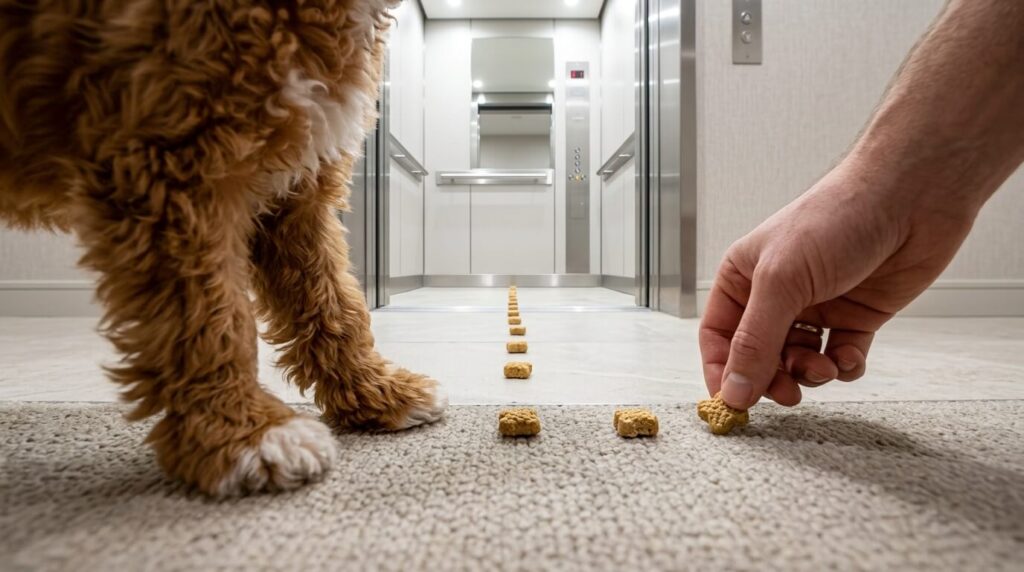
For some dogs, the metal seam and changing floor surface are harder than the lobby. Wait for an empty car. Approach only as close as your dog chooses comfortably, reward, and move away. Later, reward one paw near or over the threshold, then retreat together.
When your dog is ready to step in, enter and leave before the doors close. Keep the leash clear of the gap and stand where you can exit safely. Do not turn the dog around in a cramped doorway or hold the doors through repeated cycles.
A small dog can be carried when safety or an urgent trip requires it, but practice a calm pickup cue away from the elevator first. Scooping up a struggling dog only after they panic can make the lobby predict unwanted handling.
4. Add Door Closing Before You Add a Long Ride
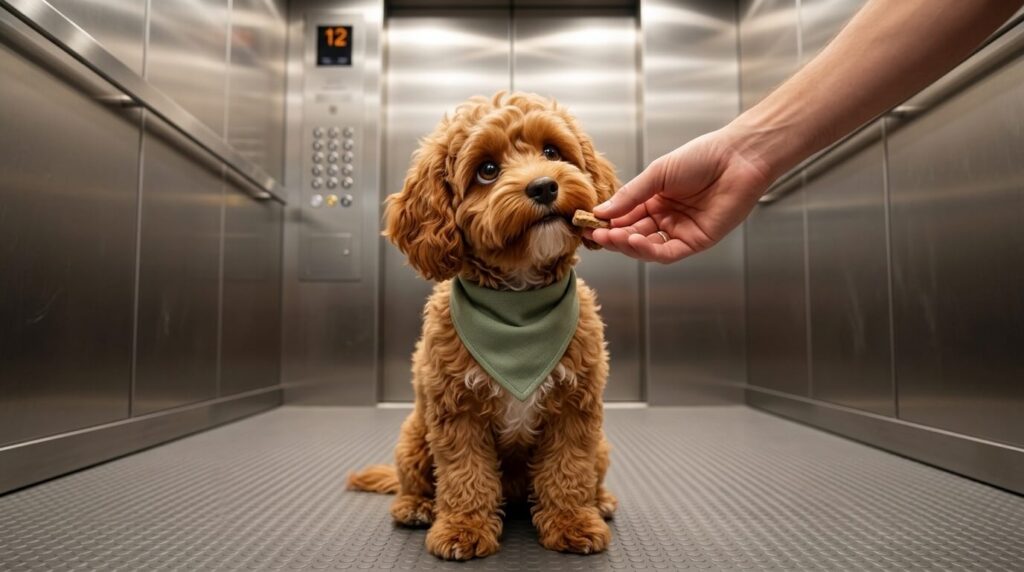
A dog may enter happily and worry only when the exit disappears. Once in-and-out practice is comfortable, stand inside an empty car for a few seconds. Reward calm behavior and leave. On a later repetition, allow the doors to begin closing only when you are certain you can complete a safe short ride.
Keep your body quiet. Stand beside the dog rather than leaning over them. A hand target or familiar settle cue can help only if the dog can already perform it comfortably. Repeating “sit” to a frozen dog does not address fear.
AVSAB recommends reward-based methods for training and behavior modification and advises against force, intimidation, and flooding. Flooding in this context would mean keeping a frightened dog in the elevator until they stop reacting. A dog becoming still does not necessarily mean the fear has resolved.
5. Ride One Floor and Plan the Recovery
Make the first ride short, quiet, and predictable. Choose an empty car, ride one floor, exit, and move to a calm hallway area. Let your dog sniff and recover. End there rather than immediately repeating the ride because it appeared successful.
On later sessions, add one variable at a time: another floor, a familiar person, a slightly busier time, or a different car. Do not combine a longer ride with strangers, groceries, and another dog on the same day.
Keep notes on the first difficult moment and recovery time. If your dog enters more easily but takes longer to settle afterward, the ride may still be too hard. Progress means the whole sequence becomes more manageable, not merely that the dog can be moved from one floor to another.
What to Do When You Cannot Avoid the Elevator
Apartment life does not pause while training catches up. A puppy may urgently need to potty, a senior dog may not manage the stairs, or you may have a veterinary appointment. On necessary rides, manage the situation instead of trying to advance training.
- Leave extra time so you are not pulling while watching the clock.
- Choose the quietest realistic time and wait for an empty car.
- Use the elevator closest to a quiet exit if your building has options.
- Keep other riders from crowding or reaching toward your dog.
- Exit at the next safe floor if distress escalates and a break is possible.
- After the necessary trip, make the next planned practice easier.
For a small dog who is comfortable being carried, carrying may be the least stressful management choice. For a large dog who refuses and cannot safely use stairs, ask a veterinarian or qualified behavior professional for help rather than relying on physical force.
Real Building Situations That Change the Plan
The Elevator Opens With Another Dog Inside
Skip the car. Fear work requires room, and elevators remove it. Waiting does not reward fear or let your dog “win”; it prevents a close-range event from making the elevator more frightening. If your dog reacts outwardly at the opening, use the separate door-lunging plan.
Your Dog Is Fine Going Down but Afraid Going Up
The motion can feel different, and the destination may matter. Going down predicts outdoors; going up predicts the end of the walk. Practice the harder direction separately with a short one-floor ride and a calm activity afterward. Do not assume refusal is manipulation.
Your Dog Is Newly Adopted or Has Just Moved
A dog can seem quiet during the first few days and show more fear after they begin noticing the building routine. Reduce unnecessary lobby exposure, keep walks predictable, and use the first-arrival setup in our first 48 hours in a new apartment guide.
Your Senior Dog Suddenly Freezes
Pause training and call your veterinarian. Pain, reduced vision, hearing changes, and balance problems can make the doorway or motion difficult. Use stairs only if they are safe for the dog’s joints and permitted by the building.
A Neighbor Insists the Dog “Just Needs to Get Used to It”
You do not owe a full explanation in the hallway. Say, “We’re training, please go ahead,” and create space. Cornell’s veterinary guidance advises against forcing fearful dogs to confront fears head-on; controlled challenges should stay below the level that triggers the full fear response.
How to Read Progress Without Chasing a Deadline
Do not use a seven-day calendar as a pass-fail test. For a dog scared of elevators, one dog may need three sessions at the hallway corner while another may enter easily and spend weeks learning to tolerate motion. Move forward when the current piece looks ordinary.
Useful signs include:
- Walking toward the lobby without slowing earlier each time
- Hearing the chime and returning attention to normal activity
- Taking food without grabbing or refusing it
- Crossing the threshold without leaning backward
- Standing with balanced weight while the doors close
- Recovering more quickly after a short ride
A setback after a crowded ride does not erase earlier learning. Return to the last easy stage for a few sessions. If fear steadily increases despite careful practice, stop experimenting and seek professional guidance.
Build a Plan for Your Actual Building
Generic advice becomes useful only after it fits the building you live in. Walk the route without your dog once and notice the details you normally ignore. Is there a quiet alcove beside the elevator? Can you hear the car before the chime? Does one elevator have a rubber floor while another has slick metal? Which hours bring delivery carts, school-age children, and most of the building’s dogs?
Choose three locations before the next session:
- The start point: the closest place where your dog can notice the elevator area and remain comfortable.
- The waiting point: a position away from the door where exiting riders have room.
- The recovery point: a quiet hallway or lobby edge where your dog can decompress after a ride.
This planning prevents improvising while the doors are closing. It also makes progress measurable. If the start point moves from twenty feet away to ten feet over several sessions, that is meaningful improvement even before the dog rides.
If You Live Alone
Practice without carrying coffee, packages, or a phone. Keep the treat pouch and leash accessible before leaving the apartment. If your dog is too large to carry and stairs are not safe, arrange a session with a qualified trainer in the building rather than attempting a difficult first ride while alone.
If More Than One Person Handles the Dog
Agree on the same start point, entry cue, and rule for skipping occupied cars. One person pulling the dog aboard while another allows slow approaches makes the elevator unpredictable. Keep a short shared note about what the dog handled comfortably so nobody accidentally doubles the difficulty.
If Your Building Has Only One Busy Elevator
You may not be able to create a perfectly quiet ride. Focus first on the hallway and doors during off-peak minutes, then arrange one controlled short ride. Ask a household member or friend to stand near the call button so you can concentrate on the dog, but do not ask them to block other residents or hold the car through repeated attempts.
What a Sensible Practice Session Can Look Like
Suppose your dog slows at the final hallway corner but can still eat there. Stop before the slowdown, wait for the dog to look toward the lobby, reward, and walk back toward the apartment. After a short break, repeat once. If the second approach is as easy as the first, finish for the day.
At the next session, stop in the same place. If your dog walks there normally, take one step closer, reward calm observation, and retreat. Do not keep advancing simply because the first closer step worked. Ending early protects the good repetition.
Several sessions later, the dog may reach the waiting point while an empty car opens. Reward once, let the doors close, and leave. Threshold work starts only after this scene is unremarkable. The first stationary entry might last two seconds. The first ride might be one floor followed by several minutes of sniffing in a quiet hall.
This pace can feel slow to a person who uses the elevator every day. To the dog, however, each element is new learning: approaching without being forced, hearing the chime without being trapped, crossing the gap voluntarily, feeling the doors close, tolerating motion, and discovering that the exit arrives quickly. Keeping those lessons separate is often faster than repeatedly rehearsing the whole frightening sequence.
Common Mistakes With Elevator Fear
Using Food to Pull the Dog Past the Fear Point
Food should create a positive association and reinforce voluntary movement, not distract the dog while you move them somewhere they would otherwise refuse. If the dog’s paws stop while the neck stretches toward the treat, make the next repetition easier.
Practicing Only During Real Potty Trips
Urgency makes both handler and dog less flexible. Schedule tiny sessions when you have nowhere to go. Walk to the workable point, reward, leave, and continue your day.
Repeating the Ride Until the Dog “Gets Over It”
Repeated exposure at full intensity can increase fear. End after a manageable repetition. More rides are useful only when the dog remains able to cope.
Correcting Growling or Escape Attempts
These behaviors communicate that the dog needs distance. Punishment can suppress warning signs without making the dog feel safer. Create space and reassess the setup.
Assuming Every Refusal Is Behavioral
A sudden change, especially in an older dog, requires a health check. Do not spend weeks training around pain or balance trouble.
When to Bring in Professional Help
Seek help if your dog has bitten, snapped, redirected onto the leash or handler, injured themselves trying to escape, cannot complete necessary building movement, or becomes more fearful despite slower practice. Contact your veterinarian promptly for sudden onset, physical symptoms, or severe panic.
A veterinarian can assess possible medical contributors and discuss whether additional treatment is appropriate. A qualified reward-based trainer, certified applied animal behaviorist, or board-certified veterinary behaviorist can help control the setup and read subtle stress signals. Avoid anyone whose plan depends on leash corrections, intimidation, or forcing repeated rides.
FAQ
Why is my dog suddenly scared of elevators?
A slip, crowded ride, loud noise, another dog, pain, vision or hearing change, or balance problem can cause a sudden change. Arrange a veterinary check when the fear appears abruptly or comes with stiffness, stumbling, disorientation, or other physical changes.
Is my dog scared of elevators or refusing for another reason?
Look at the whole sequence. Fear is more likely when refusal comes with retreating, trembling, lowered posture, panting, scanning, or slow recovery. A dog may also hesitate because the floor is slippery, the lobby predicts the end of a walk, or physical discomfort makes the threshold difficult. Sudden or unexplained refusal deserves veterinary assessment.
Should I carry my dog into the elevator?
Carrying can be reasonable for a small dog who is comfortable being picked up, especially during an unavoidable ride. It should not involve wrestling or replace gradual practice when the dog is physically able to learn.
Can treats help a dog afraid of elevators?
Yes, when treats are paired with exposure mild enough that the dog can still choose, eat, and recover. Treats should not be used to lure a resisting dog into a closing car. If familiar food is refused, increase distance or reduce difficulty.
How long does elevator fear training take?
There is no reliable fixed timeline. Mild hesitation may improve over several sessions; established fear can require weeks or longer. Progress depends on the fear point, the building environment, the dog’s health and history, and how consistently difficult surprises can be avoided.
Can I use the stairs while training?
Use stairs for management only when they are allowed and physically safe for your dog. Puppies, seniors, and dogs with joint, heart, or mobility problems may need veterinary guidance. Continue separate low-pressure elevator practice rather than waiting for an emergency.
What if my dog is afraid only when another dog is present?
The elevator itself may not be the primary fear. Wait for an empty car, create distance from the doors, and assess dog-directed fear or reactivity separately. Do not use close elevator rides as socialization practice.
Make the Elevator Predictable, Not Inescapable
A dog does not need to enjoy elevators. The practical goal is a dog who can approach, enter, tolerate a short ride, and recover without panic. That confidence is built before the full ride: at the hallway corner, during one quiet door opening, and in a voluntary step across the threshold.
Start with the first moment your dog changes, not the final refusal. Keep the exposure small, reward what the dog can genuinely handle, and protect their space from rushed neighbors and crowded cars. If the fear is sudden, severe, or unsafe, bring in veterinary and behavior support early.
References
Cornell University College of Veterinary Medicine: Fearful Dogs
American Veterinary Society of Animal Behavior: Humane Dog Training Position Statement
Merck Veterinary Manual: Treatment of Behavior Problems in Animals