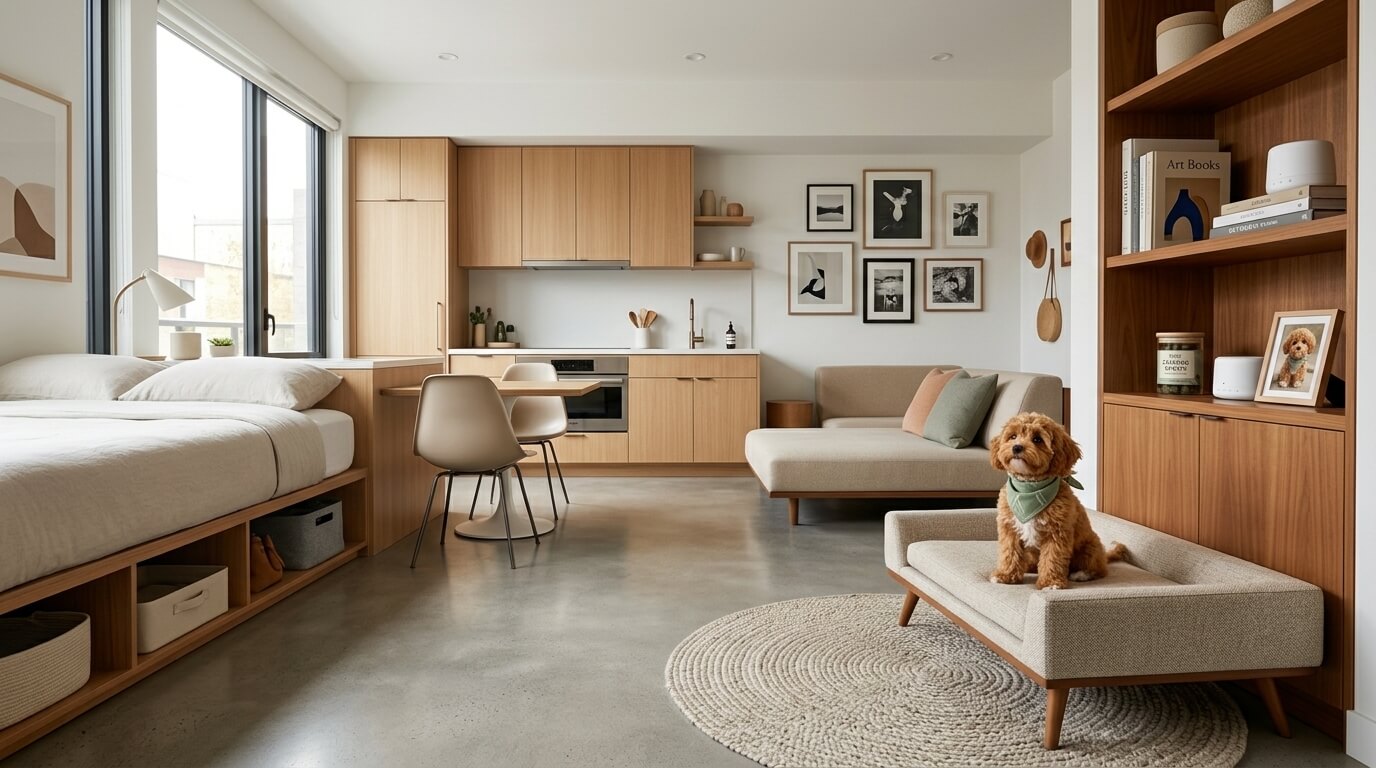
Dog in studio apartment tips have to be more practical than “buy a cute bed and use vertical storage.” In a studio, your bedroom, living room, office, dining area, entryway, and dog zone may all be the same twelve steps. Your dog hears you work, cook, sleep, eat, leave, come back, open packages, and take calls from one shared room.
That closeness can be wonderful. Many dogs love being near their person. But it can also create friction because the dog has fewer natural boundaries. A studio dog may nap beside your desk, guard the front door, hover in the kitchen, bark during meetings, steal socks from the bed, or treat every movement as the start of a walk.
This guide is written for renters and small-space dog owners. It does not assume you can remodel, drill shelves everywhere, add a mudroom, or hide a full dog station in a spare closet. The goal is to make one room feel clearer, calmer, easier to clean, and more understandable for your dog.
Quick Answer
The best dog in studio apartment tips are to create clear sleep, play, feeding, entry, and storage zones; keep the kitchen controlled; rotate toys instead of leaving everything out; protect quiet time during work and sleep; and build a daily rhythm that helps your dog understand when life is active and when it is boring. A studio does not need to be large, but it does need predictable rules.
| Studio Problem | Better Fix | Why It Works |
|---|---|---|
| Dog follows every movement | Teach a bed or mat zone | Gives the dog a job when you move around |
| Dog gear everywhere | One wall or cabinet for supplies | Reduces clutter and owner stress |
| Kitchen begging | Use a boundary before cooking starts | Prevents rehearsed hovering and safety risks |
| Barking during work | Plan pre-call exercise and quiet enrichment | Supports the dog before the meeting begins |
| Apartment smells small | Wash bedding and manage airflow | Small rooms hold odor quickly |
If your dog is still in the early setup stage, pair this with new dog owner checklist. If you are choosing a dog for a small home, read best dog breeds for small apartments before assuming only tiny dogs can succeed.
Table of Contents
The Studio Apartment Reality
A studio is not just a small apartment. It is a one-room routine. That means your dog may not understand why one corner is for sleeping, another is for eating, and another is for quiet while you work. To the dog, it may all look like one shared den with constant signals.
Owners often blame the dog for being clingy, restless, or nosy. Sometimes the real problem is that the room gives no clear information. The dog bed is beside the food bowl. Toys are everywhere. The leash hangs by the door where the dog stares at it all day. The owner works from bed some days and from a desk other days. The dog is not being difficult. The dog is guessing.
Good studio living reduces guessing. It tells the dog: this is where you sleep, this is where food appears, this is where you wait when the door opens, this is what happens during work calls, and this is where toys go when play is over.
The 9 Easy Essential Rules
1. Give the dog one real sleep zone
Your dog’s sleep zone should not be an afterthought squeezed between laundry and the trash can. It should be a place where your dog can rest without being stepped over, bumped by chairs, or interrupted every time you reach for a bag.
In a studio, the best sleep zone is often along a wall, beside the bed, near a quiet corner, or behind a low visual boundary. It does not have to be fancy. A washable bed, crate, pen, or mat can work if the dog can settle there comfortably.
Do not keep moving the bed every few days because the apartment looks better another way. Dogs like predictable rest spots. If your dog struggles with confinement but benefits from structure, read crate training apartment dogs.
2. Use rugs or mats to create zones
Rugs are not only decor. They tell your dog where activities happen. A mat by the bed can mean rest. A washable runner by the door can mean wait. A small rug near the toy basket can mean play starts here, not on top of your laptop cable.
This helps because dogs notice surfaces. Many dogs learn faster when a place feels different under their paws. If your whole studio is one continuous hard floor, rugs and mats can make the room more readable.
Choose washable, low-slip materials. A beautiful rug that traps odor, slides during play, or becomes a chew project will make studio life harder. Practical beats pretty here.
3. Control the entryway before it controls the dog
The front door is the most powerful spot in many studios. It predicts walks, guests, packages, hallway dogs, delivery sounds, and you leaving. If the bed, leash, shoes, and treat pouch all sit in one chaotic pile by the door, the dog may live in a state of low-level anticipation.
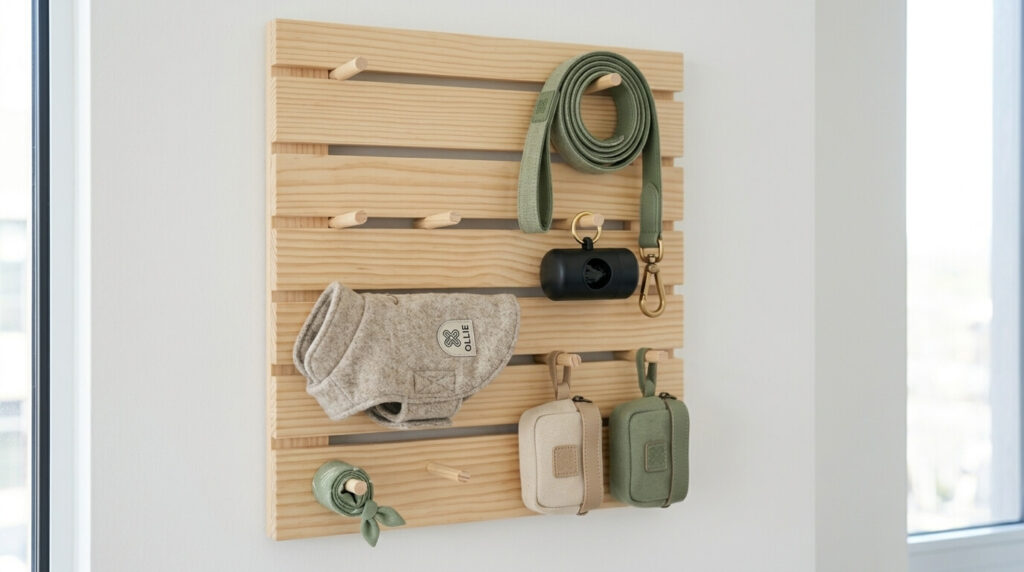
Create a tiny entry routine. Hang the leash out of reach. Keep bags stocked. Ask your dog to wait on a mat before the door opens. Step out first when needed. Return calmly after walks instead of turning the doorway into a celebration zone every time.
If your dog barks at hallway sounds or door movement, use stop dog barking in apartment. Studio walls and doors do not give much buffer, so door habits matter.
4. Keep the kitchen boring
Many studios have open kitchens. That means the dog can watch every crumb, trash movement, grocery bag, and cooking step. If you let the dog hover while you cook, the behavior becomes part of the apartment routine.
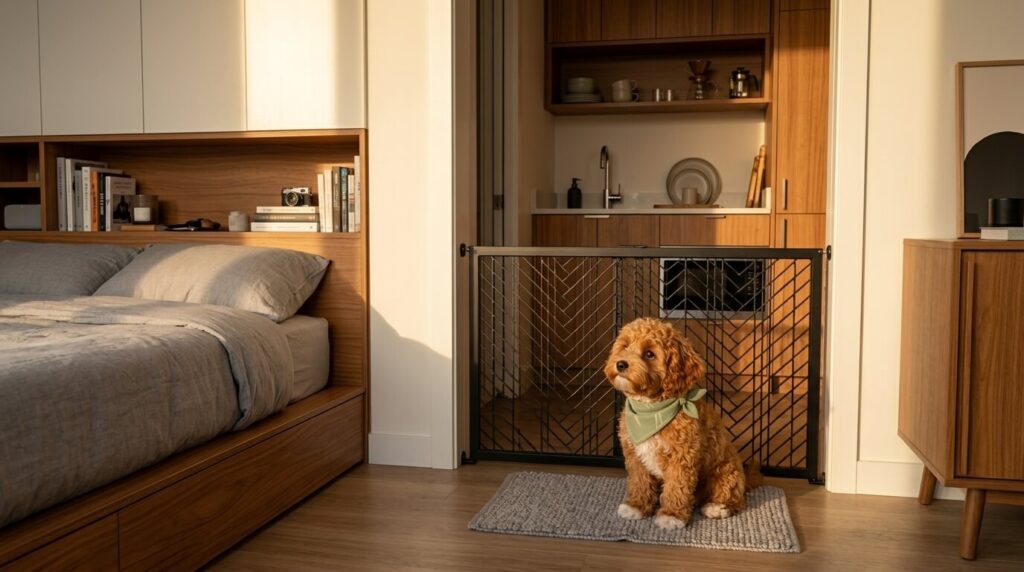
Use a boundary before food comes out. Send your dog to a mat, place a gate if the layout allows, or give a safe chew away from the cooking area. Do this before the dog is underfoot. Waiting until the dog steals food or bumps hot pans is too late.
Keep trash secure, especially in studios where the kitchen may be only a few feet from the bed. If trash is an issue, read best dog proof trash can apartments.
5. Rotate toys instead of covering the floor
Leaving every toy out can make a studio feel smaller and make toys less interesting. Keep a small basket with a few options and rotate the rest. This gives your dog novelty without turning the room into a constant obstacle course.
Rotation also helps you notice damaged toys, dirty items, and which toys cause conflict or overarousal. If a toy makes your dog bark, shred, guard, or crash into furniture, it may not be a good indoor studio toy.
For calmer options, use DIY dog enrichment ideas. In a studio, enrichment should tire the brain without making the room feel like a playground all day.
6. Build a work-from-home signal
Dogs do not automatically understand laptop time. You are home, but you are unavailable. That is confusing. A work-from-home signal helps. It can be a mat, a chew, a white noise machine, a closed pen, or a phrase that predicts quiet time.
Set the dog up before the call starts. Do not wait until the dog barks while you are unmuted. A short potty break, five minutes of sniffing, a prepared lick mat, or a calm settle cue can save both of you.
Be realistic about meeting days. If you have several long calls, your dog may need a walker, daycare day, puzzle routine, or a longer walk before work. The guide on how to keep dog entertained while at work can help you plan.
7. Keep odor management on a schedule
Studio apartments hold dog smell quickly because bedding, food, toys, shoes, laundry, and the human bed all live close together. Odor does not mean you are dirty. It means the air has fewer places to go.
Wash dog bedding weekly or more often if needed. Clean bowls daily. Rotate and wash soft toys. Vacuum edges and under the bed. Dry wet paws before your dog climbs onto fabric. If the apartment smells like dog after rain, the problem may be damp textiles, not the dog.
For a fuller cleaning plan, use control dog odor apartment and clean apartment with dog.
8. Create a guest plan before guests arrive
In a studio, guests enter directly into your dog’s whole world. There may be no separate living room, no hallway buffer, and no easy place for the dog to retreat. A friendly dog can become too excited. A nervous dog can feel trapped.
Decide before the visit: will the dog be on leash, behind a gate, on a mat, in a crate, or out for a walk with someone else? Tell guests the rule before they enter. “Ignore him for the first few minutes” is a reasonable instruction.
If your dog struggles around shared spaces and visitors, review apartment dog social etiquette. The same skills that help in lobbies often help when guests enter a tiny home.
9. Protect your own rest
This may sound less like dog training, but it matters. In a studio, you hear every lick, scratch, chew, sigh, toy squeak, and midnight reposition. If the dog does not have a nighttime routine, your sleep can fall apart. When your sleep falls apart, your patience falls apart too.
Create a bedtime transition. Last potty, water check, low lights, chew if appropriate, bed cue, and then boring quiet. Keep nighttime play off the table. If your dog expects wrestling at 10 p.m., the room will not feel restful to either of you.
If your dog has late-night energy, read how to tire out dog before bed. Studio life gets much easier when evenings have a predictable landing.
Studio Layout Ideas That Actually Help
The wall-line setup
Put the dog bed, toy basket, and leash station along one wall instead of scattering them across the room. This makes supplies easy to find and keeps the central floor open. Open floor space is valuable because dogs need room to turn, stretch, and move without knocking into furniture.
The bed-adjacent setup
Some dogs settle best near the owner at night. A bed beside your bed can work if the dog is not guarding the sleeping area or waking you constantly. If your dog becomes too clingy, move the bed a little farther away over time rather than making a sudden change.
The desk-day setup
If you work from home, place a mat where your dog can see you but not block your chair, cords, or walking path. This prevents the dog from sleeping directly under the rolling chair or popping up every time you stand.
The guest-ready setup
Keep one foldable gate, leash, or pen plan ready for visitors. In a studio, you do not want to search for management tools while a guest is already at the door and the dog is barking.
Common Mistakes
Buying too much dog furniture
A studio does not need a dog couch, huge crate, oversized toy bin, feeding tower, and three beds unless those items truly solve problems. Every item should earn its space.
Letting the dog own the only open floor
If the dog bed, toys, bowls, and chews take over the walking path, the apartment feels smaller and daily friction rises. Keep one clear route from bed to door, desk to kitchen, and door to bathroom.
Using storage that the dog can raid
Open baskets look nice, but some dogs treat them as shopping bins. Store food, medication, grooming supplies, and high-value chews in closed containers or cabinets.
Skipping alone-time practice
Studio dogs can become used to constant proximity. Practice short, calm separation even when you are home: dog on mat while you shower, dog behind gate while you cook, dog resting while you work. This supports independence without drama.
Expecting one walk to solve everything
Many studio dogs need a mix of walks, sniffing, training, chewing, and rest. A huge walk may create a tired body but an overstimulated mind. Balance matters.
Adjust the Studio for Your Actual Life
The right studio setup depends on how you live. A person who works night shifts does not need the same dog routine as someone who works from home all day. A dog who spends mornings alone needs a different setup from a dog who joins errands, daycare, or a dog walker. Do not copy a layout because it looks clean online. Copy the logic, then adapt it to your real day.
If you work from home, your biggest challenge may be teaching the dog that your presence does not always mean interaction. Put the bed or mat where your dog can see you without sitting on your feet. Prepare quiet enrichment before meetings. Keep the leash out of sight unless a walk is actually happening. Dogs in studios can become experts at reading tiny cues, so reduce accidental signals.
If you are gone for a standard workday, your challenge is boredom and transition. A dog may sleep most of the day, then explode when you return because the studio suddenly becomes active again. Make the first ten minutes calm: potty first, then greeting, then food or walk. If you walk in and immediately create chaos, the dog may spend the afternoon waiting for that burst.
If your schedule changes every week, use anchors instead of exact times. Anchors are events the dog can understand: after waking, after breakfast, before work, after the last walk, before lights out. Even if the clock changes, the sequence gives your dog a sense of order.
Do Not Design Only for Photos
Studio apartments tempt people to make every corner look intentional. That is understandable. When one room is your whole home, visual clutter can feel personal. But dog setups that photograph well do not always live well. A hidden bed may be too hot. A tiny toy basket may be too easy to raid. A crate tucked under a table may shake every time you sit down. A feeding station near the bed may make the whole room smell like dinner.
Before choosing a layout, ask boring questions. Can the dog stretch out fully? Can you wash the bed? Can air move around the crate? Can the dog reach water without crossing your work cords? Can you open the front door without the dog rushing it? Can you clean under the feeding area? Can guests enter without stepping into the dog zone?
The best studio dog setup is usually not the prettiest one. It is the one you can maintain on a tired Tuesday night when it is raining, your dog is wet, your floor is dirty, and you still need to make dinner. If the system only works when you have energy, it is not finished yet. Real life has to fit too.
The Emotional Side of Studio Dog Life
Living with a dog in a studio can feel intimate in the sweetest way. You know every stretch, nap sound, and tiny habit. It can also feel like you never get a private inch. The dog is there while you eat, work, sleep, clean, cry, date, exercise, and try to answer one email in peace.
That does not make you a bad owner. It means small-space living requires boundaries for both of you. A mat cue, a crate routine, a toy rotation, or a no-kitchen rule is not cold. It is how you protect the relationship from constant low-level irritation.
Dogs often relax when owners become clearer. If your dog knows when to play, where to rest, and what happens when you open the laptop, the apartment becomes less confusing. A studio can be small and still feel emotionally spacious.
FAQ
Is a studio apartment too small for a dog?
Not automatically. The dog’s temperament, exercise, enrichment, rest, bathroom routine, and your management matter more than square footage alone. Some calm medium dogs do better in studios than high-energy small dogs with no routine.
Where should a dog sleep in a studio apartment?
Choose a predictable place away from the busiest walking path. Beside the bed, along a quiet wall, or in a crate or pen can work. The dog should be able to rest without being stepped over or interrupted constantly.
How do I keep a studio from smelling like dog?
Wash bedding, clean bowls, manage airflow, dry wet paws, vacuum edges, and avoid letting damp fabric sit. In a studio, odor builds faster because everything is close together.
Should I use a crate in a studio apartment?
A crate can help if your dog is comfortable with it and it is introduced kindly. It can create a clear rest zone. It should not be used as punishment or as a way to avoid exercise, bathroom breaks, or training.
How do I stop my dog from following me everywhere in a studio?
Teach a mat or bed cue, reward calm staying, and practice tiny separations while you are home. Start with seconds, not hours. The goal is to make staying put feel normal and safe.
Can I have two dogs in a studio apartment?
Sometimes, but it requires careful management. Each dog needs feeding space, sleeping space, alone time, and separation options. Read two dogs in small apartment before assuming one room can support both dogs comfortably.
Next Step
Stand in the middle of your studio and look at it from your dog’s point of view. Can they tell where to sleep, where to wait, where food happens, where play happens, and what to do when you work? If not, fix one zone this week. One clear zone can change the feeling of the whole apartment.