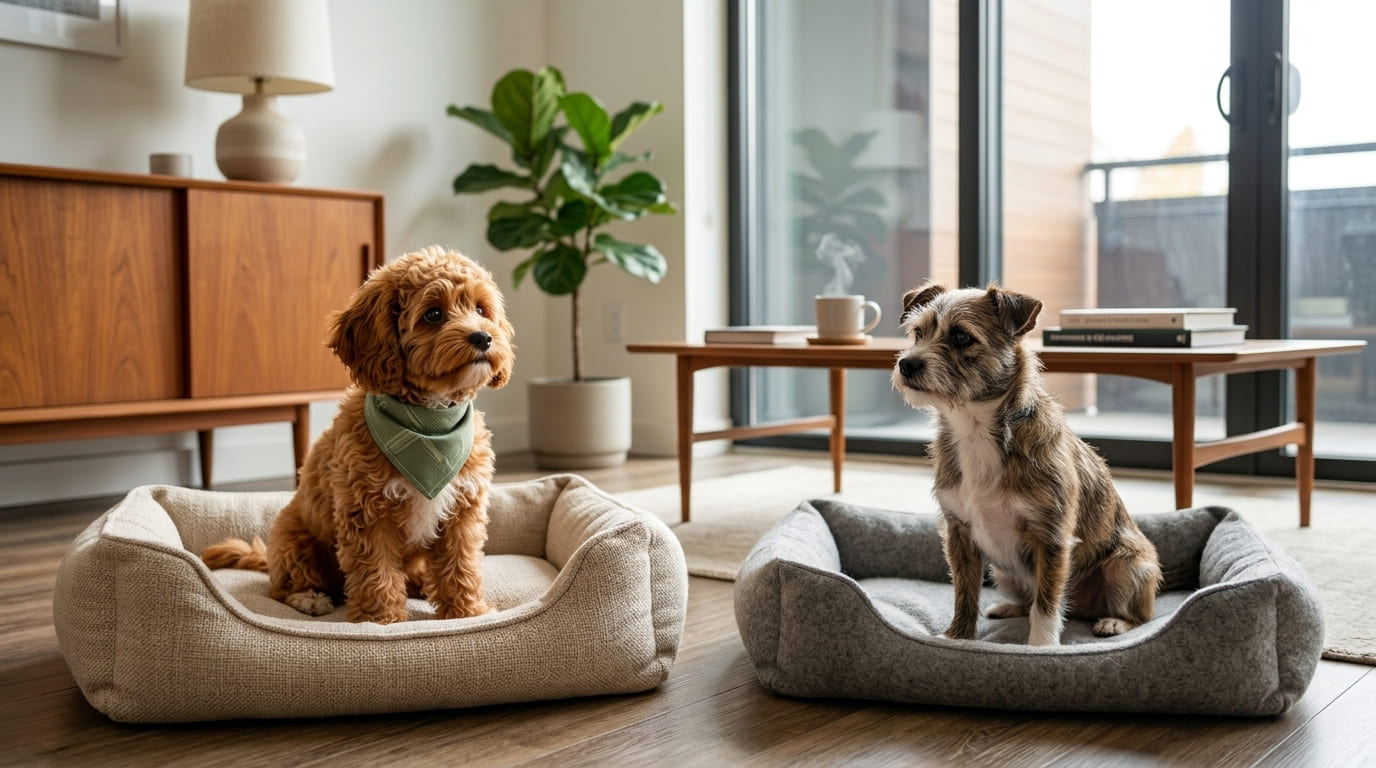
Two dogs in small apartment life can be lovely, but it is rarely effortless. The problem is not only square footage. It is doorways, food bowls, elevator rides, narrow hallways, one sofa, one human, bad weather, work calls, chew toys, beds that are too close, and the tiny daily moments where both dogs want the same thing at the same time.
If you are wondering whether a small apartment is fair for two dogs, the honest answer is: it depends less on the floor plan and more on management. Two compatible dogs with good routines can do well in a modest apartment. Two stressed dogs with shared resources, no separation options, and constant competition can struggle in a much larger home.
This guide is written for renters and city dog owners. It does not assume your apartment is perfect. It assumes you may have one bedroom, thin walls, a small entryway, shared elevators, neighbors close by, and very little room for mistakes. The goal is not to create a cute two-dog aesthetic. The goal is to keep both dogs safe, rested, understood, and able to live without constant pressure.
Quick Answer
For two dogs in a small apartment, give each dog separate feeding space, separate resting space, individual attention, managed high-value items, predictable walk routines, and a way to be apart before tension builds. Do not rely on “they will work it out.” In small apartments, dogs cannot always choose distance on their own, so the owner has to create it.
| Apartment Pressure Point | Better Rule | Why It Matters |
|---|---|---|
| Meals | Feed separately | Prevents rushing, guarding, stealing, and silent stress |
| Sleep | Give each dog a real rest zone | Dogs need recovery without being stepped on or stared at |
| Chews and toys | Use high-value items only when separated | Small spaces make resource conflict more likely |
| Walks | Train together and separately | One dog should not drag the other into reactivity or fear |
| Owner attention | Protect one-on-one time | Reduces crowding, jealousy, and over-dependence |
If one of your dogs already guards food, chews, beds, or people, also read stop dog resource guarding training. If you are still deciding whether to add a second dog, start with introduce second dog in small apartment before rearranging the whole home.
The Space vs. Management Reality
A small apartment does not automatically make two dogs unhappy. Many dogs sleep most of the day, enjoy predictable routines, and care more about calm management than room size. But small apartments remove margin. If one dog wants to leave a situation, there may be nowhere obvious to go. If one dog guards the sofa, the other dog may have to pass within inches. If one dog is excited at the front door, the second dog gets swept into that energy before the walk even starts.
That is why the question is not only “Do I have enough space?” A better question is “Can I create enough choice?” Choice means each dog can eat without pressure, sleep without interruption, move through the apartment without being blocked, and enjoy the owner without being crowded by the other dog.
In real apartments, this may look unglamorous. A gate in the hallway. Two cheap washable beds instead of one stylish bed. A feeding station in the bathroom. A leash hung by the door for one dog at a time. A rule that bully sticks happen only behind a closed door. These details are not overkill. They are how small spaces stay peaceful.
Table of Contents
The 9 Safe Rules
1. Feed dogs separately every time
Separate feeding is the easiest rule to keep and one of the most important. Feed in different rooms, behind a gate, in crates, or far enough apart that neither dog has to worry about the other approaching. Pick up bowls when meals are done. Do not let one dog clean the other dog’s bowl.
This matters even if there has never been a fight. Many dogs show food stress quietly: faster eating, hovering, staring, freezing over the bowl, blocking the other dog, or leaving food because the room feels tense. By the time a growl happens, the conflict has usually been building for a while.
Separate meals also make health easier. You can see who is eating, who is skipping food, who needs a diet change, and who may be gaining weight. If food quality is part of your routine, see best diet for apartment dogs for broader feeding considerations.
2. Give each dog a protected sleeping zone
Two dogs can share a sofa by choice, but they should not have to share rest. Each dog needs a bed, mat, crate, or quiet corner that belongs to them. In a small apartment, rest zones may be only a few feet apart, but they should not force one dog to climb over the other.
Watch for the dog who never fully relaxes. They may sleep lightly, leave when the other dog approaches, tuck their tail, or keep their head up even when lying down. That dog may need a more protected zone, not more social time.
If crates are part of your setup, use them thoughtfully. Crates should not become punishment or a place where one dog is trapped while the other bothers them. The guide on crate training apartment dogs can help you make crate time calmer and more voluntary.
3. Manage high-value items before they become arguments
High-value items include chews, stuffed toys, food puzzles, stolen socks, favorite beds, sunny spots, laps, and sometimes the human. In a small apartment, the safest default is simple: if the item would make either dog tense, use it only when separated.
Do not test dogs by placing one chew in the room and watching what happens. That is not training. That is setting up a conflict. Give each dog their own item behind a gate, in separate rooms, or during separate quiet time.
Resource guarding is not a moral flaw. It is behavior around valuable things. Merck Veterinary Manual describes possessive aggression around food, toys, resting places, and preferred people. For owners, the practical lesson is this: reduce the need to guard before you ask dogs to make better choices.
4. Use gates to create breathing room
Pet gates are not only for puppies. In a multi-dog apartment, gates are emotional architecture. They create distance in a home that does not have much distance. A gate can help during meals, deliveries, cleaning, training sessions, chews, recovery after walks, and moments when one dog needs a break.
Renters should choose gates carefully. Pressure-mounted gates may work in some doorways but are not safe for every dog or every location. If drilling is not allowed, read no drill dog gates apartments before buying a gate that looks sturdy online but fails in your actual doorway.
One of the kindest small-apartment habits is separating dogs before things get tense. Do not wait for growling. If both dogs are tired, hungry, overexcited, or crowded by guests, use the gate early.
5. Walk together only when both dogs can succeed
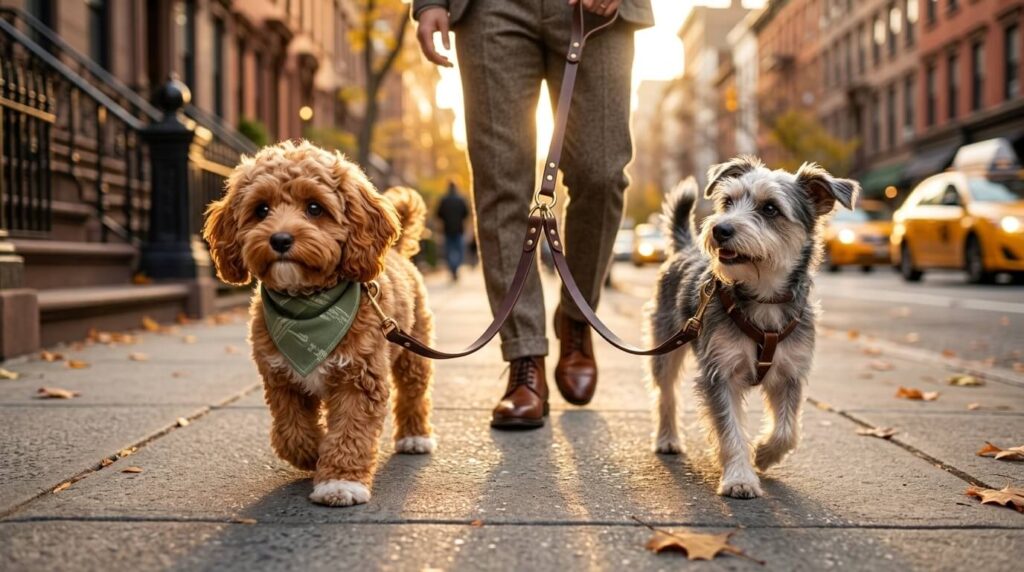
Walking two dogs together looks efficient, but it can hide problems. One dog may be confident while the other is worried. One may pull toward dogs while the other wants distance. One may bark at scooters and pull the second dog into the reaction.
Keep some walks separate. Separate walks let you see each dog’s real behavior, pace, sniffing needs, triggers, and training level. They also give each dog time with you without the other dog interrupting every cue.
If one dog struggles with city noise, pair this plan with dog city noise anxiety. If elevators are the difficult part, practice dog elevator training one dog at a time before expecting two dogs to stay calm together.
6. Protect one-on-one time without making it dramatic
Many owners feel guilty giving one dog attention while the other waits. But individual time is healthy. It can be a five-minute training session, a solo sniff walk, grooming, a quiet cuddle, or a simple mat game. The point is to remind each dog that they have a relationship with you that is not always shared.
Use low-drama swaps. One dog gets a chew behind a gate while the other practices cues. Then switch. One dog takes a short errand walk while the other gets a food puzzle. Then switch later. You are not choosing favorites. You are preventing crowding.
This is especially important when one dog is older, smaller, more sensitive, recovering from illness, or new to the household. Equal does not always mean identical. Fair means each dog gets what they need.
7. Learn each dog’s early warning signals
Small conflicts usually whisper before they shout. Watch for hard staring, body blocking, hovering near a resource, sudden stillness, lip licking, turning away, freezing over a toy, pushing between you and the other dog, stiff tails, or one dog repeatedly leaving the room.
Do not scold the warning. A growl is information. A freeze is information. If you punish the signal, you may remove the warning without changing the feeling underneath. Instead, create distance, remove the resource safely, and ask what made that moment too hard.
Get professional help quickly if there are bites, punctures, repeated fights, redirected aggression, one dog blocking access to rooms, or one dog seeming afraid to move freely in the apartment.
8. Keep cleaning realistic
Two dogs mean more hair, more paws, more odor, more laundry, more bowls, more bedding, and more hallway dirt. This is not a character failure. It is math. If cleaning slips, tension can rise because beds smell, floors get slick, toys become grimy, and the apartment feels smaller.
Create a small weekly rhythm: wash dog bedding, rotate toys, clean bowls, vacuum high-traffic areas, wipe paws after rain, and check collars or harnesses. For deeper routines, use clean apartment with dog and control dog odor apartment.
Cleaning also affects neighbors. Two wet dogs after a rainy walk can leave hallway smell, elevator paw prints, and shared laundry issues. A little routine protects your lease as much as your sanity.
9. Have a separation plan before you need it
Every two-dog apartment needs a separation plan. Not because you expect disaster, but because life happens. One dog gets sick. One needs medication. One has surgery. One becomes cranky with age. One eats something they should not. One needs quiet after a stressful vet visit.
Your plan can be simple: dog A in bedroom, dog B in living room; gate in the hallway; crates with visual barriers; separate chews; separate water access if needed; two leashes by the door. Practice this when everyone is calm so separation does not feel like punishment.
If you cannot separate your dogs safely in your current layout, solve that before adding more freedom. Small apartments are forgiving only when the owner has options.
Common Small-Apartment Mistakes
Buying one large bed instead of two useful beds
One big bed looks sweet in photos. Two practical beds often work better. Dogs can still choose to share, but they also have the option not to. In small spaces, options prevent pressure.
Letting play escalate indoors
Some dogs play beautifully. Some play until one dog is done and the other does not notice. Rough play near furniture, tables, walls, and slippery floors can become unsafe quickly. Interrupt early, reward breaks, and move high-energy play outside when possible.
Correcting both dogs when only one needs help
If one dog is crowding and the other is trying to leave, do not punish both. Help the dog who needs space and redirect the dog creating pressure. Blanket corrections make dogs more confused.
Assuming the older dog should teach the younger dog
An older dog should not have to raise a puppy, tolerate constant biting, or give endless warnings. Protect the older dog’s rest. Give the younger dog structure, enrichment, and separate training.
Ignoring the front door
The entryway is one of the highest-pressure spots in a small apartment. Leashes, shoes, delivery sounds, hallway dogs, and owner excitement all collect there. Teach both dogs to wait away from the door. Practice one dog at a time if needed.
Two-Dog Apartment Layout Ideas
Studio apartment
Use furniture as soft boundaries. One bed near your sleeping area, one bed near the living area, and a gate or pen if the layout allows it. Keep feeding stations apart, even if one is temporarily in the bathroom. For more layout help, read dog in studio apartment tips.
One-bedroom apartment
The bedroom is your best separation tool. Use it for meals, chews, recovery, or when guests arrive. Do not let one dog claim the bedroom doorway as a checkpoint. If that happens, add a gate and rebuild calm access.
Apartment with balcony or patio
Outdoor space can help, but it can also create conflict. Do not send two dogs onto a balcony with one chew, one sunny patch, or barking triggers below. If you use a balcony, review dog proof balcony first.
When Two Dogs Should Not Be Left Loose Together
Do not leave two dogs loose together when there has been recent conflict, when one dog is injured, when high-value items are available, when a new dog has just arrived, when one dog guards doorways or resting spots, or when you cannot predict what happens while you are gone.
This is not about mistrusting your dogs. It is about respecting the limits of a small home. Many dogs who do well together when supervised still need separation during alone time. A closed door, gate, crate, or separate room can prevent one bad afternoon from damaging the relationship.
If your schedule keeps both dogs alone for long hours, read how long leave dog alone apartment. Two dogs can keep each other company, but they should not be used as substitutes for exercise, bathroom breaks, enrichment, or human attention.
Dog Pairings That Need Extra Management
Some two-dog pairs are easy because their needs are different in a useful way. One likes the window, the other likes the bed. One eats slowly, the other waits calmly. One wants a long walk, the other is happy with a shorter sniff route. Other pairs need more structure because their needs collide all day.
Two young, high-energy dogs can become a motion problem in a small apartment. They may wrestle near furniture, chase through narrow paths, and ramp each other up every time a hallway sound happens. These dogs often need more separate training, more outdoor decompression, and stricter indoor play breaks.
A senior dog and a puppy can be sweet, but the senior should not be treated as unpaid childcare. Puppies bite, bounce, steal, and interrupt sleep. Protect the older dog’s bed and give the puppy planned enrichment. If the older dog has arthritis, hearing changes, or vision changes, surprise contact from a younger dog may feel threatening.
A shy dog and a socially pushy dog also need care. The pushy dog may look friendly to humans while quietly overwhelming the shy dog. Watch whether the shy dog can move away, keep a toy, reach water, and lie down without being followed. If not, friendliness is not the issue. Pressure is.
Two dogs with similar favorite resources can also be tricky. If both want the same lap, same window spot, same chew, same human, or same bed, the apartment may need clearer rules than you expected. This does not mean the dogs dislike each other. It means the environment is asking them to negotiate too often.
The Emotional Side Nobody Mentions
Two-dog apartments can make owners feel pulled in half. One dog wants your lap. The other wants the toy. One dog needs a slow walk. The other is bouncing off the door. One dog is easy, and the other makes you feel like you are failing. That emotional load is real.
Try not to build the home around guilt. Build it around clarity. Dogs usually do better when the rules are boring and predictable: meals here, beds there, chews apart, walks sometimes separate, door manners always, breaks before tension. The apartment may look less spontaneous, but it often feels calmer.
Also give yourself permission to adjust. If the first layout does not work, move the beds. If shared walks are too much, split them. If one dog needs a trainer, get help. A good two-dog home is not the one that never has friction. It is the one where friction is noticed early and handled kindly.
Pay special attention to the dog who is easiest to overlook. In many two-dog homes, one dog gets the bed, reaches the water first, crowds the doorway, and claims the human while the quieter dog simply steps away. The absence of a fight does not always mean both dogs are comfortable. If the same dog yields every time, create a protected choice for that dog instead of waiting for a louder objection.
FAQ
Is it cruel to have two dogs in a small apartment?
No, not automatically. It depends on the dogs, the routine, and whether each dog has enough rest, exercise, enrichment, bathroom access, and personal space. A small apartment with good management can be better than a larger home where dogs are constantly stressed.
How much space do two dogs need in an apartment?
There is no single square-foot number that works for every pair. Temperament, size, age, health, exercise needs, and conflict history matter more. The practical question is whether you can create separate feeding, sleeping, and recovery areas.
Should two dogs share toys?
Low-value toys may be fine for some compatible dogs, but high-value chews, food toys, and favorite items should be managed carefully. If either dog stiffens, hovers, steals, or guards, separate them before giving those items.
Should I walk two dogs together or separately?
Both can be useful. Together walks save time and build routine when both dogs are calm. Separate walks help training, confidence, sniffing, and one-on-one attention. If one dog is reactive or fearful, separate walks are usually necessary for a while.
How do I stop fights between two dogs in an apartment?
First, prevent more rehearsals by separating dogs around triggers such as food, chews, beds, doorways, guests, and high arousal. Do not punish or force them to “work it out.” Contact your veterinarian or a qualified behavior professional if there are bites, repeated fights, or fear between dogs.
Can two dogs sleep in the same bed?
They can if both dogs choose it and both can leave freely. Still, each dog should have another comfortable sleeping option. Sharing should be voluntary, not the only available arrangement.
A Five-Minute Apartment Check Tonight
Before changing anything else, walk through your apartment and identify the five tightest pressure points: meals, sleep, chews, front door, and walks. Add one separation option this week. You do not need a bigger apartment first. You need more breathing room inside the apartment you already have.
References
American Veterinary Society of Animal Behavior: Position Statements
Merck Veterinary Manual: Behavior Problems of Dogs