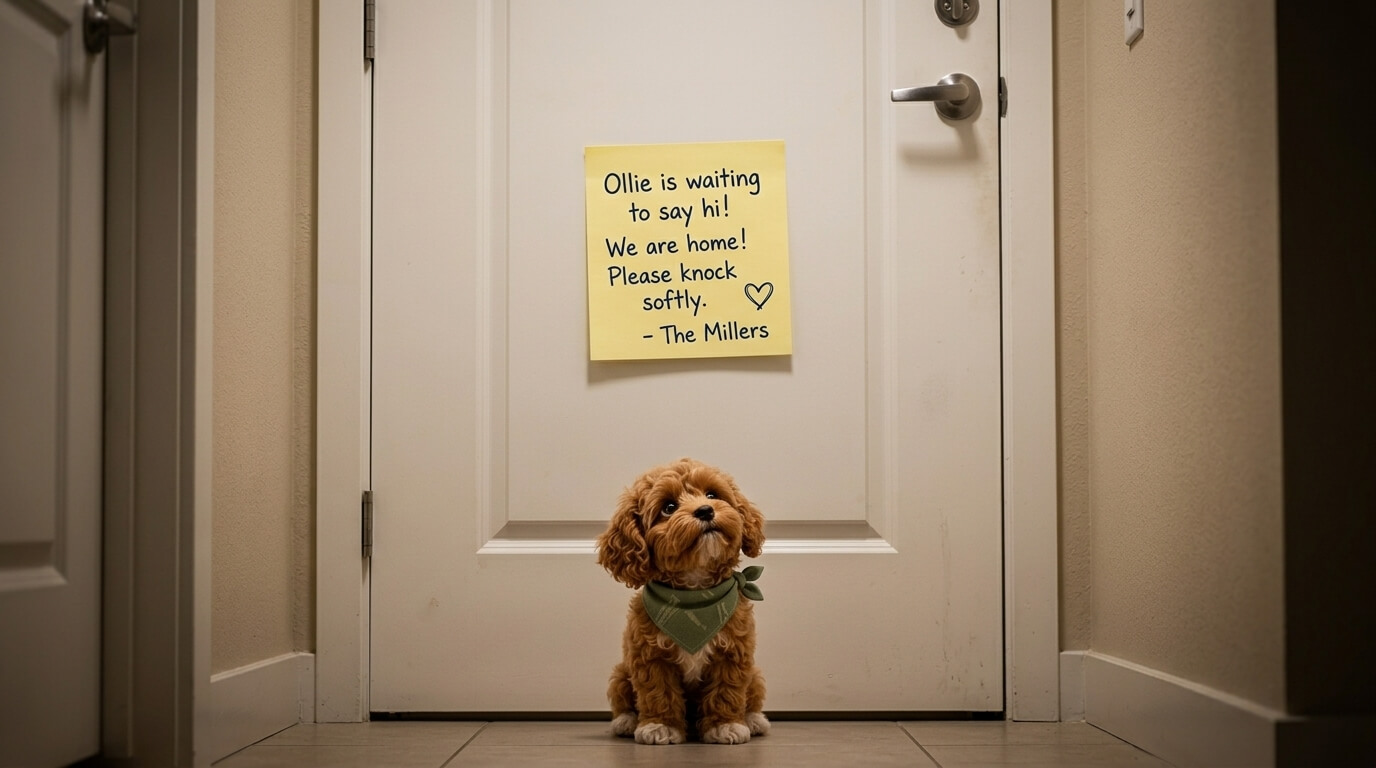
Dog Neighbor Noise Complaint: Quick Answer
A dog neighbor noise complaint should be handled calmly, quickly, and with records. Do not argue at the door, blame the neighbor, or promise that the noise will disappear overnight. First, acknowledge the concern. Then find out when the noise happens, how long it lasts, and what triggers it. Use a camera, audio log, written notes, or building feedback to separate one bad incident from a repeating pattern.
Most apartment dog noise problems fall into a few categories: barking when left alone, barking at hallway sounds, barking at windows, whining in a crate, jumping or running on hard floors, or reacting to elevators and doors. Each cause needs a different fix. Rugs help with foot noise. White noise may help hallway triggers. Training helps barking patterns. A vet or qualified behavior professional may be needed for panic, separation-related distress, or sudden behavior changes.
This guide is not legal advice and cannot tell you what your landlord will do. It gives you a practical renter plan: de-escalate, investigate, reduce noise, document progress, communicate clearly, and get help when the problem is bigger than a quick fix.
Table of Contents
What to Do First
The first response matters because noise complaints become emotional fast. You may feel embarrassed, defensive, scared, or angry. Your neighbor may feel exhausted, ignored, or worried about sleep and work. The goal is not to decide who is right in the first conversation. The goal is to keep the situation from escalating while you gather facts.
If the complaint came through a note, message, or property manager, reply briefly. Thank them for letting you know, say you are checking the pattern, and avoid long explanations. If the neighbor confronts you in person, keep it short and calm. You can say, “I am sorry it has been disruptive. I am going to check when it is happening and work on it.” That sentence does not admit every detail. It shows you are taking it seriously.
Then start tracking. A dog neighbor noise complaint without information is hard to solve. You need times, duration, triggers, and whether the sound is barking, whining, running, jumping, scratching, or something else. Sometimes the dog is not the only noise source. Sometimes the dog barks for three minutes and the neighbor experiences it as much longer because it happens at a bad time. Facts help everyone.
7 Essential Calm Steps
1. Acknowledge Without Overpromising
Start with a calm acknowledgment. You do not need to promise a total fix by tomorrow. You can promise to investigate and take reasonable steps. Overpromising creates problems if training takes time or if the complaint turns out to be partly caused by building noise, another dog, or a trigger you have not identified yet.
Good wording: “Thank you for telling me. I am sorry the noise has been bothering you. I am checking when it happens and making changes this week.” That is enough.
2. Identify the Noise Type
Different noises need different solutions. Barking at 2 p.m. after deliveries is not the same as howling for two hours after you leave. Thumping during evening play is not the same as scratching at the door during separation distress. Write down the actual sound.
| Noise | Likely pattern | First response |
|---|---|---|
| Barking after you leave | Alone-time distress or exit routine | Camera check and separation plan |
| Barking at hallway sounds | Door or corridor triggers | White noise, distance from door, training |
| Running or jumping | Floor impact noise | Rugs, play schedule, quieter enrichment |
| Whining in crate | Crate discomfort or isolation | Review crate routine and alone-time training |
| Window barking | Passersby or outdoor triggers | Limit window access and train disengagement |
3. Set Up a Short Evidence Window
Use a pet camera, spare phone, audio recorder, or simple written log for a few days. You are not spying on neighbors. You are learning your dog’s pattern. Note start time, end time, trigger, and what helped. If you already have a camera, review footage without panicking. One bark is not a crisis. Long repeated distress needs a plan.
If your dog is quiet on camera but complaints continue, keep documenting. There may be another source, a timing mismatch, or a sound transfer issue. Stay polite and factual.
4. Reduce Easy Noise First
Some apartment noise is not behavior. It is physics. Hard floors, thin walls, echoing hallways, and furniture placement can make normal dog movement louder. Add rugs where your dog runs or jumps. Move the bed away from shared walls. Put felt pads under furniture. Use a door draft blocker if hallway sound triggers barking. Close blinds if window triggers are the problem.
These changes do not replace training, but they show good faith and often reduce the complaint pressure while training begins. For barking-specific help, use stop dog barking in apartment.
5. Match Training to the Trigger
Do not use one generic anti-bark tactic for every issue. If your dog barks at hallway sounds, practice calm listening and reward quiet disengagement. If your dog howls when alone, work on gradual departures and reduce panic. If your dog barks at the window, manage sightlines and teach a away-from-window routine. If your dog runs at night, move energetic play earlier and add quieter enrichment.
Training takes repetition. Your neighbor may want immediate silence, but real behavior change is usually gradual. That is why communication and documentation matter.
6. Communicate Progress Briefly
After you make changes, send one short update if appropriate. Do not send daily essays. Example: “I added rugs, moved the bed away from the shared wall, and am recording the barking times this week. Please let me know if you notice a specific time that is still disruptive.” This invites useful information without turning the neighbor into your trainer.
If the complaint came through management, update management professionally. Keep emotion out. List actions taken and ask for specific times if complaints continue.
7. Get Help When the Pattern Is Serious
If your dog barks, howls, panics, destroys doors, drools, injures themselves, or cannot settle when alone, get help. A qualified trainer, behavior consultant, or veterinarian can help identify anxiety, pain, medical issues, or training needs. Do not wait until complaints pile up.
If your dog only started making noise recently, consider health and routine changes. Pain, aging, new medication, schedule disruption, moving, or a new neighbor dog can all change behavior.

Apartment Noise Audit
A noise audit helps you find simple fixes. Walk through your apartment as if you were the downstairs or next-door neighbor. Where does your dog jump off furniture? Which wall is beside the crate? Does the dog bark at the front door because the bed is placed beside it? Does evening play happen over a bedroom below?
Check these areas:
- Floors where your dog runs, jumps, or drops toys
- Shared walls near beds, crates, couches, and windows
- Door gaps that carry hallway sound
- Windows facing sidewalks, parking lots, or dog runs
- Elevator or stairwell noise near your unit
- Times when your dog is alone, hungry, tired, or overstimulated
For impact noise, rugs and play scheduling often help. For barking, management and training matter more. For separation-related noise, avoid punishment and work on gradual alone-time comfort. This related guide on dog separation anxiety in apartments can help if the noise happens mainly when you leave.
Message Templates
Short Neighbor Reply
“Hi, thank you for letting me know. I am sorry the noise has been disruptive. I am checking when it happens and making changes this week. If there is a specific time that is worst, that would help me solve it.”
Property Manager Update
“Thank you for the notice. I am taking this seriously. I have started documenting the times, added noise-reduction changes in the apartment, and am working on the barking trigger. If future reports come in, please share the date and approximate time so I can compare it with my log.”
Follow-Up After Changes
“I wanted to let you know I have made several changes: rugs in the play area, white noise near the door, and a training plan for hallway sounds. I appreciate your patience while I work on it.”
Keep messages short. Long defensive messages often make conflict worse. A calm tone protects you and keeps the focus on solutions.
Training and Management
Training should start where the dog can succeed. If hallway sounds trigger barking, do not begin during peak delivery hours. Play a low-level sound, reward quiet noticing, and stop before barking builds. If the real trigger is the door, move the dog bed away from the entry. If the dog barks at windows, block the lower view temporarily and teach a cue to move away.
For alone-time barking, do not simply leave a radio on and hope. Use short departure practice, predictable exit routines, and gradual duration. If the dog is panicking, get help. A dog in panic is not being stubborn.
For floor noise, change the environment. Add rugs, use soft toys indoors, move fetch outside, schedule active play before quiet hours, and give calm enrichment at night. If your dog gets evening bursts of energy, how to tire out a dog before bed can help you shift activity earlier and quieter.
What to Document
Documentation is not about fighting your neighbor. It is about clarity. Keep a simple log with date, time, your dog location, whether you were home, camera notes, and what action you took. Save polite messages. Save management notices. Save receipts or photos of rugs, door blockers, or training steps if needed.
| Record | Why it helps |
|---|---|
| Barking times | Shows patterns and progress |
| Camera clips | Confirms duration and trigger |
| Neighbor messages | Keeps communication accurate |
| Training notes | Shows what you are doing |
| Lease or building rules | Clarifies expectations |
If legal concerns arise, talk to a qualified local professional. Do not rely on generic internet advice for lease rights, eviction rules, disability accommodations, or local noise ordinances.
A 7-Day Response Plan
A dog neighbor noise complaint feels urgent, but trying to fix everything in one day can make you frantic and inconsistent. Use a short plan instead.
| Day | Main task | Goal |
|---|---|---|
| Day 1 | Reply calmly and start logging | Stop escalation and collect facts |
| Day 2 | Record likely noise periods | Find duration and trigger |
| Day 3 | Add easy apartment changes | Reduce floor, door, and window noise |
| Day 4 | Begin trigger-specific training | Teach an alternative behavior |
| Day 5 | Adjust schedule and enrichment | Reduce boredom and evening bursts |
| Day 6 | Review evidence | See whether noise is improving |
| Day 7 | Send a brief update if needed | Show good-faith progress |
This plan does not mean the problem will be solved in seven days. It means you will have moved from panic to a documented process. That alone can change the tone of the situation.
Trigger-Specific Fixes
If the Noise Happens When You Leave
Use a camera or audio recorder to see what your dog does after the door closes. If barking starts immediately and continues, this may be more than boredom. Shorten departures, reduce exit drama, practice tiny absences, and consider professional help if your dog appears distressed. Do not punish the dog when you return. They will not connect the punishment to earlier barking.
If the Noise Happens at the Front Door
Move beds, crates, and resting spots away from the door. Add white noise between the dog and hallway. Reward calm listening before barking starts. If your dog patrols the door all day, block access during busy times. Door barking often improves when the dog has less reason to monitor every footstep.
If the Noise Happens at the Window
Limit visual triggers. Use blinds, window film where allowed, furniture rearrangement, or scheduled window access. Teach your dog to move away from the window for a reward. If this is the main issue, read dog barking at window passersby and dog looking out window behavior.
If the Noise Is Running, Jumping, or Toy Dropping
Change play timing and surfaces. Use rugs in paths where your dog runs. Move tug and fetch outside or to daytime. Choose softer indoor toys. Teach a calm evening routine. If your dog gets bursts of energy because the day is too boring, increase sniff walks and food puzzles earlier.
If the Noise Happens During Crate Time
Review whether the crate is comfortable, properly introduced, and placed away from triggers. Whining in a crate may mean isolation, fear, discomfort, or insufficient training. If crate training is part of your apartment routine, use crate training for apartment dogs and avoid forcing long crate periods before the dog is ready.
What Not to Do
Do not leave an anti-bark device running and hope it solves the relationship with your neighbor. Do not shout at your dog after complaints. Do not tell your neighbor they are too sensitive before you have checked the pattern. Do not ignore management notices. Do not claim the dog is quiet without evidence. And do not create a bigger disturbance by testing loud soundproofing ideas late at night.
Also avoid flooding your dog with exercise as punishment. A tired dog may bark less in some cases, but overexcitement, pain, heat, or frustration can create new problems. Use balanced activity, mental enrichment, and rest. The goal is a calmer dog, not an exhausted one.
When Professional Help Makes Sense
Get help if the complaint involves long barking episodes, panic when alone, destructive behavior, injury risk, aggression, or repeated complaints despite your changes. A qualified trainer or behavior consultant can help identify the trigger and set a realistic plan. A veterinarian can check whether pain, cognitive changes, medication, urinary problems, or anxiety may be contributing.
Professional help is also useful when the stakes are high. If you have received formal notices, repeated management emails, or multiple neighbor complaints, a written training plan and documentation can help show that you are taking the matter seriously. It may not solve every lease issue, but it keeps your response grounded in action rather than emotion.
When to Talk to Property Management
If complaints come through management, respond professionally and promptly. Ask for dates and approximate times. Share the reasonable steps you are taking. Avoid attacking the neighbor. Management usually wants the problem reduced, not a long emotional dispute.
If your neighbor approaches you aggressively, avoid hallway arguments. It is fine to say, “I want to handle this calmly. Please send the time details in writing.” Then document the interaction.
If you need temporary flexibility while working with a trainer, ask politely and provide a plan. Do not demand patience without showing action. Specific actions build trust.
After the Complaint Improves
When the noise gets better, do not drop the routine immediately. Keep the rugs, white noise, training sessions, and schedule changes in place for a few more weeks. Many apartment barking problems return when owners relax too quickly. Continue logging briefly until you are confident the pattern has changed.
A short thank-you message can help if the neighbor has been reasonable: “Thanks for your patience while I worked on this. I have made changes and will keep monitoring it.” Do not invite a long debate. Just close the loop politely.
Use the experience as a maintenance reminder. Check your dog’s exercise, alone-time comfort, hallway triggers, and evening routine before another complaint appears. A resolved complaint is not only a crisis avoided; it is information about what your dog needs to live calmly in close quarters.
Common Mistakes
Mistake 1: Getting Defensive Immediately
Even if the complaint feels unfair, defensiveness rarely helps. Acknowledge, investigate, and document.
Mistake 2: Guessing Instead of Recording
You may think your dog is quiet while you are gone. Check. A camera or audio log can reveal patterns you did not know existed.
Mistake 3: Punishing Barking After the Fact
Your dog will not understand punishment after a complaint note. Work on triggers, environment, and training instead.
Mistake 4: Ignoring Floor Noise
Not every complaint is barking. Jumping, running, and toy dropping can be loud below you.
Mistake 5: Waiting for Multiple Notices
Take the first complaint seriously. Early action is easier than repairing trust later.

FAQ
Can my landlord make me remove my dog after a noise complaint?
Rules vary by lease, building policy, and local law. Review your lease and respond quickly. If you receive a formal notice or legal threat, seek local legal advice.
What if my neighbor exaggerates the barking?
Document with time-stamped recordings or camera clips. Stay polite and ask for specific dates and times. Facts are more useful than arguments.
Should I apologize to my neighbor?
A brief apology for the disruption is usually helpful. Keep it simple and pair it with action. You do not need to overexplain.
Will rugs fix a dog neighbor noise complaint?
Rugs can help with impact noise, running, and dropped toys. They will not fix separation barking or hallway reactivity by themselves.
What if the barking happens only when I leave?
Use a camera to check duration and behavior. If your dog seems distressed, work on alone-time training and consider professional help.
Should I use a bark collar?
Do not jump to punishment tools without understanding the cause. Barking from fear, anxiety, or panic needs a different approach. Ask a qualified professional for guidance.
How long does it take to fix apartment barking?
It depends on the cause. Simple hallway triggers may improve with management and training. Separation-related distress can take longer and may need professional support.
Next Step
If you received a dog neighbor noise complaint, take one calm hour today. Reply politely, start a noise log, check your lease, add easy noise reduction, and record your dog during the next likely problem period. Once you know the pattern, choose the right fix instead of guessing.
The best response is not panic. It is visible, documented progress: less noise, clearer communication, and a dog who is getting the right help for the real trigger.
References
VCA Hospitals: Introduction to Desensitization and Counterconditioning