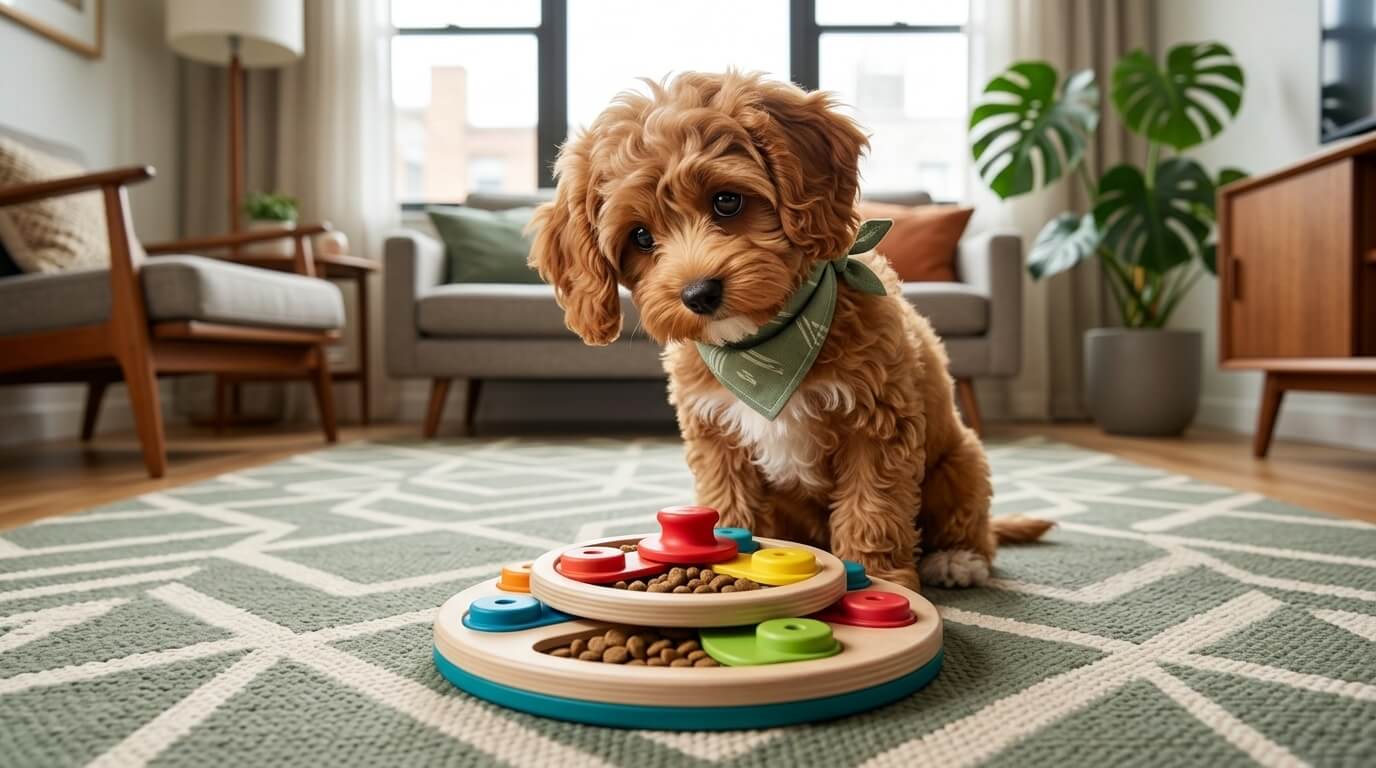
Dog puzzle toys for apartment homes should match the dog, the room, and the time of day. A useful option should be challenging enough to hold attention without becoming frustrating, unsafe, difficult to wash, or needlessly noisy on a hard floor.
This guide compares five specific products using published manufacturer information. “Evidence-checked” means we reviewed those published specifications and care instructions. It does not mean ApartmentDogExpert conducted hands-on or laboratory testing.
Quick Answer
Start with a simple fillable food toy if your dog is new to puzzles. Move to a board with several actions only after the dog can solve easier tasks without barking, pawing frantically, or chewing the toy. The Nina Ottosson Dog Brick is manufacturer-rated Level 2, while the MultiPuzzle is Level 4 within that manufacturer’s own system. KONG, West Paw, and PetSafe do not publish an equivalent shared difficulty level for the products below, so their difficulty is listed as Not specified.
Comparison Matrix
How to read this table: Product specifications come from the linked manufacturer pages. Apartment fit, floor noise, storage, and practical limitations are editorial assessments based on the published design and care requirements. Products are not ranked from first to fifth.
| Product | Puzzle Type | Manufacturer Difficulty | Dimensions | Material | Dog Size / Age Guidance | Food Format | Cleaning | Moving Parts | Replaceable Parts | Supervision Warning | Floor / Noise Risk | Storage Footprint | Apartment Fit | Main Limitation |
|---|---|---|---|---|---|---|---|---|---|---|---|---|---|---|
| Nina Ottosson Dog Brick | Flip, lift, and slide treat board | Level 2 in Nina Ottosson system | Not specified | Food-safe plastic; manufacturer states BPA-, PVC-, and phthalate-free | Not specified | Kibble or small treats in three compartment types | Hand wash with warm water and soap | Sliding covers, flip lids, removable bone pieces | Not specified | Supervise; do not allow chewing; remove if damaged | Low to medium editorial estimate; use a mat on hard floors | Flat, medium footprint | Good step after a simple beginner toy | Removable pieces require close supervision |
| Nina Ottosson MultiPuzzle | Multi-step sliding, spinning, and locking board | Level 4 in Nina Ottosson system | Not specified | Food-safe plastic; manufacturer states BPA-, PVC-, and phthalate-free | For dogs that have mastered Levels 1–3; size/age not specified | Kibble or treats in outer and center compartments | Hand wash with warm water and mild soap | Tiles, spinning wheel, locks, and center sliders | Not specified | Supervise; do not allow chewing; remove if damaged | Medium editorial estimate; place on a nonslip mat | Larger flat-board footprint | For experienced puzzle users in supervised sessions | Too complex for many beginners |
| KONG Classic | Fillable rubber food toy | Not specified | Approximately 1.5 × 1.5 × 2.25 in to 3.88 × 3.88 × 6 in across published sizes | 100% natural rubber | XS up to 5 lb; S up to 20 lb; M 15–35 lb; L 30–65 lb; XL 60–90 lb; XXL 85+ lb | Kibble, treats, or suitable soft filling | Top-rack dishwasher safe; hand washing also supported | No removable puzzle pieces | Not specified | Supervise; discontinue if damaged; power chewers may need a larger or stronger version | Low when used for licking; can bounce or roll if thrown | Compact | Simple starting point and easy small-home storage | Not a multi-step problem-solving board |
| West Paw Toppl | Fill, freeze, slow-feed, or interlock food toy | Not specified | Small 2.5 × 3 × 3 in; Large 3.5 × 4 × 3.5 in; XL 3.75 × 4.75 × 4.75 in | Zogoflex; manufacturer states no BPA, latex, phthalates, or silicone | Manufacturer provides product sizes but no product-page age range | Wet food, treats, or kibble; compatible sizes can interlock | Top-rack dishwasher safe | One-piece when used alone; two compatible sizes can twist together | Not specified | Supervise; choose an appropriate size; discontinue if damaged | Low when stationary; medium if interlocked and chased | Compact to medium, depending on size | Useful for quiet licking or a more active paired setup | Creating the interlocking chase puzzle requires two sizes |
| PetSafe Busy Buddy Kibble Nibble | Rolling kibble-dispensing ball | Not specified | Not specified | Not specified | Small for dogs under 20 lb; Medium/Large for dogs over 20 lb | Dry kibble or treats; published capacity 2 cups for small and 3.5 cups for medium/large | Top-rack dishwasher safe | Two twist-apart halves and Treat Meter prongs | Not specified | Manufacturer page does not present this as an unsupervised-use guarantee | Medium; rubber bumpers are designed to reduce noise and marks, but the toy still rolls | Medium spherical footprint | Better on a rug and during daytime in upstairs apartments | Rolling action can still disturb neighbors on hard flooring |
A Beginner-to-Advanced Selection Path
Difficulty is not standardized across brands. A manufacturer’s numbered level should not be converted into a universal score. Instead, watch what the dog must physically do and how many steps must happen before food appears.
- Begin with one clear action. A KONG Classic or Toppl can teach that calm licking, nudging, or manipulating a toy releases food.
- Add movement carefully. Kibble Nibble introduces rolling and repeated food release. Use it on a rug if hard-floor noise matters.
- Introduce a multi-action board. Dog Brick asks the dog to flip, lift, and slide. Demonstrate one section at a time if needed.
- Reserve complex sequences for experienced dogs. MultiPuzzle combines locks, sliders, a wheel, and tiles. It is not a sensible first puzzle simply because it is labeled advanced.
Move back to an easier setup if the dog abandons the toy, barks repeatedly, scratches at it frantically, tries to destroy it, or looks to you for help after every attempt. Successful enrichment should create manageable problem solving, not escalating frustration.
Five Evidence-Checked Puzzle Toys
Nina Ottosson Dog Brick
Manufacturer specification: Outward Hound identifies Dog Brick as Level 2 in the Nina Ottosson system. It uses flip lids, sliding covers, and removable bone-shaped pieces to reveal three types of treat compartments. The manufacturer describes the plastic as food-safe and free of BPA, PVC, and phthalates. It should be hand washed and used under supervision; dogs should not chew the board or its pieces. Dimensions, age guidance, and replacement-piece availability are Not specified on the reviewed official page.
Editorial assessment: Dog Brick offers more visible cause-and-effect than the MultiPuzzle, making it the more practical board option for a dog moving beyond simple food toys. In an apartment, put it on a nonslip mat to reduce sliding and paw noise. Count the removable pieces before and after each session.
Official Dog Brick manufacturer page
Nina Ottosson MultiPuzzle
Manufacturer specification: MultiPuzzle is Level 4 within the Nina Ottosson line and is intended for dogs that have already mastered Levels 1–3. It combines movable tiles, a spinning wheel, locks, and center sliders. The official page states that its food-safe plastic is free of BPA, PVC, and phthalates and instructs owners to hand wash it. It also requires supervision and storage away from the dog after use. Dimensions, dog-size guidance, and replacement parts are Not specified on the reviewed page.
Editorial assessment: This is the high-complexity option in the group, not a universal “best” choice. Its wide board and multiple actions suit short, supervised sessions more than unattended workday use. Introduce only part of the mechanism at first rather than locking every section immediately.
Official MultiPuzzle manufacturer page
KONG Classic
Manufacturer specification: KONG describes the Classic as a fillable natural-rubber toy for average chewers and publishes six sizes from XS through XXL with weight guidance. Its official specifications list 100% natural rubber and require supervised use, removal when damaged, and consideration of a larger or stronger model for power chewers. KONG’s care guidance states that Classic rubber toys are top-rack dishwasher safe. An equivalent numbered difficulty level and replaceable parts are Not specified.
Editorial assessment: The compact shape works well as a first food puzzle or a quiet licking activity. It can become noisy if tossed or bounced, so use a settled filling and a mat when neighbors are below. Correct sizing matters more than choosing the smallest toy that seems convenient to store.
Official KONG Classic manufacturer page · Official KONG cleaning guidance
West Paw Toppl
Manufacturer specification: West Paw publishes Small, Large, and XL dimensions and describes Toppl as a Zogoflex fillable toy that can be frozen, used for slow feeding, or interlocked in compatible size pairs. The product is top-rack dishwasher safe. The manufacturer states that it contains no BPA, latex, phthalates, or silicone and instructs owners to supervise, select an appropriate size, and discontinue use after damage. A numbered difficulty level, age range, and replaceable parts are Not specified.
Editorial assessment: A single Toppl supports quieter licking and food work; two interlocked pieces create a more mobile challenge with greater floor-noise potential. That makes the setup adjustable for a studio apartment, but buying a second compatible size is an additional requirement rather than an included feature.
Official West Paw Toppl manufacturer page
PetSafe Busy Buddy Kibble Nibble
Manufacturer specification: PetSafe describes Kibble Nibble as a rolling treat and kibble dispenser with adjustable Treat Meter prongs. The Small size is for dogs under 20 pounds and the Medium/Large size for dogs over 20 pounds. Published capacity is 2 cups and 3.5 cups respectively, and the toy is top-rack dishwasher safe. The official page notes rubber bumpers intended to reduce noise and marks. Exact dimensions, materials, age guidance, an equivalent difficulty level, and replaceable parts are Not specified.
Editorial assessment: This option connects movement with food release and can use a measured meal rather than extra treats. It is the least suitable of the five for late-night play on bare flooring because it must roll. A rug, daytime schedule, and short route away from shared walls make it more apartment-compatible.
Official PetSafe Kibble Nibble manufacturer page
What Makes a Puzzle Toy Apartment-Friendly?
- Floor noise: A rubber toy used for licking is usually less disruptive than a hard rolling dispenser. A rug or nonslip mat reduces impact and keeps a board in place.
- Usable footprint: Include the space a dog needs to circle, paw, and reposition—not just the product dimensions.
- Cleaning access: Match the toy to the sink, dishwasher, drying area, and food type you can realistically manage.
- Storage: Dry every food-contact surface before placing it in a closed cabinet or small apartment bin.
- Supervision: “Interactive” does not mean approved for unattended use. Follow each manufacturer’s warning and observe how your own dog manipulates the product.
Calories, Cleaning, and Small-Space Rotation
Measure puzzle food from the dog’s normal daily ration where practical. Treat calories can accumulate quickly when several people refill a toy during a workday. For wet fillings, refrigerate perishable ingredients and wash the toy promptly after use.
A small rotation is usually more useful than leaving every puzzle on the floor. Keep one easy fillable toy, one movement-based option, and one supervised board if the dog enjoys that style. Store board pieces together, inspect rubber for cracks or missing chunks, and replace any product that can no longer be used as directed.
Workday Use and the Separation-Anxiety Boundary
A puzzle may occupy a relaxed dog for part of a work block, but it does not meet exercise, toileting, social, or sleep needs by itself. It also cannot treat separation anxiety. If a dog panics, vocalizes continuously, attempts escape, drools heavily, or cannot engage with food after you leave, a more complex toy is not the primary solution.
For a broader routine, see how to keep a dog entertained while at work. If you want low-cost supervised alternatives rather than commercial products, use the ideas in DIY dog enrichment for apartments; towel and cardboard puzzles belong in that guide, not in this five-product comparison.
Common Puzzle-Toy Mistakes
- Starting too hard: Repeated failure can teach chewing or barking instead of problem solving.
- Using rolling toys late at night: A product can be quiet in the hand yet disruptive when repeatedly hitting a hard floor.
- Ignoring chewing style: Food-safe material does not make a toy indestructible.
- Leaving removable parts out: Count and store board pieces after supervised use.
- Adding calories without measuring: Use meal allocation where appropriate.
- Assuming every puzzle is safe alone: Follow the product warning and the dog’s demonstrated behavior.
FAQ
Which dog puzzle toy is best for a beginner?
A correctly sized fillable food toy is often the clearest starting point because one simple action produces a reward. “Beginner” is an editorial use description here, not a shared manufacturer rating.
Are puzzle toys safe when a dog is home alone?
Do not assume so. The two Nina Ottosson boards explicitly require supervision, and the other manufacturers also provide sizing, damage, or supervision warnings. Use a product unattended only when its instructions and your dog’s established behavior support that decision.
How can I make a puzzle toy quieter upstairs?
Choose a stationary licking or board activity, place it on a nonslip rug or mat, and avoid rolling toys during quiet hours. A mat reduces impact but cannot make a moving hard object silent.
Should every meal be served in a puzzle?
No. Some dogs benefit from puzzle feeding, but they also need predictable, low-effort meals. Stop or simplify the task if the dog becomes frustrated, guarded, or unable to finish an appropriate ration.
Can a puzzle toy fix separation anxiety?
No. A relaxed dog may enjoy food enrichment during a short absence, but panic or escape behavior requires an anxiety-focused plan and, when appropriate, veterinary or qualified behavior support.