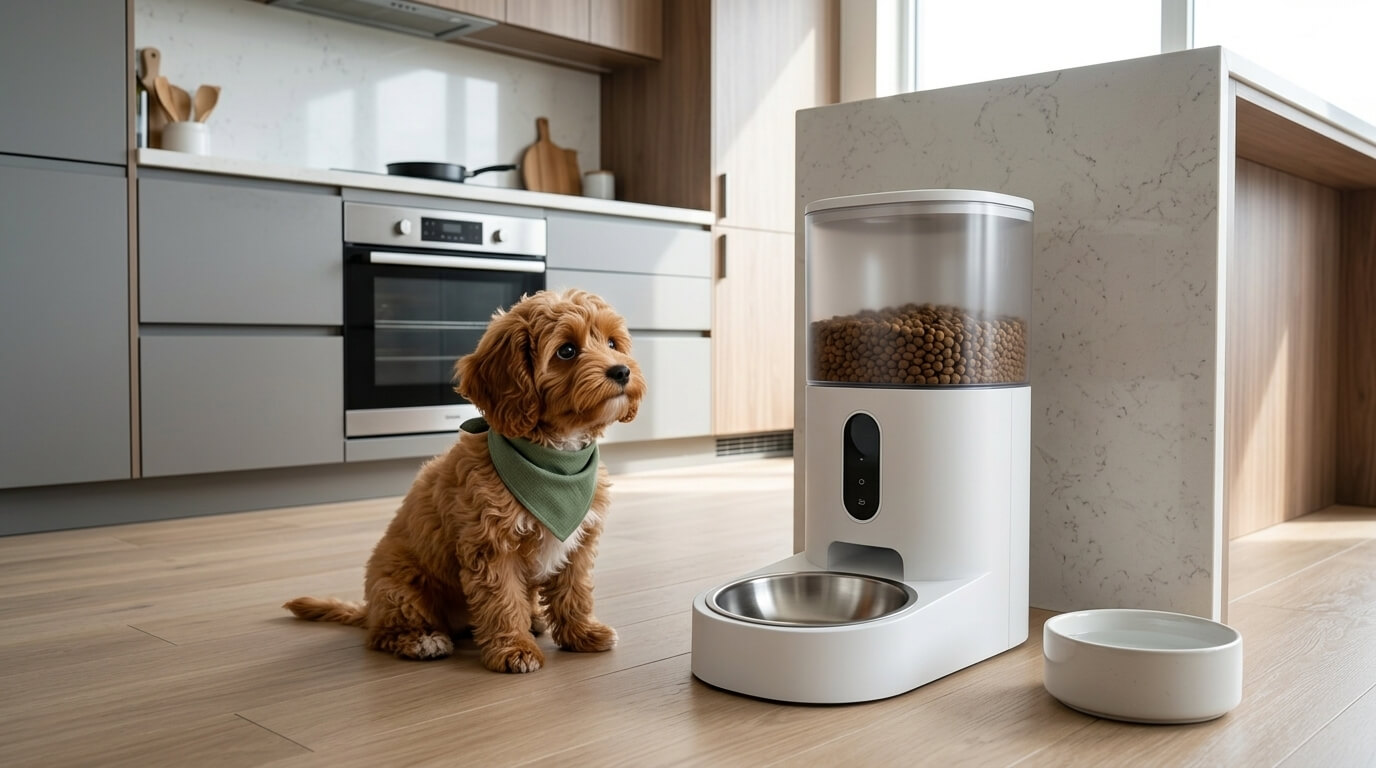
The best automatic dog feeders are not just convenience gadgets. For working owners, shift workers, first responders, office workers, and apartment dog owners, they can solve one specific problem: keeping meal timing consistent when your schedule is not.
But an automatic feeder does not replace walks, companionship, potty breaks, or supervision. It only solves the meal-timing piece. If your dog is anxious, destructive, diabetic, medically fragile, or likely to break into food storage, you need a more careful plan than simply filling a hopper and leaving for the day.
This guide compares five specific automatic feeders using current manufacturer specifications for backup power, offline behavior, low-food alerts, cameras, feeding history, capacity, cleaning, and apartment fit. It also explains when a wet-food tray or microchip-access setup is more appropriate than these five models.
Best Automatic Dog Feeders: Quick Answer
For outage resilience, the Whisker Feeder-Robot has the clearest evidence for local offline scheduling and an optional battery rated for about 24 hours. PetSafe Smart Feed provides confirmed low and empty food notifications. PETLIBRO Granary Smart Camera Feeder adds 1080p night-vision monitoring, while the base PETLIBRO Granary 2 tracks food dispensed, eaten, and remaining for small dogs. PetSafe 5 Meal is the simplest battery-only option. No automatic feeder replaces walks, supervision, or a human backup plan.
| Owner Situation | Best Feeder Feature | Why It Matters |
|---|---|---|
| Office worker | Scheduled dry-food dispenser | Keeps lunch or dinner consistent during commute delays. |
| First responder or shift worker | Wi-Fi control plus battery backup | Handles unpredictable shifts and power interruptions. |
| Remote worker | Portion control and routine scheduling | Prevents constant grazing and owner-driven overfeeding. |
| Apartment dog | Quiet motor, sealed hopper, compact footprint | Reduces noise, odor, pests, and storage problems. |
| Wet food dog | Timed tray with cold pack | Dry-food hoppers are not safe for wet food. |
| Multiple dogs | Microchip or separated feeding stations | Prevents one dog from stealing another dog’s meal. |
Table of Contents
- Quick Answer
- What Automatic Dog Feeders Actually Solve
- How to Choose an Automatic Dog Feeder
- 5 Evidence-Checked Feeders
- Safety Checklist
- Best Feeder by Work Schedule
- When Not to Use One
- Three-Day Test
- Apartment Setup
- FAQ
What Automatic Dog Feeders Actually Solve
An automatic feeder solves meal timing. It can dispense a measured portion when you are stuck in traffic, on a late call, covering a shift, commuting home, or trying to keep your dog’s meal schedule consistent.
It does not solve loneliness, boredom, potty needs, separation anxiety, exercise, or medical monitoring. A feeder can help a stable adult dog with predictable meals. It cannot make a 10-hour workday automatically humane.
If your dog is alone for long stretches, pair this guide with your alone-time article: how long can you leave a dog alone in an apartment.
How to Choose an Automatic Dog Feeder
Portion Accuracy
Portion control matters because many dogs gain weight slowly through small daily overfeeding. Look for a feeder that lets you set measured portions clearly. Then test the actual output with your dog’s kibble before trusting the schedule.
Food Compatibility
Most automatic dog feeders are made for dry kibble. Kibble size, shape, and oiliness can affect dispensing. Wet food, fresh food, and mixed food usually require a tray-style timed feeder with cold packs, not a hopper.
Battery Backup
Battery backup matters for apartment owners because a power outage or unplugged cord can make the feeder miss a meal. If your schedule is unpredictable, do not choose a feeder that depends only on wall power.
Jam Resistance
Food jams are the failure that matters most. Choose a feeder with a design that matches your kibble size and test several feedings while you are home. Do not discover a jam during a 12-hour shift.
Secure Lid
Food-motivated dogs can be surprisingly talented. If your dog paws, noses, tips, or chews food containers, choose a secure hopper and place the feeder where it cannot be knocked over easily.
Cleaning
Food residue builds up. Choose removable bowls and washable parts. The FDA recommends handling pet food safely and keeping feeding items clean, which matters even more when food sits in a device for repeated meals: FDA pet food handling tips.
5 Best Automatic Dog Feeders for Working Owners
These five feeders cover different needs rather than pretending one device is perfect for every apartment. Manufacturer specifications support the factual details below. The apartment-fit comments are editorial assessments based on footprint, power dependence, cleaning, and the amount of monitoring each setup requires. We did not conduct hands-on testing, and we do not rank camera quality, noise, dispensing accuracy, or long-term reliability without comparable independent evidence.
| Product | Power & outage behavior | Camera | Alerts / logs | Capacity | Cleaning | Apartment fit |
|---|---|---|---|---|---|---|
| Whisker Feeder-Robot | 15V DC; optional battery provides about 24 hours in power-saving mode; saved schedules continue offline | No | Refill notifications and feeding-habit trends in app | Up to 32 cups | Hand-wash removable parts | Narrow 9 x 11.25 in footprint; good outage-focused fit |
| PetSafe Smart Feed, 2nd Generation | AC adapter; optional 4 D-cell backup; duration and outage connectivity not specified | No | Low and empty food notifications; app schedule monitoring | 24 cups | Lid, hopper, bowl and holder are top-rack dishwasher-safe | Larger footprint; strong low-food alert fit |
| PETLIBRO Granary Smart Camera Feeder | 5V adapter plus 3 D-cell emergency backup; schedules continue on batteries, but Wi-Fi, camera and recording stop | 1080p, night vision, 145-degree view | Low battery, low food, jam, motion and sound alerts; cloud or microSD recording options | 5 L | Removable bowl and tank parts | Compact camera option for small or medium pets |
| PETLIBRO Granary 2 | Corded power plus built-in rechargeable backup up to 24 hours; manufacturer says Wi-Fi and schedules continue during outage | No on base model | Tracks dispensed, eaten and remaining food; feeding trends and configurable alerts | 5 L | Stainless-steel bowl and holder are washable; electronic base is wipe-only | Best fit for small dogs when meal data matters |
| PetSafe 5 Meal Pet Feeder | 4 D-cell batteries; no Wi-Fi dependence | No | No app alerts or logs | 5 one-cup compartments | Removable tray is top-rack dishwasher-safe | Simple, low-profile option for predictable schedules |
1. Whisker Feeder-Robot: Best Fit for Outage Resilience
The Whisker Feeder-Robot is the strongest evidence-backed option here for owners who want a documented offline schedule and a stated backup duration. Whisker says the feeder stores its programmed schedule locally, so scheduled meals continue if the unit loses its network connection. The optional backup battery is sold separately and provides approximately 24 hours of use in power-saving mode.
Manufacturer-supported specifications: up to eight scheduled meals per day; portions from 1/8 cup; up to 32 cups of dry food without the hopper insert; 15-inch height; 9 x 11.25-inch footprint; 15V DC power; anti-jam and food-backup detection; refill notifications and feeding-habit trends in the Whisker app. Removable parts should be hand-washed. The manufacturer does not specify whether home internet or app access remains available during a household power outage; only local scheduled feeding is confirmed.
Apartment tradeoff: The narrow footprint may fit beside a cabinet or along a wall more easily than a wider tray feeder, but the 15-inch height and large hopper create more visual bulk. Owners should still test dispensing sound and stability in the actual feeding location.
Who should skip it: Skip it if you need wet food, dishwasher-safe standard parts, or a backup battery included in the base price. It is also a poor fit for a dog that persistently paws, bites, or tips food equipment.
2. PetSafe Smart Feed, 2nd Generation: Best Fit for Low-Food Alerts
The exact current model is the PetSafe Smart Feed Automatic Dog and Cat Feeder, 2nd Generation. PetSafe confirms that built-in sensors notify the owner when food is running low and when the hopper is empty. That makes it the clearest fit for the visible low-food-alert query.
Manufacturer-supported specifications: 24-cup capacity; up to 12 meals per day; portions from 1/8 cup to 4 cups; My PetSafe app control over 2.4 GHz Wi-Fi; AC adapter; optional backup using four D-cell alkaline batteries, not included. PetSafe lists a 20.3 x 9.4 x 12.6-inch product size. The stainless-steel bowl, bowl holder, lid, and hopper are top-rack dishwasher-safe. Manufacturer-stated battery duration, continued Wi-Fi access during an outage, offline scheduling behavior, jam alerts, and reviewable feeding-log retention are not specified.
Apartment tradeoff: The dishwasher-safe food-contact parts simplify cleanup, but its 20.3-inch dimension requires more floor or counter clearance than the narrowest feeders in this comparison. Measure the intended corner and cord route before buying.
Who should skip it: Skip it if you need a documented battery runtime, a camera, or confirmed app connectivity during an outage. It is designed for dry or semi-moist food rather than wet meals.
3. PETLIBRO Granary Smart Camera Feeder: Best Fit for Camera Monitoring
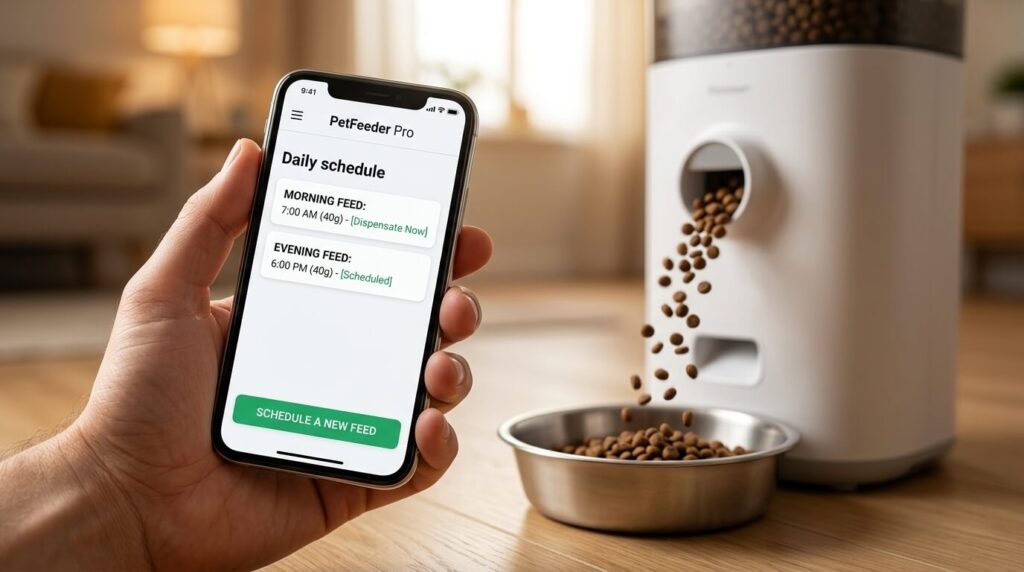
The PETLIBRO Granary Smart Camera Feeder has the most clearly documented camera package among the five products: a 1080p camera, infrared night vision, a 145-degree downward-facing view, two-way audio, and motion and sound alerts. The manufacturer says the 5 L feeder is suitable for small or medium pets, including small dogs, when kibble is within the supported 2–15 mm range.
Manufacturer-supported specifications: up to ten scheduled meals or snacks daily; 5 L capacity; 5V power adapter; emergency backup using three D-cell batteries; low-battery, low-food, and food-jam alerts. On battery power, scheduled meals continue, but Wi-Fi, camera, recording, and reset functions are disabled. Video can be stored on a compatible microSD card; optional cloud plans add seven- or 30-day storage. The PLAF203 specification lists an approximately 13 x 7.5 x 7.5-inch body. The bowl and tank parts are removable for cleaning.
Apartment tradeoff: The narrow body and downward-facing camera suit a compact feeding station better than a room-facing security camera. Camera access still depends on power and connectivity, so it should not be treated as proof that a scheduled meal occurred during every outage.
Who should skip it: Skip it if you need camera access during a power outage, do not want an app, or use wet food. Cloud recording is optional but paid; without a subscription, local microSD storage is the relevant recording option.
4. PETLIBRO Granary 2: Best Fit for Meal Tracking
This comparison uses the exact base PETLIBRO Granary 2, not the Vision, Vision Duo, or X variants. PETLIBRO states that the base Granary 2 supports cats and small dogs; the other three Granary 2 variants are described as cat-only. The built-in bowl scale measures food to within 1 gram and tracks the amount dispensed, eaten, and remaining, which directly serves the meal-history query.
Manufacturer-supported specifications: 5 L hopper; 14.05 x 7.09 x 14.02-inch dimensions; corded electric power with a built-in rechargeable backup rated up to 24 hours under manufacturer laboratory conditions; feeding schedules and Wi-Fi continue during an outage according to the current product FAQ. The stainless-steel bowl and bowl holder are washable; the electronic area underneath must be wiped rather than rinsed or submerged. The app provides feeding activity and longer-term trends. Availability is variant-dependent on the shared series page.
Apartment tradeoff: The narrow 7.09-inch width works well against a wall, but the scale needs a flat, stable surface for useful readings. Thick or uneven carpet can affect measurement, so a hard floor or rigid feeding mat is the safer apartment placement.
Who should skip it: Skip it for medium or large dogs, wet food, or anyone who does not want app-based feeding data. Do not accidentally buy a cat-only Granary 2 Vision-series model for a dog.
5. PetSafe 5 Meal Pet Feeder: Best Fit for Simple Offline Scheduling
The PetSafe 5 Meal Pet Feeder is the non-Wi-Fi option in this lineup. It runs on four D-cell alkaline batteries and uses a digital timer, so it does not depend on a router, phone app, or wall outlet. PetSafe currently lists it for cats and small to medium dogs.
Manufacturer-supported specifications: five one-cup compartments; one compartment is immediately accessible and four can be scheduled; dry or semi-moist food and treats; 15.5 x 3.4-inch listed dimensions; BPA-free plastic; removable tray that is top-rack dishwasher-safe. Manufacturer-stated battery runtime, low-battery warning, feeding confirmation, jam alert, and meal history are not specified.
Apartment tradeoff: Its low profile can slide into a feeding corner and it removes cord-routing concerns. The round 15.5-inch body uses more floor width than a narrow upright hopper, and the exposed scheduled compartments hold far less food than a large-capacity feeder.
Who should skip it: Skip it if changing shifts require remote schedule edits, you need low-food alerts, or you need more than four future meals loaded at once. Although the manufacturer permits semi-moist food, this model does not provide refrigeration.
Which Feeder Setup Fits Your Situation?
Shift workers should prioritize a tested local schedule, backup power, and a human emergency contact. Owners who mainly need low-food warnings can focus on a sensor-equipped app feeder. Camera monitoring is useful when visual confirmation matters, but it does not replace an outage plan. Meal-tracking models are most relevant when a small dog’s intake history is useful and the feeder can sit on a stable floor.
For wet food, use a purpose-built refrigerated or ice-pack tray system rather than any dry-food hopper listed above. For multiple dogs, a microchip-access feeder, separate rooms, or supervised stations may be safer than one shared open bowl. A SureFeed Microchip Pet Feeder can restrict bowl access for cats and small dogs, but it is an access-control device rather than a scheduled dispenser, so it is not counted among these five automatic feeders.
Automatic Feeder Safety Checklist
- Test at least 10 feedings while you are home.
- Measure the actual portion output with your dog’s kibble.
- Check for jams before trusting it during a long workday.
- Use only food types the feeder is designed to handle.
- Keep the hopper lid secure from food-motivated dogs.
- Clean bowls and food-contact parts regularly.
- Use battery backup if missed meals would be a serious problem.
- Do not use a feeder as a substitute for potty breaks or companionship.
Best Feeder by Work Schedule
| Schedule | Best Feeder Type | Extra Support Needed |
|---|---|---|
| Remote worker | Portion-control feeder | Use it to prevent grazing, not to replace routine. |
| Office worker | Scheduled dry-food feeder | Dog walker if the day is long. |
| First responder | Wi-Fi feeder with backup power | Emergency contact if a shift runs very long. |
| Frequent commuter | App feeder with feeding confirmation | Camera or neighbor backup for delays. |
| Multiple-dog owner | Microchip or separated feeding system | Resource guarding prevention. |
Automatic Feeder Plan by Job Type
The best automatic feeder for professionals is not always the same as the best automatic feeder for first responders, remote workers, or office workers. The right choice depends on how predictable your schedule is and what happens when you are late.
| Job Type | Main Feeding Problem | Best Feeder Setup |
|---|---|---|
| Office worker | Commute delays and late meetings | Scheduled dry-food feeder with portion control and backup battery. |
| Remote worker | Inconsistent hand-feeding and grazing | Portion feeder used to keep meals predictable even when you are home. |
| First responder | Unpredictable shifts and emergency overtime | Wi-Fi feeder with confirmation, backup power, and a human backup contact. |
| Healthcare worker | Long shifts and limited phone access | Pre-programmed schedule plus battery backup and tested portions. |
| Service worker | Variable closing times | App-controlled feeder that can dispense dinner if your shift runs late. |
| Freelancer or entrepreneur | Irregular work blocks | Routine-based feeder that prevents meals from drifting later every day. |
For Office Workers
If you work a predictable office schedule, you may not need the most advanced feeder. You need reliability. A scheduled feeder that consistently dispenses the right amount at the same time can solve the dinner-delay problem without adding unnecessary app complexity.
The risk for office workers is assuming the feeder solves the whole workday. It solves the meal. It does not solve the walk. If your dog is alone too long, arrange a dog walker, neighbor visit, or lunch break.
For Remote Workers
Remote workers often feed too flexibly. Breakfast happens between emails. Lunch becomes treats during calls. Dinner shifts later because the owner is technically home. An automatic feeder can protect routine even when your workday has no clean boundaries.
For remote workers, portion control may matter more than remote control. The feeder can stop the habit of topping off the bowl or giving extra meals because the dog is staring at you during a meeting.
For First Responders and Shift Workers
First responders and shift workers need redundancy. If you cannot guarantee when you will leave work, choose a feeder with app control, feeding confirmation, and backup power. But also choose a human backup. A neighbor, sitter, partner, or trusted friend should know what to do if your shift becomes much longer than planned.
The best automatic feeder for first responders is a safety net, not the whole care plan. It should buy time and protect meal timing, but your dog still needs water, potty breaks, movement, and human check-ins.
When Not to Use an Automatic Dog Feeder
An automatic feeder is not right for every dog. Avoid relying on one without veterinary guidance if your dog has diabetes, severe appetite changes, vomiting, a history of bloat risk, medically timed meals, or a diet that must be supervised.
Also be careful if your dog has separation anxiety. A feeder may provide routine, but it will not fix panic. If your dog barks, drools, scratches doors, or refuses food when alone, read your separation anxiety guide: dog separation anxiety in apartments.
How to Test an Automatic Feeder Before a Workday
Do not fill a feeder for the first time on Monday morning and hope it works. Test it while you are home. Automatic feeders can fail because of kibble size, oily food, low batteries, Wi-Fi issues, a loose bowl, a jammed chute, a confused dog, or a dog who decides the hopper is a puzzle toy.
The 3-Day Feeder Test
- Day 1: Run three scheduled feedings while you are in the apartment. Measure whether the portion is accurate.
- Day 2: Use the feeder for one real meal while you are in another room. Watch how your dog reacts to the sound.
- Day 3: Leave for a short errand and confirm the meal dispensed properly before using it for a workday.
If the feeder jams, dispenses too much, scares your dog, or becomes a target for pawing and chewing, fix that before relying on it. A feeder that works 90% of the time is not reliable enough for a dog who depends on it for dinner.
What to Track During Testing
| Test Item | Pass | Problem Sign |
|---|---|---|
| Portion size | Dispenses the same amount repeatedly | Portion varies widely between meals |
| Kibble flow | No jams after repeated feedings | Food bridges, sticks, or blocks the chute |
| Dog reaction | Dog approaches calmly and eats normally | Dog barks, panics, or attacks the feeder |
| Power | Battery backup works as expected | Schedule resets or feeder stops after unplugging |
| Cleaning | Bowl and food-contact parts are easy to remove | Food residue builds up in hard-to-clean areas |
Apartment Setup Tips
In a small apartment, feeder placement matters. Put the feeder on a washable mat, away from cords, curtains, trash, and busy walkways. If your dog pushes bowls around, choose a heavier base or place the feeder against a stable wall.
Avoid placing the feeder directly beside the front door if hallway noise triggers your dog. Meal time should not happen in the most reactive spot in the apartment.
If the feeder is noisy, test whether the dispensing sound makes your dog anxious or excited. Some dogs learn the sound quickly and rush the machine. Others start barking when it activates. If sound is a problem, use a quieter model or place it farther from shared walls.
Common Automatic Feeder Mistakes
Mistake 1: Buying for Features Instead of Reliability
A camera, voice recorder, and app are useful only if the feeder dispenses food accurately. Reliability comes first.
Mistake 2: Using the Wrong Food Type
Wet food does not belong in a dry-food hopper. Large, oily, irregular, or soft kibble may also jam some feeders. Match the feeder to the food.
Mistake 3: Forgetting Battery Backup
If a missed meal would matter, battery backup matters. This is especially true for working owners who may not be home to notice a power problem.
Mistake 4: Ignoring Multi-Dog Conflict
If one dog steals food, an open feeder may create stress or resource guarding. Use separation, microchip access, or supervised feeding.
Mistake 5: Treating the Feeder Like a Pet Sitter
An automatic feeder can feed your dog. It cannot notice illness, provide a potty break, clean a mess, or comfort a distressed dog.
FAQ
What are the best automatic dog feeders for working owners?
The best automatic dog feeders for working owners usually have portion control, reliable scheduling, a secure lid, anti-jam design, and battery backup. Wi-Fi and feeding confirmation are useful if your schedule changes often.
What is the best automatic feeder for professionals?
The best automatic feeder for professionals is a reliable scheduled feeder that dispenses accurate portions during long meetings, commute delays, or workdays. App control is helpful but reliability matters more.
What is the best automatic feeder for first responders?
First responders should look for Wi-Fi control, feeding confirmation, battery backup, and a secure hopper because shifts can change suddenly. A human backup plan is still important for very long delays.
Can automatic dog feeders be used for wet food?
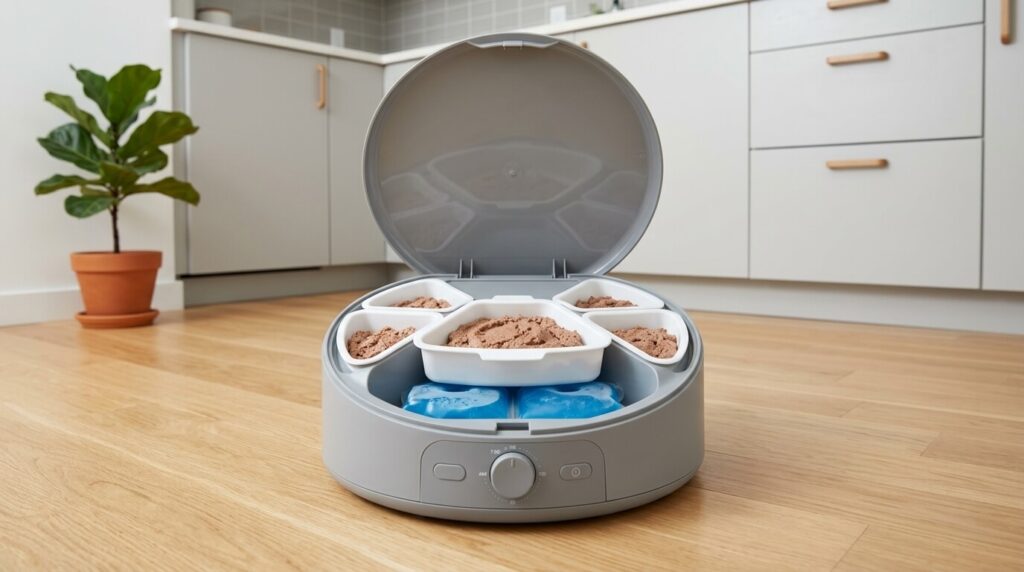
Only certain tray-style feeders are designed for wet food. Do not put wet food in a dry-food hopper. Use cold packs when appropriate and follow food safety limits.
Are automatic dog feeders safe for apartments?
Yes, if they are tested, cleaned, placed safely, and used for the right dog. They are not a substitute for exercise, potty breaks, medical care, or supervision.
Can I use an automatic dog feeder for two dogs?
Only if both dogs can eat safely without stealing or guarding. Many multi-dog homes need separate feeders, microchip access, different rooms, or supervised meals.
Do automatic feeders help with separation anxiety?
They may support routine, but they do not treat separation anxiety. If your dog panics when alone, focus on behavior support and alone-time training first.
Next Step
Before buying, write down your dog’s food type, kibble size, portion size, work schedule, power-outage risk, and whether your dog might break into the hopper. Then choose the feeder that solves your real schedule problem, not the one with the most features.
The best automatic dog feeders are reliable, boring, and safe. For working owners, that is exactly the point.