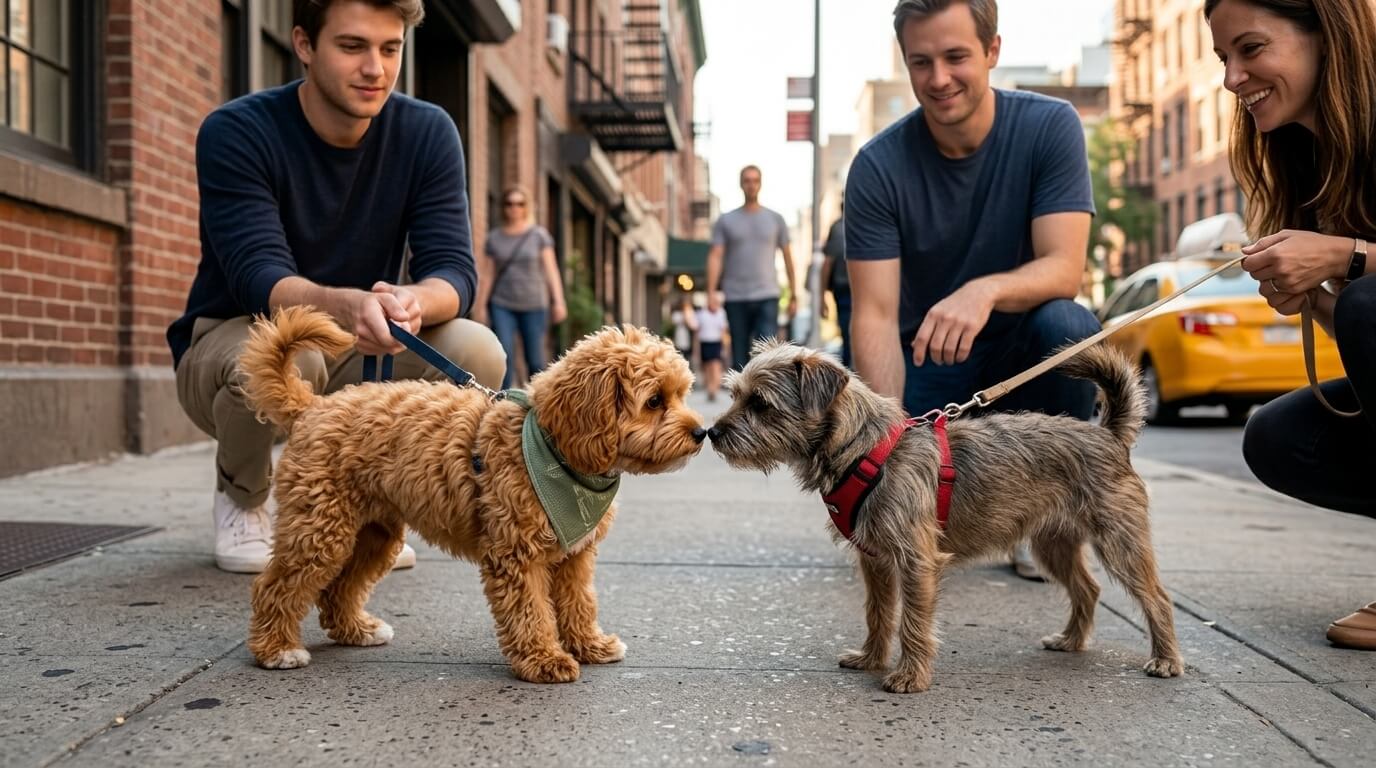
Introduce second dog in small apartment life as a gradual change in territory, routine, and relationships, not as one big greeting. A friendly meeting outside can be encouraging, but it does not tell you how the dogs will feel when they must pass through the same doorway, hear each other eating, compete for the sunny patch on the floor, or decide who gets to lie beside you on the sofa.
Small homes make ordinary canine communication harder. There is less room to curve away, pause, or choose another resting place. The elevator and hallway funnel both dogs into tight spaces. The resident dog may suddenly treat a bed, bowl, toy, doorway, or person as more valuable because another dog is present. The newcomer may be exhausted, overstimulated, or too uncertain to show their normal personality yet.
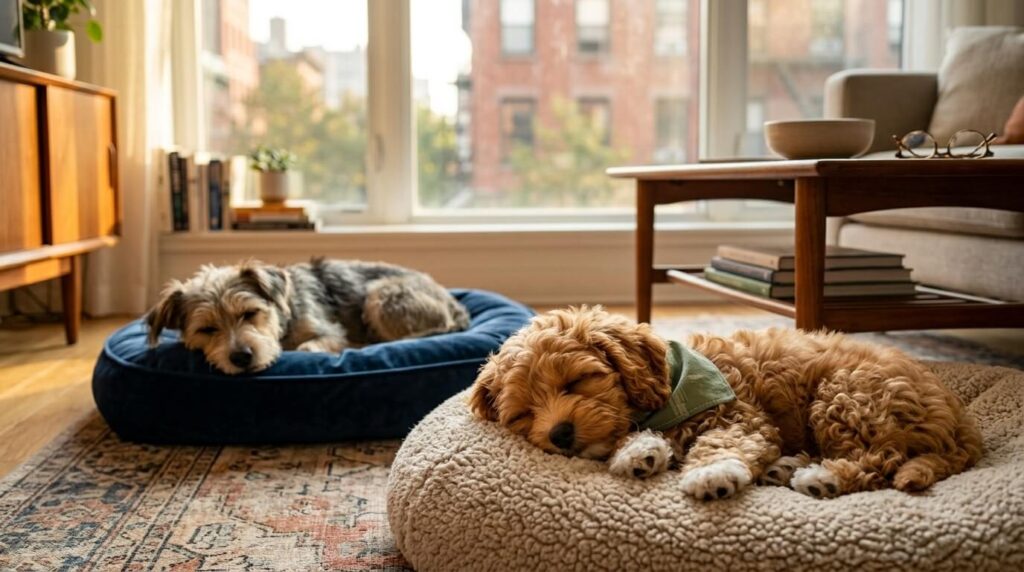
The goal is not instant friendship. The first useful milestone is much quieter: both dogs can notice each other without becoming trapped in staring, pursuit, guarding, or frantic play. They can eat, sleep, toilet, and receive human attention without having to defend access. Some pairs eventually play and sleep together. Others become comfortable housemates who prefer separate beds. Both outcomes can be successful.
Quick Answer: How to Introduce a Second Dog in a Small Apartment
To introduce second dog in small apartment spaces safely, start with a health and compatibility check, prepare two genuinely separate rest zones, remove high-value items from shared areas, and arrange a neutral outdoor meeting with two capable handlers. Walk in the same direction at a comfortable distance before allowing brief, optional sniffing. After the walk, bring the dogs indoors through a planned low-pressure route and separate them for rest. Feed, provide chews, and offer food toys behind closed doors or secure barriers. Use short supervised sessions and expand access only when both dogs repeatedly show loose bodies, easy disengagement, and the ability to rest.
Do not leave the dogs loose together because a certain number of days has passed. Calendar time is not evidence of safety. Their behavior around entrances, beds, food, toys, human attention, play, and quiet periods is what matters.
| Situation | Safer Apartment Plan | Reason to Pause |
|---|---|---|
| First outdoor meeting | Two handlers, parallel movement, generous distance | Freezing, hard staring, lunging, hiding, or inability to disengage |
| Entering the building | Use a quiet route and avoid greeting in the elevator or doorway | One dog blocks, rushes, or crowds the other |
| Resting indoors | Two zones with separate water, beds, and visual relief | Gate charging, hovering, repeated following, or no real sleep |
| Food and valued items | Closed-door feeding and separate chews or enrichment | Stiffness, gulping, bowl checking, stealing, blocking, or growling |
| Unsupervised time | Keep dogs physically separated until behavior is consistently calm | Any unresolved tension, one-sided pursuit, or unreliable recall |
Before You Introduce Second Dog in Small Apartment Spaces
Good introductions begin before the second dog crosses the threshold. Ask whether the resident dog actually enjoys living near other dogs. Tolerating a dog on a walk is different from sharing resting places and human attention every day. A dog who routinely avoids other dogs, guards important resources, panics in confined spaces, or has injured another dog needs an individualized professional assessment before an adoption decision.
Consider the dogs as individuals rather than relying on sex, breed, or size as a guarantee. Age, health, play style, recovery after excitement, handling needs, and social communication all matter. A quiet senior may find an adolescent’s constant wrestling exhausting. A small dog can be injured by friendly but uncontrolled play with a much larger dog. A fearful newcomer may need far more distance than an outgoing resident dog expects.
Arrange veterinary care for both dogs. Pain, impaired hearing or vision, gastrointestinal discomfort, skin disease, mobility limitations, and other medical problems can reduce tolerance. Confirm vaccinations, parasite prevention, medications, feeding needs, and any temporary isolation recommended by your veterinarian or shelter. Do not treat new growling or irritability as purely behavioral until health concerns have been considered.
Review the lease, building pet limit, size or breed rules, deposits, elevator requirements, and local licensing obligations. Then test the practical plan. Can you safely take the dogs out separately? Is there a closed door between their rest zones? Can one dog reach the exit without squeezing past the other? Is there a backup caregiver who can handle each dog? If the answer depends on both dogs becoming friends immediately, the setup is not ready.
If you are still weighing the decision, use the questions in Should I Get a Dog in an Apartment? and apply them twice: time, cost, noise, toilet access, exercise, veterinary care, and emergency plans all increase with a second dog.
Prepare Two Real Zones Before the New Dog Arrives
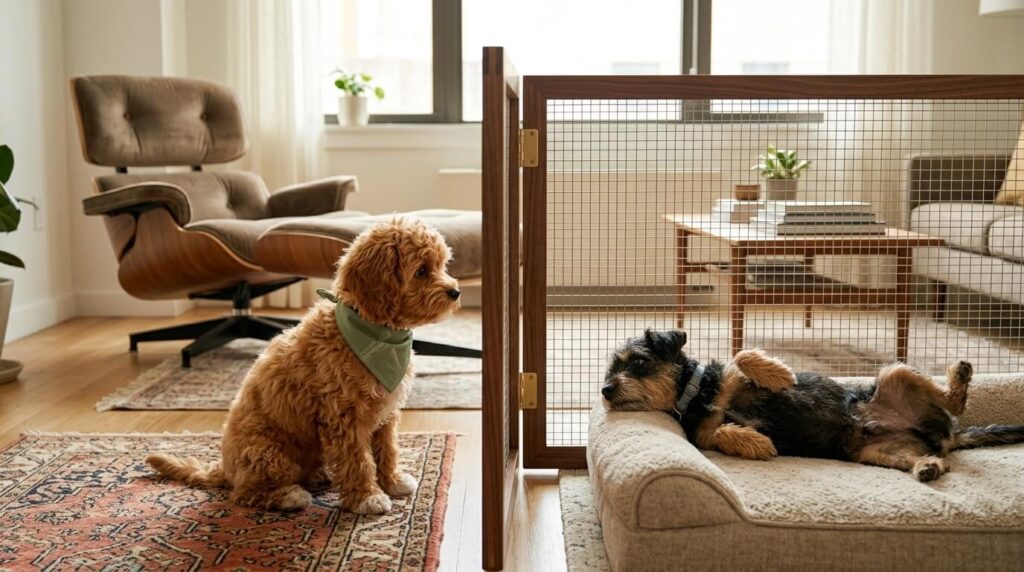
A separate zone is not one bed placed three feet from another bed. Each dog needs enough room to lie down, turn around, drink, and disengage without being followed. In a one-bedroom apartment, this may be the bedroom and living room. In a studio, it may require a sturdy pen plus a gate, strategic furniture, and rotation. If the layout cannot create safe separation, arrange a different transition location or get professional help before proceeding.
Put water and comfortable bedding in each zone. Remove food bowls, chews, stuffed toys, bones, food puzzles, favorite portable beds, and trash from shared space. Also think about less obvious resources: the sofa corner, the window, the route to the balcony, the entry mat, your desk chair, and access to you. The object is not to make the apartment empty forever. It is to remove predictable conflict while you learn what each dog values.
A gate is useful only when both dogs remain safe near it. Dogs who charge, climb, bite through, or fixate across a barrier need more distance, a visual cover, or a closed door. Choose hardware that matches the opening, dog size, jumping ability, and installation rules. The no-drill dog gate guide for apartments explains renter-safe checks, but no product substitutes for observing the dogs.
Prepare two standard leashes, treats that can be delivered separately, waste bags, cleaning supplies, and a simple written rotation. Decide who handles which dog. During an introduction, vague instructions such as “grab somebody” waste time. Each adult should know which leash and which doorway they are responsible for.

Table of Contents
Seven Safe Steps to Introduce Second Dog in Small Apartment Life
1. Start Outdoors at a Distance Both Dogs Can Handle
Choose neutral or low-ownership ground with enough width to move. A quiet sidewalk, open parking area, or broad park path can work. A crowded dog park, apartment lobby, pet-store aisle, or tiny elevator cannot. Use one calm handler per dog and ordinary leashes that allow control without forcing the dogs nose-to-nose.
Begin farther apart than you think you need. Let each dog notice the other and continue walking in the same direction. Reward orientation back to the handler, sniffing the ground, and other calm behavior. If a dog cannot eat, respond to a familiar cue, or turn away, increase distance. Excited pulling is not proof of friendliness; it may reflect frustration or overarousal.
Do not tighten both leashes and march the dogs directly toward each other. Dogs normally use curved approaches, pauses, and scent investigation. A taut leash and frontal approach can remove those options. If either dog has a bite history or significant dog reactivity, do not conduct an improvised meeting. Use a veterinarian or qualified behavior professional to plan safety measures.
2. Use Brief, Optional Greetings Instead of a Long Inspection
When both dogs can walk with loose bodies and respond to their handlers, reduce the distance gradually. A greeting should be optional and brief. Allow a curved approach, a few seconds of sniffing, then cheerfully call the dogs apart and continue moving. Reward them separately. Repeat only if both choose to approach again without pressure.
A healthy interaction includes consent from both dogs. One dog approaches, the other can leave, and the first dog respects that choice. Pauses and disengagement are valuable. Constant face licking, following, mounting, neck-over-shoulder postures, or body slamming may look social but can become exhausting when the other dog repeatedly tries to escape.
Watch the response after separation. A dog who shakes off, sniffs, and resumes walking may be recovering normally. A dog who whips around, drags back toward the other dog, remains frozen, or cannot stop scanning needs more distance and a shorter session. End while the dogs can still make good choices.
3. Take a Parallel Walk Before Entering the Building
Continue walking together rather than treating the sniff as the whole introduction. Parallel movement gives the dogs shared experience without requiring close contact. It also allows urination, sniffing, and arousal to settle before they enter the most confined part of the process.
Plan the route home. Avoid the busiest lobby period, narrow stair landing, or elevator full of neighbors. If an elevator is unavoidable, ride separately for the first entry when possible. An elevator is too small for a meaningful greeting and leaves no escape path. Dogs who already struggle with the lift should work through dog elevator training separately before being asked to ride beside a new housemate.
Keep the apartment door open only when the indoor path is secured and one dog cannot bolt back into the hall. Move calmly and avoid gathering both dogs on the threshold. Doorways concentrate movement, owner attention, and territorial emotion; they deserve more management than a wide room.
4. Choose the Entry Order for the Dogs and the Layout
There is no universal rule that the newcomer must always enter first or that the resident dog must always lead. Choose the order that creates the least crowding. In one apartment, the new dog may enter an already prepared gated zone while the resident dog waits outside with a handler. In another, the resident dog may settle behind a closed bedroom door before the new dog comes through the entry. The key is that neither dog watches the other rush toward valued space.
Bring each dog directly to a separate zone and allow a quiet decompression period. This is not a punishment and does not ruin the positive walk. Outdoor success and indoor comfort are different tasks. Let the dogs drink, sleep, and process new scent without immediately testing the sofa, toy basket, food area, and human lap.
Keep drag lines only under direct supervision and only when they will not catch on furniture or entangle the dogs. Do not leave leashes attached when the dogs are alone. If handlers are juggling crossed leashes in a tiny room, return to barriers and one dog at a time.
5. Run Short Shared Sessions With Easy Exits
When you introduce second dog in small apartment rooms, shared sessions should begin only after both dogs have rested. Use the most open room, remove food and toys, and keep the path to each separate zone clear. Ask for very little: calm movement, brief sniffing, responding to a name, or settling at a distance. You do not need to make the dogs sit side by side for treats or pose for a photo.
Call the dogs apart before play becomes frantic. Interrupt one-sided chasing, repeated pinning, mounting, cornering, and any interaction in which one dog keeps trying to hide or climb onto a person. Good play usually includes pauses, role changes, loose movement, and voluntary re-engagement. Size differences require even closer supervision because accidental injury can occur without aggression.
End the session with both dogs moving to their own zones for rest. Alternating connection and separation prevents stress from stacking. A dog can appear tolerant for twenty minutes and then lose patience because there has been no opportunity to sleep or disengage.
6. Separate Food, Chews, Toys, Beds, and Human Attention
Feed behind closed doors whenever possible. Pick up bowls before reopening the zones. Offer chews and stuffed food toys separately, then remove leftovers. Do not scatter treats between both dogs or hold one high-value item where they must crowd together. Food that is safe for one dog may also be unsuitable for the other’s diet or medical needs.
Give each dog an undisturbed bed. Do not allow the newcomer to repeatedly climb onto the resident dog’s resting place, and do not expect the resident dog to share because the bed is large. The same principle applies to crates. Dogs should not be shut into one crate together, and a crate should never be used to force close contact. Review apartment crate training if either dog does not already rest comfortably in confinement.
Human attention can also become a resource. If one dog pushes between you and the other, freezes when you touch the other dog, guards your lap, or repeatedly drives the other away, stop the shared petting session. Provide calm individual time. Do not create a competitive “who sits first gets everything” routine when both dogs are still uncertain.
If stiffness, hovering, hard staring, lip lifting, growling, snapping, blocking, or stealing occurs around valued items, increase separation and use the resource guarding safety guide. Do not punish the warning. VCA veterinary behavior guidance notes that suppressing growls and other communication can remove useful warning signals without changing the underlying discomfort.
7. Base Freedom on Behavior, Not a Deadline
Separate the dogs whenever no capable adult is actively supervising. That includes sleeping, showering behind a closed door, taking trash out, and leaving for work. A camera is useful for observing a dog who is safely separated, but it cannot prevent a conflict between two loose dogs.
Increase freedom one variable at a time. First, perhaps both dogs rest in the same room with an adult present. Later, the adult moves around the room. Then the dogs experience a low-value toy at a distance, or a calm transition through a wider doorway. If tension appears, restore the last successful level. Do not combine a new toy, visitor, meal, and longer session into one test.
Before considering unsupervised access, both dogs should repeatedly demonstrate that they can disengage, respond to interruption, rest without monitoring each other, pass at a comfortable distance, and remain relaxed when ordinary household events occur. There should be no unresolved guarding, bullying, escape attempts, or one-sided pursuit. Some pairs should remain separated when no one is home, and that can be a responsible permanent arrangement.
How to Read Body Language Before Conflict Starts
Look at the whole dog and the sequence, not one tail or sound. A wagging tail does not automatically mean comfort. Loose muscles, curved movement, blinking, a relaxed mouth, normal sniffing, and the ability to turn away are generally more reassuring than fast movement alone. Context matters: a play growl during loose, mutual play is different from a low growl over a bed paired with a frozen body.
| More Comfortable Signs | Signs to Create Distance |
|---|---|
| Curved approach and loose body | Direct rush, freezing, or rigid posture |
| Brief sniff followed by disengagement | Hard stare or relentless following |
| Play pauses and role changes | One-sided pinning, chasing, or mounting |
| Both dogs can rest | One dog blocks a bed, door, person, or water |
| Each dog can leave without pursuit | Hiding, escape attempts, tucked posture, or cornering |
Freezing often occurs before an obvious outburst. Other early warnings include a closed tense mouth, slow stalking movement, standing over the other dog, placing the head or neck across the other dog’s shoulders, guarding a route, repeated lip lifts, and a dog who stops taking treats while staring. Quiet does not always mean calm.
Growling is communication. Do not yell, alpha-roll, leash-correct, or physically hold a growling dog beside the other dog. Calmly create distance and identify what changed. Punishment can increase fear and teach the dog that the other dog’s presence predicts conflict with the owner.
A Practical Apartment Rotation That Does Not Depend on Fixed Days
Instead of following a three-day or one-week promise when you introduce second dog in small apartment life, build a repeatable rhythm and adjust it from observations. Each dog needs toilet breaks, exercise appropriate to health, individual attention, enrichment, and uninterrupted sleep. Shared time is only one part of the day.
A realistic work-from-home rotation might begin with separate toilet trips or a parallel walk, followed by breakfast in closed rooms. One dog rests near the desk while the other sleeps in the bedroom, then they switch. A brief supervised session happens after both have rested, not at the most excited point of the day. Evening may include another parallel walk and quiet time in the same room if their bodies remain loose.
For an owner who works outside the home, permanent separation during the workday is the default until there is strong evidence that another plan is safe. Arrange a dog walker, staggered break, daycare evaluation, or trusted helper according to each dog’s needs. Do not use a first full workday as the experiment.
Record what matters: trigger, location, distance, resource present, body language, intensity, recovery time, and what helped. “They fought for no reason” usually means the earlier signals or context were missed. A short log reveals patterns such as tension near the kitchen, frantic behavior after hallway noise, or one dog losing patience when overtired.
Special Cases That Need a Different Pace
Puppy and Adult Dog
A puppy’s enthusiasm can become relentless. Protect the adult dog’s sleep and do not expect repeated corrections to teach the puppy everything. Use gates, naps, leashes under supervision, and short play sessions. Interrupt before the adult needs to escalate. Give the adult dog puppy-free time with you.
Senior Dog and Younger Dog
Ask the veterinarian about pain, hearing, vision, and mobility. A senior who cannot move away quickly may growl sooner. Use nonslip routes, low-entry beds, and barriers that do not require jumping. Match shared activity to the older dog’s comfort rather than the younger dog’s maximum energy.
Large and Small Dog
Friendly size-mismatched play can still cause injury. Prevent high-speed chasing in a cramped room, body slams against furniture, and wrestling on slippery flooring. Choose parallel walks, scent games, and calm station work more often than indoor rough play.
One Dog Has Separation-Related Distress
A second dog is not a reliable treatment for distress when left alone. The anxious dog may remain distressed, and the new dog may become aroused by the pacing or vocalizing. Keep the treatment plan separate and ask the veterinarian or behavior professional whether shared or separate departures are appropriate.
One Dog Guards Resources
Do not “test” the dogs with one bowl or prized chew. Use physical separation and professional guidance. Resource guarding may involve food, toys, resting places, stolen items, doorways, or people. The safest management can remain part of daily life even after behavior improves.
Studio Apartment Strategies
A studio has no spare room, so use layers: a secure pen or gate, visual screening, furniture placement, separate crates only for crate-trained dogs, and scheduled rotation. Position beds so dogs are not forced to face each other. Keep the water stations and walking routes from becoming choke points. A bathroom can serve as a brief feeding location if it is ventilated, hazard-free, comfortable, and not used as prolonged confinement.
Rotate access to the preferred window or sofa instead of allowing one dog to control it. If a gate divides the room, keep beds away from the barrier so neither dog sleeps under the other’s stare. White noise may reduce hallway triggers, but it does not resolve dog-to-dog tension.
If one dog cannot rest while the other is anywhere in the studio, the space is not currently functioning as two safe zones. A temporary transition elsewhere, help from family, or a behavior professional may be necessary. Creativity with furniture cannot replace physical and emotional safety.
Common Introduction Mistakes
Forcing a Face-to-Face Greeting
Holding short leashes and waiting for the dogs to “get used to it” can trap them. Use movement, curved approaches, distance, and brief contact instead.
Letting Them Work It Out
Dogs communicate, but a small apartment gives them limited escape space. Repeated intimidation is not a useful negotiation. Owners should prevent rehearsals of chasing, cornering, guarding, and fighting.
Confusing Exhaustion With Acceptance
Two dogs lying down after an intense day may simply be depleted. Judge comfort after sleep and during ordinary transitions, not only after a long walk. A dog who wakes and immediately checks the other dog’s location is not fully relaxed.
Giving Both Dogs Treats From One Hand in a Tight Space
Food can increase crowding and competition. Reward at separate stations or with two handlers. If either dog rushes, blocks, or stares, increase separation.
Removing Barriers After One Calm Session
Management is not evidence of failure. Barriers are doing their job when nothing dramatic happens. Expand freedom gradually and keep the ability to separate the dogs throughout the adjustment.
Giving the New Dog Every Privilege Immediately
The resident dog should retain predictable walks, rest, and individual attention. The newcomer also needs calm one-on-one time. Fairness does not require simultaneous access to every space and person.
If a Fight Happens
Do not put your hands between fighting dogs, grab collars beside their mouths, or lean over them. People are commonly bitten during attempts to separate dogs. Use distance and available barriers without placing your body in the conflict, then secure the dogs behind closed doors. Emergency separation methods depend on the dogs, environment, and number of adults; a qualified professional should help you create a plan for your household.
Check both dogs carefully once they are safely apart. Punctures can hide under fur, and a small surface wound may cover deeper damage. Contact a veterinarian promptly after a bite, when there is pain, swelling, limping, bleeding, breathing difficulty, eye injury, or any uncertainty. A person who is bitten should seek appropriate medical advice.
Do not reunite the dogs to see whether the fight was “serious.” Preserve the details: what happened beforehand, location, resource, body language, duration, injuries, and how separation occurred. Contact the veterinarian and a qualified reward-based behavior professional. Repeated fights often become easier to trigger and harder to interrupt.
When to Get Professional Help
Seek help before another shared session if either dog has bitten, repeatedly lunges, redirects aggression toward a person, guards multiple resources, cannot disengage, or becomes increasingly fearful. Also seek help when one dog cannot eat, sleep, toilet, or move normally because of the other dog’s presence.
Start with the veterinarian to evaluate pain and other medical contributors. For significant aggression, fear, or complex household conflict, ask about a board-certified veterinary behaviorist or another appropriately qualified behavior professional who uses humane, evidence-based methods. A good professional will examine history, environment, triggers, body language, and safety rather than promising dominance or a guaranteed deadline.
The broader guide to living with two dogs in a small apartment covers long-term routines after the introduction stage, including space allocation, walks, sleep, cleaning, and neighbor considerations.
Frequently Asked Questions
How long does it take to introduce second dog in small apartment life?
There is no reliable fixed timetable. Some dogs become comfortable quickly; others need weeks of structured separation and gradual exposure. Progress should be based on relaxed behavior, easy disengagement, safe resource routines, and normal rest rather than a calendar.
Should the dogs meet inside the apartment first?
Usually, a quiet neutral outdoor meeting with parallel movement provides more space and fewer territorial pressures. Dogs with specialized medical or behavioral needs may require a professional plan.
Which dog should enter the apartment first?
Use the order that prevents crowding and protects both zones. There is no universal rule. One dog may wait outside while the other settles behind a barrier, or the resident dog may be secured before the newcomer enters. Avoid having both rush through the doorway together.
What if the resident dog growls at the new dog?
Do not punish the growl. Calmly create distance, remove any resource pressure, and review the preceding body language. Repeated, escalating, or close-range threats need professional assessment.
Can the dogs share a water bowl?
Provide separate water stations during the transition. Even if they later drink comfortably from the same source, each dog should be able to access water without passing or being watched by the other.
Can two dogs sleep in the same crate?
No. Each dog needs an individual rest space. Sharing a crate removes the ability to disengage and can turn a confined space into a conflict risk.
When can I leave the dogs alone together?
Only after repeated observations show calm behavior across rest, movement, play, resources, and ordinary household triggers. If there is any unresolved tension, keep them separated when no adult is supervising. Permanent separation during absences is appropriate for some pairs.
Can a second dog fix the first dog’s boredom or separation anxiety?
Do not adopt another dog as a treatment. The first dog’s needs remain, and the newcomer adds their own. Separation-related distress requires individual veterinary and behavior assessment.
A Safer Definition of Success
A successful plan to introduce second dog in small apartment life does not require matching beds, shared bowls, or constant play. Success looks like choice. Each dog can rest without being monitored, approach and leave without pursuit, receive care without competition, and move through the home without being blocked.
Keep the separate zones available even when things improve. Continue individual time and maintain predictable resource routines. The relationship can grow because neither dog is forced to solve every disagreement at close range. In a small home, thoughtful distance is often what makes comfortable companionship possible.