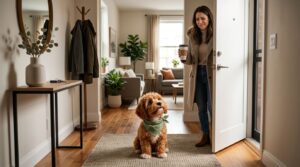
The text from the rescue coordinator arrived on a Thursday afternoon: “Milo is ready for pickup Saturday. He’s about 12 pounds, very sweet, just needs a quiet foster home for two weeks.” I had agreed to this weeks earlier, in a moment of what I now recognize as optimistic overconfidence.
By Friday night, staring at my 650-square-foot mid-century modern apartment in New York, I was significantly less confident. Ollie — my caramel-colored Cavapoo in his sage green bandana, undisputed king of every square foot of this space — had never shared his territory with another dog. There was no backyard to retreat to if things escalated.
No separate floor to put distance between them. The decision to introduce second dog in small apartment living was looking considerably more complicated than it had seemed from the emotional distance of a rescue organization’s Instagram post.

What I didn’t know on Friday night — but learned very quickly over the following two weeks — is that a small apartment introduction can go smoothly with the right protocol. The space limitation isn’t actually the core problem. The protocol problem is. Dogs who meet incorrectly in any size space will struggle. Dogs who meet correctly in a small apartment can absolutely coexist peacefully, because the science of canine introductions isn’t about square footage — it’s about sequence, neutral territory, and resource management.
Milo and Ollie are currently napping three feet apart from each other as I write this. Here is exactly how we got there.
How To Introduce Second Dog In Small Apartment (Quick Answer)
To successfully introduce second dog in small apartment settings, never allow the first meeting to happen inside your unit. Begin with a parallel walk in completely neutral outdoor territory. Inside, use freestanding pet gates to create separate visual zones with their own resources. Feed in separate rooms, remove all high-value items initially, and supervise every interaction until consistent positive body language is established between both dogs.
The “No Backyard” Problem
The backyard matters in dog introductions because it provides something that apartment living structurally cannot: neutral space with exit options. When two dogs meet in a backyard, neither dog has prior territorial claim to that specific outdoor space, and either animal can disengage by moving away when the interaction becomes uncomfortable.
Inside a small apartment, neither of those conditions exists. The resident dog has strong territorial associations with every room, every corner, every piece of furniture. The new dog is entering established territory with no spatial buffers and no retreat options.
The human is present but potentially blocking movement in a confined space. These are the conditions that turn a tense introduction into a conflict — not the dogs’ underlying temperaments.
The specific risks of an unsupported apartment introduction:
- Territorial resource guarding — the resident dog may guard not just food and toys but spatial locations they consider theirs: the sofa, a specific floor spot, the area near the door
- No escape valve — a dog who wants to disengage from an uncomfortable interaction in a confined space has nowhere to go, which means they escalate to communication that is more forceful
- Human interference backfiring — in a small space, owners instinctively get physically involved when tension rises, which can inadvertently redirect arousal into conflict
- Scent saturation — the resident dog’s scent is on every surface of the apartment, which communicates ownership to the incoming dog before they’ve even crossed the threshold
Understanding these risks doesn’t mean accepting them as inevitable. It means addressing each of them specifically, in sequence, before the two dogs ever share your apartment’s interior.
Step 1: The Neutral Territory Meet-and-Greet
The location of the first meeting is the most important decision in the entire introduction process. This is the step most apartment owners skip because it requires logistical coordination — a second person, a specific outdoor location, timing — and the temptation to just bring the new dog home and see what happens is real. Resist it entirely.
What “neutral territory” means:
Neutral territory is any outdoor location that neither dog has a prior association with — specifically, not your building’s entrance, not your block, not the areas where you regularly walk Ollie. The resident dog’s scent marking in familiar areas creates a territorial context that undermines the introduction from the start.
For apartment dwellers in New York, good neutral territory options include:
- A park several blocks from your building that you don’t regularly visit
- A quiet side street in a different neighborhood
- A parking lot or open paved area with minimal foot traffic
The first meeting protocol:
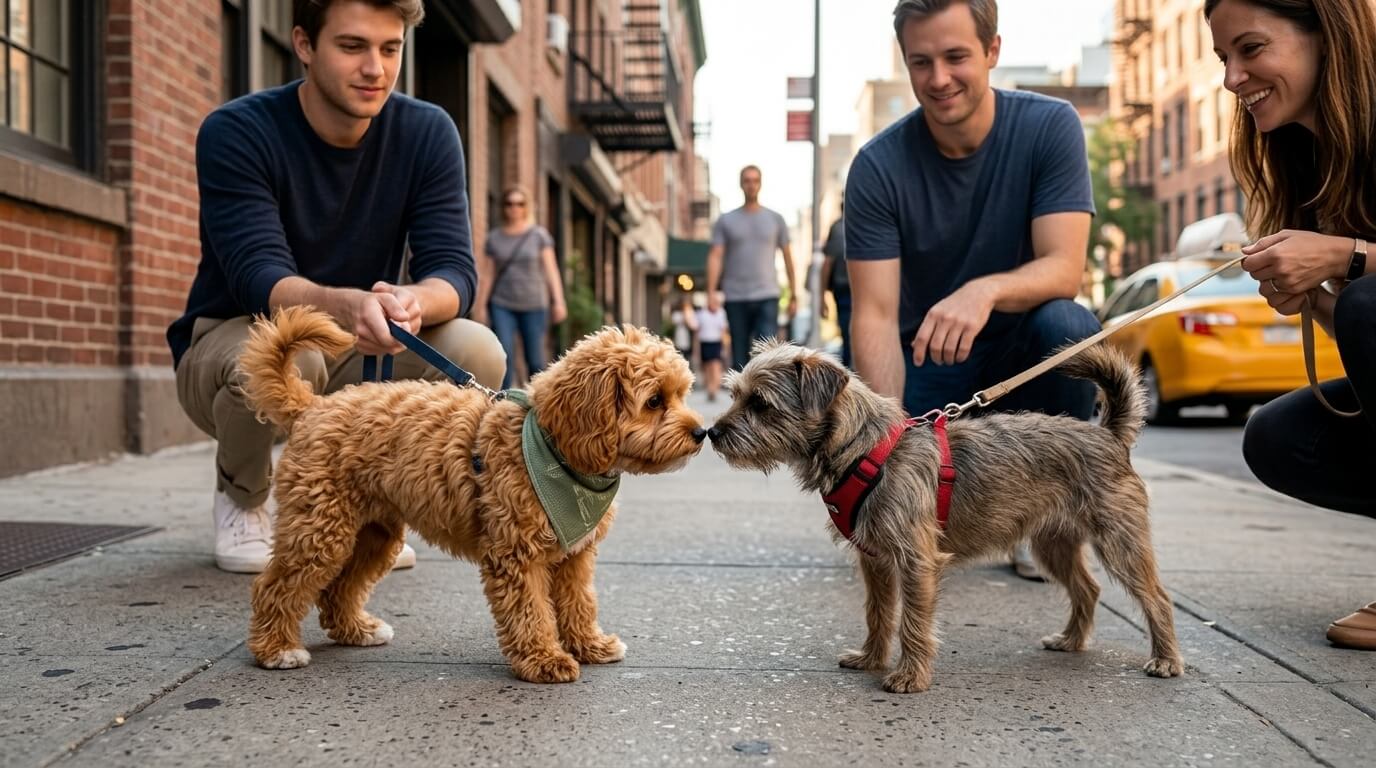
- Both dogs arrive separately — Ollie arrived with me; Milo arrived with the rescue coordinator. They did not see each other until we were both positioned and ready.
- Start at a distance of 20–30 feet — both dogs on loose leashes, both handlers calm and quiet. Let each dog observe the other at a distance where arousal is manageable.
- Watch the body language before allowing any approach:
Green light signals (proceed):
- Loose, relaxed body posture
- Soft, blinking eye contact or looking away
- Tail in neutral or low relaxed position (not raised and stiff)
- Normal breathing, not panting heavily
Red light signals (slow down):
- Stiff, forward-leaning posture
- Tail raised high and rigid
- Prolonged hard stare without blinking
- Hackles raised along the spine
- Growling or lip curling
- Allow a brief parallel sniff only — when both dogs show relaxed body language, allow them to approach and sniff briefly (3–5 seconds maximum). Then calmly separate them and walk parallel again. Multiple brief positive interactions are significantly more effective than one extended greeting that builds arousal.
Why brief matters: Arousal during greetings builds cumulatively. A five-second sniff at low arousal is a positive interaction. A thirty-second sniff where arousal escalates unmanaged is a setup for conflict, even between dogs who would ultimately be compatible.
Step 2: The Parallel Walk Home
After the neutral territory greeting has gone well — both dogs showing relaxed body language, no sustained tension — transition immediately into a parallel walk before heading home. This is not a pleasant bonus step. It is a behavioral necessity.
What the parallel walk accomplishes:
Walking side by side at a consistent pace does several specific things to canine social dynamics:
- Shared forward momentum creates a sense of common purpose that activates cooperative rather than competitive behavioral modes
- Movement dissipates arousal — dogs who are walking process stress neurochemistry significantly more efficiently than dogs who are standing still and staring at each other
- It replicates the natural pattern of pack movement — dogs who travel together in a coordinated way have already established the most fundamental form of social cooperation before they enter shared space
The parallel walk technique:
- Both dogs walk on the outside of their respective handlers — owner on the inside, dog on the outside — so the humans are physically between the dogs
- Maintain a gap of 4–6 feet between dogs initially; allow it to close naturally as both dogs relax
- Keep the pace consistent and purposeful — this is a walk with direction, not a sniff-stop session
- Walk for a minimum of 15–20 minutes before approaching your building
- End the walk by arriving at your building’s entrance together — both dogs have now traveled home cooperatively, which is a meaningful behavioral foundation
The building entrance moment:
Pause outside your entrance before going in. Let both dogs sniff the building entrance area together, at their own pace. The resident dog’s scent is concentrated here, and giving Milo the opportunity to investigate it with Ollie present — without pressure — begins the scent negotiation process before they enter.
Step 3: The “Two Zones” Apartment Setup
Before either dog enters your apartment for the first time together, the interior needs to be configured. This is setup work you do in advance — ideally the day before the new dog arrives.
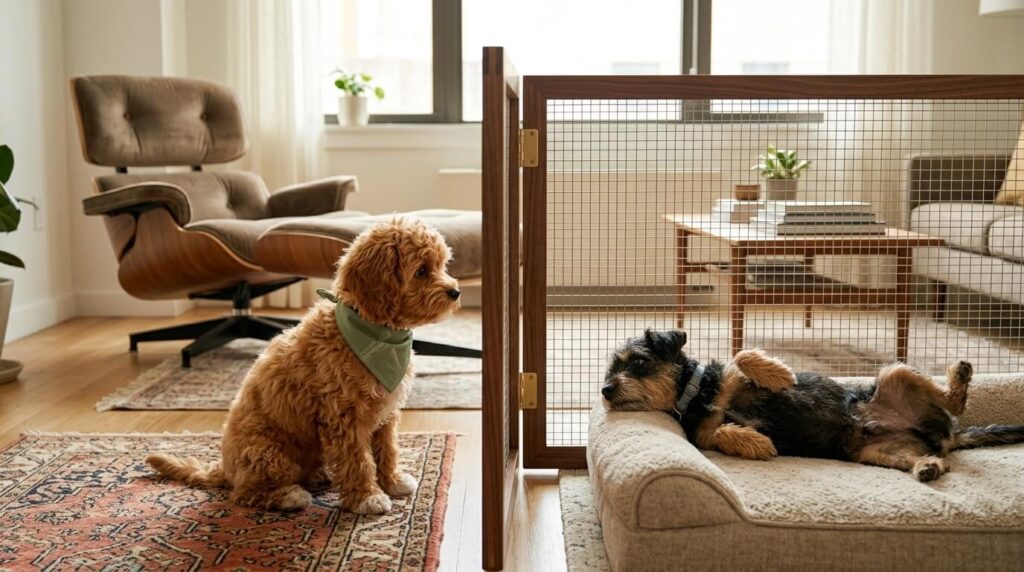
The two-zone principle: Create two distinct living areas within your apartment using a freestanding pet gate — one zone for each dog, each with its own resources, with a visual barrier between them. This setup accomplishes several things simultaneously:
- The resident dog’s core territory (the side they already know) remains theirs
- The new dog has a defined space that is becoming theirs, without the pressure of negotiating the entire apartment at once
- Both dogs can see and smell each other through the gate without the ability to have a physical interaction, which allows for gradual familiarity building at low arousal
Zone setup requirements:
Resident dog’s zone:
- Their existing bed in its normal location — do not move it
- Their existing water bowl
- No high-value toys or food initially (remove these entirely in the first 48 hours)
- Access to their normal sleeping areas
New dog’s zone:
- A new bed with a familiar-smelling item from the rescue/foster organization
- Their own water bowl
- Their own separate feeding area
- No access to the resident dog’s sleeping spots
Entering the apartment together:
- Enter with the new dog first while the resident dog is briefly leashed or held by a second person
- Allow the new dog to investigate the new-dog zone for several minutes
- Then bring the resident dog in and allow them to go to their familiar zone
- Observe through the gate — calm curiosity is the target response; sustained barking or frantic pacing means slow down
Your first step is ensuring their energy levels match by researching the best dog breeds for small apartments before bringing them home — because a high-energy adolescent dog and a low-energy senior dog sharing 650 square feet is a compatibility problem that zone setup cannot fully solve.
Managing High-Value Resources (Food & Toys)
Resource guarding is the most common source of conflict between dogs in multi-dog households, and in a small apartment where resources are concentrated in a limited space, managing this correctly is not optional.
The resource hierarchy — what dogs guard most intensely:
- Food — the most reliably guarded resource for most dogs
- High-value chews — bully sticks, raw bones, frozen Kongs
- Sleeping spots — beds, sofas, and preferred floor locations
- Toys — varies significantly by individual dog
- Human attention — particularly relevant for dogs with attachment history
The feeding protocol for a new multi-dog household:
- Separate rooms, doors closed, for every meal — not just the first few meals. Maintain this protocol for a minimum of two to four weeks before evaluating whether supervised shared-space feeding is safe.
- Feed simultaneously — both dogs eating at the same time reduces the likelihood that a finished dog will approach an eating dog
- Do not allow one dog near the other’s food bowl under any circumstances — even after meals are finished, collect bowls before reopening access between dogs
- Stagger high-value chew time — frozen Kongs and bully sticks should initially be given in separate zones with the gate between dogs, or alternated rather than given simultaneously
Toy management for the first two weeks:
Remove all toys from the shared space for the first 48–72 hours. This sounds extreme, but it eliminates the most common trigger for conflict during the highest-risk introductory period. Reintroduce toys gradually — lowest-value items first, in the presence of supervision — once both dogs are showing consistently relaxed body language in shared space.
Signs of resource guarding to watch for:
- Stiffening when the other dog approaches during eating or chewing
- Eating faster when the other dog is nearby (called speed eating — a stress response)
- Low growling when the other dog moves near a sleeping spot
- Blocking access to specific areas by standing or lying in doorways
- Whale eye (visible whites of the eyes) when the other dog approaches their resources
Any of these signals means the introduction is moving faster than your dogs are comfortable with. Slow down, reintroduce the gate separation, and give both dogs more time at the previous phase.
Leaving Them Alone For The First Time
This is the step that produces the most anxiety for owners — the morning you have to go to work and two dogs are in your apartment together for the first time without you.
The non-negotiable rule: do not leave both dogs in shared unsupervised space until you have observed at least one full week of consistently positive shared-space interactions. This is not a timeline you can compress.
You must carefully manage how long can you leave a dog alone in an apartment when managing a new multi-dog household — because the calculations that applied to one dog change significantly when a territorial dynamic is still being established and the stakes of a conflict in your absence include both injury and property damage.
The staged alone-time protocol:
Week 1 — Fully Separated:
Both dogs in their separate zones with the gate secured. They can see and smell each other. They cannot have physical contact. This is the appropriate configuration for all unsupervised time in the first week, regardless of how well they seem to be getting along when you’re present.
Week 2 — Micro-Absences in Shared Space:
Once both dogs are showing relaxed body language in shared space during full supervision, begin leaving them together — in the shared space without the gate — for brief periods while you are still in the building. Step into the hallway for five minutes. Return and observe. Step out for fifteen minutes. Return and observe. Build duration gradually.
What to look for on camera before trusting longer absences:
- Both dogs settle into rest positions independently
- No sustained staring or posturing toward each other
- No resource guarding behaviors during the alone period
- Normal activity (eating, drinking, sleeping) maintained
A pet camera is non-negotiable during this period. You need actual data about what’s happening in your apartment during your absence — not assumptions based on how things looked when you left. Review the footage and make your duration decisions based on what the camera shows, not on optimism.
If you cannot be home: A midday dog walker who separates the dogs during their visit (gate reinstated before the walker leaves) is the responsible approach for the first two weeks of a new multi-dog household.
The Full 7-Step Protocol at a Glance
For quick reference, here are all seven steps in sequence:
- Set up the apartment in two zones before the new dog arrives — gate, separate resources, high-value items removed
- Neutral territory first meeting — a park or unfamiliar area, neither dog’s established space
- Brief parallel greeting — 3–5 second sniff maximum, separate, repeat
- Parallel walk home — 15–20 minutes of cooperative forward movement before entering the building
- Managed apartment entry — new dog enters first, gate up, resident dog enters to their zone
- Strict resource separation — separate rooms for all meals, no shared high-value items for 2 weeks
- Staged unsupervised time — pet camera, micro-absences first, full absences only after documented positive shared behavior
Frequently Asked Questions
How long does it take for two dogs to get along in an apartment?
The honest range is two to six weeks for basic comfortable coexistence, with full relaxed compatibility sometimes taking three to four months. The timeline depends on several factors: the resident dog’s prior socialization history, the new dog’s confidence level and history with other dogs, whether resource guarding is present in either dog, and how consistently the introduction protocol is implemented.
Dogs who are rushed through the introduction process often show prolonged tension that a properly paced introduction would have resolved in days. The two-zone gate setup is typically needed for the first one to two weeks of physical coexistence in the apartment, with shared space access building gradually after that.
Measuring progress by actual behavioral indicators — relaxed body language, voluntary proximity during rest, play behavior — is more reliable than measuring by days elapsed.
Can you successfully introduce second dog in small apartment spaces under 700 square feet?
Yes — with the right setup, a small apartment is workable for two compatible dogs. The key is that the zone separation system is implemented thoughtfully, even in a compact space. In a studio or one-bedroom apartment, this might mean one dog in the main living area and one in the bedroom initially, or using a room divider or gate across an open-plan space.
The square footage matters less than the clarity of the zone boundaries and the consistency of resource separation. Many behaviorally stable pairs of small-breed dogs live peacefully in New York City studio apartments because their owners implemented structured introductions and maintain clear resource management.
The breed combination, energy level match, and both dogs’ individual social histories are more predictive of long-term success than the apartment’s square footage.
What do I do if the two dogs fight during the introduction?
First: do not put your hands between fighting dogs. This is the fastest way to receive a serious bite wound, and it is the instinctive response that sends the most dog owners to urgent care. Instead, use a barrier — a chair, a cardboard box, a sofa cushion — to physically separate the dogs by pushing between them, or use noise (a sharp clap, a dropped object) to interrupt and then separate.
After any physical altercation, separate both dogs immediately and return to full zone separation. Assess both dogs for injuries — bite wounds are often more significant than visible fur damage suggests, and puncture wounds especially need veterinary evaluation. Then honestly reassess the introduction protocol — what step was skipped or rushed?
Most first-week conflicts in apartment introductions trace directly to a specific protocol shortcut: skipping the neutral meeting, allowing unsupervised shared access too early, or failing to remove high-value resources from shared space. Restart the protocol from the beginning and slow every stage down significantly.
References
- Reisner, I. R., Houpt, K. A., & Shofer, F. S. (2007). “National survey of owner-directed aggression in English Springer Spaniels.” Journal of the American Veterinary Medical Association, 227(10), 1594–1603. Referenced for resource guarding etiology and multi-dog household conflict patterns. https://doi.org/10.2460/javma.227.10.1594
- Tiira, K., Sulkama, S., & Lohi, H. (2016). “Prevalence, comorbidity, and behavioral variation in canine anxiety.” Journal of Veterinary Behavior, 16, 36–44. Referenced for territorial behavior, social stress responses, and multi-dog household dynamics in confined living environments. https://doi.org/10.1016/j.jveb.2016.06.008
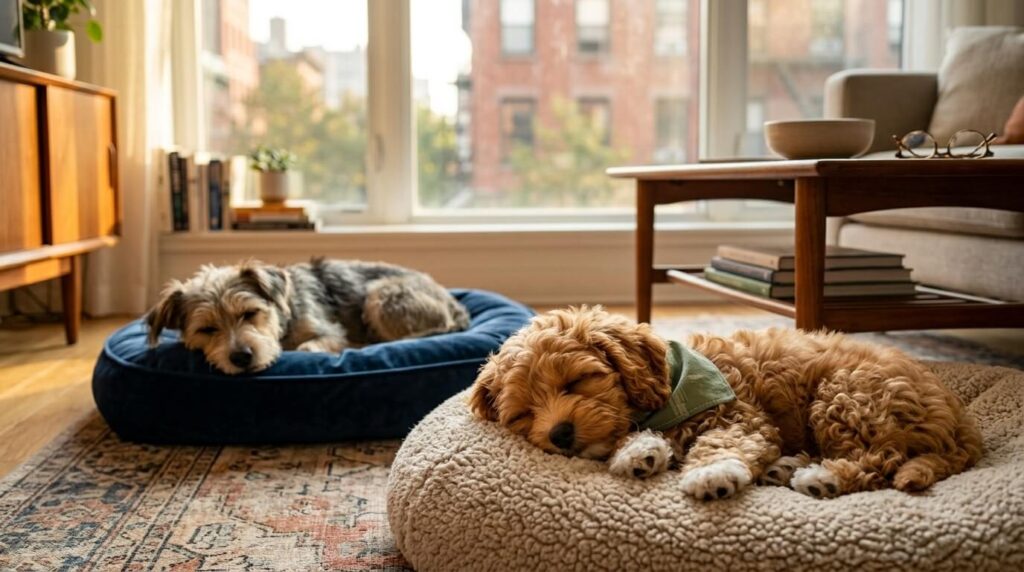
Milo went back to the rescue organization after two weeks, as planned — a much better-socialized, calmer dog than he arrived as, having spent fourteen days learning how to share space with Ollie’s particular brand of Cavapoo personality. The protocol worked. The gate came down on day nine. By day twelve, I found them asleep three feet apart without any intervention from me. If you’re standing where I was on that Friday night, staring at your apartment and wondering if this is actually possible — it is. You just need the right sequence.