Indestructible dog toys for apartments should do more than survive chewing. They also need to be quiet enough for shared walls, safe enough for teeth, large enough not to swallow, easy to clean, and useful in a small room where fetch, tug, chewing, and boredom can all collide.
Here is the honest starting point: no dog toy is truly indestructible. The better goal is to choose more durable toys that fit your dog’s chewing style and your apartment. A toy that works for a gentle chewer may be unsafe for a power chewer. A toy that survives a large dog may sound like a hammer on hardwood floors.
This guide is a buyer decision guide, not a fake personal test of every product. It explains the 7 types of durable toys that make the most sense for apartment dogs, who should use each type, who should skip it, and how to know when a toy needs to be retired.
Indestructible Dog Toys for Apartments: Quick Answer
The best indestructible dog toys for apartments are durable rubber food-stuffing toys, quiet rubber chew toys, flexible heavy-chewer rings, soft but tough tug toys used with supervision, treat-dispensing puzzle toys, freezer-safe enrichment toys, and size-appropriate nylon-style chews for dogs who can use them safely. Avoid toys that are too small, too hard for your dog’s teeth, too loud for the floor, or easy to shred and swallow.
| Dog Need | Best Toy Type | Apartment Caution |
|---|---|---|
| Chewing and licking | Durable rubber food toy | Count food calories |
| Quiet chewing | Flexible rubber chew | Avoid hard floor bouncing |
| Heavy chewing | Heavy-duty rubber ring | Supervise first sessions |
| Indoor tug | Soft tug toy | Put away after play |
| Bored workdays | Puzzle or treat dispenser | Test before leaving alone |
Table of Contents
How to Choose Durable Dog Toys for Apartment Life
Durability is only one part of the decision. In an apartment, you also have to think about sound, space, flooring, neighbors, cleanup, and what happens when your dog uses the toy while you are not watching.
- Chew style: Is your dog a licker, nibbler, shredder, cruncher, or power chewer?
- Noise: Will the toy bang on hardwood, hit walls, or squeak through thin floors?
- Size: Is the toy too small to be safe for your dog’s mouth?
- Hardness: Is it so hard that tooth damage becomes a concern?
- Supervision: Can your dog use it alone, or only when you are present?
- Cleaning: Can food residue, saliva, and hair be cleaned easily?
- Replacement: Will you notice when it becomes cracked, torn, or unsafe?
For apartment owners, the best toy is often not the toughest possible object. It is the safest durable option your dog will use calmly on a rug, mat, crate area, or quiet corner.
The 7 Best Toy Types for Apartment Dogs
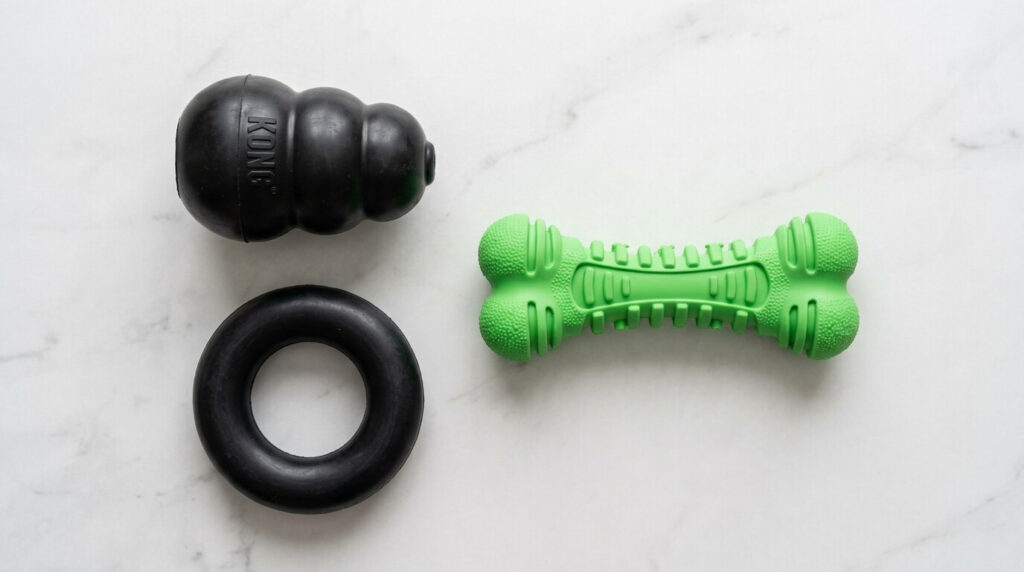
1. Best Overall: Durable Rubber Food-Stuffing Toy
A durable rubber food-stuffing toy is the most useful first choice for many apartment dogs. It can slow breakfast, encourage licking, support crate training, and turn a small amount of food into a longer calm activity.
This type is especially helpful in apartments because it is usually quieter than hard plastic, antlers, bones, or heavy rolling toys. Use it on a rug or mat to reduce floor noise. Start with easy fillings so your dog succeeds instead of barking from frustration.
Best for: bored dogs, workday enrichment, crate routines, and dogs who like licking more than smashing.
Skip it if: your dog tears rubber pieces off, guards food toys, or gets frustrated and throws the toy against the floor.
2. Best Quiet Chew: Flexible Rubber Bone or Bar
Flexible rubber chews can satisfy chewing without the loud clatter of hard nylon or plastic toys. They are a good fit for dogs who want to gnaw but do not need an extreme heavy-chewer product.
Choose a size that cannot slide too far into your dog’s mouth. Avoid thin ends that can be chewed off quickly. Check the toy after every session during the first week.
Best for: moderate chewers, small apartments, hardwood floors, and evening wind-down time.
Skip it if: your dog removes chunks, eats rubber, or needs a stronger supervised option.
3. Best for Heavy Chewers: Heavy-Duty Rubber Ring
Heavy-duty rubber rings are designed for dogs who destroy ordinary toys quickly. Their shape can make them easier to inspect because cracks, missing chunks, and bite damage are visible.
For apartments, choose a ring that does not become a noisy bowling ball. Use it in a defined area with a rug. Do not leave a heavy ring with a dog who throws toys, drops them from furniture, or slams them into walls.
Best for: strong chewers who need supervised chew sessions and owners who inspect toys often.
Skip it if: your dog has dental problems, bites down with extreme force, or gets obsessive and frantic around hard chews.
4. Best Indoor Tug Option: Soft Tug Toy Used With Supervision
Tug can be a great apartment game because it does not require a long hallway or outdoor space. The toy should be soft enough for indoor use, long enough to keep hands away from teeth, and strong enough for your dog’s size.
Do not leave rope or fabric tug toys out for unsupervised chewing. Many dogs shred fibers or swallow strings. Use tug as an interactive game, then put the toy away.
Best for: short indoor play breaks, training rewards, and dogs who enjoy playing with people.
Skip it if: your dog resource guards toys, swallows fabric, or becomes too aroused to release.
5. Best for Workday Boredom: Treat-Dispensing Puzzle Toy
Treat-dispensing toys can help dogs use their nose and brain. In an apartment, they are useful when you need a calm activity before work, after a walk, or during a quiet evening.
Choose a puzzle that is not too hard. A frustrated dog may bark, throw the toy, chew the mechanism, or scratch the floor. Test the toy while you are home before using it as part of a workday plan. The keep dog entertained while at work guide can help you build that routine.
Best for: dogs who need mental enrichment and can use puzzles calmly.
Skip it if: your dog breaks puzzle parts, eats plastic, guards food, or becomes noisy when frustrated.
6. Best for Calm Alone-Time Prep: Freezer-Safe Licking Toy
A freezer-safe licking toy can turn part of a meal into a slower, quieter activity. Licking can be calming for many dogs, and frozen fillings can last longer than loose treats.
Use safe ingredients your dog already tolerates and count them as part of the daily food. Avoid turning every enrichment session into extra calories. If your dog is overweight or on a special diet, ask your veterinarian what fillings make sense.
Best for: crate training, post-walk settling, and dogs who need quiet enrichment.
Skip it if: your dog destroys the toy to reach the food or has dietary restrictions you have not discussed with a vet.
7. Best for Some Power Chewers: Size-Appropriate Nylon-Style Chew
Nylon-style chews can be useful for some dogs, but they require judgment. They can be too hard for certain dogs, especially dogs with dental disease, aggressive bite force, or a habit of trying to crack objects instead of gnawing them.
Use the fingernail test as a rough screen: if a toy is so hard that you cannot make any impression with a fingernail, think carefully before offering it. Ask your veterinarian if your dog has tooth wear, broken teeth, or a history of dental problems.
Best for: dogs who calmly gnaw appropriate-size chews under supervision.
Skip it if: your dog tries to snap hard objects, has dental issues, or swallows pieces.
What “Indestructible” Should Mean
In marketing, “indestructible” often means stronger than average. In real apartment life, it should mean three things: the toy lasts longer for your dog’s chew style, it does not create obvious tooth or swallowing risks, and you know when to replace it.
A toy that lasts forever but risks cracked teeth is not a good toy. A toy that is quiet but comes apart in chunks is not safe. A toy that keeps the dog busy but makes them frantic may be the wrong enrichment style.
Think in terms of “durable enough and safe enough,” not indestructible. That mindset keeps the article honest and keeps readers from trusting a toy too much.
Apartment Noise and Floor Safety
Noise is the difference between a great apartment toy and a neighbor complaint. Hard toys can sound much louder downstairs than they sound in your room. The safest setup is often a toy zone with a rug, play mat, or crate mat.
- Avoid heavy balls indoors unless they stay on carpet.
- Choose rubber over hard plastic for evening chewing.
- Put puzzle toys on a rug to reduce scraping.
- Avoid squeakers if your walls are thin.
- Do tug and fetch away from shared walls.
- Do not let dogs drop hard toys from the sofa or bed.
If your dog gets loud or overexcited indoors, pair toy choices with the dog zoomies in small apartments guide and the exercise dog in small apartment guide.
Safety Rules Before You Leave a Toy Unsupervised
Do not leave a new toy with your dog while you are gone. Test it first while you are home and able to watch.
| Test | What to Watch | Decision |
|---|---|---|
| 10-minute session | Does the dog calmly use it? | If yes, test longer |
| Damage check | Any chunks, cracks, strings, or sharp edges? | Remove if damaged |
| Noise check | Does it bang or scrape? | Use only on rug or supervised |
| Behavior check | Relaxed chewing or frantic guarding? | Skip if stressful |
| Food check | Any stomach upset? | Change filling or ask vet |
If your dog destroys toys because of panic when alone, the toy is not the root fix. Start with dog separation anxiety in apartments and use durable toys only as part of a safer behavior plan.
Choose by Chew Style, Not Breed Label
Breed can give clues, but chew style matters more. Two dogs of the same breed can use toys very differently. One may lick and carry toys gently; another may try to remove pieces immediately. Watch what your dog actually does.
| Chew Style | What It Looks Like | Better Toy Direction |
|---|---|---|
| Licker | Licks food toys and settles | Stuffable rubber, licking mats used safely |
| Nibbler | Small controlled chewing | Moderate rubber chews |
| Shredder | Pulls seams, fabric, and fibers apart | Avoid fabric unsupervised |
| Cruncher | Bites down hard to crack objects | Vet guidance and careful hardness choices |
| Thrower | Drops or flings toys onto floors | Soft rubber on rugs only |
If your dog is a cruncher or shredder, do not judge a toy by the first five minutes. Some toys look fine at first and fail after repeated sessions. Inspect them every time until you know the wear pattern.
Best Toy Choice by Apartment Scenario
Thin-Wall Apartment
Skip squeakers, hard rolling toys, and toys that trigger barking. Use licking, gentle chewing, and food puzzles on a rug. If your dog vocalizes during enrichment, lower the difficulty before assuming the toy is bad.
Downstairs Neighbors
Floor noise matters. Put a thick rug or mat under the toy zone. Avoid heavy rings and hard toys at night. If a toy sounds loud to you, it may sound worse below you.
Studio Apartment
Studios need tidy toy systems. Keep only a few toys accessible at once and store the rest in a bin. This reduces clutter and makes it easier to notice damage.
Workday Alone Time
Use only toys that have passed supervised testing. For long workdays, combine toys with walks, potty breaks, rest zones, and realistic alone-time limits. A toy cannot replace a schedule that is too long for your dog.
Multi-Dog Apartment
Do not leave high-value food toys loose with multiple dogs unless you are certain there is no guarding risk. Separate dogs for chews and food enrichment. If tension appears, remove the toys and ask a trainer or behavior professional for help.
Buying Checklist for Durable Apartment Toys
Use this checklist before you buy or recommend a toy. It keeps the page honest and helps readers make safer choices.
- Is the toy sized for my dog’s mouth and body?
- Can I inspect it easily for cracks, missing chunks, or frayed pieces?
- Is it quiet enough for my flooring and neighbors?
- Can it be cleaned after food, saliva, or outdoor dirt?
- Does it match my dog’s chew style?
- Will my dog use it calmly, or does it create frustration?
- Does the toy require supervision?
- Do I know when I will throw it away?
If the answer to several questions is unclear, choose a simpler toy first. For apartment dogs, simple and safe is usually better than clever and risky.
When to Throw a Dog Toy Away
Replacing a toy early is cheaper than an emergency vet visit. Throw a toy away if you see missing chunks, deep cracks, loose strings, exposed stuffing, sharp edges, a broken squeaker, damaged seams, or pieces small enough to swallow.
Also remove the toy if your dog becomes obsessive, guards it, or changes from calm chewing to frantic destruction. A toy that creates stress is not good enrichment.
For dogs with dental disease, broken teeth, or mouth pain, ask your veterinarian what textures are appropriate. If dental health is a concern, connect toy decisions to your indoor dog vet visits routine.
Common Mistakes Apartment Owners Make
Mistake 1: Buying the Hardest Toy Available
Harder is not always safer. Extremely hard chews can be a tooth risk for some dogs.
Mistake 2: Leaving Rope Toys Out All Day
Rope toys are best for supervised play. Dogs who shred and swallow fibers should not have free access.
Mistake 3: Using Food Toys Without Counting Calories
Food enrichment can quietly add a lot of calories. Use part of meals instead of adding constant extras. For weight concerns, revisit best diet for apartment dogs.
Mistake 4: Ignoring Neighbor Noise
A toy that is fun at noon may be a problem at 10 p.m. Match toys to time of day and floor type.
Mistake 5: Trusting the Word “Indestructible”
Inspect every toy. Your dog’s mouth is the real test, not the product label.
How to Build a Small Apartment Toy Rotation
You do not need twenty toys on the floor. A smaller rotation is cleaner, safer, and easier to inspect.
- One durable food-stuffing toy.
- One quiet chew toy.
- One supervised tug toy.
- One puzzle or sniffing activity.
- One backup toy drying or being washed.
Rotate toys every few days to bring back novelty. Keep high-value food toys separate if you have multiple pets. Wash toys regularly and inspect them before they return to the rotation.
Cleaning and Storage in a Small Apartment
Durable toys still get dirty. Food toys collect residue, rubber toys pick up hair, and tug toys hold saliva. In a small apartment, dirty toys can make the whole room smell faster than owners expect.
Keep a simple system: one bin for clean toys, one place for toys that need washing, and one regular inspection day. Wash food toys before old food dries inside. Let toys dry fully before storing them. Throw away anything that smells bad even after cleaning, because odor can mean the material is breaking down or holding residue.
Storage also prevents overexcitement. If every toy is always on the floor, none of them feel special and damage is harder to notice. A small rotation keeps the apartment tidier and makes each toy easier to manage.
When Toys Are Not Enough
Durable toys can help chewing, boredom, and settling, but they cannot solve every behavior problem. If your dog destroys toys and furniture, barks constantly, paces, has accidents, or cannot rest, the real issue may be exercise, anxiety, pain, under-stimulation, or an unfair routine.
Start with the pattern. Destruction right after you leave may point toward alone-time distress. Destruction at night may mean the evening routine is too stimulating or too empty. Destruction after short walks may mean the dog needs sniffing and mental work, not just more chewing.
Use toys as one part of the apartment plan. Pair them with walks, training, sleep, food management, vet care, and calm routines. A better toy helps most when the rest of the day also makes sense.
FAQ
What are the best indestructible dog toys for apartments?
The best indestructible dog toys for apartments are durable rubber food toys, quiet rubber chews, heavy-duty rings, supervised tug toys, puzzle toys, freezer-safe licking toys, and carefully chosen nylon-style chews. The right choice depends on your dog’s chew style and safety needs.
Are any dog toys truly indestructible?
No. Some toys are more durable than others, but every toy can fail with the wrong dog, wrong size, or enough chewing. Inspect toys often and remove damaged ones.
What dog toys are quiet for apartments?
Soft rubber chews, food-stuffing toys, licking toys, and supervised tug toys are usually quieter than hard balls, hard plastic puzzles, antlers, bones, or loud squeaky toys.
Are hard bones and antlers good for heavy chewers?
They can be risky for some dogs because very hard items may contribute to tooth damage or other problems. Ask your veterinarian before using very hard chews, especially if your dog bites forcefully.
Can I leave durable toys with my dog while I work?
Only after testing them while you are home. Make sure your dog does not break pieces off, swallow material, guard the toy, or become frustrated. Some toys should stay supervised only.
How many toys does an apartment dog need?
Most apartment dogs do better with a small, clean rotation than a crowded floor. Start with one chew, one food toy, one interactive toy, and one puzzle or sniffing activity.
What if my dog destroys every toy?
Stop leaving toys unsupervised and look at the reason. The dog may need more exercise, better enrichment, anxiety support, a different material, or veterinary advice about chewing and teeth.
Next Step
Before buying another toy, identify your dog’s chew style: licker, nibbler, shredder, cruncher, or power chewer. Then choose one apartment-quiet toy that matches that style and test it while you are home.
The best indestructible dog toys for apartments are not magic objects. They are safer, more durable tools used with supervision, inspection, and a routine that meets your dog’s real needs.