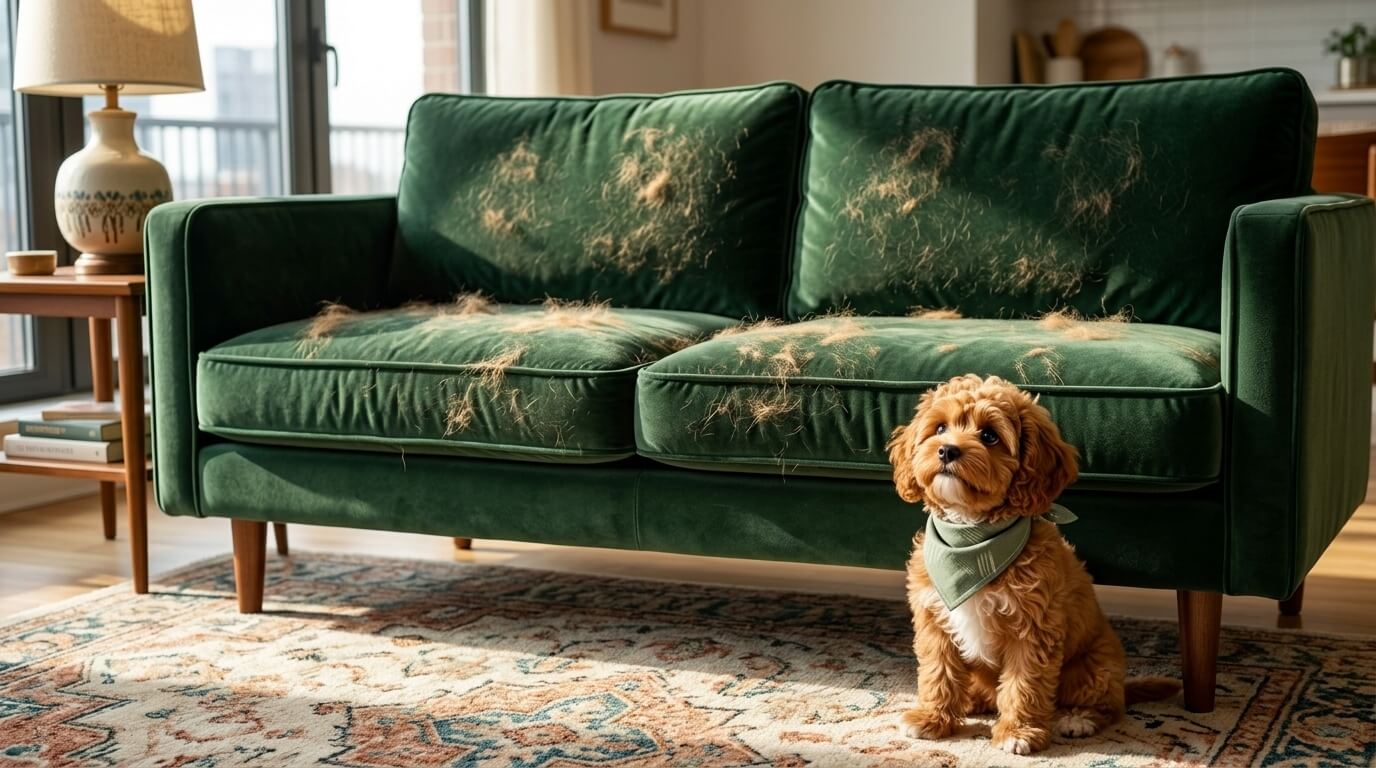
Meet Ollie. He is a caramel-colored Cavapoo who weighs eleven pounds, wears a sage green bandana like a tiny fashionable cowboy, and has completely destroyed my laundry routine. I was promised he was low-shedding. The breeder said it.
The internet said it. My allergist practically winked at me. And yet, if you are trying to figure out how to get dog hair off everything in a 750-square-foot mid-century modern rental in New York City, trust me when I say that “low-shedding” is a marketing term, not a biological fact. I find caramel fluff on my black wool coat before I even make it to the door.
It is embedded in the velvet threads of my mustard sofa. Last Tuesday, I watched a single curly fur float down and land directly in my coffee. This is my life now, and I have made peace with it — but only because I spent an embarrassing amount of time and money testing every fur-removal tool on the market so you do not have to.
How To Get Dog Hair Off Everything (Quick Answer)
To successfully get dog hair off everything, stop relying solely on vacuuming. Use a damp rubber squeegee to pull embedded fur from carpets, apply electrostatic pet hair rollers for upholstery, and use wool dryer balls in the dryer to release static-clung hair from clothing. Long-term prevention starts with daily brushing and consistent grooming appointments.
The “Low-Shedding” Myth
Let me say this plainly: there is no truly non-shedding dog.
The term “hypoallergenic” technically refers to reduced allergenic proteins (specifically the Can f 1 protein found in dog saliva and skin cells), not to the absence of shedding. Cavapoos, Goldendoodles, and other Poodle crosses do shed less than double-coated breeds like Huskies, but their curly coats actually trap shed hair close to the body — which means when it finally releases, it goes everywhere at once.
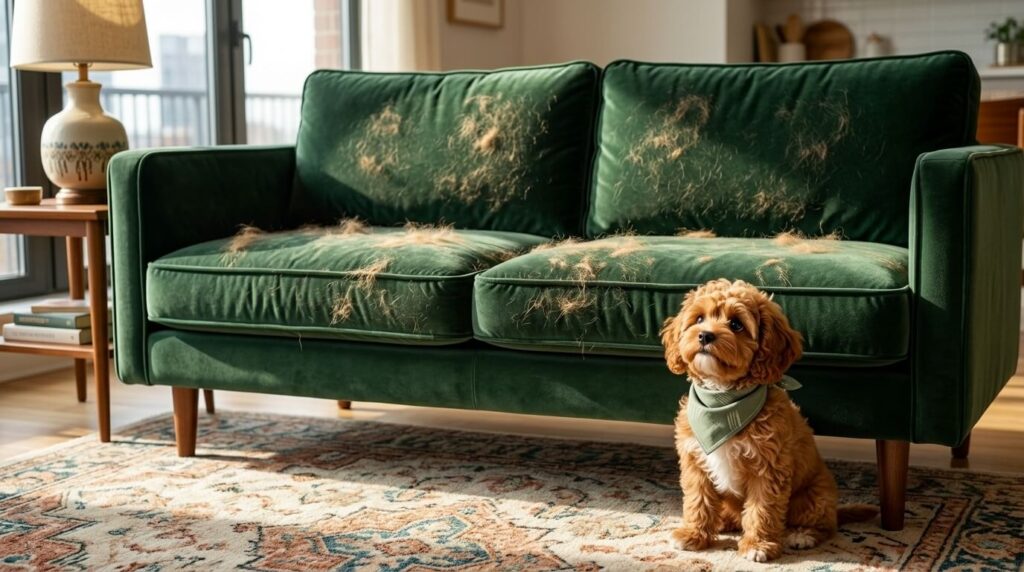
Here is what nobody tells you about renting in New York with a dog: your landlord does not care about your low-shedding dog. Your dark hardwood floors, however, absolutely highlight every single strand. And if you have ever worn a black turtleneck in the same zip code as Ollie, you understand why I now own four different fur-removal tools.
The real problem is not just aesthetics. Trapped dog hair holds dander and skin oils against fabric fibers. This is precisely why removing the fur is the most important first step if you want to learn [How To Control Dog Odor Apartment (7 Best Fixes)] — because the smell is living inside those fibers right along with the fur.
Hack 1: The Rubber Squeegee Miracle (For Carpets)
This is the one that made me gasp out loud in my bathroom at 11pm on a Thursday.
I was using a basic window squeegee — the kind you buy at a hardware store for $4 — and dragged it across the small area rug under my coffee table. What came up looked like a small mammal. I had vacuumed that rug the day before.
Why it works:
- The rubber creates static friction against carpet fibers
- It physically dislodges hair that is wound around the base of each fiber
- Vacuums suction; squeegees pull — and those are two completely different actions
How to do it:
- Press the flat rubber edge firmly against the carpet
- Pull in short, deliberate strokes toward yourself
- Watch the fur gather into satisfying clumps
- Vacuum up the clumps afterward
This works on low-pile rugs, area rugs, and stair carpet. For high-pile shag? Use a stiff-bristled rubber broom instead — same principle, more surface contact.
Pro tip: Dampen the squeegee edge very slightly with water before you start. It amplifies the electrostatic effect dramatically.
Hack 2: Electrostatic Rollers (For Sofas)
I need to distinguish between two things that sound similar but perform very differently: sticky lint rollers and electrostatic pet hair rollers.
We will get to lint rollers later (short version: they are a trap). Electrostatic rollers use a charged surface to attract and lift pet hair without adhesive. The hair collects on the roller and you either wipe it clean or wash it. No refills. No waste. No running out of sheets when you have a date coming over in ten minutes.
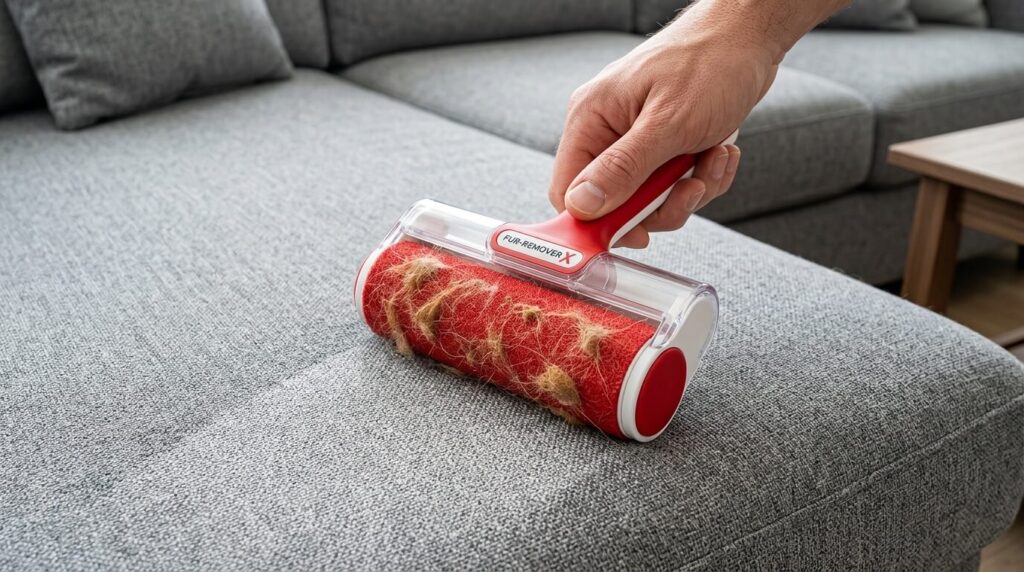
The best surfaces for electrostatic rollers:
- Velvet and velveteen upholstery
- Microfiber sofas
- Fabric headboards
- Car seat fabric (though I have a separate hack for this below)
My exact method for the velvet sofa:
- Use short back-and-forth strokes in the direction of the nap
- Then roll against the nap once to catch anything that lifted
- Wipe the roller on a damp cloth between sections
- Do the cushion sides and backs — Ollie does not only sleep on the obvious parts
This is now a Sunday ritual in my apartment, like watering plants or making a large, hopeful pot of coffee.
Hack 3: The Dryer Trick (For Clothes)
This one is so simple it almost feels like cheating.
Before you wash a load of dog-hair-covered clothing, toss it in the dryer on a no-heat or low-heat tumble cycle for 10 minutes first. The tumbling loosens the hair from the fibers and the lint trap catches it. Then wash normally.
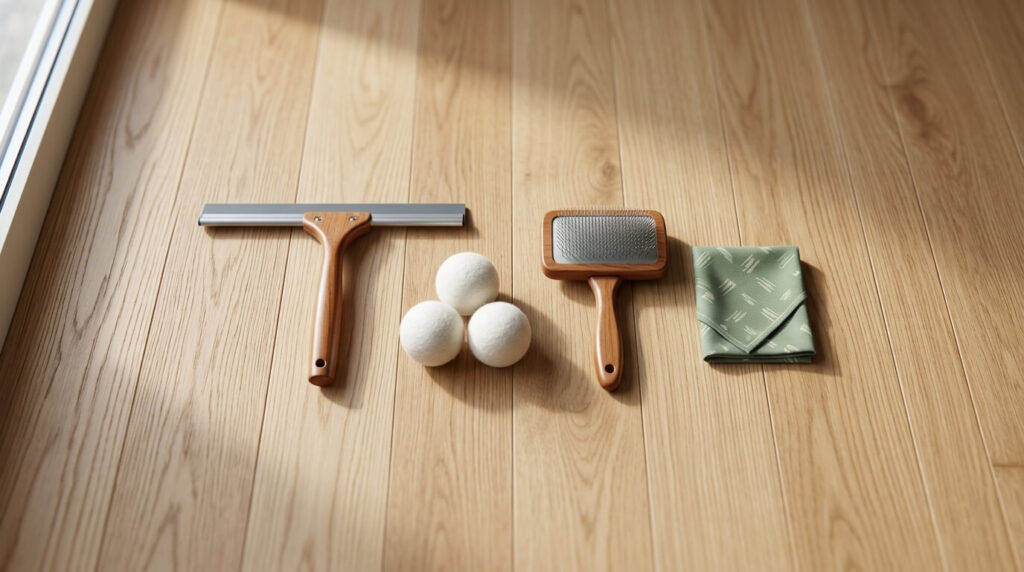
Add wool dryer balls to that pre-dry cycle. The dryer balls create friction between garments, break the static bond holding hair to fabric, and move hair toward the lint trap far more aggressively than tumbling alone.
Why this order matters:
- Washing dog-hair-covered clothes without this step traps the wet hair even deeper into the weave
- Wet hair clumps and is harder to remove
- The lint trap is far more effective on dry, static-clung hair than a washing machine drum is
After the wash cycle, run a second 10-minute dryer cycle with the dryer balls again. Clean the lint trap in between both cycles — seriously, it will be full.
For my black wool coat specifically, I use a slightly damp microfiber cloth wiped in one direction before the dryer step. Wool is too delicate for aggressive rolling or dry heat.
Hack 4: The Rubber Glove Method (For Car Seats)
I do not own a car in New York (classic), but I take Ollie in cabs, Ubers, and my mother’s Subaru. The Subaru suffers the most.
The rubber glove method is exactly what it sounds like: put on a household rubber cleaning glove, dampen it slightly, and wipe it across the car seat fabric in firm strokes. The rubber surface grips individual hair strands and rolls them into peel-able clumps you can simply pick up and toss.
Why this beats a lint roller in a car:
- You have more pressure control with your hand
- Rubber conforms to seat creases and headrest edges that a flat roller cannot reach
- A single pair of gloves replaces approximately 47 lint roller refill packs
- The clumps lift cleanly without tearing or leaving adhesive residue
This method also works beautifully on fabric car door panels and the fabric ceiling lining, which is somehow always covered in fur even though Ollie has never been to the ceiling.
Hack 5: Grooming at the Source
Every single hack above becomes dramatically easier when you invest in regular grooming.
Ollie goes to the groomer every six to eight weeks for a full haircut and deshed treatment. In between, I brush him every single day with a slicker brush — takes about four minutes, happens while I watch something on my phone, and it is now just a part of our routine like feeding and walks.
What daily brushing actually accomplishes:
- Removes loose, shed hair before it transfers to furniture, clothes, or my coffee
- Distributes skin oils through the coat, which reduces the dander that sticks to fur
- Prevents the matting that Cavapoo curls are tragically prone to
- Gives you a legitimate excuse to sit on the floor with your dog every day
I brush Ollie over a large silicone mat so the collected hair forms a neat pile I can toss rather than watching it drift across my apartment like tumbleweed.
Important note on the “low-shedding” myth revisited: Regular brushing on a low-shedding breed releases the hair you would otherwise find on your sofa over the next three days all at once, in a controlled environment. It is not reducing shedding — it is scheduling it.
Why Sticky Lint Rollers Are A Waste of Money
I know this is controversial. I know you have three in your bag right now. I had five.
Here is the problem with traditional adhesive lint rollers: they are a consumable product designed to run out. Each sheet removes hair from the immediate surface but does nothing for hair embedded in fibers. You peel a sheet, it looks okay, you peel another, it looks okay, you use half the roll, and 20 minutes later the sofa looks the same.
The math also does not work in your favor:
- Average lint roller refill: $6–$9 for 60 sheets
- A Cavapoo owner in a small apartment easily burns through 4–6 sheets per cleaning session
- That is $15–$20 per month minimum, forever, solving a surface-level problem
Compare that to a $12 electrostatic roller that lasts years, or a $4 squeegee that outlasts the sofa.
Lint rollers have one legitimate use case: a quick once-over on your coat in the thirty seconds before you leave the house. For that specific scenario, keep one by the door. For everything else, put your money toward the tools listed above.
A Complete System, Not Just Individual Hacks
Fur removal is one battle, but it is only part of the war.
Once I had all of these tools dialed in, I realized I still needed a broader framework for keeping the apartment genuinely livable — not just fur-free in isolated spots. That led me to develop a complete system for [Clean Apartment With Dog: 7 Best Daily Routines], which covers everything from floor mopping schedules to managing the front-door chaos that happens every time Ollie comes in from a muddy walk.
The hacks above are your tactical weapons. A cleaning system is the strategy that holds it all together.
FAQ
What dissolves dog hair in the washing machine?
Nothing truly “dissolves” dog hair, but adding half a cup of white vinegar to the rinse cycle helps relax fabric fibers and release embedded hair so it drains more easily. Always pre-dry dog-hair-covered clothes before washing to prevent the hair from clumping wet inside the drum. Clean your washing machine’s lint filter after every pet-hair-heavy load.
How do I get dog hair off everything in my apartment all at once?
Work from top to bottom and far to near: start with upholstery using your electrostatic roller, move to rugs with the rubber squeegee, then do a final vacuum pass on floors. Doing all surfaces in one session prevents fur you dislodge from one surface from settling onto a surface you already cleaned.
Why does my vacuum not pick up dog hair from carpet?
Most standard vacuums suction hair from the surface without dislodging hair that has wound itself around carpet fibers at the base. Use the rubber squeegee method first to pull embedded hair into clumps on the surface, then vacuum those clumps. A vacuum with a motorized brush head performs better than suction-only models for pet hair specifically.
References
- Vredegoor, D. W., Willemse, T., Chapman, M. D., Heederik, D. J. J., & Krop, E. J. M. (2012). Can f 1 levels in hair and homes of different dog breeds: Lack of evidence to describe any dog breed as hypoallergenic. Journal of Allergy and Clinical Immunology, 130(4), 904–909.e7. https://doi.org/10.1016/j.jaci.2012.05.013
- Custovic, A., Simpson, A., Pahdi, H., Green, R. M., Chapman, M. D., & Woodcock, A. (1998). Distribution and aerodynamic characteristics of indoor allergen-carrying particles in domestic environments. Thorax, 53(12), 1030–1033. https://doi.org/10.1136/thx.53.12.1030
Ollie is unbothered by all of the above. He is currently asleep on the freshly squeegee’d rug wearing his sage green bandana, shedding infinitesimally but spiritually a great deal.