Quick Answer
A quiet robot vacuum can reduce day-to-day dog-hair buildup in an apartment, but published noise figures do not predict how an individual dog will react. Compare the cleaning mode, brush design, obstacle system, robot height, dock footprint, and the noise made by both the robot and its self-empty station. Introduce the machine gradually, keep a dog-free safe zone, and stop if your dog shows persistent distress.
Evidence-checked means we verified the specifications below against manufacturer-published sources. It does not mean ApartmentDogExpert independently lab-tested or used these products. Manufacturer figures may use different modes and test conditions, so the published dB and dBA numbers in this guide are not ranked against one another.
Quiet Robot Vacuum Comparison for Dog Apartments
The table separates manufacturer specifications from our apartment-focused editorial assessment. “Not specified” means the reviewed manufacturer source did not provide the requested figure. A lower number in one row does not prove that model is quieter than another because operating modes and test environments differ.
| Product | Published Noise | Noise Evidence / Test Mode | Suction / Cleaning System | Pet-Hair Brush Design | Bin / Self-Empty System | Obstacle Avoidance | Pet-Waste Avoidance | Hard Floor / Rug Fit | Robot Height | Dock Footprint | Runtime | Charging | Apartment Fit | Main Limitation |
|---|---|---|---|---|---|---|---|---|---|---|---|---|---|---|
| Roborock Qrevo Curv | 55 dB | Manufacturer-published figure for quiet mop-only mode in a semi-anechoic chamber; not normal vacuuming noise | 18,500 Pa HyperForce; vacuum and dual spinning mops | DuoDivide main brush plus FlexiArm anti-tangle side brush | Onboard bin plus automatic dust emptying in Multifunctional Dock 3.0 | Reactive AI obstacle recognition and LiDAR navigation | Not specified in the reviewed source | Liftable brush and mops; adjustable chassis for mixed floors and thresholds | 4.1 in | 17.7 × 17.7 × 17.7 in | Not specified in the reviewed source | Automatic dock charging; exact charging time not specified | Strong hair-management features, but the cubic dock needs substantial clear floor space | The 55 dB figure applies only to a specific mop-only test mode |
| Dreame L40 Ultra Gen 2 | Not specified | No exact dB/dBA figure in the reviewed U.S. manufacturer source | 25,000 Pa Vormax suction; vacuum and DuoScrub mopping | Rubber main brush; optional TriCut brush sold separately | 250 ml robot dust box; 3.2 L dock bag with auto-empty | LDS navigation with 3D structured-light avoidance | Not specified in the reviewed source | 10.5 mm mop lift and app carpet controls | 3.82 in | 17.99 × 13.39 × 23.23 in | Exact runtime not specified; 5,200 mAh battery published | Automatic dock charging; exact charging time not specified | Low robot body can help under furniture; tall dock requires vertical clearance | No exact published operating-noise figure |
| ECOVACS DEEBOT T30C | 64.4 dBA standard vacuuming; 64.6 dBA vacuum + mop; 75.2 dBA auto-empty | Manufacturer-published figures for separate operating modes; not directly comparable with other brands’ figures | 20,000 Pa suction; vacuum and dual-mop system | ARClean side brush and Triple-V anti-tangle main brush | 260 ml robot dust box plus auto-empty OMNI station | Single-line structured-light avoidance with LDS navigation | Not specified in the reviewed source | Carpet detection, suction boost, and 9 mm mop lift | 3.95 in | 13.8 × 18.8 × 21.0 in with base | 220 min silent vacuum; 200 min standard vacuum; 180 min standard vacuum + mop | Fast charging; manufacturer lists about 4.5 hours | Detailed mode-specific noise data helps plan cleaning and avoid auto-emptying during quiet hours | The auto-empty figure is materially higher than normal cleaning figures |
| iRobot Roomba Plus 504 Vac | Not specified | No exact dB/dBA figure in the reviewed U.S. manufacturer source | Three-stage cleaning, Carpet Boost, and manufacturer-relative suction claim | Dual anti-tangle rubber brushes plus edge-sweeping brush | AutoEmpty dock with an enclosed bag | PrecisionVision AI with ClearView Pro LiDAR | Yes—manufacturer states the model recognizes and navigates around pet waste; conditions apply | Dual rubber brushes are designed to maintain floor contact across hard floors and carpet | 4.1 in | Not specified in the reviewed source | Not specified in the reviewed source | Automatic dock charging; exact charging time not specified | Specific pet-waste avoidance evidence is useful for dog homes, but the floor should still be checked before every run | No exact published noise, runtime, or dock-dimension figure in the reviewed source |
| eufy Robot Vacuum Omni E25 | Not specified | No exact dB/dBA figure in the reviewed U.S. manufacturer source | 20,000 Pa suction with HydroJet rolling mop | DuoSpiral detangle brushes and CornerRover edge arm | All-in-one station for emptying, mop washing, drying, and refilling | RGB camera plus LED obstacle avoidance | Not specified in the reviewed source | Manufacturer materials position it for hair on carpets and hard floors | 4.40 in | 14.63 × 19.07 × 17.29 in | 216 min standard vacuum; 125 min standard vacuum + mop | Omni station charging; exact charging time not specified | Good published hair-handling and runtime information, but the robot is the tallest of these five | No exact published operating-noise figure |
How to Read the Noise Numbers
Robot-vacuum noise changes with suction mode, floor surface, brush condition, room acoustics, distance, and whether the dock is washing, drying, or emptying. Roborock’s 55 dB figure is for quiet mop-only operation in a specified test environment. It must not be treated as normal vacuuming noise. ECOVACS publishes separate figures for standard vacuuming, vacuum-and-mop operation, and auto-emptying; those figures show why dock noise should be evaluated separately.
Dreame, iRobot, and eufy do not publish an exact operating dB/dBA figure in the manufacturer sources reviewed for this comparison. That absence should remain visible instead of being filled with retailer estimates or unrelated tests. No cross-brand quietness ranking is made here.
Five Evidence-Checked Options
1. Roborock Qrevo Curv
Manufacturer specification: Roborock lists 18,500 Pa suction, a DuoDivide main brush, an anti-tangle side brush, Reactive AI obstacle recognition, liftable brushes and mops, and a 4.1-inch-high robot. Its published 55 dB figure applies only to quiet mop-only mode in a semi-anechoic chamber. The reviewed source does not provide a directly comparable normal-vacuum noise figure.
Editorial assessment: The anti-tangle system is relevant for long dog hair, and the adjustable chassis can help in mixed-floor apartments. The 17.7-inch cube dock is the key small-space tradeoff. Measure the proposed dock location before buying and do not use the 55 dB figure as evidence that a dog will remain calm.
2. Dreame L40 Ultra Gen 2
Manufacturer specification: Dreame publishes 25,000 Pa suction, a rubber main brush, 3D structured-light obstacle avoidance, a 3.2 L dock bag, a 5,200 mAh battery, and a 3.82-inch robot height. The optional TriCut brush is sold separately. Exact operating noise and exact runtime are not specified in the reviewed U.S. source.
Editorial assessment: The low robot body may suit apartments with low sofas or beds, while the tall 23.23-inch dock needs more vertical space. Treat the manufacturer’s general quiet-operation language as a design claim, not proof that the vacuum is appropriate for a noise-sensitive dog.
3. ECOVACS DEEBOT T30C
Manufacturer specification: ECOVACS lists 20,000 Pa suction, ZeroTangle 3.0 brush technology, structured-light obstacle avoidance, carpet detection, fast charging, and up to 220 minutes of vacuuming in silent mode. Its mode-specific figures are 64.4 dBA for standard vacuuming, 64.6 dBA for vacuum plus mop, and 75.2 dBA for dust collection.
Editorial assessment: The separate auto-empty figure is useful in an apartment because a short dock cycle can be much more noticeable than routine cleaning. Schedule auto-emptying away from building quiet hours and away from a shared bedroom wall where practical. These figures are not compared numerically with Roborock’s differently tested mop-only figure.
4. iRobot Roomba Plus 504 Vac
Manufacturer specification: iRobot lists dual anti-tangle rubber brushes, Carpet Boost, PrecisionVision AI, ClearView Pro LiDAR, and an AutoEmpty dock. The manufacturer specifically states that this model recognizes and navigates around pet waste, subject to its published conditions. Exact operating noise, runtime, and dock dimensions are not specified in the reviewed source.
Editorial assessment: This is the only option in this five-model set for which the reviewed manufacturer page explicitly supports a pet-waste avoidance statement. Even so, no robot should be run over an unchecked floor when a dog may have had an accident; sensors and software are safeguards, not guarantees.
5. eufy Robot Vacuum Omni E25
Manufacturer specification: eufy publishes 20,000 Pa suction, DuoSpiral detangle brushes, RGB-camera-plus-LED obstacle avoidance, a 216-minute standard vacuum runtime, and a 125-minute standard vacuum-and-mop runtime. The robot is 4.40 inches high and the station is 14.63 × 19.07 × 17.29 inches. Exact operating noise is not specified.
Editorial assessment: The published brush and runtime information makes it easier to assess heavy-shedding routines. The 4.40-inch height may exclude it from furniture clearances that accommodate lower robots, and the station remains a substantial permanent object in a small entryway or kitchen.
Apartment Decision Framework
Measure the Robot and the Dock Separately
Robot height determines whether the machine can clean under a sofa, bed, or cabinet. Dock dimensions determine whether the system can live in the apartment without blocking a walkway. Leave the manufacturer-required clearance around the dock, and avoid a location beside the dog’s bed, crate, food area, or a shared bedroom wall when another practical location exists.
Match the Cleaning System to Hair and Flooring
Hard floors usually need consistent edge pickup and manageable daily scheduling. Low-pile rugs add brush contact, carpet detection, and mop-lift questions. Long dog hair makes brush access and detangling design especially important. A robot vacuum can reduce loose fur between deeper cleans, but it does not replace upholstery cleaning, filter maintenance, or grooming. See our guide to getting dog hair off household surfaces for the broader cleaning routine.
Separate Routine Noise From Dock Noise
A quiet or low-power cleaning mode may reduce routine motor sound, but it can also change pickup performance. Self-empty stations produce a separate, brief sound event that may be more startling and more noticeable through a shared wall. Where the app permits it, schedule cleaning and dust collection for reasonable daytime hours. A single-room or short-route clean can be more practical than sending the robot through the whole apartment at once.
Quiet Does Not Predict a Dog’s Reaction
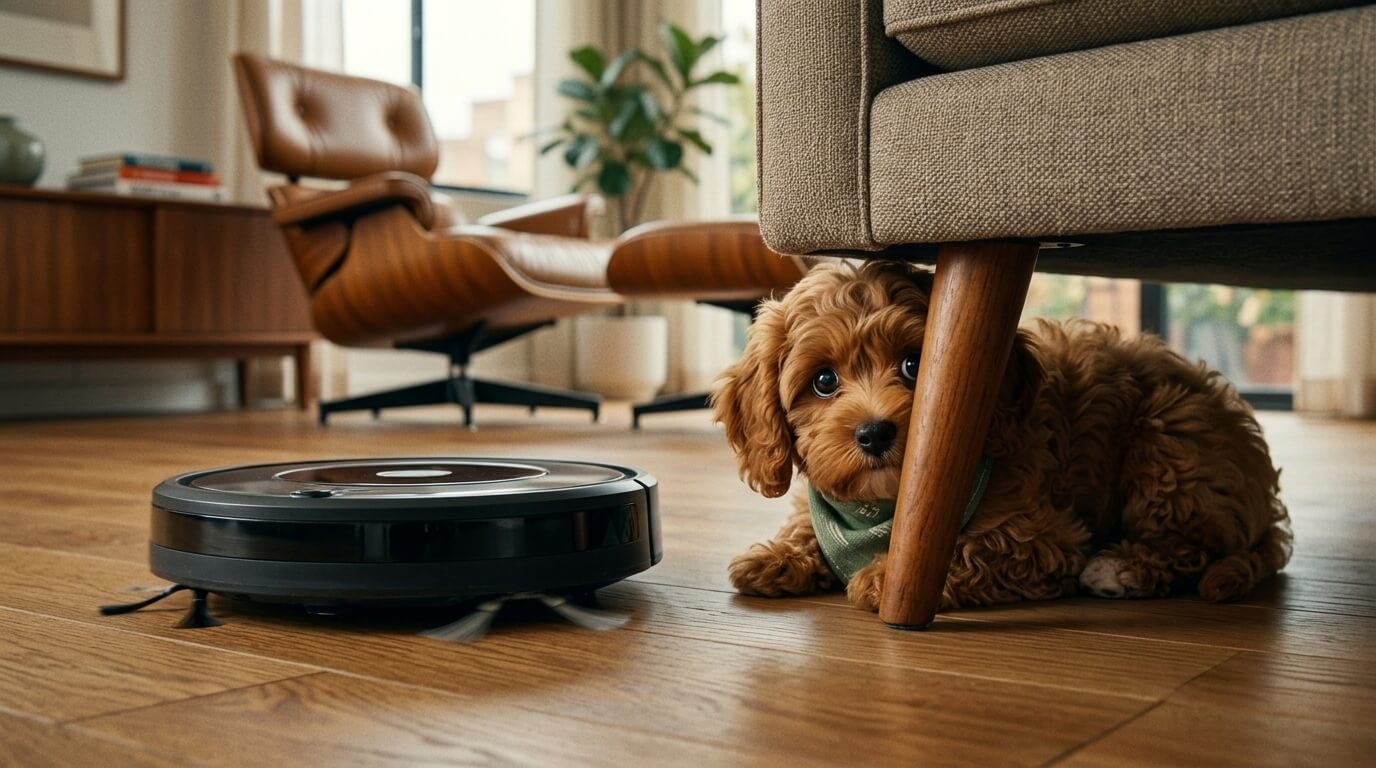
Dogs may react to motor noise, wheel vibration, beeps, moving brushes, sudden direction changes, docking sounds, or the machine entering their resting space. There is no universal sound number that predicts every dog’s response. A lower manufacturer-published sound figure cannot guarantee that a particular dog will accept the device.
If the main problem is persistent fear of city and household sounds rather than floor cleaning, treat it as a behavior and welfare question—not an appliance-shopping problem. Our city-noise anxiety guide explains environmental management, desensitization, counterconditioning, and when professional support may be appropriate.
Gradual, Supervised Acclimation
- Place the powered-off robot in the room and allow the dog to observe it from a comfortable distance.
- Move or dock it manually while it remains off, without pushing it toward the dog.
- Run a manufacturer-provided quiet or low-power mode briefly in another room while the dog has an open route to a safe area.
- Use a mapped no-go zone around the dog’s bed, crate, food, and water.
- Increase duration or route length only while the dog remains relaxed.
- Supervise several full sessions before considering a scheduled run while the dog is elsewhere.
Stop the session if the dog repeatedly hides, flees, barks or lunges at the machine, chases it, cannot settle, or shows persistent distress. Do not keep running the robot in the hope that forced exposure will make the dog “get used to it.” Create distance, return to an easier step, and seek qualified behavioral or veterinary guidance when the response is intense or persistent.
Pet-Waste and Household Safety
Obstacle avoidance is not automatically pet-waste avoidance. Among these five products, only the reviewed iRobot source explicitly states that the Roomba Plus 504 Vac recognizes and navigates around pet waste. Check the floor before every run if a dog may have had an accident, and do not schedule unsupervised cleaning when the dog is ill, has diarrhea, or is not reliably house-trained.
Keep cords, lightweight toys, food, water, and loose fabric away from the route. Inspect the brush and wheels for long hair, and follow the manufacturer’s cleaning and replacement instructions. A mapped safe zone should remain available to the dog throughout operation.
Which Type Fits Your Apartment?
- Small hard-floor apartment: prioritize robot height, compact dock placement, edge pickup, and short room-by-room schedules.
- Long-haired dog: prioritize an accessible anti-tangle brush system and a bin or dock that is easy to maintain.
- Hard floor plus low-pile rugs: verify carpet detection, mop lifting, and app-based rug controls.
- Dog with occasional accidents: manufacturer-supported waste recognition is useful, but floor inspection remains necessary.
- Noise-sensitive household: look for mode-specific manufacturer data, controllable schedules, and control over self-empty timing. Do not assume these features treat canine anxiety.
Final Buying Checklist
- Measure the lowest furniture clearance and the full dock location.
- Check whether noise data refers to vacuuming, mopping, or auto-emptying.
- Confirm brush type and how the brush is removed for long-hair cleanup.
- Match mop and carpet controls to your actual floors and rugs.
- Verify what the manufacturer’s obstacle system identifies; do not infer pet-waste avoidance.
- Choose where the dog’s permanent no-go safe zone will be.
- Plan supervised, short introductory sessions before any unattended schedule.
References
- Roborock Qrevo Curv — official product specifications
- Dreame L40 Ultra Gen 2 — official product specifications
- ECOVACS DEEBOT T30C — official product specifications
- iRobot Roomba Plus 504 Vac — official product specifications
- eufy robot vacuum comparison — official manufacturer guide
- VCA: Desensitization and counterconditioning
- ASPCA: Common dog behavior issues